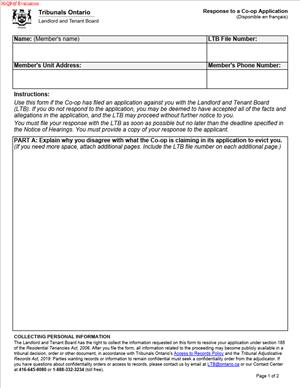
Response to a Co-op Application
Fill out nowJurisdiction: Country: Canada | Province or State: Ontario
If you have applied to buy or occupy a co‑operative housing unit and the co‑op has taken steps that affect your application, you may need to complete a Response to a Co-op Application. This document is used within Ontario’s co‑operative housing system and is connected to proceedings before the Landlord and Tenant Board.
A Response to a Co-op Application allows you to formally answer claims or statements made in an application filed by a housing co‑operative. It gives you space to explain your side, correct information, and provide relevant details.
You complete this form when a co‑op has started a formal process, and you are named as a responding party. It is not a casual letter. It becomes part of an official record.
Understanding how this document works helps you present your position clearly. Small errors, missing details, or unclear explanations can affect how your response is understood.
This guide explains what the Response to a Co-op Application is, when it is used, and how to complete it in a clear and organized way.
What is a Response to a Co-op Application?
Clear definition
A Response to a Co-op Application is a formal written document submitted to the Ontario Landlord and Tenant Board in reply to an application filed by a housing co‑operative. It sets out your position in relation to the claims or remedies the co‑op is asking for.
In practical terms, it is your opportunity to respond point by point. If the co‑op claims unpaid housing charges, breach of occupancy rules, or another issue, this form lets you confirm, deny, or explain those claims.
The document becomes part of the Board’s file. It may be reviewed before or during a hearing. Clear and complete answers help ensure your perspective is considered.
Who typically uses this form?
This form is typically used by a co‑op member, former member, or applicant who has received notice that a co‑operative has filed an application involving them.
You may use it if you currently live in a co‑op unit and the co‑op has applied for an order related to occupancy, termination, or arrears. Former occupants may also need to respond if the co‑op is claiming money owed after they moved out.
In some situations, a person whose membership was refused or terminated may need to respond if the co‑op has initiated a formal process that requires a reply.
The responding party is usually an individual, but in some cases, it may involve more than one person listed on the occupancy agreement.
Why might you need this form?
You need this form when you want your side of the dispute to be formally recorded. Without a response, the Board may rely mainly on the co‑op’s version of events.
The form allows you to correct factual errors. For example, you can clarify payment history, explain the circumstances behind alleged rule breaches, or provide context about communication with the co‑op.
It also allows you to raise additional information that may affect the outcome. You may describe efforts to resolve the issue, misunderstandings, or changes in circumstances.
Filing a Response to a Co-op Application can shape how the hearing proceeds. It signals that you intend to participate and present your position.
Typical real-life scenarios
- A co‑op may apply to terminate your occupancy because it claims you have not paid the monthly housing charges. You receive notice of the application and complete a response explaining your payment history and attaching details about the amounts you believe were misapplied.
- In another situation, the co‑op may allege that you breached occupancy rules by having unauthorized occupants. Your response can clarify who lives in the unit and whether the co‑op was previously informed.
- You might also face an application related to behavior that the co‑op says interferes with other members. In your response, you can describe your version of events and any steps taken to address concerns.
- There are cases where a membership decision leads to further proceedings. If the co‑op seeks an order connected to that decision, your response outlines why you disagree or what you believe was misunderstood.
- In financial disputes, the co‑op may claim arrears that include additional fees or charges. Your response can separate what you agree is owing from what you dispute, providing a clear breakdown.
When would you use Response to a Co-op Application?
You use a Response to a Co-op Application after you have been served with notice that the co‑operative has filed an application involving you. This usually happens when there is a disagreement that has moved beyond informal discussion.
Timing matters. The form is generally completed after you receive official notice of the co‑op’s application and before the scheduled hearing or deadline for submissions.
You may use this form if you intend to attend a hearing and want your position documented in advance. It helps structure what you plan to say and ensures key points are not overlooked.
This form is not used to start a new claim against the co‑op. It is specifically for replying to an existing application. If you want to raise separate issues, a different form may be required.
If more than one person is named in the co‑op’s application, each named person may need to be included in the response. The document should clearly identify all responding parties.
You would not use this form if you agree fully with the co‑op’s claims and do not wish to dispute them. In that case, you may choose not to file a response, though that changes how your position is presented.
Legal Characteristics of a Response to a Co-op Application
A Response to a Co-op Application is part of a formal tribunal process. It must contain accurate identifying information, including file numbers and party names, so it is matched correctly to the co‑op’s application.
For the document to be effective, it must be completed clearly and submitted in accordance with the Board’s process. Missing file numbers, incomplete contact details, or unsigned declarations can create delays or confusion.
Consistency is important. If your response contradicts documents you previously submitted, that may affect how your statements are viewed. Clear explanations help avoid misunderstandings.
The form does not replace oral testimony at a hearing. It summarizes your position but does not, by itself, resolve the dispute. Evidence and testimony may still be required.
Common problems include vague answers, emotional language without factual detail, or failing to address the specific claims made by the co‑op. The Board focuses on relevant facts tied to the issues in the application.
The document does not change your occupancy status automatically. Filing a response does not stop a process on its own. It ensures your position is formally included in the record.
While tribunal procedures are generally consistent across Ontario, administrative practices may vary slightly depending on the case type or how hearings are conducted. The underlying purpose of the form remains the same: to provide a structured reply.
Is it legally binding?
The Response to a Co-op Application is a formal submission in a legal proceeding. The information you provide is part of the official record and may be considered by a decision‑maker.
By signing the form, you confirm that the information is true to the best of your knowledge. Providing false or misleading information can have serious consequences in a tribunal setting.
The document itself does not create a new agreement between you and the co‑op. It does not settle the dispute unless the parties later reach a separate agreement.
However, statements made in the response can influence the outcome. They may shape the issues in dispute and guide what is examined at a hearing. In that sense, the content has practical legal significance.
How to fill out a Response to a Co-op Application
Step 1 – Identify the file and parties
Start by entering the file number exactly as it appears on the co‑op’s application. This ensures your response is linked to the correct case.
Write the full legal name of the housing co‑operative as shown on the application. Then list your full name and the names of any other responding parties. Make sure spelling matches the original application.
Step 2 – Provide contact information
Enter your current mailing address, phone number, and any other required contact details. Use an address where you can reliably receive correspondence.
If you have moved since the events described in the application, provide your current address rather than the co‑op unit address, unless the form asks for both.
Accurate contact information allows the Board to send notices about hearing dates, decisions, or procedural updates.
Step 3 – Review the co‑op’s claims carefully
Before writing your response, read the co‑op’s application in full. Note each allegation and each remedy the co‑op is requesting.
Pay attention to dates, amounts, and descriptions of events. Your response should address these specific points rather than general concerns.
Keep the application beside you as you complete the form so your answers correspond directly to what has been claimed.
Step 4 – State whether you agree or disagree
For each main claim, indicate clearly whether you agree, partially agree, or disagree. Avoid long explanations at this stage. Focus on clarity.
If you agree with part of a financial claim but dispute the total amount, state what portion you acknowledge and what portion you contest.
Clear positions help narrow the issues and make your response easier to follow.
Step 5 – Provide your explanation of events
Use the space provided to explain your version of events. Write in chronological order when possible.
Include specific dates, amounts, and actions. For example, describe when payments were made, when notices were received, or when conversations occurred.
Stick to facts that relate directly to the claims in the application. Avoid unrelated history that does not affect the issues before the Board.
Step 6 – Describe any steps taken to resolve the issue
If you attempted to resolve the matter before the application was filed, describe those efforts. This may include payment arrangements, meetings, or written communication.
Explain the outcome of those attempts. Indicate whether any agreements were reached and whether they were followed.
This information provides context for the dispute and shows the sequence of events leading to the application.
Step 7 – List any supporting documents
Identify any documents you intend to rely on, such as payment records, letters, emails, or notices. Refer to them clearly in your explanation.
Keep copies organized so you can provide them if required during the process. Make sure each document relates directly to a point in your response.
Clear references to documents strengthen the structure of your submission.
Step 8 – State what outcome you are seeking
If the form allows, explain what result you believe is appropriate. This might involve disputing the amount claimed or asking that the application be dismissed.
Be concise and connect your requested outcome to the facts you have described. Avoid broad statements that are not tied to specific issues in the application.
Clarity about the outcome you are seeking helps focus the discussion at a hearing.
Step 9 – Review for accuracy and completeness
Read through the entire Response to a Co-op Application before signing it. Check names, dates, and amounts for accuracy.
Ensure every section is filled in where required. Incomplete forms can create delays or require corrections.
Confirm that your explanation addresses the key points raised in the co‑op’s application.
Step 10 – Sign and date the form
Sign the form where indicated. By signing, you confirm that the information is true to the best of your knowledge.
Write the date of signing clearly. This establishes when the response was completed.
Keep a copy of the signed document for your records so you can refer to it later in the process.
Legal Terms You Might Encounter in Response to a Co-op Application
- Applicant: This is the person or housing co‑operative that started the case at the Board. In this context, it is usually the co‑op claiming that you breached an occupancy agreement or owe money. The applicant’s name and contact information must match the details shown in the application you received.
- Respondent: You are the respondent if you are filing this form. It means you are the member or occupant responding to the claims made against you. Your full legal name must be written exactly as it appears on the application and your occupancy agreement.
- Occupancy Agreement: This is the contract between you and the co‑op that sets out your rights and obligations. The application will usually refer to specific sections of this agreement. When completing your response, you should review the exact clauses mentioned so you can address them directly.
- Arrears: Arrears are unpaid housing charges, fees, or other amounts the co‑op says you owe. The amount claimed will appear in the application. You should check the dates, calculations, and whether any payments you made are missing.
- Breach: A breach is an alleged failure to follow the occupancy agreement or co‑op rules. The co‑op may claim you breached by not paying charges, damaging property, disturbing others, or violating bylaws. Your response should clearly state whether you agree or disagree with each alleged breach.
- Termination of Occupancy: This refers to ending your right to live in the unit. The co‑op may ask the Board for an order terminating your occupancy and requiring you to move out. This is often the most serious outcome requested in the application.
- Relief from Forfeiture: This is a legal concept where the Board may allow you to keep your unit even if there was a breach, especially if you correct the problem. If you are asking for another chance or a payment plan, this may be relevant to the outcome you request.
- Order: An order is the official written decision issued by the Board after a hearing or review. The co‑op’s application will state what order it wants. In your response, you can explain what order you believe is fair and appropriate instead.
- Service: Service means delivering legal documents to the other party in an approved way. You must ensure your completed form is properly delivered to the co‑op and, if required, filed with the Board. Improper service can delay or complicate your case.
FAQs
What is the purpose of the Response to a Co-op Application?
This form allows you to answer the claims made by the co‑operative in its application to the Board. You use it to confirm your name and contact details, state whether you agree or disagree with each allegation, and explain your version of events. It creates a written record of your position before the hearing.
What if I agree with some parts of this document but not others?
You can partially agree. Read each allegation carefully and respond to it one by one. Clearly state which facts you accept, which amounts (if any) you agree you owe, and which statements you dispute. Be specific about dates, payments, conversations, or incidents so the Board understands exactly what is in dispute.
Do I need to attach documents when I complete this form?
You should attach copies of any documents that support what you wrote. This may include receipts, bank statements, emails, letters, photographs, payment records, or repair requests. Label each attachment clearly and refer to it in your written explanation so it is easy to follow.
What date should I use when signing this form?
Use the actual date you sign it. Do not pre‑date or post‑date your signature. The date shows when you confirmed that the information is accurate. Make sure it is before any filing deadline and that it matches the date you deliver or submit the document.
What happens if my name is spelled differently on the application?
Write your full legal name exactly as it appears on the application so the file matches correctly. If there is a spelling error, you can note in your explanation that your correct legal name is spelled differently. Do not change the applicant’s version of your name on the form itself without clarifying it.
Can I update my contact information on this form?
Yes. There is a section where you provide your current address, phone number, and email. Make sure this information is accurate and up to date, because notices of hearing and orders will be sent there. If your contact information changes later, you must update it separately according to the Board’s process.
Will filing this document stop the hearing?
No. Submitting your completed Response to a Co-op Application does not cancel or delay the hearing on its own. The hearing will usually proceed as scheduled. This form simply ensures that your side of the story is formally recorded before the decision is made.
What outcome can I ask for in my response?
You can state clearly what you want the Board to decide. For example, you may ask that the application be dismissed, that the amount claimed be reduced, or that you be allowed to stay if you follow a payment plan. Be realistic and specific about the order you are requesting so it can be written clearly if granted.
Checklist: Before, During, and After Response to a Co-op Application
Before
- Read the entire application carefully, including all attachments and schedules.
- Highlight each allegation and note whether you agree or disagree.
- Gather your occupancy agreement and any related co‑op bylaws.
- Collect proof of payments, communications, and maintenance requests.
- Confirm all deadlines listed in the notice of hearing.
- Check that you understand the amount claimed and how it was calculated.
- Write a timeline of key events to keep your explanation clear.
- Verify the correct legal names of all parties.
During
- Enter your full legal name exactly as shown on the application.
- Provide current and complete contact information.
- Respond to each allegation separately and clearly.
- Use short, factual statements instead of emotional language.
- Refer to the attached documents by name or number in your explanation.
- State the outcome you are asking the Board to order.
- Review all dates, amounts, and figures for accuracy.
- Sign and date the form after reviewing it fully.
After
- Make at least one copy of the completed form for your records.
- Deliver a copy to the co‑op using an accepted method of service.
- File the form with the Board if required by the instructions.
- Keep proof that you served and filed the document.
- Organize your attachments in the same order as referenced in the form.
- Prepare to explain your written response clearly at the hearing.
- Bring original documents and extra copies to the hearing.
- Monitor your mail or email for confirmation or further notices.
Common Mistakes to avoid with Response to a Co-op Application
- Mistake: Ignoring certain allegations because you think they are minor, which often happens when you focus only on eviction, but this can lead to unanswered claims being accepted as true, so do not forget to respond to every single point raised.
- Mistake: Providing emotional arguments instead of facts, which happens when the situation feels unfair, but this can weaken your credibility, so do not forget to include dates, amounts, and clear evidence.
- Mistake: Failing to attach proof of payment or communication, which often occurs when you assume the co‑op already has copies, but this can result in missing evidence, so do not forget to include and label your documents.
- Mistake: Missing deadlines because you misread the notice of hearing, which can lead to decisions made without your full participation, so do not forget to check and calendar all important dates.
- Mistake: Using a nickname or incomplete name, which happens out of habit, but this can cause confusion in the file, so do not forget to use your full legal name exactly as shown.
- Mistake: Forgetting to sign and date the form, which is common when you are rushing, but this can make the document incomplete or rejected, so do not forget to review the signature section carefully.
- Mistake: Changing the applicant’s information instead of correcting it in your explanation, which can create inconsistencies in the record, so do not forget to keep their details as listed and clarify separately.
- Mistake: Not keeping copies of what you submitted, which happens when you rely on memory, but this can leave you unprepared at the hearing, so do not forget to store a complete copy for yourself.
What to do after filling out the Response to a Co-op Application
Once you complete the form, your next steps are just as important as what you wrote. You need to make sure the document is properly delivered, recorded, and organized for the hearing.
- Step 1: Make at least two copies of the completed and signed form, including all attachments.
- Step 2: Keep one full copy for your personal records in a dedicated folder for this case.
- Step 3: Deliver a copy to the co‑op using an accepted method of service, such as personal delivery, mail, or another approved method.
- Step 4: If required, file the original or a copy with the Board according to the instructions on your notice.
- Step 5: Complete any required certificate or proof of service showing how and when you delivered the document.
- Step 6: Confirm that your filing was received, whether through a receipt, confirmation number, or acknowledgment.
- Step 7: Organize your evidence in the same order listed in your response so you can find it quickly.
- Step 8: Prepare brief notes summarizing your key points for the hearing.
- Step 9: Bring original documents and extra copies to the hearing in case the Board or the co‑op asks to see them.
- Step 10: Update your contact information immediately if it changes before the hearing date.
Stay organized and proactive. Check your mail, email, or online account regularly for updates about the hearing. If you reach a settlement with the co‑op before the hearing, make sure it is documented properly and submitted if required. Keep all paperwork related to your occupancy agreement and the case together in one secure place. Clear records and careful follow‑through can make a significant difference in how confidently you present your case.
Disclaimer: This guide is provided for informational purposes only and is not intended as legal advice. You should consult a legal professional.