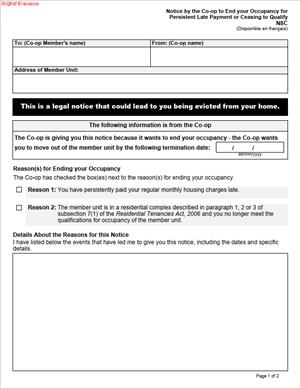
N8C – Notice by the Co-op to End your Occupancy for Persistent Late Payment or Ceasing to Qualify
Fill out nowJurisdiction: Country: Canada | Province or State: Ontario
The N8C – Notice by the Co-op to End your Occupancy for Persistent Late Payment or Ceasing to Qualify is a formal notice used by housing co-operatives in Ontario. It tells a member that the co-op intends to end their occupancy under specific circumstances.
This document is not a casual warning. It is part of a structured legal process connected to the Ontario Landlord and Tenant Board. The form sets out the reasons the co-op believes the occupancy should end and provides key dates.
If you are filling out this form, you are likely acting on behalf of a housing co-operative. You may be a board member, property manager, or authorized representative. Your role is to complete the document clearly and accurately.
This form matters because errors can delay the process. Missing information, incorrect dates, or unclear reasons can create procedural problems. Taking the time to understand each section helps ensure the notice reflects the co-op’s position properly.
What is N8C – Notice by the Co-op to End your Occupancy for Persistent Late Payment or Ceasing to Qualify?
Clear definition
N8C – Notice by the Co-op to End your Occupancy for Persistent Late Payment or Ceasing to Qualify is a formal notice used by a non-profit housing co-operative to begin the process of ending a member’s right to occupy a unit. It applies in two main situations: ongoing late payment of housing charges or when a member no longer meets eligibility requirements.
This document sets out the grounds for termination and the date the co-op wants the occupancy to end. It gives written notice to the member and creates a record that the co-op has started the formal process.
The form is structured and standardized. It requires specific details, including the member’s name, the unit address, and a clear explanation of the reasons for termination.
Who typically uses this form?
This form is typically completed by the housing co-operative, not the member. It is often prepared by a property manager, co-op staff member, or a board member authorized to act for the co-op.
The person completing the form usually has access to the member’s payment history and membership records. They rely on internal documentation to confirm late payments or changes in eligibility status.
The form is part of the co-op’s governance and housing management process. It reflects a decision that has often been discussed or approved within the co-op’s structure before the notice is issued.
Why might you need this form?
You may need this form when a member repeatedly pays housing charges late. Persistent late payment generally means there is a pattern, not just a single missed deadline.
You may also need it if a member no longer qualifies for occupancy under the co-op’s rules. This could involve income-based requirements, occupancy standards, or other eligibility criteria set out in the co-op’s governing documents.
The form allows the co-op to formally state its position. Without this written notice, the co-op cannot move forward with the next stage of the process.
Typical real-life scenarios
- A member pays housing charges late month after month. Even after reminders and discussions, payments continue to arrive after the due date. The co-op decides the pattern is ongoing and uses this form to start the termination process.
- A member’s household income changes significantly. As a result, they no longer qualify for a rent-geared-to-income subsidy. The co-op determines that the member does not meet the eligibility rules and issues the notice.
- A member stops providing required documentation to confirm continued eligibility. Despite repeated requests, the co-op does not receive the necessary information. The co-op may rely on this form to address the situation formally.
- A unit becomes occupied by individuals who are not approved members, and this affects eligibility or compliance with co-op rules. After internal review, the co-op uses the notice to state that the occupancy no longer meets the required conditions.
When would you use N8C – Notice by the Co-op to End your Occupancy for Persistent Late Payment or Ceasing to Qualify?
You would use this form after the co-op has identified a consistent issue with late payment or a change in qualification status. The decision to issue the notice often follows internal communication, reminders, or meetings.
In cases of persistent late payment, the co-op typically reviews payment records over a period of time. The pattern may involve several months of late payments rather than one isolated event.
For ceasing to qualify, the form may be used when a member’s circumstances change. This can include income increases, changes in household composition, or failure to comply with verification requirements.
The form is used before applying to the Landlord and Tenant Board for an order. It is part of a step-by-step process. The notice informs the member of the co-op’s intention and provides a specific termination date.
You would not use this form for non-payment of rent alone if the issue is a single missed payment. There are different forms designed for different types of notices. Using the correct document for the situation is part of ensuring the filing is processed properly.
Legal characteristics of N8C – Notice by the Co-op to End your Occupancy for Persistent Late Payment or Ceasing to Qualify
This form has legal significance because it begins a formal termination process. It must be completed accurately and served properly to be effective.
An effective notice usually includes clear reasons, accurate dates, and correct identification of the member and unit. Inconsistent information can create delays or complications later in the process.
Common problems include listing the wrong termination date, failing to describe the pattern of late payment clearly, or providing vague statements about eligibility. The document works best when the facts are specific and supported by records.
The notice does not itself end the occupancy. It gives notice of the co-op’s intention. Further steps may be required if the member does not move out by the termination date.
Housing co-operatives operate under a distinct legal framework compared to private landlords. While the process connects to the Landlord and Tenant Board, co-ops often have additional internal governance steps that form part of the overall procedure.
Is it legally binding?
The notice becomes legally significant once it is properly completed and delivered in accordance with the applicable rules. It creates a formal record that the co-op has given notice of termination.
However, the form alone does not automatically remove a member from the unit. If the member does not leave by the stated date, the co-op may need to apply to the Landlord and Tenant Board for an order.
Its binding effect depends on proper completion and service. If key details are missing or incorrect, the notice may not support further action. Accuracy and clarity are central to its legal effect.
How to fill out N8C – Notice by the Co-op to End your Occupancy for Persistent Late Payment or Ceasing to Qualify
Step 1 – Identify the member and the unit
Enter the full legal name of the member as it appears in the co-op’s records. Include the complete address of the unit, including unit number if applicable. Ensure the spelling matches internal documentation to avoid confusion later.
Step 2 – Select the reason for the notice
Indicate whether the notice is based on persistent late payment of housing charges or on ceasing to qualify for occupancy. Choose the option that matches the co-op’s documented reason. Do not select both unless the circumstances clearly support each ground.
Step 3 – Provide details of persistent late payments if applicable
If the reason is persistent late payment, describe the pattern clearly. Include the months involved and indicate how payments were late. Base your entries on payment records rather than memory. Specific dates and amounts help demonstrate consistency.
Step 4 – Provide details of ceasing to qualify if applicable
If the reason is that the member has ceased to qualify, explain the change in circumstances. State the relevant eligibility requirement and how it is no longer met. Keep the explanation factual and tied to the co-op’s rules or criteria.
Step 5 – State the termination date
Enter the date on which the co-op intends the occupancy to end. Confirm that the date aligns with the required notice period. Double-check the calendar calculation to ensure the timeframe is accurate.
Step 6 – Include co-op information and signature
Provide the legal name of the housing co-operative. The authorized representative should sign and date the form. Print the signer’s name and position clearly so the member understands who is acting on behalf of the co-op.
Step 7 – Review the form for completeness
Before serving the notice, read through each section. Confirm that names, dates, and reasons are consistent throughout the document. Compare the information against internal records to ensure accuracy.
Step 8 – Arrange for proper service of the notice
Once completed, arrange for the notice to be delivered to the member in a manner consistent with the applicable service rules. Record the method and date of service for the co-op’s files, as this information may be needed if the matter proceeds further.
Legal terms you might encounter in N8C – Notice by the Co-op to End your Occupancy for Persistent Late Payment or Ceasing to Qualify
- Persistent Late Payment: This means the member has paid housing charges late repeatedly, not just once. On this form, the co-op must show a pattern. That usually includes specific months and the dates payments were actually made. The focus is on repeated behaviour, not a single late payment.
- Housing Charges: These are the regular monthly amounts a member must pay to the co-op. They may include base housing charges and other approved fees. The form refers to unpaid or late housing charges as the reason for ending occupancy.
- Ceasing to Qualify: This applies when a member no longer meets the eligibility rules set out in the co-op’s by-laws or applicable housing rules. For example, income limits or occupancy requirements may change. The notice must clearly state how the member no longer qualifies.
- Termination Date: This is the date the co-op wants the occupancy to end. It must be clearly written on the form. The date cannot be random. It must follow the minimum notice period required by the applicable rules.
- Service (of Notice): Service means delivering the notice to the member in an approved way. The method of service affects when the notice is considered given. The form must be served properly for it to be valid.
- Member: In a housing co-op, the occupant is usually a member, not a tenant. This distinction matters because the rights and obligations come from membership and occupancy agreements, not a standard lease. The form identifies the member by name as it appears in the co-op’s records.
- Occupancy Agreement: This is the contract between the co-op and the member. It sets out payment obligations and qualification requirements. The N8C notice refers to breaches of this agreement.
- Board of Directors: The co-op’s board makes decisions about ending occupancy. The person signing the form must have authority from the board. This ensures the notice reflects an official decision, not a personal one.
- Landlord and Tenant Board (LTB): This is the decision-making body that handles disputes about co-op occupancy terminations. If the member does not move out, the co-op may need to apply to the LTB. The notice is often the first step before such an application.
- Remedy Period: In some situations, there may be time for the member to correct the issue. For persistent late payment, the issue is about repeated conduct, not just one missed payment. The form itself sets out the termination date, but it does not automatically end occupancy without further steps if the member stays.
FAQs
How do I calculate the correct termination date on this form?
Start by identifying the reason you selected. Then confirm the minimum notice period that applies to that reason. Count the days carefully from the date you plan to serve the notice, not the date you sign it. Write the full date clearly, including the year, and double-check that it gives the required amount of time before the termination date.
What details do I need to include to prove persistent late payment?
You need more than a general statement. List specific months when housing charges were due, the amount due, and the date each payment was actually received. Make sure your records match your internal ledger. If you later apply to the Board, you will rely on these same details, so accuracy matters now.
Do I need to attach documents when serving N8C – Notice by the Co-op to End your Occupancy for Persistent Late Payment or Ceasing to Qualify?
You are not always required to attach documents to the notice itself. However, you should have supporting records ready, such as payment ledgers or qualification assessments. If the matter goes to the Board, those documents will support what you wrote in the notice. The information in the notice must match your records exactly.
Who is allowed to sign this document on behalf of the co-op?
The person signing must have proper authority, usually granted by the board of directors. This may be the president, secretary, or another authorized officer. The signature confirms that the co-op is formally giving notice. Make sure the name and title of the signer are clearly printed.
What happens if the member’s name is spelled differently than in our records?
Use the name exactly as it appears in the occupancy agreement and the co-op’s official records. Even small spelling differences can create confusion later. If you are aware of an alternate spelling, you may reference it in brackets, but the primary name should match the official documents.
Can the member fix the problem after receiving this form?
If the issue is persistent late payment, paying one month on time does not erase the past pattern. For ceasing to qualify, the member may try to provide updated information to show they still qualify. However, the notice sets out the co-op’s position at the time it was issued. Any change should be documented and confirmed in writing.
Does giving this notice automatically end the occupancy on the termination date?
No. If the member does not move out by the termination date, the co-op must apply to the Landlord and Tenant Board for an order. The Board will review whether the N8C – Notice by the Co-op to End your Occupancy for Persistent Late Payment or Ceasing to Qualify was completed and served properly. Until an order is issued, occupancy does not end automatically.
What information from this form becomes important if the case goes to a hearing?
Every key detail becomes important. The reason selected, the dates of late payments, the termination date, and the method of service will all be reviewed. The Board will compare what you wrote with your internal records. Any inconsistency can weaken your case, so this document must be complete and accurate from the start.
Checklist: Before, During, and After N8C – Notice by the Co-op to End your Occupancy for Persistent Late Payment or Ceasing to Qualify
Before
- Review the occupancy agreement and co-op by-laws about payment and qualification.
- Confirm the pattern of late payments with a detailed payment ledger.
- Verify the member’s full legal name as shown in your records.
- Confirm board authorization to issue the notice.
- Calculate the correct termination date using the proper notice period.
- Decide on the approved method of service.
- Gather supporting documents in case of a later application.
- Double-check the unit address and any unit number.
During
- Complete every required field on the form clearly and legibly.
- Select only the reason that truly applies.
- List specific dates and amounts for late payments.
- Clearly describe how the member ceased to qualify, if applicable.
- Write the full termination date without abbreviations.
- Print and sign the form with the authorized officer’s name and title.
- Review the completed notice for errors or missing information.
- Make a copy of the signed notice before serving it.
After
- Serve the notice using an approved method.
- Record the date and method of service in your internal file.
- Keep proof of service, such as a certificate or affidavit if required.
- Monitor whether the member makes further payments.
- Document any communication from the member about the notice.
- Prepare for a possible application to the Board if the member does not move.
- Keep all related records organized in one file.
- Update internal tracking systems to reflect that notice was served.
Common mistakes to avoid with N8C – Notice by the Co-op to End your Occupancy for Persistent Late Payment or Ceasing to Qualify
- Mistake: Listing “late payment” without specific dates and amounts, which happens when records are incomplete, leading to weak evidence at a hearing; do not forget to match every statement to your ledger.
- Mistake: Calculating the termination date from the signing date instead of the service date, which happens due to confusion about notice periods, causing an invalid notice; do not forget to count from the correct starting point.
- Mistake: Having someone sign without proper board authority, which happens in urgent situations, risking challenges to the notice’s validity; do not forget to confirm authorization before signing.
- Mistake: Using an incorrect or outdated member name, which happens when records are not updated, creating identity disputes later; do not forget to verify the exact legal name in the occupancy agreement.
- Mistake: Serving the notice by an unapproved method, which happens when staff assume regular mail is always acceptable, possibly voiding the notice; do not forget to follow approved service rules.
- Mistake: Combining multiple issues unclearly on the form, which happens when trying to cover all concerns at once, making the reason confusing; do not forget to clearly select and explain the specific ground relied upon.
- Mistake: Leaving blank fields or unclear handwriting, which happens when forms are rushed, leading to misunderstandings at the Board; do not forget to review the entire document before service.
- Mistake: Failing to keep proof of service, which happens when internal processes are informal, making it hard to prove delivery; do not forget to document how and when the notice was served.
What to do after filling out N8C – Notice by the Co-op to End your Occupancy for Persistent Late Payment or Ceasing to Qualify
Once the form is complete and signed, your focus shifts to proper service and careful recordkeeping. Accuracy and organization now will save time later if the matter proceeds to a hearing.
- Step 1: Make at least two copies of the signed notice, one for the member and one for the co-op’s file.
- Step 2: Serve the notice using an approved method and note the exact date of service.
- Step 3: Complete any internal proof of service record immediately after delivery.
- Step 4: Place the original signed notice and proof of service in a dedicated file for this member.
- Step 5: Update the co-op’s internal tracking system to show the termination date and reason.
- Step 6: Monitor payments and communications after service and log every interaction.
- Step 7: If the termination date passes and the member has not moved out, prepare the application materials for the Landlord and Tenant Board.
- Step 8: Gather supporting documents such as payment ledgers, board resolutions, and qualification assessments.
- Step 9: Ensure that all information in any application matches the notice exactly, including dates and amounts.
- Step 10: Continue to document events until the matter is resolved, including any new payments or agreements.
Stay organized throughout the process. Keep all documents in chronological order. If the situation changes, record it clearly. Consistent documentation strengthens your position and reduces confusion.
Disclaimer: This guide is provided for informational purposes only and is not intended as legal advice. You should consult a legal professional.