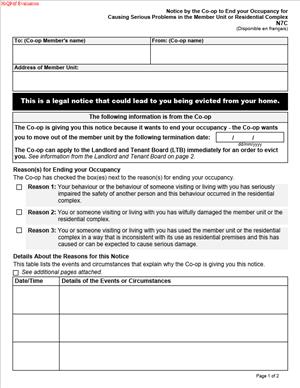
N7C – Notice by the Co-op to End your Occupancy for Causing Serious Problems in the Member Unit or Residential Complex
Fill out nowJurisdiction: Country: Canada | Province or State: Ontario
If you are dealing with serious problems in a co‑operative housing unit, the N7C – Notice by the Co-op to End your Occupancy for Causing Serious Problems in the Member Unit or Residential Complex is a formal document you may encounter. It is used within Ontario’s co‑operative housing system when a co‑op believes a member’s behaviour has crossed a serious line.
This form is not a general complaint. It is a legal notice that starts a formal process to end someone’s occupancy in a co‑operative housing unit. Because of that, every detail matters.
You may be reading this because you are on a co‑op board, part of management, or assisting with administration. You might also be a member who has received this notice and wants to understand what it means.
Before filling it out, it helps to understand what the document does, when it applies, and how it fits into the broader housing process in Ontario. This guide walks you through that step by step.
What is N7C – Notice by the Co-op to End your Occupancy for Causing Serious Problems in the Member Unit or Residential Complex?
Clear definition
The N7C – Notice by the Co-op to End your Occupancy for Causing Serious Problems in the Member Unit or Residential Complex is a formal notice used by a housing co‑operative in Ontario to notify a member that the co‑op intends to end their occupancy because of serious problems.
It is not a court order. It is a written notice that sets out the reasons the co‑op claims justify ending the occupancy. It also states a termination date and explains what may happen next.
This document is part of the legal framework that governs housing co‑operatives. It is typically connected to a possible application to the Landlord and Tenant Board if the issue is not resolved.
Who typically uses this form?
This form is generally completed and signed by an authorized representative of the housing co‑operative. That may be a board member, property manager, or another person permitted to act on behalf of the co‑op.
It is not a document that members use to end their own occupancy. It is initiated by the co‑op when it believes a member has caused serious problems in the unit or the residential complex.
Administrative staff may prepare the document, but it must reflect the decision and authority of the co‑operative as an organization.
Why might you need this form?
You may need this form when a member’s actions are alleged to have seriously affected the safety, rights, or reasonable enjoyment of others in the building or complex.
The notice is used in situations that go beyond minor disputes. It is designed for more severe conduct, such as significant damage, threats, or serious interference with other members.
Because ending occupancy is a serious step, the form ensures that the member is clearly informed of the allegations and the timeline involved. It creates a written record of the co‑op’s position.
Typical real-life scenarios
- A member is alleged to have caused substantial damage to their unit or common areas, beyond normal wear and tear. The co‑op believes the damage was deliberate or reckless and creates safety risks.
- There are repeated incidents of serious harassment or threats directed at other members or staff. The behaviour affects the sense of safety within the complex.
- Illegal activity is alleged to have taken place in the unit, and it significantly disrupts the residential community or exposes the co‑op to risk.
- A member’s actions are claimed to have seriously interfered with others’ reasonable enjoyment of their homes, such as ongoing aggressive behaviour, extreme disturbances, or dangerous conduct.
- In each of these scenarios, the co‑op may consider using this notice to formally begin the process of ending occupancy.
When would you use N7C – Notice by the Co-op to End your Occupancy for Causing Serious Problems in the Member Unit or Residential Complex?
You would use this form when the issue involves serious problems rather than routine rule breaches. The key factor is the severity and impact of the behaviour.
This notice is often used when the co‑op believes the situation cannot be resolved through informal warnings or internal discussions. It signals that the matter has reached a formal stage.
Timing is important. The notice must clearly identify the events and the date the co‑op intends the occupancy to end. It is typically used soon after the serious incident or pattern of conduct becomes clear.
The form may also be used where safety is a concern. For example, if conduct poses a risk to other residents, staff, or property, the co‑op may move directly to a formal notice rather than progressive steps.
Board members or management usually make this decision following internal procedures. The notice reflects that the co‑op is prepared to pursue further legal steps if necessary.
Legal characteristics of N7C – Notice by the Co-op to End your Occupancy for Causing Serious Problems in the Member Unit or Residential Complex
This document has specific legal features that make it effective. It must clearly identify the member, the address of the unit, and the detailed reasons for ending occupancy. Vague statements often create problems later in the process.
The notice must also include a termination date. That date must comply with the applicable timing rules for this type of notice. If the date is incorrect, the notice may not have the intended effect.
Service of the notice is another key element. The co‑op must deliver it in a way that is recognized under the governing rules. Improper service can delay or complicate further proceedings.
Common issues that lead to rejection or challenges include incomplete information, unclear descriptions of events, missing signatures, or errors in dates. Even small mistakes can affect the outcome.
This form does not, by itself, remove the member from the unit. It does not authorize immediate eviction. It is a required step before the co‑op can seek an order from the appropriate tribunal.
Housing co‑operatives operate under a distinct framework compared to private landlords. While many principles are similar, co‑op occupancy is tied to membership, which can add procedural layers. The notice fits within that specific structure.
Is it legally binding?
The notice is legally significant once properly completed and delivered. It formally communicates the co‑op’s decision and triggers potential next steps.
However, it does not automatically end occupancy on its own. If the member does not leave by the stated termination date, the co‑op typically needs an order from the Landlord and Tenant Board to enforce the termination.
In that sense, the document is binding as a formal legal notice, but it is not self‑enforcing. Its legal effect depends on proper completion, correct service, and compliance with the governing process.
How to fill out N7C – Notice by the Co-op to End your Occupancy for Causing Serious Problems in the Member Unit or Residential Complex
Step 1 – Identify the member and the unit
Start by entering the full legal name of the member whose occupancy the co‑op seeks to end. Use the name exactly as it appears in the occupancy agreement or membership records. Then provide the full address of the unit, including unit number and postal code. Accuracy here prevents confusion about who the notice applies to.
Step 2 – State the reasons for ending occupancy
Describe the serious problems in clear, factual language. Include specific dates, locations, and actions. Avoid general statements such as “causing trouble.” Instead, explain what happened, when it happened, and how it affected others or the property. The description should allow someone reading the form to understand the exact conduct being alleged.
Step 3 – Provide details of the incidents
If there are multiple incidents, set them out in chronological order. Separate each event clearly. Include relevant details such as witnesses, reports, or damage observed, if space allows. If additional space is needed, attach extra pages and refer to them in the form so the information is clearly connected.
Step 4 – Insert the termination date
Enter the date on which the co‑op intends the occupancy to end. Ensure the date matches the required notice period for this type of serious problem. Double‑check that the date is calculated correctly and written clearly to avoid ambiguity.
Step 5 – Review internal authorization
Before signing, confirm that the co‑op has followed its internal decision‑making process. This may include a board resolution or documented approval. The person signing should have authority to act on behalf of the co‑op. The signature confirms that the notice reflects the co‑op’s official position.
Step 6 – Sign and date the notice
The authorized representative signs the form and includes the date of signing. Print the name and title clearly. This shows who is responsible for issuing the notice and when it was formally created.
Step 7 – Prepare for service
Make copies of the completed notice. One copy is for the member. Another is for the co‑op’s records. Ensure the version being served is complete, including any attached pages. Keep a record of how and when the notice is delivered, as this information may be important later in the process.
Legal terms you might encounter in N7C – Notice by the Co-op to End your Occupancy for Causing Serious Problems in the Member Unit or Residential Complex
- Serious Problem: This refers to conduct that goes beyond minor inconvenience. On this form, it means behaviour that seriously interferes with others’ reasonable enjoyment, causes serious damage, or poses a safety risk. The co-op must describe what makes the issue “serious,” not just annoying.
- Reasonable Enjoyment: This is the right of other members to use and live in their units without major disruption. In this document, the co-op must explain how your actions allegedly interfered with that right. Vague statements are not enough; the impact should be clearly described.
- Substantial Interference: This means more than a small disturbance. The notice should outline repeated, ongoing, or significant incidents. The wording must connect the behaviour to real consequences for neighbours or the co-op.
- Termination Date: This is the date your occupancy is supposed to end. It must be clearly written on the form. The date must follow the required notice period; otherwise, the notice can be challenged.
- Service (Serving the Notice): Service is the formal delivery of the notice to you. The method of delivery matters. The co-op must be able to prove when and how the notice was given.
- Member Unit: This refers to your specific residential unit within the co-op. The form must correctly identify the unit number and address. Errors here can create confusion about who the notice applies to.
- Residential Complex: This includes the entire co-op property, not just your unit. Allegations can relate to common areas, parking lots, hallways, or shared facilities. The notice should specify where the incidents occurred.
- Board Authorization: In many co-ops, the board must approve the decision to issue this notice. Internal authorization should happen before the form is signed. The person signing should have authority to act on behalf of the co-op.
- Affidavit of Service: This is a sworn statement confirming how and when the notice was delivered. It is not part of the notice itself, but it may be required later. Keeping accurate service records helps if the matter goes before the Board.
FAQs
What if my name is spelled incorrectly on this form?
Check how your name appears on your occupancy agreement and co-op records. Minor spelling errors do not automatically cancel this document, but major errors that identify the wrong person can create problems. Make sure the unit address and member details clearly match you. If you are preparing the form as a co-op, copy the name exactly as it appears in official records to avoid disputes about identity.
How do I calculate the correct termination date on the N7C – Notice by the Co-op to End your Occupancy for Causing Serious Problems in the Member Unit or Residential Complex?
Start by identifying the date the notice will be served. Then count the required number of days allowed by the rules before termination can take effect. Do not include the day of service in your count unless specifically required. Write the full date clearly, including the year, and double-check that the timeline meets the minimum notice period.
Do I need to attach evidence to this document when I serve it?
You do not attach evidence to the notice itself. However, you should have your supporting documents ready. Incident reports, photographs, complaint logs, or witness statements should match the dates and details written in this form. If the matter proceeds further, those documents may be reviewed to confirm the accuracy of what you stated.
Who is allowed to sign this form?
The person signing must have authority to act for the co-op. This is usually a board member or an authorized representative. Before signing, confirm that internal approval has been recorded in meeting minutes or a resolution. The signature should include the signer’s name and title so there is no confusion about their authority.
What happens if the termination date is wrong?
If the termination date does not comply with the required notice period, the notice can be found defective. That can delay the process and require a new notice to be issued. Always recalculate the timeline before serving the document and confirm the date written matches the rules and the method of service used.
Can the notice be withdrawn after it is served?
Yes, it can be withdrawn, but that decision should be documented. If circumstances change or the issue is resolved, the co-op should provide written confirmation that the notice is no longer being relied on. Keep a copy of that written confirmation with your records so there is no confusion later.
What if the incidents described are not detailed enough?
This document must clearly describe what happened, when it happened, and where it happened. General phrases like “causing problems” are not enough. If you are completing the form, include specific dates and actions. If you are receiving it, review whether the allegations are concrete and tied to identifiable events.
Does serving this form automatically end my occupancy?
No. Serving the N7C – Notice by the Co-op to End your Occupancy for Causing Serious Problems in the Member Unit or Residential Complex does not automatically remove you from the unit. It starts a legal process. Further steps are required before occupancy can be formally terminated, and the information written on the notice becomes part of that process.
Checklist: Before, During, and After N7C – Notice by the Co-op to End your Occupancy for Causing Serious Problems in the Member Unit or Residential Complex
Before
- Review the occupancy agreement and co-op by-laws for relevant rules.
- Confirm the incidents meet the threshold of “serious” under applicable standards.
- Gather detailed notes, dates, and any internal reports about the incidents.
- Verify the full legal name of the member and the correct unit address.
- Calculate the correct termination date based on the intended service date.
- Obtain proper board authorization and record it in meeting minutes.
- Confirm who will sign and serve the notice.
- Prepare a service plan and a record-keeping system.
During
- Write the member’s full name exactly as it appears in co-op records.
- Clearly describe each incident with specific dates and locations.
- State how the conduct affected other members or the complex.
- Insert the correct termination date in full.
- Review the completed form for blanks or inconsistencies.
- Sign and date the notice in the appropriate section.
- Serve the notice using an accepted delivery method.
- Record the exact date and method of service immediately.
After
- Complete and store an affidavit or proof of service.
- Keep copies of the signed notice and all supporting documents.
- Monitor any further incidents and document them.
- Be prepared to file an application if the matter proceeds.
- Update internal records to reflect that the notice was issued.
- Communicate internally with the board about next steps.
- Preserve all correspondence related to the issue.
- Track deadlines for any further action required.
Common mistakes to avoid with N7C – Notice by the Co-op to End your Occupancy for Causing Serious Problems in the Member Unit or Residential Complex
- Mistake: Using vague descriptions like “disturbing others” because it feels simpler, which weakens the notice and can lead to dismissal; do not forget to include specific dates, actions, and locations.
- Mistake: Writing the wrong termination date due to miscounting days, which can invalidate the notice; do not forget to calculate from the actual service date and double-check the timeline.
- Mistake: Having someone without proper authority sign the form because it seems convenient, which can undermine the co-op’s position; do not forget to confirm board approval and signing authority.
- Mistake: Failing to properly serve the notice because of assumptions about delivery, which creates disputes about timing; do not forget to document how and when service occurred.
- Mistake: Leaving sections blank or incomplete due to rushing, which can create ambiguity; do not forget to review every field before signing.
- Mistake: Mixing multiple unrelated issues into one unclear narrative because there are many complaints, which confuses the core allegation; do not forget to organize incidents chronologically and clearly.
- Mistake: Not keeping copies of the signed notice and supporting documents, which makes it difficult to prove what was served; do not forget to store complete records securely.
- Mistake: Ignoring internal procedures set out in by-laws, which can expose the co-op to procedural challenges; do not forget to align the notice process with internal governance rules.
What to do after filling out N7C – Notice by the Co-op to End your Occupancy for Causing Serious Problems in the Member Unit or Residential Complex
Once you complete the form, pause before serving it. Read it line by line. Make sure every date matches your notes. Confirm that the member’s name and unit number are correct. Small clerical errors can cause unnecessary delay.
Next, organize your supporting documents. Even though you do not attach them to the notice, you should have them ready. Match each incident described in the notice to a document or internal record. This keeps your file consistent.
- Step 1: Make at least two complete copies of the signed notice—one for service and one for your records.
- Step 2: Serve the notice using an accepted delivery method and record the exact date and method immediately.
- Step 3: Complete a proof or affidavit of service and store it with your copy of the notice.
- Step 4: Update your internal tracking system to note the service date and the termination date written on the form.
- Step 5: Monitor the timeline carefully and calendar any follow-up deadlines.
- Step 6: Keep detailed notes of any further incidents that occur after service.
- Step 7: If the issue continues or the member does not move out by the termination date, prepare the next required application documents.
- Step 8: Organize your file chronologically so that each incident, notice, and communication is easy to find.
- Step 9: Keep communication professional and in writing whenever possible.
- Step 10: Review your co-op’s policies to ensure consistency in how similar situations are handled in the future.
Stay organized. Treat the notice as the foundation of your record. What you wrote in it may be reviewed later, so accuracy and clarity are essential from the start.
Disclaimer: This guide is provided for informational purposes only and is not intended as legal advice. You should consult a legal professional.