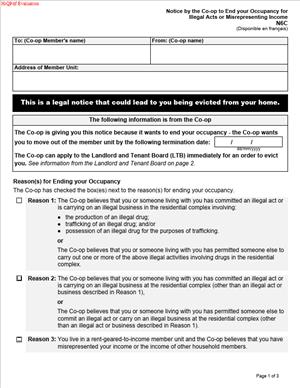
N6C – Notice by the Co-op to End your Occupancy for Illegal Acts or Misrepresenting Income
Fill out nowJurisdiction: Country: Canada | Province or State: Ontario
If you have received or are reviewing the N6C – Notice by the Co-op to End your Occupancy for Illegal Acts or Misrepresenting Income, you are dealing with a serious housing document. This form is used in Ontario housing co-operatives to start the process of ending a member’s occupancy. It usually relates to alleged illegal activity or claims that a member gave false income information.
This document is not a court order. It is a formal notice. It tells you that the co-op believes certain actions have taken place and that it wants to end your right to live in the unit.
For many people, this form is confusing and stressful. You may be unsure what the co-op is claiming or what happens next. Understanding what this notice does, and what it does not do, helps you stay focused on the facts.
This guide explains how the form works in Ontario, who uses it, and how it is typically completed. It is written for people who are reading or filling out the form and want clear, practical information.
What is N6C – Notice by the Co-op to End your Occupancy for Illegal Acts or Misrepresenting Income?
Clear definition
The N6C – Notice by the Co-op to End your Occupancy for Illegal Acts or Misrepresenting Income is a formal notice used by a housing co-operative in Ontario. It states that the co-op intends to end a member’s occupancy agreement because of alleged illegal acts or misrepresentation of income.
In a co-op, members do not usually have a standard lease like in private rentals. Instead, they have an occupancy agreement tied to their membership. This form is used when the co-op believes the member has seriously breached that agreement in specific ways.
The notice sets out the reasons for ending the occupancy. It also gives a termination date. This is the date the co-op says your occupancy will end unless the matter is resolved or reviewed through the proper process.
Who typically uses this form?
This form is typically prepared and issued by the housing co-operative. It may be completed by a property manager, a co-op staff member, or a board representative acting on behalf of the co-op.
The person receiving the form is usually a co-op member who occupies a unit under an occupancy agreement. In some cases, it may also involve other occupants connected to that member.
The form is connected to proceedings before the Ontario Landlord and Tenant Board. The co-op uses it as part of the process to seek an order to end occupancy and potentially require the member to move out.
Why might you need this form?
A co-op may use this form if it believes a member committed an illegal act in the unit or residential complex. This can include activities that are criminal in nature or that seriously affect safety or property.
It may also be used if the co-op believes the member misrepresented income. This often relates to rent-geared-to-income arrangements, where housing charges are based on reported household income. If the co-op believes income was underreported or false information was provided, it may issue this notice.
From the member’s perspective, you may need to understand this form because you have received it. The information in the document affects your housing and sets out what the co-op is alleging.
Typical real-life scenarios
- One common scenario involves allegations of illegal drug activity in a unit. The co-op may claim that certain activities took place that put other members at risk. The notice would outline the alleged conduct and state that the co-op is ending the occupancy because of it.
- Another scenario involves property damage tied to illegal actions. For example, if the co-op believes a member or someone in the unit caused serious damage during unlawful activity, it may rely on that conduct as grounds for ending the agreement.
- Misrepresentation of income is another frequent reason. A co-op may review income documents and conclude that a member did not fully disclose employment income, self-employment earnings, or other financial support. If the housing charge was calculated using incorrect information, the co-op may issue this notice.
- A further situation may involve repeated issues where earlier warnings or internal processes did not resolve the concern. In that case, the co-op may decide to proceed with a formal notice to end occupancy based on the alleged illegal conduct or misrepresentation.
When would you use N6C – Notice by the Co-op to End your Occupancy for Illegal Acts or Misrepresenting Income?
This form is used when a housing co-op believes there has been a serious breach related to illegal acts or income reporting. It is not meant for minor rule violations or general disagreements.
Illegal acts can include conduct that breaks the law and affects the residential complex or other members. The co-op may rely on police reports, complaints, or internal investigations. The notice is typically used when the alleged behaviour is considered serious enough to justify ending the occupancy agreement.
Misrepresentation of income often arises in rent-geared-to-income housing. Members are required to provide accurate and complete income information. If the co-op believes the member knowingly gave false information or failed to report income, it may use this form to begin the termination process.
The form is usually used after the co-op has reviewed the situation internally. In many cases, the board or a committee considers the issue before authorizing the notice. The notice is then served on the member, which starts a formal timeline connected to potential proceedings before the Board.
Legal characteristics of N6C – Notice by the Co-op to End your Occupancy for Illegal Acts or Misrepresenting Income
This document has legal significance because it starts a formal process. It tells the member that the co-op intends to end the occupancy agreement for specific reasons allowed under Ontario housing law.
For the notice to be effective, it generally needs to be completed accurately. The member’s name, the unit address, the reasons for termination, and the termination date must be clearly stated. The allegations must be described in enough detail to explain what conduct is being relied on.
Common problems include missing information, unclear dates, or vague descriptions of the alleged acts. If the reasons are too general, it can create confusion and disputes later in the process. Errors in service, such as delivering the notice in a way not permitted by the rules, can also create issues.
This form does not, by itself, force a member to leave. It is not an eviction order. The co-op must usually apply to the Ontario Landlord and Tenant Board for an order to end occupancy and evict. Until the Board makes a decision, the member remains in the unit unless they choose to move out earlier.
While housing law is provincial, co-op procedures and internal rules can vary. The general structure of notice and Board review is consistent in Ontario, but each case depends on its facts and the evidence presented.
Is it legally binding?
The N6C – Notice by the Co-op to End your Occupancy for Illegal Acts or Misrepresenting Income is legally meaningful, but it is not a final decision. It does not automatically end your occupancy the moment you receive it.
It becomes part of a legal process when the co-op files an application with the Board based on the notice. At that stage, the Board reviews whether the legal requirements have been met and whether the allegations justify ending the occupancy.
If the Board issues an order terminating the occupancy agreement, that order is legally binding. The notice is one step in reaching that point. Its validity can affect whether the co-op’s application succeeds.
If the notice is incomplete, inaccurate, or not properly served, it may weaken the co-op’s case. The binding outcome depends on the full process, not just the existence of the notice.
How to fill out N6C – Notice by the Co-op to End your Occupancy for Illegal Acts or Misrepresenting Income
Step 1 – Identify the member and unit
Enter the full legal name of the member as it appears in the occupancy agreement. Include the complete address of the unit, including the unit number and postal code. Accuracy here is essential because the notice must clearly identify who and what unit it applies to.
Step 2 – Select the reason for ending occupancy
Indicate whether the notice is based on alleged illegal acts, misrepresentation of income, or both. Use the sections provided in the form to mark the appropriate grounds. Make sure the selected reason matches the details you will describe later in the document.
Step 3 – Describe the alleged illegal acts
If the notice is based on illegal activity, provide a clear description of what is alleged. Include dates, locations, and the nature of the conduct. Avoid vague statements. The description should explain what happened and how it relates to the unit or residential complex.
Step 4 – Describe the alleged misrepresentation of income
If the issue relates to income, state what information was allegedly incorrect or incomplete. Identify the reporting period involved and the type of income in question. Clarify how the co-op believes the information provided differed from the actual income.
Step 5 – State the termination date
Enter the date on which the co-op intends the occupancy to end. Ensure the date complies with the required notice period under Ontario rules. The date must be clearly written and consistent with the timing rules that apply to this type of notice.
Step 6 – Provide details about the service
Indicate how and when the notice will be delivered to the member. Record the method of service, such as personal delivery or another permitted method. Keep a record of the date of service, as timelines are calculated from that date.
Step 7 – Sign and date the notice
The authorized representative of the co-op must sign and date the form. The signature confirms that the information in the notice is being formally issued on behalf of the co-op. Ensure the date of signature is accurate and matches the service details.
Step 8 – Review the completed form for accuracy
Before serving the document, review every section carefully. Check names, dates, addresses, and the description of the allegations. Confirm that the termination date reflects the correct notice period. A careful review reduces the risk of delays or challenges later in the process.
Legal terms you might encounter in N6C – Notice by the Co-op to End your Occupancy for Illegal Acts or Misrepresenting Income
- Termination Date: This is the date the co-op says your occupancy will end. It must be clearly written on the form. You need to check that the date gives the required amount of notice and is calculated properly from the date you were served.
- Illegal Act: This refers to conduct that violates criminal law or other laws, not just co-op rules. On this form, the co-op must describe the specific act, when it happened, and how it affects the property or other members. Vague statements are not enough.
- Misrepresentation of Income: This means providing false, incomplete, or misleading income information, often in relation to rent-geared-to-income calculations. The form should explain what income was reported, what the co-op believes is accurate, and how the discrepancy affects your housing charges.
- Member: In a housing co-op, you are a member, not a tenant in the traditional sense. This term appears throughout the document and identifies the person whose occupancy is being ended. Your full legal name must match the co-op’s records.
- Unit Address: This is the specific co-op unit involved. The form must list the correct address, including the unit number. Any mistake here can create confusion about which occupancy is affected.
- Service (of Notice): Service means delivering the document to you in a legally recognized way. The form will indicate how and when it was served. The method of service affects how the termination date is calculated.
- Landlord and Tenant Board: This is the tribunal that handles disputes about occupancy and termination notices. The notice itself does not automatically remove you from the unit. Further steps may involve this Board.
- Application to Terminate: After serving this notice, the co-op may apply to the Board to request an order ending your occupancy. The notice is usually a required first step before such an application.
- Subsidy: In many co-ops, housing charges are based on income. If income is misrepresented, the subsidy amount may be incorrect. The form may refer to how this affects what you pay.
- Effective Date of Service: This is the legally recognized date the notice is considered delivered. It may not be the same as the date written on the notice. You must confirm this to calculate deadlines correctly.
FAQs
How do I check if the termination date on this form is correct?
Start by finding the date you were served. Then count the required number of days from that service date, not from the date the form was signed. Make sure the termination date gives the full notice period required. If the date falls too soon, that may affect how you respond.
What details should be included about the alleged illegal act?
The document should describe what happened, when it happened, and where it happened. It should connect the conduct to your unit or the co-op property. If it only uses general language like “illegal activity” without specifics, note that. You need enough detail to understand what you are being accused of.
How specific does the co-op need to be about misrepresenting income?
The form should identify what income you reported, what income the co-op believes you actually had, and the time period involved. It should also explain how this affects your housing charges. If numbers are involved, check that they are clearly stated and tied to specific dates.
Does receiving the N6C – Notice by the Co-op to End your Occupancy for Illegal Acts or Misrepresenting Income mean I have to move out right away?
No. This document is a notice, not an eviction order. It tells you the co-op intends to end your occupancy on a stated date. If the matter proceeds further, a hearing process may follow before any final order is made.
Who is allowed to sign this document on behalf of the co-op?
It must be signed by someone with authority to act for the co-op, such as a board member or authorized representative. Check that the signature is present and dated. An unsigned form can create issues about whether it was properly issued.
What if my name or unit number is spelled incorrectly?
Compare the name and address on this form to your membership agreement and co-op records. Small spelling errors may not always invalidate a document, but major mistakes can cause confusion. Make note of any discrepancy and keep a copy that shows the error.
Do I need to attach any documents when I respond?
This document itself does not require you to attach anything when you receive it. However, if you later respond in writing or attend a hearing, you may need documents such as income records, correspondence, or proof of payment. Organize these early so you are not rushing later.
Will this notice automatically be filed with the Board?
Not automatically. The co-op must take a separate step to apply if it wants an order ending your occupancy. You may receive additional documents if that happens. Keep the original notice because it will likely be referenced in any further proceedings.
Checklist: Before, During, and After N6C – Notice by the Co-op to End your Occupancy for Illegal Acts or Misrepresenting Income
Before
- Read the entire notice from start to finish without skipping sections.
- Confirm your full legal name and unit address are correct.
- Identify the reason selected: illegal act, misrepresentation of income, or both.
- Locate the termination date and calculate the notice period.
- Note the date and method of service.
- Gather your membership agreement and recent income documents.
- Collect any written communication between you and the co-op about the issue.
- Write down a timeline of events while they are fresh in your memory.
During
- Highlight the specific allegations and dates listed.
- Check whether the description of events is detailed or vague.
- Compare reported income figures with your actual records.
- Verify the signature and date on the notice.
- Keep the envelope if the notice was mailed to you.
- Make a copy or scan of the full notice for your records.
- Mark important deadlines on a calendar.
- Prepare a list of questions you may need clarified.
After
- Store the original notice in a safe place.
- Organize supporting documents in one folder.
- Monitor for any further documents from the co-op or the Board.
- Respond promptly to any hearing notice you receive.
- Update your contact information with the co-op if needed.
- Avoid discussing the matter publicly within the co-op community.
- Keep records of all conversations and emails going forward.
- Track any payments or changes related to your housing charges.
Common mistakes to avoid with N6C – Notice by the Co-op to End your Occupancy for Illegal Acts or Misrepresenting Income
- Mistake: Ignoring the notice because you believe it is unfair, which often happens due to frustration, leading to missed deadlines and fewer options later, so do not forget to read it carefully and track all dates immediately.
- Mistake: Miscalculating the termination date by counting from the wrong day, which happens when you use the signature date instead of the service date, resulting in confusion about timelines, so do not forget to confirm how and when it was delivered.
- Mistake: Failing to check the income figures listed, often because the numbers seem complex, which can allow incorrect assumptions to go unchallenged, so do not forget to compare every figure with your own records.
- Mistake: Overlooking small errors in your name or address, which happens when you focus only on the allegations, potentially causing identification issues later, so do not forget to verify all personal details.
- Mistake: Throwing away the envelope or proof of delivery, which happens when you think the form alone is enough, making it harder to prove service dates, so do not forget to keep everything that came with the notice.
- Mistake: Communicating only verbally about serious allegations, which happens out of habit or urgency, creating no paper trail, so do not forget to keep written records of all exchanges.
- Mistake: Waiting until a hearing notice arrives to gather documents, which often leads to rushed preparation and missing evidence, so do not forget to organize your paperwork as soon as you receive the notice.
- Mistake: Assuming the notice automatically ends your occupancy, which happens due to fear or misunderstanding, possibly leading you to move out unnecessarily, so do not forget that further steps are usually required before an order is made.
What to do after filling out N6C – Notice by the Co-op to End your Occupancy for Illegal Acts or Misrepresenting Income
If you are the co-op representative completing this form, your work is not finished when you sign it. Proper handling after completion is critical. Small procedural errors can delay or complicate the next steps.
If you are the member receiving it and reviewing a completed copy, your focus should be on preserving evidence and preparing for what may come next.
Start with document control. Make clean copies of the signed notice before it is served or immediately after you receive it. Keep one original in a secure file. Digital scans are helpful, but do not discard paper originals.
- Step 1: Make at least two copies of the fully completed and signed notice.
- Step 2: Confirm the method of service and record the exact date and time of delivery.
- Step 3: Complete any required certificate or proof of service and store it with the notice.
- Step 4: Calendar the termination date and any internal follow-up deadlines.
- Step 5: Prepare a file with all supporting documents referenced in the notice.
- Step 6: Monitor for any response, communication, or correction requests.
- Step 7: If proceeding further, prepare the materials needed for an application.
- Step 8: Keep a communication log of all interactions about the notice.
- Step 9: Update internal records to reflect that the notice was issued and served.
- Step 10: Review compliance with internal policies to ensure consistency in similar cases.
Accuracy and organization matter. If you are serving the notice, ensure that service complies with recognized methods and that you can prove it later. If you are receiving it, document everything from the moment it arrives.
Keep your records in chronological order. Label each document clearly. If the matter proceeds to a hearing, you will rely on these records to explain what happened and when.
Finally, stay attentive to new documents. A notice is often the first step in a process, not the last. Acting promptly and keeping thorough records protects your position and reduces unnecessary stress.
Disclaimer: This guide is provided for informational purposes only and is not intended as legal advice. You should consult a legal professional.