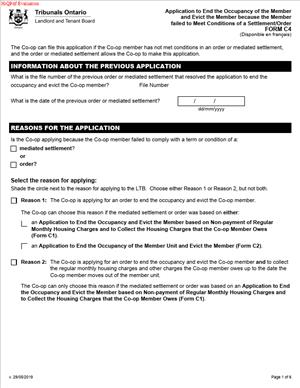
Form C4 – Application to End the Occupancy of the Member and Evict the Member because the Member failed to Meet Conditions of a Settlement or Order
Fill out nowJurisdiction: Country: Canada | Province or State: Ontario
Form C4 – Application to End the Occupancy of the Member and Evict the Member because the Member failed to Meet Conditions of a Settlement/Order is a document used at the Ontario Landlord and Tenant Board. It is part of the co‑operative housing process, not the standard landlord‑tenant eviction process.
You use this form when a housing co‑operative believes that one of its members has not followed the terms of a settlement or an order that was previously made. The form asks the Board to end the member’s occupancy and allow eviction based on that failure.
This is not the first step in a dispute. It comes after an earlier agreement or order that already set conditions that the member had to follow. The focus is on whether those conditions were breached.
If you are about to complete this document, you need to understand what the earlier settlement or order required, how it was breached, and what outcome you are asking the Board to make now.
What is Form C4 – Application to End the Occupancy of the Member and Evict the Member because the Member failed to Meet Conditions of a Settlement/Order?
Clear definition
Form C4 – Application to End the Occupancy of the Member and Evict the Member because the Member failed to Meet Conditions of a Settlement/Order is a formal application to the Ontario Landlord and Tenant Board. It asks the Board to terminate a co‑op member’s right to occupy their unit because they did not comply with specific terms set out in a settlement agreement or Board order.
A settlement may have been reached at a previous hearing. An order may have been issued by the Board after a decision. In both cases, the document usually sets out clear conditions, such as payment deadlines, behaviour requirements, or other obligations.
This form tells the Board that those conditions were not met. It asks the Board to review the situation and decide whether the occupancy should now end.
Who typically uses this form?
This form is typically used by non‑profit housing co‑operatives. It is filed by the co‑op as the housing provider, not by individual landlords or property managers in the private rental market.
Within the co‑op, the application is often authorized by the board of directors. A representative of the co‑op completes and signs the form on behalf of the organization.
Members do not file this form against the co‑op. It is a tool used by the co‑op when it believes a member has failed to meet agreed or ordered conditions.
Why might you need this form?
You might need this form if there was already a dispute that led to a settlement or a Board order, and the member did not follow through. The earlier document may have given the member another chance to correct a problem.
For example, a settlement may have allowed the member to stay if they paid arrears in installments. If those payments were missed, the co‑op may rely on that breach to apply for termination of occupancy.
The purpose of this form is not to revisit the original dispute from the beginning. It focuses on the failure to meet the specific conditions that were clearly set out before.
Typical real-life scenarios
- A member falls behind on housing charges. At a previous hearing, the parties agreed that the member can stay if they pay the arrears in monthly installments on top of regular charges. The settlement states that missing a payment may lead to eviction. The member later misses several payments. The co‑op applies using this form.
- A Board order requires a member to stop engaging in certain conduct that disturbs other residents. The order allows the member to remain if the behaviour stops. Complaints continue after the order. The co‑op files this application based on the alleged breach.
- A settlement requires a member to provide documents to confirm income for subsidy purposes by a specific date. The deadline passes without compliance. The co‑op claims the condition was not met and applies to end occupancy.
- An order sets out a strict timeline for cleaning or repairing damage inside the unit. The co‑op inspects after the deadline and believes the required work was not done. The co‑op relies on that failure when completing the form.
When would you use Form C4 – Application to End the Occupancy of the Member and Evict the Member because the Member failed to Meet Conditions of a Settlement/Order?
You would use this form after there is already a written settlement or Board order that includes clear, enforceable conditions. The document must set out what the member was required to do and often what would happen if they did not comply.
This form is not used for a brand‑new problem. If no settlement or order exists, a different application process is typically required. The C4 process depends on an earlier document.
Timing matters. The alleged breach must relate to conditions that were active and in effect. If the settlement or order has already expired or been fully satisfied, this form may not apply.
The person completing the form is usually acting for the co‑op. They gather the earlier agreement or order, confirm the specific clauses that were breached, and explain how the member failed to meet them.
Legal characteristics of Form C4 – Application to End the Occupancy of the Member and Evict the Member because the Member failed to Meet Conditions of a Settlement/Order
This application has legal effect because it starts a formal proceeding before the Ontario Landlord and Tenant Board. Once filed and properly served, it leads to a hearing or review process where evidence can be presented.
For the application to be effective, it must clearly identify the earlier settlement or order. The terms relied on must be specific. Vague claims that a member was “non‑compliant” are not enough. The Board generally looks for clear wording and clear facts.
Common problems include incomplete information, incorrect member details, missing dates, or failing to attach or reference the correct order. If the conditions are not accurately described, the Board may have difficulty assessing the claim.
Service is also important. The member must receive the application in a way that meets Board requirements. Improper service can delay the process or require the application to be redone.
This form does not automatically evict someone. Filing it only asks the Board to consider ending occupancy. The Board must still review the evidence and make a decision.
The form also does not change the original settlement or order. It relies on that earlier document. If there is a dispute about what the earlier document means, the Board may need to interpret it.
While housing co‑operatives follow a distinct framework from private landlords, the general principle is similar across many legal systems. An eviction based on breach of a prior agreement usually requires clear proof of the condition and the failure to meet it.
Is it legally binding?
The form itself is not legally binding in the sense of creating new obligations just by being completed. It becomes legally significant once it is filed with the Board and processed according to the rules.
The earlier settlement or order is what carries binding force. Those documents set out the conditions the member agreed to or was required to follow. The application relies on that binding document.
If the Board grants the application, the resulting order can be legally enforceable. That later order may authorize eviction if the Board is satisfied that the conditions were not met.
How to fill out Form C4 – Application to End the Occupancy of the Member and Evict the Member because the Member failed to Meet Conditions of a Settlement/Order
Step 1 – Identify the co‑operative and the member
Enter the full legal name of the housing co‑operative as it appears in official records. Provide complete contact information. Then enter the member’s full name and the address of the unit in question. Accuracy here prevents delays and confusion later in the process.
Step 2 – Provide details about the unit and occupancy
State the address of the rental unit clearly, including the unit number if applicable. Confirm that the person named is a member of the co‑op and currently occupies the unit. This section connects the individual to the specific housing unit involved.
Step 3 – Reference the settlement or order
Identify the exact settlement agreement or Board order you are relying on. Include the date it was made and any file or case number associated with it. Be precise so the Board can easily locate and review the earlier document.
Step 4 – Set out the conditions that were not met
Describe the specific terms of the settlement or order that the member was required to follow. Quote or closely summarize the relevant clauses. Focus only on the conditions that were allegedly breached, not the entire history of the dispute.
Step 5 – Explain how the conditions were breached
Provide clear facts about what happened. Include dates, amounts, or actions that show non‑compliance. Keep the explanation factual and organized so the Board can compare the condition with what actually occurred.
Step 6 – State the remedy requested
Indicate that you are asking the Board to end the member’s occupancy and issue an eviction order based on the failure to meet the conditions. Make sure the request matches what the form allows and relates directly to the breach described.
Step 7 – Sign and date the application
The authorized representative of the co‑op signs the form. Print the name and title of the person signing. Dating the form confirms when the application was completed and supports the timeline of events.
Step 8 – Review before submission
Read through the entire document carefully. Confirm that names, dates, amounts, and references to the settlement or order are correct. Ensure all required sections are completed so the submission can move forward without unnecessary delay.
Legal terms you might encounter in Form C4 – Application to End the Occupancy of the Member and Evict the Member because the Member failed to Meet Conditions of a Settlement/Order
- Settlement Agreement: A settlement agreement is a written arrangement between the co‑operative and the member that resolves a dispute. It often sets out specific conditions the member must follow, such as paying arrears by certain dates. In this form, you must identify the settlement and explain which terms were not followed.
- Order: An order is a formal decision issued by the Landlord and Tenant Board. It may require the member to do something, such as pay outstanding housing charges or comply with rules. This document asks you to reference the exact order and describe how the member failed to comply.
- Conditions: Conditions are the specific obligations listed in the settlement or order. They might include payment schedules, behavior requirements, or deadlines. You must clearly state which condition was breached and provide details.
- Breach: A breach occurs when a member does not meet a required condition. This could mean missing a payment, paying late, or ignoring another obligation. In this application, you must explain the breach in factual terms with dates and amounts.
- Occupancy Rights: Occupancy rights refer to the member’s legal right to live in the co‑operative unit. If the Board grants this application, those rights may be terminated. The form is specifically about ending those rights because of non‑compliance with prior terms.
- Eviction Order: An eviction order is a directive that requires the member to move out by a certain date. If granted, it can be enforced if the member does not leave voluntarily. This application seeks that outcome based on an earlier broken agreement or order.
- Arrears: Arrears are unpaid housing charges or other amounts owed. Many settlements involve repayment plans to clear arrears. If the member fails to follow that plan, you must set out the current amount owing.
- Effective Date: The effective date is the date when the termination of occupancy or eviction would take effect. You may need to confirm dates linked to missed payments or deadlines in the prior order. Accuracy here is critical.
- Service: Service means formally delivering the application and related documents to the member. The Board has specific rules about how and when documents must be served. You must confirm that the service was completed properly and on time.
- Supporting Documents: Supporting documents are attachments that back up your claims. These often include the original settlement agreement, the Board order, payment ledgers, and notices. You should ensure each attachment is clearly labeled and matches what you reference in the form.
FAQs
Do I need to attach the original settlement or order when filing Form C4 – Application to End the Occupancy of the Member and Evict the Member because the Member failed to Meet Conditions of a Settlement/Order?
Yes. You should attach a copy of the signed settlement agreement or the Board order you are relying on. The decision-maker must see the exact terms and deadlines. Make sure the copy is clear and complete, including signatures and dates. If you refer to a specific paragraph or payment schedule, highlight or clearly identify it so it matches what you describe in the application.
What details about the breach should I include in this document?
Be precise. State the exact condition that was not met, the deadline in the settlement or order, and what actually happened. For example, list the required payment date and the amount due, then state that no payment was received or that a partial payment was made. Use dates and dollar amounts. Avoid general statements like “the member did not comply.”
How do I confirm the correct effective date for termination?
Check the wording in the prior settlement or order. Some orders specify that if a payment is missed, eviction may proceed without further notice. Others may require an additional step. Make sure the dates you enter reflect when the breach occurred and any grace periods mentioned. Double-check your calendar and your payment records before you write the date in this form.
Who is authorized to sign this application on behalf of the co‑operative?
The person signing must have authority to act for the co‑operative. This is often a board member, officer, or authorized representative. Confirm that your internal records support that authority. The name and title you enter should match your co‑operative’s official records. If you use an agent or representative, ensure their authorization is properly documented.
What happens if the member makes a partial payment after missing a deadline?
You must still disclose that payment. Update your arrears calculation to show the correct outstanding balance. Explain whether the partial payment met the condition or fell short of the required amount. The Board will look at whether the exact terms were met, not just whether some money was paid.
Can I correct an error after filing this form?
Minor clerical errors may sometimes be corrected, but significant errors can delay your case. If you discover a mistake in names, dates, or amounts, act quickly. You may need to submit an amended document or notify the Board according to its procedures. Always review carefully before filing to avoid this situation.
How do I make sure the member’s name is entered correctly?
Use the exact legal name that appears on the membership agreement, the prior settlement, and the Board order. Check spelling, middle initials, and hyphenated names. If more than one member is listed on the occupancy agreement, ensure all required names are included. Inconsistent names can cause confusion or delay.
Will filing this application automatically change the public record?
Filing creates a record of the application with the Board. The outcome, including any eviction order, becomes part of the official file. This document does not change ownership or membership records by itself. Only a Board order granting the requested remedy affects the member’s occupancy rights.
Checklist: Before, During, and After Form C4 – Application to End the Occupancy of the Member and Evict the Member because the Member failed to Meet Conditions of a Settlement/Order
Before
- Review the full settlement agreement or Board order and highlight each condition.
- Confirm the exact date and nature of the breach using payment ledgers or incident records.
- Calculate the current arrears accurately, including any partial payments.
- Gather clear copies of all supporting documents.
- Verify the correct legal names of the co‑operative and the member.
- Confirm who has the authority to sign the application.
- Check internal meeting minutes if board approval is required.
- Review service rules and timelines.
During
- Enter names exactly as they appear on official documents.
- Reference the specific paragraph or clause that was breached.
- List dates and amounts clearly and in chronological order.
- Attach the settlement or order and label it clearly.
- Double-check arithmetic in arrears calculations.
- Ensure all required sections of the form are completed.
- Sign and date the application in the correct place.
- Prepare copies for filing and service.
After
- File the application using the accepted submission method.
- Serve the member according to the Board’s service rules.
- Complete and retain proof of service documentation.
- Calendar the hearing date once scheduled.
- Organize a hearing package with copies of all evidence.
- Keep a record of all communications after filing.
- Update internal tracking records within the co‑operative.
- Prepare to present clear, factual evidence at the hearing.
Common mistakes to avoid with Form C4 – Application to End the Occupancy of the Member and Evict the Member because the Member failed to Meet Conditions of a Settlement/Order
- Mistake: Describing the breach in vague terms because you assume the Board already knows the background, which can weaken your case; the consequence is delay or dismissal, so do not forget to list exact dates, amounts, and missed conditions.
- Mistake: Attaching incomplete copies of the settlement or order because you only include the signature page; this can result in adjournment, so do not forget to include every page and schedule.
- Mistake: Using outdated arrears figures because you did not update the ledger before filing; this can damage credibility, so do not forget to reconcile all payments up to the filing date.
- Mistake: Misspelling the member’s name or leaving out a joint member because you rely on memory; this may require amendments, so do not forget to verify names against the membership agreement.
- Mistake: Having someone sign without proper authority because it seems convenient; this can lead to procedural challenges, so do not forget to confirm signing authority in advance.
- Mistake: Failing to follow proper service rules because you assume regular mail is always acceptable; improper service can delay the hearing, so do not forget to document how and when service was completed.
- Mistake: Ignoring partial payments made after the breach because you think they do not matter; this can affect the Board’s view of fairness, so do not forget to disclose and account for every payment received.
- Mistake: Waiting too long after the breach to file because you hope the issue resolves itself; delay can complicate timelines, so do not forget to act promptly once conditions are clearly unmet.
What to do after filling out Form C4 – Application to End the Occupancy of the Member and Evict the Member because the Member failed to Meet Conditions of a Settlement/Order
Once you complete the form, slow down. Review every page. Confirm that all names, dates, and dollar amounts match your supporting documents. Make sure each attachment is labeled and easy to read.
- Step 1: Make at least two complete copies of the signed application and all attachments.
- Step 2: Organize the copies in the same order as referenced in the form.
- Step 3: Submit the application using the Board’s accepted filing method and keep confirmation of submission.
- Step 4: Pay any required filing fee and retain proof of payment.
- Step 5: Serve the complete application package to the member according to the approved methods of service.
- Step 6: Complete a certificate or affidavit of service, recording the date, method, and address used.
- Step 7: Mark your calendar with any deadlines and the hearing date once you receive notice.
- Step 8: Prepare a hearing brief with the settlement or order, payment ledger, correspondence, and proof of service.
- Step 9: Update the co‑operative’s internal records to reflect that an application has been filed.
- Step 10: Monitor any payments or communication from the member and keep detailed notes.
Stay organized. Keep a dedicated file for this matter. Bring complete, well‑ordered documents to the hearing. Be ready to explain the sequence of events clearly and calmly. Accurate records and careful follow‑through make the process smoother and reduce the risk of delay.
Disclaimer: This guide is provided for informational purposes only and is not intended as legal advice. You should consult a legal professional.