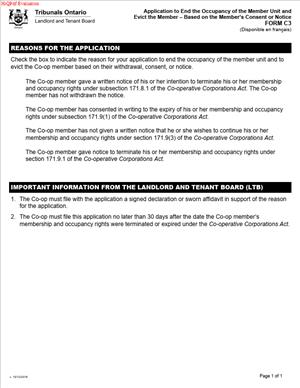
Form C3 – Application to End the Occupancy of the Member Unit and Evict the Member – Based on the Member’s Consent or Notice
Fill out nowJurisdiction: Country: Canada | Province or State: Ontario
Form C3 – Application to End the Occupancy of the Member Unit and Evict the Member – Based on the Member’s Consent or Notice is a document used within Ontario’s co‑operative housing system. It is filed with the Landlord and Tenant Board when a housing co‑operative asks the Board to end a member’s right to occupy a unit and to issue an eviction order, based on the member’s own consent or notice.
This form is not a general eviction notice. It is part of a formal process that involves a housing co‑op and one of its members. It comes into play after certain internal steps have already happened within the co‑op.
If you are preparing to complete this form, you are likely acting on behalf of a housing co‑operative. You may be a board member, staff person, or authorized representative. Your goal is to ask the Board to issue an order that reflects the member’s agreement to leave or their written notice that they are ending their occupancy.
Understanding how this form works helps you avoid delays. Small errors can result in rejected filings or adjourned hearings. Clear, accurate information makes the process smoother.
Because this document leads to a possible eviction order, accuracy matters. The information you include forms the basis of the Board’s decision.
What is Form C3 – Application to End the Occupancy of the Member Unit and Evict the Member – Based on the Member’s Consent or Notice?
Clear definition
Form C3 – Application to End the Occupancy of the Member Unit and Evict the Member – Based on the Member’s Consent or Notice is an application filed with the Ontario Landlord and Tenant Board by a housing co‑operative. It asks the Board to formally end a member’s occupancy rights and issue an eviction order.
The key feature of this form is that it relies on the member’s consent or notice. That means the member has either agreed in writing to end their occupancy or has given notice that they are moving out. The co‑op is not claiming a breach or misconduct in this specific application. Instead, it is asking the Board to formalize what the member has already agreed to or initiated.
This document is part of a legal proceeding. Once filed, it opens a case at the Board. The Board may schedule a hearing or review the materials to decide whether to issue an order.
Who typically uses this form?
This form is typically used by non‑profit housing co‑operatives in Ontario. The applicant is the co‑op itself, not an individual landlord.
The person completing the form is often a board member, property manager, or another authorized representative of the co‑op. They act on behalf of the co‑op’s governing body.
Members of the co‑op do not usually complete this form. Instead, they may have signed a consent to end occupancy or provided written notice to leave. The co‑op then uses that document as the basis for its application.
Because co‑ops operate under a distinct legal structure, this form is specific to that context. It is not used in standard landlord‑tenant situations outside a co‑operative.
Why might you need this form?
You may need this form when a member has agreed to move out but has not left by the agreed date. The co‑op may need a formal eviction order to regain possession of the unit.
You might also use it when a member provides notice of termination, but there is uncertainty about whether they will vacate. Filing the application allows the co‑op to obtain an enforceable order if needed.
In some cases, a co‑op wants to ensure that the end of occupancy is formally recognized by the Board. A Board order can provide clarity and finality.
This form can also be used where the member has signed an agreement ending occupancy, and the co‑op wants that agreement reflected in an official order.
Typical real-life scenarios
- A member signs an agreement with the co‑op stating that they will move out by a specific date. The date passes, and the member remains in the unit. The co‑op files this form to ask the Board for an eviction order based on the signed agreement.
- A member submits a written notice that they are terminating their membership and occupancy. Before the move‑out date, concerns arise that the member may not leave. The co‑op files the application so that an order can be issued if the unit is not vacated.
- A member and the co‑op reach a settlement after a dispute. As part of the settlement, the member agrees to end occupancy. The co‑op files the form to have the Board issue an order consistent with that settlement.
- A member provides notice but later indicates they may change their mind. The co‑op proceeds with the application to ensure that the original notice is recognized and enforced through a Board order.
- In each scenario, the form is not about proving wrongdoing. It is about formalizing the member’s own decision or agreement to leave.
When would you use Form C3 – Application to End the Occupancy of the Member Unit and Evict the Member – Based on the Member’s Consent or Notice?
You would use this form after the member has already taken a step to end their occupancy, either by signing a consent or giving notice. It is not the first step in the process. It follows an internal decision or written communication.
Timing matters. The application is generally filed close to the date when the occupancy is expected to end. Filing too early may raise questions about whether the consent or notice is still effective. Filing too late may delay the co‑op’s ability to regain possession.
This form is used in situations involving co‑operative housing members. It is not designed for private landlords renting out units in the regular rental market. The relationship between the co‑op and the member is based on membership and occupancy rights, not a standard lease alone.
If you are acting as a representative, you would typically use this form after confirming that the consent or notice is in writing and properly documented. The Board will expect clear evidence that the member agreed or gave notice voluntarily.
Legal characteristics of Form C3 – Application to End the Occupancy of the Member Unit and Evict the Member – Based on the Member’s Consent or Notice
This form starts a legal proceeding before the Landlord and Tenant Board. Once accepted for filing, it creates a case file and may lead to a hearing or written decision.
For the application to be effective, it must contain complete and accurate information. This includes correct names, addresses, and dates. The consent or notice relied on must be clear and identifiable.
Common problems include inconsistent dates, missing signatures on the underlying consent, or unclear proof that the member actually provided notice. If the Board cannot confirm that the member agreed or gave notice, the application may be delayed or dismissed.
Another issue arises when the consent appears conditional or ambiguous. If the agreement to leave depends on other events, the Board may need further clarification before issuing an order.
This form does not replace internal co‑op procedures. The co‑op is generally expected to follow its own governance rules before applying to the Board. The Board focuses on whether there is valid consent or notice and whether the legal requirements are met.
The form also does not automatically remove a member from the unit. An eviction order must be issued, and enforcement may involve additional steps if the member does not leave voluntarily.
Housing co‑operative rules in Ontario differ from standard rental arrangements. The process reflects that distinction. While both involve the Landlord and Tenant Board, the rights and obligations arise from a membership relationship.
Is it legally binding?
The form itself is an application. It becomes legally significant once the Board issues an order based on it. The binding effect comes from the Board’s order, not from the application alone.
If the member has signed a clear and voluntary consent to end occupancy, that document can carry legal weight. When the Board reviews it and issues an order, the order is enforceable.
If the member provided a valid written notice to terminate occupancy, that notice may also have legal effect. The Board can confirm the end date and issue an eviction order if necessary.
However, if the consent was not properly signed, was obtained under questionable circumstances, or is unclear, the Board may decline to issue an order. In that case, the application does not create a binding outcome.
The binding nature depends on proper completion, accurate information, and a valid underlying consent or notice.
How to fill out Form C3 – Application to End the Occupancy of the Member Unit and Evict the Member – Based on the Member’s Consent or Notice
Step 1 – Identify the housing co‑operative
Enter the full legal name of the housing co‑operative as it appears in official records. Include the complete address and contact information requested. Ensure the name matches the name used in the consent or notice documents.
Step 2 – Identify the member
Provide the member’s full legal name. Use the name that appears in the co‑op’s records and on the written consent or notice. Add the address of the member unit exactly as it appears, including unit number and postal code.
Step 3 – Provide details of the member unit
Fill in the full address of the rental unit within the co‑op. Be precise. Errors in the unit number or street address can delay the case. Confirm that the unit listed matches the location connected to the consent or notice.
Step 4 – State the basis of the application
Indicate that the application is based on the member’s consent or the member’s notice to end occupancy. Select or complete the section that reflects which situation applies. Ensure the dates in this section match the written documents.
Step 5 – Enter the relevant dates
Provide the date the member signed the consent or gave notice. Also include the date the occupancy is to end. Double‑check that these dates are consistent throughout the form and with any attached documents.
Step 6 – Attach supporting documents
Attach a copy of the signed consent agreement or the written notice from the member. Make sure the copy is clear and legible. If there are multiple pages, include all of them in the correct order.
Step 7 – Provide additional information if required
If the form includes space for explanations, briefly describe the circumstances. Keep the description factual and focused on the consent or notice. Avoid adding unrelated disputes or background details.
Step 8 – Sign and date the application
An authorized representative of the co‑operative must sign the form. Print the signer’s name and indicate their role, such as board member or manager. Enter the date of signing. The signature confirms that the information provided is accurate to the best of your knowledge.
Step 9 – Review before submission
Read through the entire form from start to finish. Check names, dates, and addresses carefully. Confirm that all required sections are complete and that all supporting documents are attached. Once reviewed, the form is ready for submission to the Board.
Legal terms you might encounter in Form C3 – Application to End the Occupancy of the Member Unit and Evict the Member – Based on the Member’s Consent or Notice
- Housing Co‑operative: This is the legal entity that owns and operates the property. On this form, the co‑operative is the applicant. You must use the co‑operative’s full legal name exactly as it appears in its governing documents and prior Landlord and Tenant Board records.
- Member: A member is the individual whose membership in the co‑operative gives them the right to occupy a unit. The form requires the member’s full legal name. The spelling must match the occupancy agreement and any consent or notice you rely on.
- Member Unit: This is the specific residential unit the member occupies. You must provide the full address, including unit number. The Board uses this to identify the exact premises affected by the application.
- Occupancy Agreement: This is the contract between the co‑operative and the member. It sets out the terms of occupancy. When you complete this form, you are asking the Board to end the member’s right to occupy under that agreement based on consent or notice.
- Consent to Termination: This refers to a written agreement where the member agrees to end their occupancy. The form relies on that consent. You must attach proof of the signed consent and confirm the agreed termination date.
- Notice to End Occupancy: This is a written notice given by the member stating their intention to move out. The form is used when the member has given notice but has not vacated the unit by the effective date. You must include details such as the date the notice was given and the intended move‑out date.
- Termination Date: This is the date the occupancy is supposed to end. It may come from the member’s consent or their notice. You must enter this date clearly because the Board relies on it to determine whether the application is timely and valid.
- Eviction Order: This is a formal order issued by the Landlord and Tenant Board requiring the member to vacate the unit. The form is a request for this order. It does not, by itself, remove the member; it starts the process.
- Service: Service means delivering documents to the member in a legally recognized way. After filing, you may need to serve copies of the application or hearing materials. Accurate service details protect the validity of your case.
- Application: In this context, the application is the formal request to the Board to end occupancy and authorize eviction. It includes the completed form, supporting documents, and any required fee. Accuracy and completeness affect whether the Board accepts and processes it.
FAQs
What if the member signed a consent but now says they changed their mind?
If you are relying on written consent, this document records the date and terms of that consent. You must attach a copy showing the member’s signature and the agreed termination date. If the member disputes it later, the Board will look at what was signed and whether it clearly shows agreement to end occupancy.
Do I need to attach the member’s written notice to move out?
Yes. If the basis of your application is the member’s notice, you should attach a copy of that notice. The Board needs to see the date it was given, the termination date stated in it, and the member’s name and signature so it can confirm the occupancy was meant to end.
What date should I enter as the termination date?
You must enter the exact date stated in the consent or in the member’s notice. Do not estimate or pick a different date. If the date on this form does not match the date in the attached document, the Board may question the accuracy of your application.
Can I file this document before the termination date has passed?
This form is generally used when the member has not vacated the unit by the agreed or stated termination date. Check that the date has already passed before you file. Filing too early can delay the process if the Board determines the application is premature.
What name should I use if the member uses a nickname?
Use the full legal name as it appears on the occupancy agreement and the consent or notice. If a nickname is commonly used, you can include it in brackets, but the primary name must match the legal documents to avoid confusion in the Board’s records.
What happens if I make a mistake on Form C3 – Application to End the Occupancy of the Member Unit and Evict the Member – Based on the Member’s Consent or Notice after filing?
If you notice an error after filing Form C3 – Application to End the Occupancy of the Member Unit and Evict the Member – Based on the Member’s Consent or Notice, act quickly. Minor clerical errors may be corrected through an amendment process, but significant errors, such as the wrong termination date or wrong unit number, can affect scheduling or require additional steps. Review everything carefully before submission.
Do I need a hearing for this application?
In many cases, the Board may schedule a hearing to review the information in this form and any attached documents. Even if the termination was based on consent or notice, the Board must be satisfied that the legal requirements were met before issuing an eviction order.
Will filing this form automatically remove the member from the unit?
No. Filing starts the formal process. The Board must review the application and issue an eviction order before enforcement can occur. This document records your request, but it does not itself authorize physical removal from the unit.
Checklist: Before, During, and After Form C3 – Application to End the Occupancy of the Member Unit and Evict the Member – Based on the Member’s Consent or Notice
Before
- Confirm you have a signed written consent or a clear written notice from the member.
- Check that the termination date in the consent or notice has already passed.
- Verify the member’s full legal name and spelling.
- Confirm the complete unit address, including unit number and postal code.
- Gather a copy of the occupancy agreement.
- Make sure the co‑operative’s legal name is accurate.
- Review internal records to confirm the member has not already vacated.
- Prepare copies of all supporting documents for attachment.
During
- Enter the co‑operative’s legal name exactly as registered.
- Enter the member’s full legal name as shown on the occupancy agreement.
- Carefully type or print the full address of the member unit.
- State clearly whether the basis is consent or notice.
- Enter the correct termination date from the attached document.
- Attach legible copies of consent or notice and any related documents.
- Double‑check dates for consistency across all documents.
- Sign and date the application in the appropriate section.
- Confirm that all required sections are completed before submission.
After
- Make copies of the completed application and all attachments for your records.
- Submit the application using the approved filing method.
- Keep proof of submission or filing confirmation.
- Calendar any scheduled hearing date immediately.
- Prepare organized copies of all documents for the hearing.
- Ensure proper service of any required documents to the member.
- Keep detailed notes of any communication with the member.
- Update the co‑operative’s internal file to reflect the application.
- Monitor for any correspondence or notices from the Board.
Common mistakes to avoid with Form C3 – Application to End the Occupancy of the Member Unit and Evict the Member – Based on the Member’s Consent or Notice
- Mistake: Entering the wrong termination date because you rely on memory instead of the written consent or notice, which can lead to delays or dismissal; always copy the exact date from the attached document.
- Mistake: Using an incomplete or misspelled member name, often due to informal records, which can create confusion in the Board’s file; do not forget to match the name to the occupancy agreement.
- Mistake: Forgetting to attach the signed consent or written notice, which happens when you assume the form alone is enough; without proof, the application may not proceed, so always include clear copies.
- Mistake: Filing before the termination date has passed, usually out of urgency, which can result in the application being considered premature; check the calendar carefully before submitting.
- Mistake: Listing the wrong unit number or address, especially in large co‑operatives, which can invalidate service or delay enforcement; verify the address against official records.
- Mistake: Leaving signature sections blank because you think a typed name is enough, which can cause rejection; do not forget to sign and date where required.
- Mistake: Failing to keep copies of everything filed, often due to time pressure, which makes it harder to respond to questions later; always retain a complete duplicate set.
- Mistake: Assuming the filing alone ends the occupancy, which leads to inaction after submission; remember that you must wait for and follow the Board’s order.
What to do after filling out Form C3 – Application to End the Occupancy of the Member Unit and Evict the Member – Based on the Member’s Consent or Notice
Once you complete the form, slow down before you file. A careful review now prevents delays later. Read every line again. Make sure names, dates, and addresses are consistent with your attachments.
- Step 1: Make at least one complete copy of the signed application and all attachments for your records.
- Step 2: Organize your documents in a logical order, with the form on top and supporting documents behind it.
- Step 3: Submit the application to the Landlord and Tenant Board using an approved filing method.
- Step 4: Pay any required filing fee and keep proof of payment.
- Step 5: Wait for confirmation that the application has been accepted and processed.
- Step 6: Note any file number assigned to your case and use it in all future communication.
- Step 7: Watch for a Notice of Hearing or other instructions from the Board.
- Step 8: If a hearing is scheduled, prepare a clean, organized package of documents to present.
- Step 9: Ensure any required service of documents on the member is completed according to the Board’s rules.
- Step 10: Update the co‑operative’s internal records to reflect the pending application and expected next steps.
Stay organized throughout the process. Keep all correspondence, confirmations, and notices in one dedicated file. Record key dates, including filing, hearing, and any deadlines given by the Board.
If the Board issues an eviction order, read it carefully. Confirm the effective date and any conditions listed. Follow the order exactly as written and update your internal occupancy records once the matter is resolved.
Disclaimer: This guide is provided for informational purposes only and is not intended as legal advice. You should consult a legal professional.