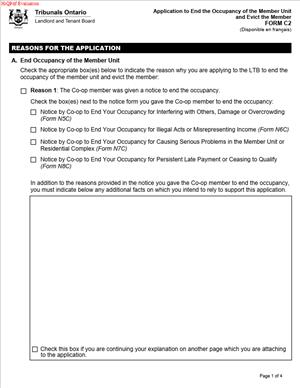
Form C2 – Application to End the Occupancy of the Member Unit and Evict the Member
Fill out nowJurisdiction: Country: Canada | Province or State: Ontario
Form C2 – Application to End the Occupancy of the Member Unit and Evict the Member is used to ask the Landlord and Tenant Board in Ontario to end someone’s right to live in a housing co‑operative unit and to evict them. It is a formal application, not a notice.
You would complete this form if you are acting on behalf of a housing co‑operative and need the Board to make an order. The order can end a member’s occupancy and require them to leave the unit.
This form matters because a co‑operative cannot simply remove a member on its own. An order from the Board is typically required before eviction can take place.
If you are filling it out, you are likely preparing for a hearing. The information you include becomes part of the official record and shapes how the Board understands the situation.
What is Form C2 – Application to End the Occupancy of the Member Unit and Evict the Member?
Clear definition
Form C2 – Application to End the Occupancy of the Member Unit and Evict the Member is an application filed with the Ontario Landlord and Tenant Board. It asks the Board to make a legal order ending a co‑op member’s right to occupy their unit and to authorize eviction.
This document starts a formal case. Once submitted, the Board usually schedules a hearing and notifies the member. Both sides can present evidence and explain their position.
The form sets out key details, including the co‑operative’s information, the member’s name, the unit address, and the reasons for requesting termination and eviction.
Who typically uses this form?
This form is typically used by non‑profit housing co‑operatives. It is often completed by a co‑op manager, board member, or someone authorized to act for the co‑op.
In some cases, a legal representative may prepare and submit the application on behalf of the co‑op. The person signing the form must have the authority to act for the housing provider.
Individual members do not use this form to remove another member. It is specifically designed for the co‑operative to apply to the Board.
Why might you need this form?
A co‑operative may need this form when it has decided to end a member’s occupancy rights under its internal rules and the governing legislation. The Board’s order is generally required to make that decision enforceable.
The application is often connected to issues such as non‑payment of housing charges, serious breaches of co‑op by‑laws, or conduct that affects the safety or enjoyment of other members.
Without filing this form and obtaining an order, the co‑op cannot legally enforce eviction through the Board’s processes.
Typical real-life scenarios
- A member has not paid monthly housing charges for several months. The co‑op follows its internal steps and votes to terminate the membership. To enforce that decision, it files this application.
- A member repeatedly violates occupancy rules, such as subletting without permission or using the unit for unauthorized purposes. After internal procedures, the co‑op applies to the Board to end occupancy.
- There are ongoing complaints from other members about serious disturbances or unsafe behaviour. The co‑op determines that the situation meets the threshold for termination and seeks a Board order.
- A member no longer qualifies for certain housing assistance tied to co‑op membership and does not resolve the issue after notice. The co‑op applies to have the occupancy formally ended.
When would you use Form C2 – Application to End the Occupancy of the Member Unit and Evict the Member?
You would use Form C2 – Application to End the Occupancy of the Member Unit and Evict the Member after the co‑operative has completed its internal decision‑making process to terminate a membership or occupancy rights. The Board process usually follows a formal resolution or decision by the co‑op’s board or members.
This form is used when the co‑op is seeking more than just payment of arrears or compliance with rules. It is specifically for ending occupancy and requesting eviction. Other forms may exist for different types of applications, such as collecting money only.
The application is appropriate when the member has not vacated the unit voluntarily after being notified of the termination decision. It allows the Board to review whether the co‑op followed proper procedures and whether the legal grounds are met.
In many cases, a co‑op manager or board representative prepares the filing. They gather supporting documents such as meeting minutes, notices, payment records, and correspondence to support the reasons stated in the application.
Legal characteristics of Form C2 – Application to End the Occupancy of the Member Unit and Evict the Member
This form initiates a legal proceeding before the Ontario Landlord and Tenant Board. Once filed and accepted, it triggers notice requirements and a hearing process.
For the application to be effective, it generally must be complete and accurate. It must clearly identify the parties, the unit, and the legal grounds relied on. Missing information or unclear reasons can delay the case or result in procedural issues.
Common problems include incorrect names, incomplete addresses, failing to attach required details, or not following internal co‑op procedures before filing. If the co‑op cannot show that it properly terminated the membership according to its rules and governing law, the Board may not grant the order.
This form does not automatically remove a member from the unit. Filing it does not end occupancy by itself. Only a Board order can authorize eviction, and enforcement usually requires further steps after an order is made.
Housing co‑operatives operate under a legal framework that differs in some ways from private landlord‑tenant relationships. The Board often considers both co‑op by‑laws and statutory requirements when deciding an application.
Is it legally binding?
The form itself is not legally binding in the sense of creating immediate rights or obligations. It is a request for a legally binding order.
Once the Board issues an order ending occupancy and authorizing eviction, that order is legally enforceable. At that stage, the decision can be acted upon through the proper enforcement process.
The information you provide in the application is significant. It forms part of the evidence and may be reviewed at the hearing. Statements made in the form can influence the outcome, especially if supported by documents and testimony.
How to fill out Form C2 – Application to End the Occupancy of the Member Unit and Evict the Member
Step 1 – Identify the co‑operative
Enter the full legal name of the housing co‑operative as it appears in official records. Include complete contact information, such as mailing address, phone number, and email if requested. This ensures the Board and the member can communicate with the correct organization.
Step 2 – Provide the member’s details
Fill in the full name of the member whose occupancy you seek to end. Use the name exactly as it appears in co‑op records. Add the full address of the unit, including unit number, street name, city, and postal code.
Step 3 – State the grounds for the application
Clearly describe the reasons for requesting termination and eviction. This section often requires you to select or specify legal grounds and then explain the facts. Be specific about dates, amounts owed if applicable, and the nature of any alleged breaches.
Step 4 – Provide details of the co‑op’s decision
Indicate when and how the co‑op decided to terminate the membership or occupancy rights. This may include the date of the board meeting or member vote. Ensure the information matches internal records and resolutions.
Step 5 – List amounts owed, if relevant
If the application involves unpaid housing charges or other arrears, state the total amount claimed. Break down the figures by time period if the form requires it. Accuracy is important because the Board may rely on these numbers in its order.
Step 6 – Indicate whether you are seeking additional remedies
Some applications allow you to request related orders, such as payment of arrears or costs. Complete this section carefully if it appears on the form. Only include amounts or remedies that are clearly connected to the grounds described earlier.
Step 7 – Attach supporting information if required
Review whether the form requires schedules or additional pages. If you need more space to explain the facts, attach extra sheets and clearly label them. Ensure any attachments are consistent with the statements in the main document.
Step 8 – Sign and date the application
The person signing must have authority to act for the co‑operative. Print their name and title if requested. Enter the date of signing to confirm when the application was completed.
Step 9 – Review before submission
Read through the entire form to confirm that names, dates, and amounts are correct. Check that all required sections are completed and that any additional pages are included. Once satisfied, prepare the form for submission to the Landlord and Tenant Board in accordance with its filing process.
Legal terms you might encounter in Form C2 – Application to End the Occupancy of the Member Unit and Evict the Member
- Applicant: This is the housing co‑operative bringing the application. On this form, the applicant is usually the co‑op corporation, not an individual board member. You must enter the legal name of the co‑op exactly as it appears in its corporate records.
- Respondent: The respondent is the member whose occupancy the co‑op wants to end. You must list the full legal name of every person who holds membership and occupancy rights to the unit. If more than one member is involved, all names must be included.
- Occupancy Agreement: This is the contract between the co‑op and the member that sets out the member’s right to live in the unit. The application relies on alleged breaches of this agreement. You may need to refer to specific clauses when stating your grounds.
- Grounds for Termination: These are the legal reasons the co‑op claims justify ending the member’s occupancy. They can include non‑payment, serious interference, or other breaches. You must clearly state the facts supporting each ground.
- Notice of Termination: Before filing the application, the co‑op usually serves a written notice ending the occupancy. The form may ask for the date that the notice was given and the termination date stated in it. Accuracy here is critical because the Board reviews timing closely.
- Arrears: Arrears are amounts owed, often for housing charges or other required payments. If you claim arrears, you must provide a breakdown and the period covered. The total should match any attached account statement.
- Remedy: A remedy is what you are asking the Board to order. This can include eviction, payment of arrears, or other relief permitted by law. You must check the appropriate boxes and ensure the remedy aligns with the facts described.
- Service: Service refers to delivering the notice and later the application to the member in an approved way. The Board expects proof of how and when documents were served. You may need to file a separate certificate or declaration of service.
- Hearing: A hearing is the proceeding where the Board reviews the evidence and hears from both sides. The form starts the process, but you must be prepared to attend and present your case. Dates and instructions will be sent after filing.
- Order: An order is the written decision issued by the Board. If granted, it may authorize eviction and payment of money. The application must clearly request the orders you want so the Board can include them if appropriate.
FAQs
Do I need to attach the termination notice when filing this form?
Yes. You should attach a copy of the written notice that ended the occupancy, including all pages and any schedules. Check that the date of service and the termination date in the notice match what you enter in this document. If the notice is missing or incomplete, the Board may question whether the application can proceed.
What date do I put as the termination date?
Use the exact termination date stated in the written notice you served on the member. Do not guess or change it to the filing date. The date must follow the required notice period, counted from the day after service. Double‑check your calendar calculation before you submit the Form C2 – Application to End the Occupancy of the Member Unit and Evict the Member.
Who is allowed to sign the application on behalf of the co‑op?
The person signing must have authority to act for the co‑op. This is usually a board officer or an authorized representative. Make sure the signer prints their name and position clearly. If the Board questions authority, you may need to show a board resolution or other proof.
What if there are multiple members listed on the occupancy agreement?
List every member who has occupancy rights in the unit. Use the exact spelling from the occupancy agreement or membership records. If you leave someone out, the order may not apply to that person. That can delay enforcement later.
How detailed do the reasons need to be?
Be specific. Include dates, amounts, and examples of conduct where relevant. Avoid vague statements like “breach of rules” without explaining what happened and when. The Board relies on what you write here to understand your claim before the hearing.
Can I claim money owed and an eviction at the same time?
Yes, if the facts support both remedies. You must clearly state the total amount owed and the period it covers. Make sure the figure matches your attached statement of account. Inconsistent numbers can undermine your credibility.
What happens after I file Form C2 – Application to End the Occupancy of the Member Unit and Evict the Member?
After filing, the Board will issue a notice of hearing and instructions. You must then serve the application package to the member according to the rules. Keep proof of service because you may need to file it before the hearing date.
What if I realize I made a mistake after submitting this form?
Act quickly. Minor errors like typos may be corrected by contacting the Board and following its process for amendments. More serious errors, such as wrong dates or missing parties, may require a formal amendment request. Do not ignore the mistake, because it can affect the outcome at the hearing.
Checklist: Before, During, and After Form C2 – Application to End the Occupancy of the Member Unit and Evict the Member
Before
- Confirm that the co‑op properly approved the termination decision according to its bylaws.
- Review the occupancy agreement and identify the exact clauses allegedly breached.
- Ensure the written termination notice was completed and served correctly.
- Calculate all notice periods and double‑check the termination date.
- Prepare a clear statement of arrears if money is owed.
- Gather supporting documents such as account ledgers, warning letters, and meeting minutes.
- Verify the full legal names of all members on the unit.
- Confirm who has the authority to sign on behalf of the co‑op.
During
- Enter the co‑op’s legal name exactly as registered.
- List every respondent with correct spelling and unit address.
- Copy the termination date exactly as shown on the notice.
- Clearly describe each ground for ending occupancy with dates and details.
- State the total arrears and the period covered, if applicable.
- Check all requested remedies carefully before selecting them.
- Attach required documents in a logical order.
- Review the entire form for consistency before signing.
- Sign and date the form in the appropriate section.
After
- Make copies of the completed form and all attachments.
- File the application using the accepted filing method.
- Wait for confirmation that the application has been accepted.
- Serve the issued application and hearing notice on the member as required.
- Complete and file proof of service within the required timeframe.
- Prepare an organized hearing package with numbered pages.
- Mark important deadlines in your calendar.
- Keep all originals in a secure file for reference at the hearing.
Common mistakes to avoid with Form C2 – Application to End the Occupancy of the Member Unit and Evict the Member
- Mistake: Listing only one member when multiple people hold membership, which often happens when records are outdated, leading to an order that cannot be enforced against everyone; do not forget to confirm all current members before filing.
- Mistake: Using the wrong termination date because of miscounted notice periods, which can result in dismissal at the hearing; do not forget to count from the day after service and verify the timeline.
- Mistake: Claiming arrears without attaching a detailed statement, often due to assuming the Board will request it later, which weakens your evidence; do not forget to include a clear breakdown.
- Mistake: Providing vague reasons like “rule violations” without facts, which happens when you rely on internal knowledge not written on the form, causing confusion for the Board; do not forget to include dates and specific conduct.
- Mistake: Having someone sign without documented authority, which may occur in urgent situations, creates challenges to the application’s validity; do not forget to confirm and record signing authority.
- Mistake: Failing to serve the filed application properly after acceptance, often due to misunderstanding service rules, which can delay or adjourn the hearing; do not forget to follow approved service methods and file proof.
- Mistake: Inconsistent numbers between the form and attached documents, usually caused by last‑minute updates, which damages credibility; do not forget to reconcile all totals before submission.
- Mistake: Ignoring minor errors after filing, assuming they are unimportant, which can become major issues at the hearing; do not forget to address corrections promptly through the proper process.
What to do after filling out Form C2 – Application to End the Occupancy of the Member Unit and Evict the Member
Once you have completed the form, pause before you file it. Read every page slowly. Confirm that names, dates, and amounts are consistent throughout the document and attachments. Small inconsistencies can become major issues later.
- Step 1: Make a complete copy of the signed form and every attachment for your records.
- Step 2: Submit the application using the accepted filing method and pay any required fee.
- Step 3: Wait for confirmation that the application has been received and accepted for processing.
- Step 4: Review the notice of hearing issued by the Board and note the hearing date, time, and format.
- Step 5: Serve the application package and hearing notice on each respondent using an approved method.
- Step 6: Complete a certificate or declaration of service and file it within the required timeframe.
- Step 7: Organize your evidence in a logical order, with page numbers and a table of contents.
- Step 8: Prepare a short outline of what you will say at the hearing, focusing on facts and documents.
- Step 9: Ensure the person who signed the application or another authorized representative is available to attend the hearing.
- Step 10: Bring copies of all documents and proof of service to the hearing, whether it is in person or virtual.
After filing, keep communication within the co‑op clear. Update your internal records to reflect that an application has been started. Track all deadlines and correspondence in a dedicated file. If the matter settles before the hearing, document the agreement in writing and follow the proper steps to notify the Board if required.
Staying organized and proactive reduces delays. The more complete and consistent your paperwork, the smoother the process will be.
Disclaimer: This guide is provided for informational purposes only and is not intended as legal advice. You should consult a legal professional.