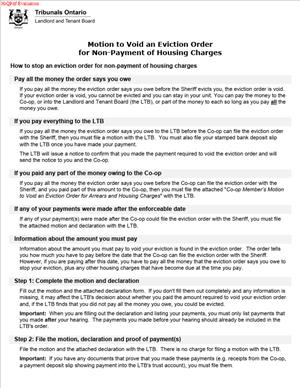
Co-op Member’s Motion to Void an Eviction Order for Arrears of Housing Charges
Fill out nowJurisdiction: Country: Canada | Province or State: Ontario
If you have received an eviction order because of unpaid housing charges in a housing co‑operative, the Co-op Member’s Motion to Void an Eviction Order for Arrears of Housing Charges is the document used to ask that the order be cancelled. It is a formal request made to the Ontario Landlord and Tenant Board.
This form is designed for co‑op members, not traditional tenants in private rental housing. Housing co‑operatives operate under a different structure, and members have occupancy agreements rather than standard leases. That difference affects how eviction and arrears are handled.
When a co‑op obtains an eviction order for unpaid housing charges, the order can move quickly toward enforcement. This motion gives you a way to ask the Board to stop and void that order, usually because the arrears have been paid or there is another valid reason.
If you are about to complete this document, you are likely facing tight timelines. Understanding what the form does, what it requires, and how it works within the eviction process helps you avoid mistakes that could delay or weaken your request.
What is a Co-op Member’s Motion to Void an Eviction Order for Arrears of Housing Charges?
Clear definition
The Co-op Member’s Motion to Void an Eviction Order for Arrears of Housing Charges is a written request to the Ontario Landlord and Tenant Board asking that an eviction order for unpaid housing charges be cancelled. “Void” means to cancel or set aside the order so it no longer has legal effect.
This document is not an appeal. It does not challenge the reasoning behind the original decision in the usual sense. Instead, it typically asks the Board to cancel the eviction order because the arrears have been paid in full or because there is a specific ground allowed under the Board’s rules.
The form sets out key details such as the file number, the address of the unit, the amount of arrears claimed, and the reason you believe the order should be voided. It becomes part of the official case record once filed.
Who typically uses this form?
This form is used by members of a non‑profit housing co‑operative who have received an eviction order for arrears of housing charges. In a co‑op, you are a member and occupant, not just a tenant.
The person completing the form is usually the member named in the eviction order. In some cases, a representative may assist with preparation, but the request relates to the member’s occupancy and arrears.
Co‑op boards or management do not use this form. It is specifically for the member who wants the eviction order cancelled.
Why might you need this form?
You might need this form if you have paid all outstanding housing charges after the eviction order was issued. Payment in full is a common reason to request that the order be voided.
You may also need it if you believe the arrears listed in the order were incorrect and you have resolved the discrepancy. For example, there may have been a calculation error or a payment that was not properly credited.
In some situations, you may have entered into an agreement with the co‑op to address the arrears, and the order was issued despite compliance. The motion allows you to present that information to the Board.
Without filing this motion, the eviction order can proceed to enforcement. That can include involvement of enforcement officers. The document is the formal way to ask the Board to stop that process.
Typical real-life scenarios
- You fell behind on housing charges after losing income. The co‑op applied to the Board, and an eviction order was issued. Before enforcement took place, you paid the full amount owed. You now need a formal way to have the order cancelled.
- You believed you were up to date, but the co‑op claimed arrears based on additional charges you did not understand. After reviewing your account, the co‑op corrected the balance. An eviction order had already been made, and you now seek to void it.
- You received financial assistance from a program or family member after the eviction order was granted. The funds were used to clear the arrears in full. Even though payment has been made, the order remains active until it is formally voided.
- You and the co‑op reached an agreement about a payment plan before enforcement. There is confusion about whether the order still stands. You use the motion to clarify the situation and ask the Board to cancel the order based on the updated circumstances.
When would you use a Co-op Member’s Motion to Void an Eviction Order for Arrears of Housing Charges?
You would use this form after the Ontario Landlord and Tenant Board has already issued an eviction order against you for arrears of housing charges. It is not used at the start of a case. It is used after a decision has been made.
Timing is important. In many cases, the ability to void an eviction order for arrears depends on paying the full amount required within a specific period. The motion is typically filed promptly after payment or after the reason for voiding arises.
This document is used before the eviction has been carried out. If enforcement has already occurred, different procedures may apply. The motion is meant to stop an active order from being enforced.
The typical roles involved are the co‑op member as the moving party and the housing co‑operative as the responding party. The Board reviews the motion and may decide it based on the written materials or schedule a hearing.
You would not use this form to dispute unrelated issues, such as maintenance concerns or governance disputes within the co‑op. It is focused specifically on an eviction order for arrears of housing charges.
Legal Characteristics of Co-op Member’s Motion to Void an Eviction Order for Arrears of Housing Charges
This document operates within the procedural rules of the Ontario Landlord and Tenant Board. For it to be effective, it must clearly identify the existing eviction order and the legal basis for asking that it be voided.
Accuracy is critical. The file number, unit address, names of the parties, and dates must match the original order. Errors in these details can delay processing or cause confusion about which order you are addressing.
The motion generally needs to explain the reason the order should be voided. A common ground is payment in full of all arrears and any required costs. Supporting details, such as payment dates and amounts, help clarify the request.
Common problems include incomplete sections, missing signatures, or failing to provide enough information about the payment or circumstances. If the Board cannot determine whether the legal requirements are met, it may decline to void the order.
In Ontario, housing co‑operatives are governed by specific legislation and Board procedures that differ from private landlord‑tenant matters. While the overall concept of voiding an eviction order for arrears is similar, the terminology and forms are tailored to co‑op members.
This motion does not reopen the entire case. It does not erase the history of arrears or change past findings. It only addresses whether the existing eviction order should remain in effect.
Is it legally binding?
When properly filed and accepted, the motion triggers a formal review by the Board. If the Board issues an order voiding the eviction order, that new order has legal effect. It cancels the previous eviction order.
Until the Board grants the motion, the original eviction order remains legally valid. Filing the document alone does not automatically cancel the order.
If the Board determines that the legal requirements to void the order have been met, the resulting decision is binding on both you and the co‑op. Enforcement of the eviction based on that order would no longer proceed.
If the Board denies the motion, the eviction order continues to stand. The legal effect depends entirely on the Board’s decision following review of the completed form and any supporting information.
How to fill out Co-op Member’s Motion to Void an Eviction Order for Arrears of Housing Charges
Step 1 – Identify the Board file and parties
Start by entering the Landlord and Tenant Board file number exactly as it appears on the eviction order. This connects your motion to the correct case.
Write the full legal name of the housing co‑operative as it appears on the order. Then enter your full name as the member listed in the case. Include the complete address of the unit, including unit number and postal code.
Check that every detail matches the original order. Even small differences in spelling or numbers can cause delays.
Step 2 – State the order you want to void
Indicate the date of the eviction order you are asking to have voided. This is usually found at the top of the written decision or order document.
Clearly state that you are requesting the eviction order for arrears of housing charges be voided. Keep your wording direct and consistent with the language used in the order.
If the form asks for the type of order, confirm that it relates to arrears of housing charges in a housing co‑operative setting.
Step 3 – Explain the reason for the motion
Provide the specific reason you believe the eviction order should be cancelled. A common reason is that you have paid all arrears and any required fees.
List the total amount that was outstanding under the order. Then state the amount you paid and the date or dates of payment. If payments were made in more than one instalment, include each one clearly.
If your reason is something other than payment in full, describe the circumstances in clear, factual language. Focus on dates, amounts, and events rather than opinions.
Step 4 – Provide payment details or supporting information
If the motion is based on payment, indicate how the payment was made, such as by cheque, money order, or electronic transfer. Include reference numbers if available.
Note when the co‑op received the funds, if known. If the form allows space for attachments, list any documents that confirm payment, such as receipts or account statements.
Keep your explanation organized. Present the facts in chronological order so the Board can easily follow what happened from the date of the order to the date of payment.
Step 5 – Review declarations and statements
Most forms include a section where you confirm that the information provided is true. Read this section carefully before signing.
Ensure that all required fields are completed. Blank spaces in required areas can result in the motion being returned or delayed.
Check again that your contact information is accurate. This is how the Board will communicate with you about next steps or a hearing date.
Step 6 – Sign and date the form
Sign your name in the space provided. Use the same name that appears in the case file.
Enter the date you are signing the document. The signing date may be relevant to timing requirements, especially if the motion must be filed within a certain period after payment.
If you are completing the form electronically, follow the instructions for electronic signatures as provided on the form.
Step 7 – Prepare for submission
Before submitting, make a copy of the completed form for your records. Keep copies of any supporting documents you referenced.
Confirm that all pages are included and in the correct order. If there are attachments, ensure they are clearly labelled and referenced in the form.
Once everything is complete, submit the motion according to the filing options available through the Ontario Landlord and Tenant Board.
Legal terms you might encounter in Co-op Member’s Motion to Void an Eviction Order for Arrears of Housing Charges
- Arrears: This means unpaid housing charges that have accumulated over time. On this form, arrears are the amount the eviction order was based on. You need to confirm the exact total and show how it has been paid or resolved.
- Eviction Order: This is the formal decision made by the Board that allows the co-op to evict you for unpaid housing charges. The order includes important dates and conditions. Your motion asks the Board to cancel or “void” that specific order.
- Void: To void an order means to cancel it so it no longer has legal effect. If the order is voided, the eviction process based on that order stops. It is as if the order cannot be enforced.
- Motion: A motion is a formal request asking the Board to make a new decision about an existing order. This document is your written request. It explains why the eviction order should be cancelled.
- Housing Charges: These are the monthly amounts you must pay to live in the co-op unit. They may include base housing charges and other approved amounts. The arrears listed in the eviction order are tied to these charges.
- Order Date: This is the date the eviction order was issued. You must enter this exactly as shown on the order. The date affects timelines and whether your motion can proceed.
- Enforcement: Enforcement refers to steps taken to carry out the eviction order, such as filing it with the sheriff. If enforcement has started, you must act quickly. Voiding the order can stop further enforcement.
- Board File Number: This is the unique number assigned to your case. It appears on the eviction order and on previous notices. You must enter it correctly so the Board can match your motion to the right file.
- Payment in Full: This means the entire amount required under the eviction order has been paid, including any additional costs listed in the order. Partial payment is usually not enough to void the order. You must clearly show that the full amount has been paid.
- Declaration: This is the statement you sign to confirm that the information in the form is true. It is a formal confirmation. Providing false information can have serious consequences.
FAQs
What do I need in front of me before I start filling out this form?
You should have a copy of the eviction order, any payment receipts, and your case file number. Check the exact amount of arrears listed in the order and any additional costs. You will need the order date and the names of the parties exactly as written. Having these documents beside you helps prevent errors that could delay your motion.
Do I have to pay the full amount before filing the Co-op Member’s Motion to Void an Eviction Order for Arrears of Housing Charges?
This document is generally used after you have paid everything required under the eviction order. Review the order carefully to confirm the total amount, including any extra fees or costs. If you have not paid the full amount, your request may not succeed. Make sure your payment matches what the order requires, not just what you think you owe.
What if my name is spelled differently on the eviction order?
Use the name exactly as it appears on the eviction order in the main sections of this form. If there is a spelling error, you can note the correct spelling in the appropriate area, but do not change the name as shown on the order. The Board relies on exact name matching to connect documents to the correct file. Mismatched names can slow down processing.
Where do I show that I paid the arrears?
There is a section in this document where you state that payment has been made. You should clearly indicate the date you paid and the total amount. Attach copies of receipts or proof of payment if required. Make sure the amounts shown on your proof match the amount listed in the eviction order.
Can I file this document if the sheriff has already been contacted?
Yes, you can still file this form, but timing is critical. If enforcement steps have already started, you should act quickly. Clearly indicate the current status of enforcement when completing the document. If the order is voided, enforcement based on that order should stop.
How do I know if my motion has been accepted for processing?
After submission, you should receive confirmation that your document has been received and added to the file. Check that the Board file number on the confirmation matches your case. If anything looks wrong, follow up promptly. Keep the confirmation with your records.
What happens to the eviction order if my request is granted?
If the Board approves your request through this form, the eviction order is cancelled and cannot be enforced. The case record will reflect that the order has been voided. This does not erase the past proceedings, but it stops the eviction based on that order. You should keep a copy of the decision confirming the order was voided.
Do I need to notify the co-op after filing this document?
You should ensure that the co-op receives notice of your motion if required by the process. Check whether service on the co-op is needed and keep proof of delivery. Make sure the copy you provide matches what you filed. Clear communication reduces misunderstandings about payment and enforcement status.
Checklist: Before, During, and After Co-op Member’s Motion to Void an Eviction Order for Arrears of Housing Charges
Before
- Review the eviction order carefully, including the total amount owing and the order date.
- Confirm you have paid the full amount required under the order.
- Collect receipts, bank confirmations, or written acknowledgments of payment.
- Locate your Board file number and verify it matches the order.
- Confirm the correct legal names of all parties as shown on the order.
- Check whether any enforcement steps have already started.
- Make copies of all supporting documents.
- Read through the entire form once before writing anything.
During
- Enter the Board file number exactly as shown on the eviction order.
- Write the names of the parties exactly as they appear on the order.
- State clearly the date of the eviction order you want voided.
- Provide the exact total amount paid and the date(s) of payment.
- Attach proof of full payment if required.
- Complete all required sections without leaving blanks.
- Review the declaration section carefully before signing.
- Sign and date the form in the correct place.
After
- Make copies of the completed form and all attachments.
- Submit the form using the accepted filing method.
- Obtain confirmation that the form was received.
- Provide a copy to the co-op if required.
- Keep proof of service or delivery.
- Monitor your case status for updates.
- Keep the decision confirming the order was voided.
- Update your personal records to reflect the payment and outcome.
Common mistakes to avoid with Co-op Member’s Motion to Void an Eviction Order for Arrears of Housing Charges
- Mistake: Paying only part of the arrears because you misunderstood the total owing, which happens when you do not read the full order; this can lead to your motion being denied, so do not forget to confirm the exact total, including costs.
- Mistake: Entering the wrong Board file number due to copying it from memory; this may cause delays or misfiling, so do not forget to double-check the number directly from the eviction order.
- Mistake: Using a nickname or corrected spelling instead of the name shown on the order, which happens when trying to fix an error; this can create confusion in the record, so do not forget to match the order exactly.
- Mistake: Forgetting to attach proof of payment because you assume the co-op will confirm it; this may weaken your motion, so do not forget to include clear documentation.
- Mistake: Leaving sections blank because you think they do not apply; incomplete forms can be rejected, so do not forget to review every section before signing.
- Mistake: Waiting too long to file after making payment, often due to uncertainty about the process; delay can allow enforcement to continue, so do not forget to act promptly once payment is complete.
- Mistake: Failing to keep copies of what you filed, which happens when filing in a hurry; this can leave you without proof later, so do not forget to store copies safely.
- Mistake: Not checking for confirmation of receipt, assuming submission is enough; this can result in missed deadlines if the filing was not processed, so do not forget to verify acceptance.
What to do after filling out the Co-op Member’s Motion to Void an Eviction Order for Arrears of Housing Charges
Once you complete the form, focus on proper filing and follow-up. Accuracy and proof are essential at this stage. Small oversights can create unnecessary stress.
- Step 1: Make at least two copies of the completed form and all attachments. Keep one for yourself and use the other if you must provide a copy to the co-op.
- Step 2: Review every page to ensure signatures, dates, and attachments are included. Confirm the Board file number appears on all pages if required.
- Step 3: Submit the form using the approved filing method. Make sure you follow the required format and include all supporting documents.
- Step 4: Obtain confirmation that your motion has been received. This may be a receipt, email confirmation, or file update notice. Check that the file number and your name are correct.
- Step 5: If required, serve a copy on the co-op. Keep proof of when and how you delivered it.
- Step 6: Monitor your case status regularly. Watch for notices about a decision or further steps.
- Step 7: If enforcement was underway, confirm that it has been paused once your motion is processed. Do not assume it has stopped without confirmation.
- Step 8: When you receive the Board’s decision, read it carefully. Confirm that it clearly states the eviction order is void.
- Step 9: Store the decision and your payment proof together in a safe place. You may need them if questions arise later.
- Step 10: Keep paying your housing charges on time going forward. A new arrears situation could lead to a new notice or application.
Staying organized protects you. Keep all related documents in one folder. Write down dates of payment, filing, and confirmation. Clear records make it easier to respond quickly if anything unexpected happens.
Disclaimer: This guide is provided for informational purposes only and is not intended as legal advice. You should consult a legal professional.