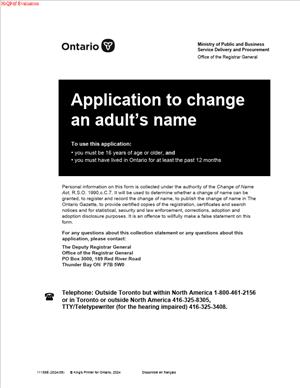
007-11155E – Application to Change an Adult’s Name
Fill out nowJurisdiction: Country: Canada | Province or State: Ontario
The 007-11155E – Application to Change an Adult’s Name is the official government form used to request a legal name change in Ontario. You complete it when you want your name formally changed on public records. This is not just a nickname update. It creates a legal change recognized by government institutions.
You use this form if you are 16 years of age or older and want to change your own name. The change applies to your birth registration if you were born in Ontario. It can also create a legal record of your new name if you were born outside Ontario but live in the province.
Filling out this document carefully matters. A legal name change affects your identification, financial records, and many other documents. Errors or missing information can delay your application or result in it being returned.
If you are about to complete this form, you likely want clarity. You need to know what information is required, how it is reviewed, and what happens after submission. This guide walks you through those points in plain language.
What is 007-11155E – Application to Change an Adult’s Name?
Clear definition
The 007-11155E – Application to Change an Adult’s Name is a formal application submitted to the provincial authority responsible for vital statistics in Ontario. It asks the government to legally change your registered name.
When approved, the change becomes part of your official record. If you were born in Ontario, your birth registration is updated. If you were born elsewhere, the province records your name change and may issue a change of name certificate.
This form is not a casual request. It requires detailed personal information, supporting documents, and, in most cases, a fee. The government reviews the application before making a decision.
Who typically uses this form?
Adults who want to legally change their first name, middle name, or last name use this form. This includes people who want a completely new name or who want to modify part of their existing name.
People who have recently married or divorced sometimes consider a legal name change. However, some may use other processes to assume a spouse’s surname without a formal name change. This form is used when you want a fully registered legal change, not just an assumed name.
Permanent residents and certain other residents living in Ontario may also apply, depending on their status and eligibility requirements. The key factor is that you meet the province’s criteria for residency and age.
Why might you need this form?
You may want a legal name change for personal reasons. This can include aligning your name with your identity, simplifying a name, or distancing yourself from a name you no longer wish to use.
You may also want consistency across all identification documents. Using different names in different places can cause problems with banking, travel, or employment records.
In some situations, a legal name change supports a major life transition. It creates a clear and official record that institutions can rely on when updating their files.
Typical real-life scenarios
- You have used a preferred name for years and now want it to be your legal name. Friends, colleagues, and community members already know you by this name. A legal change makes your identification match your daily life.
- You recently divorced and want a surname that is not connected to your former spouse. While some people can revert to a previous surname through other processes, others choose a completely new surname. A formal application allows for broader change.
- You immigrated to Canada and want a name that is easier to pronounce or spell in your current community. A legal change can simplify your documents and reduce confusion.
- You are transitioning and want your legal name to reflect your gender identity. A registered name change allows you to update other identification and records consistently.
- When would you use 007-11155E – Application to Change an Adult’s Name?
You would use 007-11155E – Application to Change an Adult’s Name when you want the government of Ontario to formally recognize a new name for you. This is typically done after you have decided on the exact spelling and order of your new name.
This form is used when the informal use of a name is not enough. For example, banks, employers, and government agencies often require official proof before updating your records. A legal name change certificate or updated birth registration provides that proof.
You might also use this form when other name change options do not apply to you. Some marital name changes can be handled without a formal change of name application. If your situation falls outside those options, a full application may be the appropriate process.
People in many different roles use this form. Students may want their educational records to reflect a new name. Professionals may want licensing bodies to update their registration. Individuals receiving benefits may need consistent records across agencies. In each case, the goal is the same: one legally recognized name.
Legal Characteristics of 007-11155E – Application to Change an Adult’s Name
This document is a formal government filing. Its legal effect comes from approval by the provincial authority, not simply from signing it. Until it is reviewed and accepted, your legal name does not change.
For the application to be valid, it generally must be complete, accurate, and accompanied by required supporting documents. These may include proof of identity, proof of residency, and other background information. Incomplete answers, missing signatures, or incorrect fees commonly lead to delays or rejection.
The information you provide is typically reviewed for accuracy and compliance with eligibility rules. Authorities may also check for reasons that a name change cannot proceed, such as concerns about fraud or avoiding legal obligations. If concerns arise, the process may pause while further review takes place.
Requirements can vary by province. This form is specific to Ontario. Other provinces have their own forms and processes. Even within Ontario, small details may change over time, such as fees or documentation standards.
It is also important to understand what this form does not do. It does not automatically update all your other records. After approval, you usually need to contact banks, employers, and government agencies yourself to update your name with each one.
Is it legally binding?
The 007-11155E – Application to Change an Adult’s Name becomes legally effective only after it is approved and registered by the province. Signing and submitting it does not, by itself, change your name.
Once approved, the change is legally recognized in Ontario. Your new name replaces your former legal name in the provincial record. You can then use official documents issued after the change as proof of your new name.
If the application is denied or returned, no legal change occurs. That is why accuracy and completeness are central to the process. The legal effect depends entirely on formal acceptance by the proper authority.
How to fill out 007-11155E – Application to Change an Adult’s Name
Step 1 – Provide your current legal name
Enter your full current legal name exactly as it appears on your birth certificate or other official record. Include all given names and your surname. Accuracy here is critical because this links your request to your existing record.
Step 2 – Enter your proposed new name
Write your new full name exactly as you want it to appear after the change. Double-check spelling, spacing, and order. The approved name will be recorded exactly as written, so this is not the place for rough drafts.
Step 3 – Confirm your eligibility details
Provide information about your age, residency, and status in Canada, as requested in the form. This section establishes that you meet the basic requirements to apply in Ontario. Answer each question clearly and completely.
Step 4 – Provide birth information
Enter details about your birth, including date and place. If you were born in Ontario, this information connects to your birth registration. If you were born outside Ontario, it helps create a record of your name change within the province.
Step 5 – List your marital status and family information
Complete the section that asks about your current marital status. You may also need to provide information about a spouse or children, depending on the form’s questions. Read each line carefully and respond as it applies to you.
Step 6 – Answer background and declaration questions
Respond to any questions about past name changes, criminal matters, or other legal issues. These questions are part of the review process. Provide truthful and complete answers, as false information can affect the outcome of your application.
Step 7 – Review the consent and declaration section
Read the declaration carefully before signing. By signing, you confirm that the information you provided is true and complete. You also confirm that you understand the nature of the request you are making.
Step 8 – Sign and date the form
Sign your name in the space provided, using your current legal name unless the form instructs otherwise. Add the date of signing. Some applications require witnessing or commissioning, so check whether a witness section must also be completed.
Step 9 – Attach required supporting documents
Gather the identification and supporting documents listed in the form’s instructions. Ensure copies are clear and complete if copies are required. Missing documents are a common reason for delay.
Step 10 – Prepare the fee and submit the application
Confirm the required fee amount and accepted payment methods. Place the completed form, supporting documents, and payment together as instructed. Submit the application through the designated submission method described in the form’s instructions.
Legal terms you might encounter in 007-11155E – Application to Change an Adult’s Name
- Legal Name: Your legal name is the name currently recorded on your birth registration or most recent legal name change. On this form, you must enter it exactly as it appears on official identification. Even small differences, like missing middle names, can cause delays.
- Proposed Name: This is the new name you want to use going forward. The form asks you to clearly print your proposed first, middle, and last names. Once approved, this becomes your new legal name for government records.
- Birth Registration: This refers to the official record of your birth maintained by the government. The details you enter on the form must match your birth registration, including place of birth and date of birth. If they do not match, your application may be flagged for review.
- Marital Status: You must state whether you are single, married, divorced, or widowed. This information helps determine whether additional documents, such as proof of marriage or divorce, are required. It also affects how your name change interacts with prior name changes.
- Criminal Record Declaration: The form asks whether you have been convicted of certain offences. You must answer truthfully. Providing false information can lead to refusal and possible legal consequences.
- Outstanding Court Orders: You may be asked to confirm whether you are subject to court orders, such as probation, parole, or restraining orders. This helps authorities assess whether your name change could interfere with legal supervision or enforcement.
- Consent or Notification Requirement: In some cases, you must confirm that certain people have been notified of your name change. This is especially relevant if your name change could affect others, such as a spouse. The form records whether any required notice has been given.
- Guarantor: Some applications require a guarantor to confirm your identity. A guarantor is a person who knows you and can verify that you are who you claim to be. They may need to sign a declaration or provide identifying details.
- Statutory Declaration: This is a formal written statement that you declare to be true. When you sign the declaration section of the form, you are stating that all information provided is accurate. Making a false declaration can have serious consequences.
- Effective Date: This is the date your new name legally takes effect. It is not the date you sign the form. It is typically the date the government approves and registers your name change.
FAQs
When does my new name become legally effective?
Your new name becomes legal on the effective date shown on the official change of name certificate issued after approval. It does not take effect when you submit 007-11155E – Application to Change an Adult’s Name or when you sign it. Wait for formal confirmation before updating identification or signing contracts under your new name.
Do I need to list every name I have ever used?
Yes, this document usually asks you to list previous legal names, including maiden names or past changed names. This helps ensure your records are linked correctly. If you leave one out, your application may be delayed while officials verify your identity history.
What happens if the name on my ID does not exactly match my birth certificate?
You must enter your current legal name exactly as it appears on your birth registration or most recent legal change document. If your ID shows a shortened or different version, you may need to provide supporting documents that explain the difference. Inconsistent information can cause processing delays.
Do I need a guarantor to complete this form?
If the form requires a guarantor, you must provide someone who meets the stated criteria and has known you for the required period. The guarantor confirms your identity, not your reasons for changing your name. Make sure they complete their section fully and sign where required.
Can my application be refused?
Yes. It can be refused if you provide incomplete information, fail to attach required documents, do not pay the correct fee, or give false answers. Authorities may also review criminal record disclosures before approving 007-11155E – Application to Change an Adult’s Name.
Will my name change be made public?
In many cases, adult name changes are published in an official record. This creates a public link between your former and new names. This document may ask whether you are requesting any special consideration regarding publication, if available.
What documents do I need to attach?
You typically need proof of identity and proof of birth, and sometimes proof of marital status or prior name changes. The form instructions specify what is acceptable. Missing attachments are one of the most common reasons applications are returned.
What records will be updated automatically after approval?
Once approved, your change is registered with the vital statistics authority. However, most other records, such as your driver’s licence, passport, bank accounts, and professional licences, require you to update them yourself using your change of name certificate.
Checklist: Before, During, and After 007-11155E – Application to Change an Adult’s Name
Before
- Confirm you meet the residency and age requirements.
- Gather your birth certificate or certified copy.
- Collect proof of any previous legal name changes.
- Review your identification to ensure names and dates match.
- Check whether you need a guarantor.
- Confirm the current application fee and payment method.
- Read all instructions carefully from start to finish.
During
- Print clearly and use consistent spelling throughout.
- Enter your current legal name exactly as recorded.
- Provide all previous names in the correct order.
- Answer every background question honestly.
- Double-check dates of birth, marriage, or divorce.
- Ensure your guarantor completes and signs their section if required.
- Review the declaration before signing.
- Sign and date the form in the correct place.
After
- Make copies of the completed form and attachments.
- Submit the application using the approved method.
- Keep proof of payment.
- Track delivery if you mailed the package.
- Wait for written confirmation of approval.
- Store your change of name certificate in a safe place.
- Begin updating your identification and records.
- Notify relevant institutions of your new legal name.
Common mistakes to avoid with 007-11155E – Application to Change an Adult’s Name
- Mistake: Using a nickname or shortened version of your current name because it is what you commonly use, which happens out of habit, can lead to rejection since the form requires your exact legal name, so do not forget to copy it precisely from your official record.
- Mistake: Leaving out a prior married or previously changed name because you think it no longer matters, which often happens after divorce, can delay processing due to incomplete identity history, so do not forget to disclose all former legal names.
- Mistake: Providing inconsistent dates of birth or marriage due to guessing instead of checking documents, which can trigger verification issues, may result in your application being returned, so do not forget to verify every date against official documents.
- Mistake: Forgetting to include required supporting documents because you assumed photocopies were optional, which is common when instructions are skimmed, can cause refusal or delay, so do not forget to attach all specified documents.
- Mistake: Signing in the wrong place or missing a signature because you rushed through the final page, which can invalidate the declaration, may require resubmission, so do not forget to review all signature lines carefully.
- Mistake: Paying the wrong fee or using an incorrect payment method due to outdated information, which can result in the application being returned unprocessed, so do not forget to confirm the current fee and accepted payment options before submitting.
- Mistake: Assuming approval is automatic and starting to use your new name immediately, which can create legal and financial confusion, may complicate contracts and identification updates, so do not forget to wait for official confirmation.
- Mistake: Failing to update other records after approval because you believe the government will notify everyone, which can leave mismatched records across institutions, may cause administrative problems, so do not forget that you must update most records yourself.
What to do after filling out 007-11155E – Application to Change an Adult’s Name
Once you have completed the form, slow down. Review everything one more time. Most delays happen because of small errors that could have been caught with a careful read.
- Step 1: Make a complete copy of the signed form and all attachments for your records.
- Step 2: Confirm you have included all required supporting documents in the correct format.
- Step 3: Prepare the correct fee using the approved payment method.
- Step 4: Submit the application using the permitted submission method, such as mail or in-person delivery, as specified in the instructions.
- Step 5: If mailing, use a trackable delivery option and keep the tracking number.
- Step 6: Keep your payment receipt or proof of submission in a safe place.
- Step 7: Wait for written confirmation that your application has been received and processed.
- Step 8: Review the official change of name certificate carefully once issued to ensure your new name is spelled correctly.
- Step 9: Store the original certificate securely. You will need it to update identification and official records.
- Step 10: Begin updating your records with government agencies and financial institutions using your certificate as proof.
- Step 11: Update employment records, insurance policies, educational credentials, and professional licences.
- Step 12: Keep a checklist of each organization you notify so you can track which records have been updated.
Take your time with each update. Many institutions require you to present the original certificate or a certified copy. Plan appointments if necessary. Keep copies of all correspondence confirming your updated name.
Your name change is complete only when your key records reflect your new legal name. Stay organized, keep your documents safe, and move through each update step methodically.
Disclaimer: This guide is provided for informational purposes only and is not intended as legal advice. You should consult a legal professional.