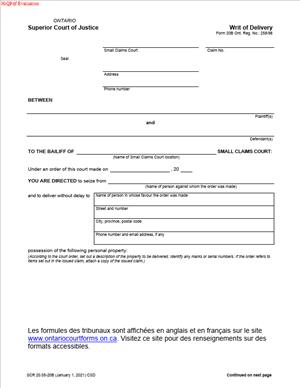
Form 20B – Writ of Delivery
Fill out nowJurisdiction: Country: Canada | Province or State: Ontario
What is a Form 20B – Writ of Delivery?
Form 20B is a Small Claims Court enforcement form. It orders an enforcement officer to return specific goods to you. It applies when a court order says the goods must be returned. It is used in the Ontario Small Claims Court system.
You use this form after you win an order for the delivery of goods. The order can be a judgment or a later order. The order must identify the goods. It may also set a dollar value if delivery fails. The writ turns that order into action by the sheriff.
The writ directs the enforcement office to act. The office is usually held by the local sheriff. The sheriff can enter, locate, and take the goods. The sheriff then delivers them to you. The writ can also support the collection of an alternate amount. That applies if the order allows payment instead of delivery.
Who uses this form?
Judgment creditors use it. That means the successful party who is owed the goods. You can be a business owner, a lender, a lessor, or a buyer. You can also be an individual who owns unique property. Representatives can use it as well. A licensed paralegal or lawyer can complete and file it for you.
Why would you need this form?
You need it when the other side refuses to hand over goods. You also need it when they hide the goods. You use it when you want the sheriff to enforce your order. Self-help is risky and can be unlawful. The writ avoids those risks.
Typical usage scenarios
You leased equipment, and the lessee will not return it. You sold goods on a conditional sale, and repossession is ordered. You won a claim for a specific chattel, like a unique tool. You recovered consigned inventory that was withheld. You obtained an order for a prototype that you own. You got an order for a vehicle under the court’s value limit. In each case, the writ tells the sheriff to act.
The form belongs to the Small Claims Court rules. It is designed for personal property, not land. It is not for money-only awards. It focuses on delivering identified goods. It fits the court’s practical enforcement approach.
When Would You Use a Form 20B – Writ of Delivery?
You use this form when the time to enforce has arrived. You already have an order to return specific goods. The other party has not complied. Voluntary return failed. Negotiations went nowhere. You now need the sheriff’s help.
You also use it when the goods are at risk. You suspect the goods will be moved or sold. You want a prompt and controlled recovery. The writ lets the sheriff secure the items lawfully. It reduces the chance of confrontation or loss.
You use it if your order includes “deliver or pay” wording. Many orders allow either delivery or payment of a set value. If delivery cannot be made, the writ supports the collection of the value. The sheriff can take steps toward the alternate amount when applicable. The priority remains delivery, if possible.
Typical users include business owners. A contractor may need tools returned. A distributor may need branded displays returned. A manufacturer may need a prototype back. A retailer may need consigned stock returned. A rental company may need the equipment back. A secured lender may need collateral returned. Individuals also use it. A hobbyist may need a rare instrument returned. A collector may need a specific artwork returned.
Some landlord and tenant disputes involve chattels. You might have an order for fixtures or equipment. The writ can help recover those movable items. It does not apply to possession of a unit. It is not an eviction writ. It focuses on goods that can be moved and delivered.
Timing matters. Do not wait too long after judgment. Delay increases the chance that the goods will move or change hands. Confirm the goods are within Ontario. The sheriff only acts within Ontario. Choose the correct local enforcement office. The office must cover the place where the goods sit. If goods sit in multiple places, you may need more than one writ.
Use this writ only when your order targets a specific property. If you only have a money judgment, choose a different tool. That might be a writ of seizure and sale of goods. Use the right enforcement path. It saves time and money.
Legal Characteristics of the Form 20B – Writ of Delivery
The writ is a binding court process. It is issued under the authority of the court. It directs the sheriff to act on your order. It draws its legal force from your existing judgment or order. The writ itself does not create new rights. It enforces rights already granted.
It is enforceable because it bears the court’s seal. The clerk issues it in the court file. It contains the correct case style and file number. It references the order that authorizes delivery. It identifies the goods to be delivered. It commands the sheriff to find and deliver them.
Enforceability depends on accurate information. The description of goods must be clear. Ambiguity creates problems on-site. The location must be within the sheriff’s jurisdiction. The parties must match the court record. The order must still be valid and in force. If the order allows an alternate amount, list it correctly.
The sheriff carries out the writ. The sheriff controls the enforcement process. The sheriff may schedule a time for attendance. You or your agent may need to attend. You may need to identify the goods. Bring documents that prove your right to them. Bring keys, manuals, or ownership records if relevant.
Entry to the premises follows strict rules. The sheriff decides how to enter. Some locations require cooperation or court directions. The sheriff will not risk a breach of the peace. The sheriff may ask you to arrange movers. You may need a locksmith. You must cover those costs. Factor logistics into your plan.
Third-party claims can arise. Another person may claim ownership or possession. The sheriff may pause enforcement in those cases. The court may require a further motion. Clear paperwork reduces that risk. The description and order should prove your right.
Exemptions generally protect debtors’ basic property. Those rules focus on money enforcement. Your writ targets specific items the court ordered returned. Exemptions rarely block delivery of specific goods. However, the sheriff will still follow the law. If a conflict appears, you may need directions from the court.
The writ remains effective for a set period. Writs commonly last several years. Renewal is possible if time runs long. Do not rely on renewal. Act quickly while the goods are traceable. Ask the clerk about current timelines before filing.
The writ is not a license for self-help. You cannot act without the sheriff. You cannot use force to take goods. Keep interactions professional and safe. Let the sheriff manage the site.
If the sheriff cannot find the goods, it will be reported. You may then pursue the alternate amount if your order allows it. You may also return to court for further directions. You can seek costs of failed enforcement where justified. Keep records of your efforts and expenses.
How to Fill Out a Form 20B – Writ of Delivery
Start by reviewing your order.
Confirm it directs the delivery of specific goods. Confirm it identifies those goods clearly. Confirm it sets an alternate amount, if any. Check the date and the parties’ names. Make sure the order is final and enforceable.
Gather key details before you draft.
You need the exact court file number. You need the court location and address. You need each party’s full legal name and address. You need the judgment or order date. You need a precise description of the goods. You need the likely location of the goods. You need the enforcement office that covers that location. You need your contact and representative details. You need any alternate amount, if set by the order.
Complete the court caption exactly.
Use “Ontario Superior Court of Justice, Small Claims Court.” Enter the correct court address. Insert the court file number as it appears on the order. Do not guess. Check a recent endorsed document to confirm.
Insert the style of cause.
List the plaintiff(s) and defendant(s) the same way as in the case. Use the same spelling and order. If there are multiple defendants, include them all. The writ must mirror the court record.
State the judgment or order details.
Enter the date the order was made. You can note the type of order. Use simple wording that matches the order. Do not add new terms. The writ enforces; it does not change the order.
Identify the enforcement office.
Name the sheriff for the place where the goods sit. Use the county, district, or region name. If you are unsure, call the court office to confirm. If goods are stored in more than one area, plan separate filings. Each office only acts in its territory.
Describe the goods clearly.
Use make, model, serial number, and VIN if available. Include color, size, and quantity. Add any unique markings or accessories. If the list is long, attach a schedule. Label it “Schedule A – Goods to be Delivered.” Refer to Schedule A in the main form. Number each item on the schedule. Use one line per item. Avoid vague terms like “tools and equipment.” Precision drives successful enforcement.
State the delivery instructions briefly.
Identify the delivery address for you or your agent. Add a contact person and phone number. Keep it simple. The sheriff will coordinate details with you later.
Include the alternate amount if applicable. Only include it if the order provides one. Do not invent a value. Use the exact amount stated by the court. If the order sets interest, note that too. If the order does not set a value, leave this part blank. The sheriff cannot enforce a value the court did not set.
Add costs if the order awarded them.
Use the amount the court awarded. Do not add enforcement fees here. Enforcement fees are handled by the sheriff. The writ shows court-awarded costs, not your future expenses.
Complete your party and representative details.
Insert your name, address, phone, and email. If you have a paralegal or lawyer, add their details. Indicate who should receive calls. Ensure your contact info is accurate. The sheriff will rely on it.
Do not sign where the clerk must sign.
The writ is issued by the clerk. The clerk signs and applies the court seal. Your role is to prepare and present it. You sign any necessary request or cover page, if required. Leave the clerk’s signature line empty.
Review every entry twice.
Check the file number, names, and dates. Check the enforcement office. Check the goods description. Cross-check with your order. Consistency avoids delays at the counter.
Prepare attachments.
Attach a copy of the order. Attach Schedule A if used. Attach any proof that helps identify goods, like photos. Do not overload the filing. Keep identification materials for the sheriff’s visit. Bring those when the sheriff attends.
File the writ for issuance at the Small Claims Court.
Pay the issuance fee. Ask for a sealed set of originals and copies. Confirm the court has applied the seal and signature. Check that the date of issue is present and clear.
File the issued writ with the enforcement office.
Take or send the sealed writ to the sheriff’s office. Include a letter of instructions. Identify the goods, locations, and access issues. Provide the delivery address and contact details. Pay the enforcement deposit or fees required. Ask about scheduling and next steps.
Plan logistics for the recovery day.
Arrange movers suited to the goods. Arrange transport appropriate for size and weight. Arrange a locksmith if entry to the storage is required. The sheriff may require you to supply these services. Confirm appointment details in writing.
Attend the enforcement if requested.
Bring identification and the order. Bring keys, ownership papers, or manuals. Bring Schedule A and any photos. Be ready to identify items quickly. Keep interactions calm and professional.
Receive the goods and sign any receipt.
Inspect items for condition. Note any missing parts. Inform the sheriff if anything is wrong. Arrange immediate transport to a secure location. Keep your receipts for costs.
If the goods are not found, ask for a report.
The sheriff will note what happened. Review the report with your representative. Decide your next step. If your order allows an alternate amount, pursue it. You may seek further court directions if needed.
Avoid common mistakes.
Do not use the wrong enforcement office. Do not submit a vague description of goods. Do not mismatch names or file numbers. Do not include values not stated by the court. Do not delay filing until goods are gone. Each mistake costs time and money.
Update your records after enforcement.
Record the items delivered. Record all enforcement costs. Update the status of the judgment. If partial delivery occurred, note what remains. Consider whether further steps are required.
If time passes with no success, reassess.
You may need updated intelligence on the goods. You may need a motion for directions. You may need to renew the writ if time runs long. Speak with your representative about options.
With a clear order and a precise writ, enforcement goes smoothly. Your job is to provide clarity and logistics. The sheriff’s job is to enforce safely and lawfully. Prepare well, and you improve your chances of prompt recovery.
Legal Terms You Might Encounter
- Writ of Delivery. This is the court’s enforcement order. It directs an enforcement officer to take specific goods and deliver them to you. You use this form to issue that order after you have a judgment for delivery.
- Judgment Creditor. That’s you, the person who won the case. The form records your details so the enforcement office knows who receives the goods.
- Judgment Debtor. This is the person who must hand over the goods. The form needs the debtor’s correct legal name and address to guide enforcement.
- Goods or Chattels. These are the movable items you are trying to recover. Describe them clearly on the form. Use make, model, serial number, and any unique marks.
- Enforcement Office. This office carries out writs. The issued writ goes to the enforcement office where the goods are located. The office schedules and executes the pick‑up.
- Seizure. This means the enforcement officer takes physical control of the goods. The officer then delivers them to you, as the writ directs.
- Delivery Up. This is the legal remedy of getting the goods back, not money. Your writ tells the enforcement office to deliver the items to you.
- Stay of Enforcement. A stay pauses enforcement. If the court grants a stay, the writ cannot proceed until it ends. The form should not be filed or used while a stay is in effect.
- Return of the Writ. After enforcement, the office completes a return. It reports the outcome, such as delivered, not found, or unable to seize. Keep a copy for your records.
- Security or Bond. In uncommon cases, an officer may ask for security to cover potential claims. Ask about this when you hand in the writ. Note any conditions on your records.
FAQs
Do you need a judgment before filing a Writ of Delivery?
Yes. You must already have a court order requiring the delivery of specific goods. The writ enforces that order. Without a delivery judgment, the court will not issue the writ.
Do you have to know exactly where the goods are?
You should know the likely location. The writ must go to the enforcement office where the goods sit. If you do not know the location, enforcement will stall. Gather addresses and leads before you file.
Do you need serial numbers or a VIN?
Yes, if available. Clear identification helps the officer find the correct items. Include serial numbers, VINs, model numbers, or unique markings. Photos help when you give directions to the enforcement office.
Can you use a Writ of Delivery if you only have a money judgment?
No. A Writ of Delivery enforces a delivery order. If your judgment is for money only, you must use money enforcement tools. Ask the clerk or review your judgment wording before you proceed.
How long is a Writ of Delivery valid?
Writs do not last forever. Enforcement periods are limited. If the writ expires, you may need to renew or reissue it. Track dates carefully and act promptly after issuance.
Can you amend the writ if you made an error?
You can correct clerical errors. If your description of goods or parties is wrong, seek a correction quickly. Some changes need a fresh writ or a court order. Do not submit handwritten edits after issuance.
What happens if the debtor sold or hid the goods?
The officer cannot seize what no longer exists or cannot be found. Ask the court for alternate relief if allowed by your judgment. You may pursue money enforcement options if your order includes a fallback value.
Do you need to serve the debtor with the writ?
You do not serve the writ like a claim. The enforcement office acts on the issued writ. Still, current contact details help the officer arrange access. Give phone numbers, emails, and workplace details when you file.
Will the officer open locked areas or use a locksmith?
The officer can take reasonable steps under court authority. You may need to arrange a locksmith, movers, or storage. Coordinate in advance. Confirm cost responsibilities before the appointment.
Who pays enforcement costs?
You usually pay upfront enforcement costs. You can add allowable costs to your enforcement totals if the court permits. Keep receipts. Ask the office what fees apply before you submit the writ.
Checklist: Before, During, and After the Form 20B – Writ of Delivery
Before signing
- Confirm your judgment orders the delivery of specific goods.
- Verify no stay of enforcement is in place.
- Gather the debtor’s full legal name and current addresses.
- Identify the goods with precise details, including serial numbers or VINs.
- Collect location details where the goods are likely to be stored or used.
- Prepare evidence that helps identify the items (photos, invoices, registration).
- Confirm the correct court file number and court location.
- Check any deadlines or expiry periods that apply to writs.
- Estimate enforcement logistics: movers, transport, and storage needs.
- Set a budget for court and enforcement fees.
- List contact information for you and any representative.
- Prepare directions for the enforcement office (access points, gate codes, hours).
During signing
- Review party names for accuracy and spelling.
- Verify the court file number and court location.
- Ensure the description of goods is specific and complete.
- Confirm the address(es) where the goods are located.
- Check that your contact information is current and reachable.
- Make sure the judgment date and details match the court record.
- Ensure the form is legible, with no blanks in required fields.
- Sign and date in the correct spot. Use your full legal name.
- If the form requires attachments, label and reference them clearly.
After signing
- File the form with the court for issuance. Pay the filing fee.
- Obtain the issued writ with the court’s seal.
- Deliver the issued writ to the correct enforcement office.
- Provide a written direction for enforcement with practical details.
- Ask about needed logistics: locksmith, movers, or vehicle tow.
- Pay any enforcement deposit or fee required to start the process.
- Keep copies of everything: judgment, writ, proof of filing, receipts.
- Calendar key dates. Track the expiry period for the writ.
- Update the enforcement office if you learn new location details.
- After enforcement, request a copy of the return of the writ.
- Store the final paperwork securely for your records.
Common Mistakes to Avoid
- Don’t forget to confirm you have a delivery order. Submitting a writ on a money judgment only will be rejected. Consequence: delays and extra fees to refile correctly.
- Don’t use vague item descriptions. “One laptop” is too broad. Consequence: the officer may seize the wrong item or fail to find it.
- Don’t send the writ to the wrong enforcement office. Enforcement only works where the goods are located. Consequence: your writ sits unused, and time runs out.
- Don’t ignore a stay or pending motion. Enforcement during a stay is not allowed. Consequence: wasted fees and potential court sanctions.
- Don’t miss the writ’s timelines. Expired writs cannot be enforced. Consequence: you must renew or redo, which adds cost and delay.
- Don’t assume the officer supplies movers or storage. You often must arrange logistics. Consequence: cancellations on the day of execution and additional fees.
What to Do After Filling Out the Form
1) File for issuance. Bring the completed form to the court office. Pay the fee. Get the writ issued and sealed.
2) Prepare your enforcement package. Include:
- A copy of the judgment that orders delivery.
- The issued writ.
- A concise description sheet for the officer.
- Photos, serial numbers, and proofs of ownership.
- Your contact information and best times to reach you.
3) Choose the correct enforcement office. Send or take the writ to the office that covers the goods’ location. If goods may be in more than one place, consider multiple offices and plan accordingly.
4) Give clear directions. Provide:
- Exact addresses and unit numbers.
- Business hours or occupant schedules.
- Vehicle plate numbers, VINs, and parking spots.
- Access instructions and gate codes.
- Any safety concerns the officer should know.
5) Arrange logistics. Ask the office what you must supply. Line up movers, a truck, towing, a locksmith, or storage as needed. Confirm who pays and when.
6) Coordinate the execution date. Provide dates when you and your helpers are available. Ask for an approximate timeline. Stay reachable by phone.
7) Be ready on the day. Bring identification. Bring tools or supplies you agreed to provide. Ensure the delivery location is open and prepared to receive the goods.
8) Receive and inspect the goods. Check serial numbers and condition on delivery. Photograph the items and note any issues. Sign any inventory the officer prepares.
9) Track the return of the writ. Request a copy of the return for your files. It confirms what happened during enforcement.
10) If the goods are not found. Give new leads to the enforcement office if you have them. If recovery looks unlikely, review your judgment. If it allows an alternate value, consider money enforcement options.
11) If you need to amend or reissue. Correct errors early. If the writ expires before enforcement, apply to renew or reissue. Keep proof of all steps you take.
12) Close out and store records. Keep copies of the issued writ, return, receipts, and any transport invoices. Store them with your case file in a safe place.
Disclaimer: This guide is provided for informational purposes only and is not intended as legal advice. You should consult a legal professional.