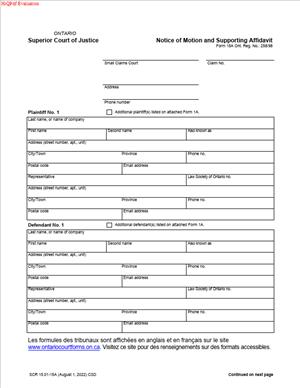
Form 15A – Notice of Motion and Supporting Affidavit
Fill out nowJurisdiction: Canada, Ontario
What is a Form 15A – Notice of Motion and Supporting Affidavit?
Form 15A is the Small Claims Court document you use to ask a judge for an order in an ongoing case. It combines two things in one package. The first is a Notice of Motion, which tells the other side what you want and when the court will hear it. The second is a Supporting Affidavit, which is your sworn evidence that explains the facts behind your request.
You file it in the Ontario Superior Court of Justice, Small Claims Court. You can use it before trial, during the case, or after judgment. The form frames your request and gives the judge the factual record to decide it.
Who Typically Uses This Form?
Plaintiffs and defendants both use it. So do added parties or garnishees in enforcement steps. You can file it yourself, or through a licensed representative or lawyer. Corporations often have a legal representative to file it for them. Individuals commonly file it on their own.
If you are a judgment debtor or creditor, you may use it to change how a judgment is enforced. If you are behind on a deadline, you may use it to ask for more time. If you need the court to make a procedural ruling, this is the vehicle.
Why Would You Need This Form?
You use Form 15A when you need a court order that affects the conduct of your Small Claims Court case. You cannot get most procedural relief by letter or email to the court. The court needs a formal request and a sworn factual record. Form 15A provides both.
Common reasons include these:
- You missed a filing deadline and need an extension.
- You were noted in default and want that set aside.
- You need to amend a claim or defence.
- You want to transfer the case to a different court location.
- You cannot find the other party and need substituted service.
- You want the other side to follow a previous order.
- You seek an adjournment of a scheduled event.
- You want to vary how payments will be made under a judgment.
- You want to strike a pleading that fails to meet basic standards.
Typical Usage Scenarios
Here are practical examples.
- You are a defendant who learned about a default judgment only after enforcement started. You would bring a motion to set aside the default judgment. You would attach evidence showing why you missed the deadline and that you have a real defence.
- You are a plaintiff who cannot serve the defendant despite many attempts. You would bring a motion for substituted service. You would ask to serve by email or social media. Your affidavit would show your efforts and why that method will reach the defendant.
- You are a business that sued in the wrong location by mistake. You would bring a motion to transfer the case to the correct court. Your affidavit would explain the error and show that the other location is proper.
- You are a defendant who needs two extra weeks to file documents due to illness. You would bring a motion to extend time. You would explain the impact of the illness and your prompt steps once recovered.
- You are a plaintiff who wants to amend the claim to add a numbered company you later learned was involved. You would bring a motion to amend pleadings and add a party. You would attach your draft amended claim as an exhibit.
- You are a judgment debtor with irregular income. You would bring a motion for a payment schedule. You would propose affordable installments and attach proof of income and expenses.
- In each case, the form tells the court what order you seek and why. Your affidavit supports the facts the judge will rely on.
When Would You Use a Form 15A – Notice of Motion and Supporting Affidavit?
You use Form 15A any time you want the court to decide a procedural or interim issue in your Small Claims Court case. That could be at the very start, before trial, or after judgment. The form is the standard way to move your request onto a court list for a decision.
Before trial, you might need directions about the service or deadlines. If a party is delaying or ignoring steps, you can ask the court to enforce timelines. If you discover new facts, you can ask to amend your pleading. If a scheduled event conflicts with a medical appointment, you can ask for an adjournment, showing genuine reasons.
During the run-up to trial, you may need clarity on what issues the trial will cover. You may also ask for relief that could simplify the trial, such as striking clearly improper parts of a pleading. If the other side fails to comply with a previous order, you can bring a motion to compel compliance or seek consequences.
After judgment, you may ask the court to manage how the judgment is enforced. If wage garnishment would cause hardship, you can ask for a payment plan. If a default judgment was obtained without your knowledge, you can ask to set it aside. If you discover that a writ was issued in the wrong name, you can ask for a correction order.
Typical users vary. Consumers often use it to set aside defaults or ask for payment schedules. Contractors and small businesses use it to amend claims or seek transfers. Landlords or tenants sometimes use it after a tenancy ends if they sue for damages within Small Claims Court jurisdiction. Insurers and finance companies may use it to address enforcement issues.
In urgent situations, you can ask for short notice or to proceed without notice to the other side. Your affidavit must clearly justify the urgency and explain any risk of prejudice. The court decides whether the urgency warrants shortened service or no notice.
Legal Characteristics of the Form 15A – Notice of Motion and Supporting Affidavit
Form 15A does not, by itself, create a binding order. It is a request for the court to exercise its authority in your Small Claims Court case. The affidavit is your evidence. The court only grants relief after reviewing your materials and hearing from the other side, unless the court allows you to proceed without notice.
What makes the outcome binding is the court’s order that follows the motion. The judge or deputy judge considers your Notice of Motion, your Supporting Affidavit, any responding materials, and submissions at the hearing. If the court grants your request, it issues an order. That order is enforceable like any other order in your case.
Enforceability depends on process and content. You must use the proper form. You must set out the relief you want in clear terms. You must serve the motion materials on every other party in the manner the rules permit. You must file proof of service with the court. If the court requires a hearing date to be set before service, you must get that date from the court office first. If you ask to proceed without notice, you must explain why notice would cause harm, delay, or defeat your request.
The affidavit is sworn or affirmed under oath. You make it under oath or affirmation before a commissioner for taking affidavits. This gives your facts legal weight. False statements can have serious consequences. Your affidavit should state facts within your personal knowledge. If you include information you believe to be true based on others, say that it is based on information and belief and identify the source.
The court expects your motion to be focused and necessary. Judges can refuse relief if the request is premature, abusive, or would cause unfair prejudice. The court may also award costs for or against you, depending on the outcome and your conduct. Keep the motion tight, supported, and proportionate to the amount in dispute.
Privacy and confidentiality matter. Avoid including unnecessary personal information. Redact bank account numbers and similar data in exhibits. Use only what the judge needs to decide the issue. Be legible, complete, and consistent with the style of cause used in your case.
How to Fill Out a Form 15A – Notice of Motion and Supporting Affidavit
Follow these steps. Keep sentences clear and specific. Attach all supporting documents.
1) Confirm your case details
- Make sure you have an existing Small Claims Court file.
- Gather the court file number, court location, and names of all parties as they appear on the claim.
- Note any scheduled dates that your motion might affect, such as a trial or assessment date.
2) Get a motion date or timing instruction
- Contact the Small Claims Court office where your case is filed.
- Ask how motions are scheduled at that location.
- Some courts give you a hearing date. Others ask you to propose dates or file first.
- Write the date, time, and location format the court gives you. You will need it on the form.
3) Complete the court header
- At the top, enter “Ontario Superior Court of Justice, Small Claims Court.”
- Enter the court address that matches your case location.
- Enter the court file number exactly as shown on previous documents.
- Enter the full names of the plaintiff(s) and defendant(s) as they appear in your case.
4) Identify the moving party
- State who is bringing the motion (you). Example: “The Defendant, John Smith, will make a motion.”
- Confirm your role: plaintiff, defendant, added defendant, or garnishee.
5) Set out the hearing details
- Insert the hearing date, time, and whether it will be in person, by video, or by teleconference if directed.
- If your court requires you to request a hearing after filing, note that on the form as your court directs.
6) Describe the order you want (Relief sought)
I- Use short, numbered paragraphs.
II- Be specific and practical. Examples:
- An order setting aside the default judgment dated March 1, 2025.
- An order granting the Defendant leave to file a defence within 20 days.
- An order permitting substituted service by email to name@example.com.
- An order transferring the action to the Small Claims Court at Ottawa.
- An order extending the time to serve the claim to May 15, 2025.
- The costs of this motion, payable forthwith or in the cause.
III- Avoid vague terms like “any further relief as deemed just.” Ask for what you need.
7) State the grounds briefly in the notice
- Add a short statement of the legal and factual basis. Keep it tight.
- Example: “This motion is based on the court’s authority to set aside a default judgment. The Defendant did not receive notice and has a meritorious defence.”
8) Prepare your Supporting Affidavit caption
- Use the same court header and style of cause.
- Title it “Affidavit of [Your Name] in Support of Motion.”
- State your name, role in the case, and your address for service, email, and phone.
9) Swear or affirm your affidavit
- You must sign before a commissioner for taking affidavits.
- You can swear (oath) or affirm (solemn affirmation). Both carry the same weight.
- Do not sign the affidavit until you are before the commissioner.
10) Write the affidavit contents in numbered paragraphs
- Start with who you are and your relationship to the case.
- Provide a short background: when the claim was issued, what it is about, and key dates.
- Set out the facts that support the order you seek. Use a clear timeline.
- Keep each paragraph to one point. Be factual, not argumentative.
11) Attach exhibits and label them
- Attach documents that support your facts: the claim, defence, emails, delivery attempts, medical notes, financial records, draft amended pleading, or the judgment you want set aside.
- Mark each exhibit with a letter: “Exhibit A,” “Exhibit B,” etc.
- Add a brief exhibit stamp or cover page that identifies the exhibit and your name.
- Refer to exhibits in the affidavit text. Example: “A true copy of the default judgment is attached as Exhibit A.”
12) Address the specific tests for common motions
- Set aside default judgment: explain why you did not respond, that you acted promptly, and that you have an arguable defence. Attach your proposed defence as an exhibit.
- Substituted service: detail all attempts to serve, dates, times, addresses, and why the requested method will reach the person. Attach search results or correspondence.
- Extend time: explain the reason for the delay and why the extension will not prejudice the other side. Show diligence once you become aware of the issue.
- Amend pleadings: explain what changed and why the amendment is needed for a fair hearing. Attach the draft amended claim or defence.
- Transfer venue: show why the new location is proper and fair, such as where parties live or where events occurred. Note any consent from the other side.
- Payment schedule: set out income, expenses, dependents, and a realistic proposal. Attach pay stubs, benefit statements, or bank summaries.
13) Include a cost request
- Add a paragraph asking for the costs of the motion. State your out-of-pocket costs and time spent.
- If you are self-represented, you can still ask for a modest amount for time and expenses.
- The court will decide if costs are appropriate.
14) Complete the jurat section
- Leave the jurat (the section the commissioner signs) blank until you swear or affirm.
- The commissioner will complete the city, date, and their name and title.
- Sign in the commissioner’s presence.
15) Make copies
- Prepare at least one copy for yourself and one for each other party.
- Include all exhibits in each copy, clearly labeled and legible.
16) Serve the motion materials
- Serve every other party with the completed Form 15A and all exhibits.
- Use a permitted method of service. Acceptable methods include personal service, courier, mail, or electronic service where allowed or consented.
- Keep detailed records of how and when you served each party.
17) Prepare and file proof of service
- Complete an affidavit of service that lists what you served, on whom, when, and how.
- Attach delivery confirmations or email headers if you served electronically.
- You will file this with the court to prove proper service.
18) File your motion materials with the court
- File the original Form 15A, your affidavit with exhibits, and your proof of service.
- Include any required fee, if applicable.
- If you have a draft order, file it to assist the judge.
19) Confirm the hearing, if required
- Some court locations require a confirmation step close to the hearing date.
- If so, file the required confirmation by the deadline.
- If your location does not require it, be ready to proceed on the scheduled date.
20) Prepare for the hearing
- Bring organized copies of your materials and a clean draft order.
- Prepare a brief, spoken outline: what you want, the key facts, and where they appear in your affidavit.
- Stay focused on the relief you asked for in the Notice of Motion.
21) Consider consent resolutions
- If the other side agrees, you can file a consent. Attach it to the motion or present it at the hearing.
- The court may issue the order by consent, which saves time and cost.
22) If you seek short notice or no notice
- In your affidavit, explain clearly why notice would cause serious prejudice or why the matter is urgent.
- Describe what attempts you made to contact the other side, if any.
- Be prepared for the court to limit the order to temporary relief and schedule a follow-up.
23) After the hearing
- Get a copy of the signed order. Review it for accuracy.
- Serve the order on the other parties if required.
- Follow any steps the order sets out, including new deadlines.
24) Keep your record accurate
- File any new addresses for service if they change.
- Keep copies of all filings, proofs of service, and orders in one folder.
- This reduces the risk of missed steps and supports future motions if needed.
Practical tips as you complete the form:
- Use plain language. Avoid arguments in the affidavit; stick to facts.
- Be precise in what you ask the court to order. Vague relief is hard to enforce.
- Match names and court file numbers exactly to your existing case.
- Ensure every exhibit is readable. If needed, add brief captions to explain context.
- Move quickly. Delay can harm your credibility and your chance for relief.
If you follow these steps, your Form 15A will present a clear request with solid evidence. That helps the court understand your issue and decide your motion efficiently.
Legal Terms You Might Encounter
- A motion is a request for a court order made within an existing case. You use Form 15A to both give notice of that request and present your sworn evidence that supports it. The motion does not start a case. It asks the court to decide a specific issue in a case that already exists.
- The Notice of Motion is the first part of Form 15A. It tells the court and the other parties what order you want, why you want it, and when and where the court will hear it. Think of it as the agenda for your motion. It sets the scope of what the judge can decide that day.
- An affidavit is the second part of Form 15A. It is your written, sworn evidence. In it, you tell the facts you know first-hand or on information and belief. You attach documents as exhibits if you refer to them. The court treats the affidavit as evidence under oath.
- The deponent is the person who swears or affirms the affidavit. If you are bringing the motion, you are likely the deponent. If someone else has the facts, that person may be the deponent instead. The deponent takes an oath or affirmation before a commissioner or notary.
- Exhibits are documents or items you attach to an affidavit to prove or illustrate your facts. You must label each exhibit and refer to it in the affidavit. Each exhibit should be legible and complete. Mark them in order so a judge can find them easily.
- Relief sought means the exact order you want from the court. It must be specific and clear. For example, you might seek an order extending a deadline, striking a pleading, or compelling production of documents. The court can only grant the relief you ask for in your notice.
- Grounds are the reasons you say the court should grant the relief. They are the bridge between your facts and the order you want. Grounds can be factual and legal. In Form 15A, you state the grounds briefly in the Notice and explain them in the affidavit.
- Service is how you deliver your motion materials to every party who needs to receive them. You must serve the Notice of Motion and supporting affidavit on each party, unless the court says otherwise. Keep proof of service to file with the court and to show the judge.
- Filing is the step of submitting your completed and signed materials to the court. Filing can be electronic or in person. The court will not hear your motion unless your materials are filed in the proper file, within the required timelines, and in the correct format.
- Commissioning is the process of swearing or affirming your affidavit before a person authorized to take oaths. The commissioner or notary will verify your identity, administer the oath or affirmation, and sign and stamp the jurat. Without commissioning, the affidavit is not valid evidence.
FAQs
Do you need to attach all evidence to the affidavit?
Yes. Your affidavit is where your evidence lives. If you refer to a document, attach it as an exhibit. Use clear copies and label exhibits in order. Do not attach materials you will not refer to. Keep the affidavit focused on facts relevant to the relief you seek.
Do you have to attend the motion hearing?
In most cases, yes. You or your lawyer must attend on the hearing date listed in your Notice of Motion. Some motions can proceed in writing or on consent. Some courts use virtual hearings. Your attendance method depends on the court’s directions for your case.
Do you need a draft order with your motion?
It is often helpful. A draft order shows the exact wording you want the judge to sign. It can reduce errors and speed up the hearing. Some courts expect you to upload or bring a draft. Use clear, neutral language and match the relief in your notice.
Do you need to serve every party in the case?
Serve each party that may be affected by the order you seek. Use a method of service that the court accepts. Get proof of service for each person served. If you need to serve someone new or outside the case, consider whether you first need the court’s permission.
Do you need a commissioner or notary for the affidavit?
Yes. You must swear or affirm your affidavit before a person authorized to take oaths. Many affidavits can be commissioned by video if permitted by the court and the commissioner. The jurat must show the date, location, and the commissioner’s details.
Do you have to pay a filing fee for a motion?
Usually, courts charge a fee to file a motion. Fee amounts and payment methods can vary. If you cannot afford the fee, ask about fee waiver options. Keep your receipt as proof of payment.
Do you need to confirm or book the motion date?
You typically need to secure a date and may need to confirm it before the hearing. Courts use scheduling systems and confirmation forms. Deadlines apply. If you do not confirm, your motion may not be heard. Check the court’s process for your location and case type.
Do you need a factum or a brief for your motion?
That depends on the type and length of your motion. Short, simple motions may not need a factum. Complex or longer motions usually require a written argument and an authorities’ brief. If required, follow page limits and formatting rules.
Checklist: Before, During, and After the Form 15A – Notice of Motion and Supporting Affidavit
Before signing
Court file information:
- Correct court name and location.
- Exact court file number.
- Full style of cause (names match the court file).
Hearing details:
- Proposed date, time, and hearing method.
- Time estimate for your motion.
- Whether it is on consent, unopposed, or opposed.
Substance of the motion:
- Clear relief sought in numbered paragraphs.
- Concise grounds linking facts to the relief.
- Any legal points you will rely on.
Evidence package:
- Draft affidavit with numbered paragraphs.
- Relevant exhibits labeled in order (A, B, C…).
- Each exhibit is referenced in the affidavit.
- Confidential information redacted if needed.
Formalities:
- Space for the commissioner’s jurat.
- Deponent’s full name and contact details.
- Date and place for swearing or affirming.
Service planning:
- List of parties and addresses for service.
- Method of service allowed for each party.
- Any need for substituted service or consent to email.
Additional documents (as applicable):
- Draft order matching the relief sought.
- Brief, factum, or authorities list if required.
- Costs outline for longer or contested motions.
- Compendium or motion record if used.
Logistics:
- Filing method (electronic or in-person).
- Filing fees and payment method.
- Scheduling and confirmation steps with deadlines.
During signing
Verify accuracy:
- Names, file number, and court location.
- Hearing date, time, and room or virtual link.
- Relief sought matches the draft order.
Affidavit integrity:
- Read every paragraph before swearing or affirming.
- Confirm facts are true and within your knowledge.
- Separate information and belief from the source named.
Exhibits:
- Each exhibit is marked and fastened.
- Exhibit stamps or labels are completed.
- References in the affidavit match exhibit letters.
Commissioning:
- Show ID to the commissioner or notary.
- Sign in the commissioner’s presence (or as directed for remote).
- Ensure the jurat shows date, location, and commissioner details.
Final check:
- Pages are numbered and in order.
- No blanks or missing attachments.
- Signature lines completed with names printed.
After signing
File with the court:
- Submit the Notice of Motion and affidavit.
- Pay filing fees and keep receipts.
- Receive confirmation of filing or court stamp.
Serve parties:
- Serve all required materials to each party.
- Use an accepted method of service.
- Prepare and sign proof of service for each party.
Confirm and schedule:
- Complete any required confirmation form.
- Reconfirm the hearing method and time.
- Resolve any scheduling conflicts early.
Prepare for the hearing:
- Organize a motion record or brief.
- Prepare a short outline of your argument.
- Tab exhibits and key cases for quick reference.
Manage updates:
- File any reply materials if permitted.
- If a settlement occurs, advise the court promptly.
- If you need an adjournment, seek consent and inform the court.
Store records:
- Keep filed copies and service proofs.
- Save electronic copies with clear names.
- Maintain a checklist of what you served and filed.
Common Mistakes to Avoid
- Don’t forget to state precise relief. Vague requests can derail your motion. If the relief is unclear, the judge may not grant it. You risk an adjournment or dismissal, and may face costs.
- Don’t leave your affidavit uncommissioned. An unsigned or uncommissioned affidavit is not evidence. The court may refuse to hear your motion until you fix it. That can waste your hearing date and fee.
- Don’t mismatch your exhibits and references. If your affidavit refers to Exhibit B, ensure Exhibit B is attached and legible. Missing or mislabeled exhibits cause confusion. The judge may give little weight to your evidence.
- Don’t skip service or serve late. If you fail to serve every required party on time, your motion may be adjourned. The court may award costs against you. Build in buffer time for delivery issues.
- Don’t introduce new relief at the hearing. The court deals with what is in your Notice. If you add new requests orally, the judge may refuse to hear them. Amend your notice and re-serve if you need to expand the relief.
- Don’t ignore page limits and format rules. Overlong or non-compliant materials can be rejected. Even if accepted, judges may not read beyond limits. Edit the core issues and follow the court’s requirements.
What to Do After Filling Out the Form
- File your materials with the court. Confirm you included the Notice of Motion, the commissioned affidavit, all exhibits, and any required attachments like a draft order or brief. Pay the fee and keep proof. If the court returns your materials for a fix, address the issue promptly and re-file.
- Serve every required party. Use a method of service that the court allows. Email service may require consent. Personal service may be required for some orders. Serve complete, legible sets, including exhibits, so the other side can respond. Prepare proof of service and sign it.
- Secure and confirm your hearing date. If you have not booked a date, contact the court to schedule one. Many courts also require a confirmation before the hearing. If you do not confirm, your motion may not be placed on the list. Track and meet all timelines.
- Organize a motion record or binder. Put the Notice, affidavit, and exhibits in logical order with tabs. Add your draft order at the back. If a factum or brief is required, include it with a table of contents. Keep a working copy with your highlights and notes.
- Prepare to present. Draft a short outline of your key points: the order you want, the main facts, and the legal basis. Note where each fact appears in your affidavit and exhibits. Practice a concise opening that fits your time estimate.
- Handle replies and updates. If you receive responding materials, read them closely. Prepare reply evidence only if permitted and necessary. If your position narrows or settles, update your draft order. If you no longer need the hearing, notify the court and the other parties.
- Address logistics for the hearing. Confirm how to attend, whether in person or virtual. Test your technology if remote. If in person, arrive early with extra copies. Bring a clean version of your draft order and a USB or print copy if required.
- Know how to amend. If you need to change the relief or correct errors, prepare an amended Notice of Motion. Update your affidavit only if new facts are needed. Re-serve and re-file as required. Do not surprise the other side with new issues at the hearing.
- After the hearing, finalize the order. If the judge grants your motion, the court may endorse the record or ask you to submit a formal order for signing. Make sure the order matches the judge’s decision. Serve the entered order to the other parties and keep proof.
- Follow any next steps in the order. Comply with deadlines and conditions set by the court. If the order requires payment, production, or further filings, calendar those items. Keep track to avoid non-compliance and possible costs or sanctions.
- Store your records securely. Keep the stamped copies, the entered order, and service proofs. Name files clearly and back them up. You may need them for appeals, future motions, or enforcement.
Disclaimer: This guide is provided for informational purposes only and is not intended as legal advice. You should consult a legal professional.