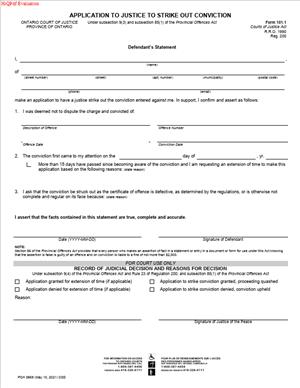
Form 101.1 – Application to Justice to Strike Out Conviction
Fill out nowJurisdiction: Country: Canada | Province or State: Ontario
What is a Form 101.1 – Application to Justice to Strike Out Conviction?
Form 101.1 is a court form you use to ask a justice to set aside a conviction that was entered without your input. In plain terms, you ask the court to strike the conviction and reopen your case. If the justice agrees, the conviction disappears, and the charge returns to the pre-conviction stage. You then get a chance to respond, resolve, or go to trial.
This form is used in the Ontario Court of Justice for provincial offence matters. These are cases like traffic tickets, parking matters, and other regulatory or by-law charges. It is not used for criminal convictions. It is not an appeal. It is a request to undo a conviction that was recorded because you did not respond or did not appear when required.
Who typically uses this form?
Defendants who were convicted without a trial or guilty plea. You may have missed the response deadline on a ticket. You may have missed your trial date due to a serious problem. You may never have received the notice at all. Sometimes, a clerk or mailing error caused the notice to go to an old address. Sometimes a sudden illness or emergency stopped you from attending. Small business owners also use it when a ticket addressed to the business was wrongly handled. Fleet managers and drivers use it for ticket matters tied to work vehicles. In each case, the common link is the same: you did not have your say, and a conviction was entered in your absence.
Why would you need this form?
A conviction in absence carries real consequences. You may face fines, late fees, and enforcement actions. Your licence or permit may be flagged or suspended. Collection activity can start. Insurance costs can rise. If the conviction resulted from a missed step or a notice problem, you can ask the court to fix that. Form 101.1 is the tool to do so.
Typical usage scenarios
You moved and never received a trial notice, then learned later you were convicted. You attended court but went to the wrong room and missed the call. You were in hospital on the trial date and could not attend. You requested a trial on time, but the court did not process your request. You selected the wrong option on the ticket by mistake. You paid an amount thinking it resolved the matter, but a conviction still issued. You were out of the country and had no way to attend. In each scenario, you can explain what happened, attach proof, and ask for the conviction to be struck out.
One key point matters. This form targets convictions entered without your participation. It does not undo a conviction after a full trial. It does not undo a conviction you entered by a voluntary guilty plea. If you pleaded guilty or lost at trial, your remedy is an appeal, not a strike-out application. If you are unsure which path applies, look at how the conviction happened. If it happened because you missed a response or appearance, Form 101.1 is usually the right form.
When Would You Use a Form 101.1 – Application to Justice to Strike Out Conviction?
Use this form when the court recorded a conviction against you, and you did not have a chance to be heard. Most often, the conviction comes from a missed response to a ticket or a missed court date. The process records a conviction automatically in those cases. You then learn about it later, often by mail or from a notice of suspension or collections. When that happens, act quickly. You can apply to have the conviction struck out, and your case reopened.
Here are practical examples. You received a speeding ticket, checked the box to request a trial, mailed it, and heard nothing. Months later, you receive a notice showing a conviction and a fine. You apply to strike out the conviction, explain that you requested a trial, and attach a copy of your trial request or a mail receipt. Or, you changed addresses and did not update your documents. The trial notice went to your old address. You later find out about the conviction when you renew your licence. You apply, confirm the date you first learned about the conviction, and supply proof of the address change timeline.
Another example. You operate a small contracting business. A by-law ticket arrived at your office while you were on a remote job. Staff placed it in the wrong file, and no one responded. A conviction was entered for non-response. You apply with Form 101.1 and attach a brief explanation of the misfile. You also attach a copy of your internal mail log if you have it. Or, you are a rideshare driver. You intended to attend your trial, but the hearing time changed, and you never received the updated notice. You apply and attach proof of the change notice date and your contact details.
Typical users include drivers, vehicle owners, business owners, and property managers. Students and new residents use it often due to address changes. Employers use it for tickets linked to company plates. Landlords or tenants may also use it for by-law matters. The common theme is a conviction that flowed from non-attendance or non-response, not from a contested hearing.
Timing matters. You should file as soon as you learn about the conviction. There is a standard timeline that starts when you first became aware of it. If you pass that window, you can still ask for an extension. You must explain why you did not learn of the conviction sooner or why you could not file earlier. The justice can grant an extension when fairness requires it.
Legal Characteristics of the Form 101.1 – Application to Justice to Strike Out Conviction
This is an official court application. It is part of the Ontario Court of Justice process for provincial offences. When granted, the order to strike out the conviction is legally binding on the parties and the court record. The conviction is vacated. Enforcement linked to that conviction is paused or removed. The case returns to an active state. You will then receive a new date or instructions on the next steps.
The form’s enforceability flows from the justice’s authority to reopen matters decided in the absence. The law gives a justice the power to reverse a default conviction where fairness was compromised. Submitting the form is how you ask the justice to exercise that power. The form captures the facts, dates, and reasons the justice needs to decide. You sign it under oath or affirmation. That sworn detail gives the application legal weight.
Two conditions support success. First, you must show a good reason for missing the response or appearance. Good reasons include not getting notice, serious illness, emergency, or a proven clerical error. Mere regret or a change of strategy is not enough. Second, you must show that you acted promptly after learning of the conviction. The justice will look at when you found out and when you filed. A long delay without explanation can undermine the request.
A strike-out order does not dismiss the charge. It does not erase the incident entirely. It simply removes the conviction and puts you back to square one. You still must deal with the charge. You can choose to resolve, request disclosure, or go to trial. If fines were paid toward the conviction, the court will hold or apply them based on the new outcome. Ask the clerk how those funds are handled in reopened cases.
If the justice denies your application, the conviction stands. You still have an appeal route. Appeals face strict timelines and different tests. If your denial flowed from missing the filing window, you may apply again if new facts arise. But repeated applications with no new facts will likely fail. It is better to submit a complete, well-supported application the first time.
Finally, the form is sworn. False statements can carry penalties. Keep your facts precise and honest. If you do not know a date, say so. If you guess, label it as an estimate. The justice will assess credibility. Clear, accurate details help your case.
How to Fill Out a Form 101.1 – Application to Justice to Strike Out Conviction
Gather your documents first.
Collect the ticket or charging document. Get the conviction notice, fine notice, or any enforcement letters. Print any emails that show what happened. If you mailed a response, find proof of mailing. If you missed court due to illness, get medical proof. If you moved, print proof of your address change timeline. Have your government-issued ID ready for filing.
Complete the form in black ink or fillable PDF, as provided.
Use your full legal name exactly as shown on the conviction. Match your date of birth, if requested. Include current contact details with a reliable phone and email. If your mailing address differs from your residence, include both.
Identify the case.
Enter the offence number or ticket number. Include the case or file number if known. Add the offence date and the court location shown on your notice. If you have a conviction date, include it. If you do not have the date, leave it blank or mark “unknown.” The clerk can often locate it.
State what you are asking for.
The form will have a section where you request the conviction be struck out, and the matter reopened. Use the exact wording on the form. If there is a checkbox or line for “order sought,” check or write it clearly. If your case includes multiple counts on one ticket, list each count.
Explain why you missed the response or appearance.
This is the core of your application. Keep your explanation clear and factual. State the events in order with dates. Example: “I moved on March 1. The trial notice was mailed to my old address on March 15. I did not receive it. I learned of the conviction on June 10 when I received a collection letter at my new address.” Avoid blame or emotion. Focus on facts that show you did not get a fair chance to be heard.
Explain when you first learned of the conviction.
This date starts the filing clock. Write the exact date if you know it. If you learned by phone, write the call date and who you spoke with, if known. If you learned from a letter, attach the letter and keep the envelope if it shows a postmark.
Ask for an extension of time if needed.
If you are outside the usual time window, include a short paragraph that asks for an extension. Explain why you could not file earlier. Example: “I was out of the country from May 1 to June 20 and did not receive the notice until June 25.” Attach proof where possible.
Attach your evidence.
Label each attachment with a simple title and number. For example, “Attachment A: proof of address change,” “Attachment B: hospital discharge summary,” “Attachment C: copy of mailed trial request.” Refer to these labels in your explanation. Keep attachments legible and complete. Do not attach original ID or irreplaceable documents. Use copies.
Complete the declaration.
Most versions require you to swear or affirm that your statements are true. You must sign in front of an authorized commissioner or a justice. Do not sign in advance. Bring photo ID when you attend to sign. Many court counters can provide a commissioner at no cost. If you sign by remote means, follow the instructions you are given. Make sure the date and location on the declaration match the signing session.
Review the form for accuracy.
Names, numbers, and dates must be correct. Check that all attachments are included. Add your phone and email in case the court needs to reach you. If someone helps you fill out the form, you still must review it yourself. You are the one swearing to its truth.
File the form at the court office that handled the conviction.
If you are unsure of the location, check the conviction notice or the ticket. You can also call the court information line for directions to the correct office. When you file, ask the clerk for a stamped copy for your records. Keep it with your attachments list.
There is usually no filing fee for this application. Ask the clerk to confirm. If a fee applies in your location or for a specific service, the clerk will tell you the amount and payment options.
After filing, you may receive a hearing date or a written decision.
Some courts decide based on the paperwork. Others schedule a short hearing. If a hearing is set, attend on time and bring your stamped copy and attachments. Be ready to explain your reasons and answer questions. Keep your answers short and factual. If your application is granted, ask the clerk how the court will update the record and notify enforcement. If a licence suspension occurred, ask when the record will reflect the change.
If the application is denied, ask for the reasons.
You can request a copy of the endorsement or order. Consider whether an appeal is appropriate. Pay any active fines by the deadline unless you file an appeal or a different order changes the timeline.
Keep notes of every step.
Record dates you filed, who you spoke with, and what you were told. Save copies of all documents. If you need to follow up, these records help the court locate your file quickly.
A final tip
Be prompt, be clear, and be complete. The justice needs two things to grant your request: a good reason for your absence and proof that you acted quickly once you found out. Your form should make both points easy to see.
Legal Terms You Might Encounter
- You will see “conviction” on the form. It means the court found you guilty and entered it on the record.
- The phrase “strike out” means to remove that conviction from the record in this case.
- The “justice” is the judicial officer who decides your application.
- Your “grounds” are the reasons you say the conviction should be struck out.
- The “record of conviction” is the formal entry the court keeps for your case.
- An “affidavit” or “sworn statement” is your signed evidence supporting the form.
- “Filing” means delivering the completed Form 101.1 to the court office.
- “Service” means giving a copy of your materials to the other party in the case.
- An “order” is the written decision granting or denying your request.
- An “endorsement” is the note the justice writes on the file to show the decision and reasons. A “hearing” is the court date when the justice listens to both sides.
- “Relief requested” is the exact outcome you ask for on Form 101.1.
FAQs
Do you qualify to ask for a conviction to be struck out?
You can apply if a conviction was entered and you have clear reasons to challenge it. You should explain what happened and why striking it out is fair. Use Form 101.1 to make that request.
Do you need to explain why you missed court?
If your conviction happened when you were not present, explain why. Give specific facts. Include dates, times, and what prevented attendance. Attach proof if you have it.
Do you need evidence with Form 101.1?
Yes, include supporting documents. For example, travel records, medical notes, or correspondence. Keep items relevant and easy to read. Label each attachment clearly.
Do you have to serve the other side?
Usually yes. The other side must know about your application. Provide a copy of what you filed. Keep proof of when and how you served them.
Do you have to attend a hearing?
Often you do. Be ready to answer questions. Bring copies of your materials. Arrive early and plan to wait.
Do you pay a fee to file?
Fees may apply. Check the current amount before you file. If you cannot afford it, ask about available options.
Do you lose the conviction immediately after filing?
No. Filing does not change your record. The conviction remains unless a justice orders otherwise. You must wait for the decision.
Do you need a transcript?
Sometimes a transcript helps. It can show what happened in the earlier appearance. If you use one, attach it and point to the key parts.
Checklist: Before, During, and After the Form 101.1 – Application to Justice to Strike Out Conviction
Before signing
- Get your case details: case number, charge, and conviction date.
- Obtain copies of the conviction document or notice.
- Write your reasons for asking to strike out the conviction.
- Collect evidence that supports those reasons.
- Confirm names and contact details for you and the other side.
- Prepare any dates you are unavailable for a hearing.
- Decide the exact relief you want the justice to order.
- If using an affidavit, prepare it in clear numbered paragraphs.
- Number and label each exhibit consistently.
- Plan how you will serve the other side and provide service.
During signing
- Verify your full name, address, and contact details.
- Confirm the case number matches your court file.
- Check the conviction date and offence details for accuracy.
- State your grounds clearly and in plain language.
- Confirm the relief you request matches what you want.
- If there is a declaration or affidavit, sign where required.
- If a witness or commissioner is needed, sign in their presence.
- Initial any corrections neatly. Avoid handwritten edits if possible.
- Ensure all pages are included and in order.
- Attach exhibits and mark them consistently (A, B, C, etc.).
After signing
- Make at least two copies of the complete package.
- File the original with the court office that holds your case.
- Pay any filing fee or address fee options if available.
- Ask how the hearing date will be set and recorded.
- Serve the filed materials on the other side as required.
- Complete and keep proof of service.
- Calendar the hearing date and any deadlines.
- Prepare a short outline of the points you will make at the hearing.
- Store your stamped copy and proof of service together.
- Monitor for any updates or scheduling changes.
Common Mistakes to Avoid Form 101.1 – Application to Justice to Strike Out Conviction
Leaving out key facts or dates
- Don’t forget to explain exactly what happened and when. Missing a detail can lead to delay or denial.
Not attaching supporting documents
- Don’t rely on bare statements. Without proof, the justice may not accept your explanation.
Using the wrong case number or courthouse
- Don’t guess file details. Errors can cause misfiling, missed hearings, or dismissal.
Failing to serve the other side properly
- Don’t skip service. The court may refuse to hear your application if service is defective.
Asking for relief, the form does not cover
- Don’t request outcomes that this application cannot provide. That can undermine your request and waste time.
What to Do After Filling Out the Form 101.1 – Application to Justice to Strike Out Conviction
File your materials
- File Form 101.1 and supporting documents with the court that recorded the conviction.
- Confirm any filing fee and method of payment.
- Ask how you will receive the hearing date or scheduling details.
- Get a stamped copy for your records.
Serve the other side
- Serve the complete filed package to the other party in the case.
- Use a permitted method of service. Follow timing rules if noted on the form.
- Complete a proof of service and keep a copy.
Prepare for the hearing
- Create a brief outline of your grounds and the relief you seek.
- Tab your exhibits and highlight key passages.
- Rehearse a short, clear explanation of what went wrong and why.
- Bring two extra copies of everything to the hearing.
Attend the hearing
- Arrive early with your materials organized.
- Be ready to answer questions about dates, documents, and service.
- Stay focused on your grounds and the relief requested.
- Take notes of the justice’s directions and any timelines.
After a decision
- If granted, get a copy of the order or endorsement.
- Ask what happens next with the case. You may receive a new date or directions.
- Keep proof of the order for your records and any follow-up.
- If denied, note the reasons. Consider whether other procedures may be available.
If you need to amend
- If you discover an error before filing, correct and re-sign.
- If you discover an error after filing, prepare an amended form.
- File the amended form and serve it promptly. Label it clearly as amended.
Distribute and store
- Keep a complete, stamped copy of what you filed.
- Store proof of service, hearing notices, and the decision together.
- Update your calendar with any new dates or deadlines.
- Maintain a checklist of tasks completed and pending.
Disclaimer: This guide is provided for informational purposes only and is not intended as legal advice. You should consult a legal professional.