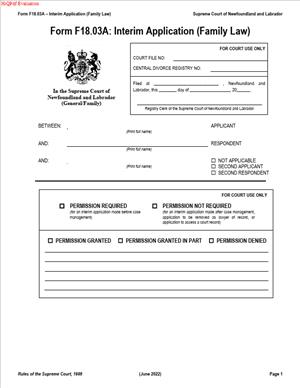
Form F18.03A – Interim Application (Family Law)
Fill out nowJurisdiction: Country: Canada | Province or State: Newfoundland and Labrador
Form F18.03A – Interim Application (Family Law) is a court document used in family law cases before the Supreme Court of Newfoundland and Labrador. You use it to ask the court for a temporary order while your case is still ongoing.
Family law cases can take time to resolve. During that time, important issues may need immediate attention. This form allows you to formally request short-term decisions from a judge.
If you are representing yourself, this document may feel technical at first. It follows a structured format and requires clear information about what you are asking for and why.
Understanding how this form works helps you present your request in a focused and organized way. It also helps you avoid common errors that can delay your matter.
What is Form F18.03A – Interim Application (Family Law)?
Clear definition
Form F18.03A – Interim Application (Family Law) is a written request to the court for temporary orders in a family law case. “Interim” means the order is meant to apply until a final decision is made.
This form does not start a new case. It is used within an existing family law proceeding. It tells the court what temporary relief you want and the legal basis for your request.
The document sets out the specific orders you are asking for. It may also reference supporting materials, such as affidavits or financial information, that explain your position.
Who typically uses this form?
You may use this form if you are a party in a family law case before the Supreme Court. This includes people involved in divorce, custody, parenting, support, or property disputes.
Both applicants and respondents can file an interim application. It is not limited to the person who started the case.
Self-represented individuals often use this form when they need the court to address urgent or time-sensitive matters before trial. Lawyers also use the same form when acting for clients.
Why might you need this form?
You might need this form if you cannot wait for a final hearing to resolve a problem. Family situations often involve immediate concerns about children, finances, or living arrangements.
An interim order can create structure and stability while the case moves forward. It may set temporary parenting schedules, require support payments, or address possession of the family home.
Without a temporary order, one party may be left without financial support or clear parenting arrangements. This form provides a formal way to ask the court to step in.
Typical real-life scenarios
- You and the other parent have separated, but there is no agreed parenting schedule. One parent is limiting contact. You may apply for an interim parenting order to establish a clear schedule until the final hearing.
- After separation, one spouse stops contributing to household expenses. The other spouse may apply for interim spousal or child support to cover living costs while the case continues.
- There is disagreement about who stays in the family home. An interim application may request temporary exclusive possession until property issues are resolved.
- One parent plans to move with the children before the case is finished. The other parent may seek an interim order to prevent relocation until the court makes a final decision.
When would you use Form F18.03A – Interim Application (Family Law)?
You would use this form after a family law case has already been started in the Supreme Court of Newfoundland and Labrador. It is part of the ongoing court process.
It is commonly used when circumstances change after the initial filing. For example, income may change, living arrangements may shift, or conflict may increase.
You may also use it when urgent issues arise. Urgency often relates to child safety, financial hardship, or risk of property being sold or disposed of.
In many cases, interim applications are scheduled before a trial date is set. They help manage day-to-day issues while the parties prepare for a final hearing.
If both parties agree on temporary arrangements, they may not need this form. It is typically used when there is a dispute that requires a judge’s decision.
Legal characteristics of Form F18.03A – Interim Application (Family Law)
This form is procedural. It triggers a court hearing where a judge considers your request for temporary relief. The form itself does not create rights or obligations until the court makes an order.
For the application to be effective, it must be completed accurately and filed in the correct court file. It usually needs to be served on the other party, along with any supporting documents.
Common problems include incomplete information, unclear wording of the requested orders, or failure to attach required supporting materials. These issues can lead to delays or adjournments.
The form must relate to matters already before the court. It cannot be used to introduce entirely new claims that were never part of the original proceeding.
Procedural details may vary slightly depending on the judicial centre and the nature of the case. Timelines for service and filing are set by court rules and scheduling practices.
This document does not resolve your case permanently. It does not replace a trial or final order. It addresses temporary arrangements only.
Is it legally binding?
The form itself is not binding. It is a request to the court.
Once a judge reviews the interim application and issues an order, that order is legally binding. Both parties are expected to follow it unless it is varied or replaced by another court order.
An interim order remains in effect until a final order is made or the court changes it. Even though it is temporary, it carries the same authority as other court orders while in force.
How to fill out Form F18.03A – Interim Application (Family Law)
Step 1 – Review your existing court file
Confirm that there is an active family law case in the Supreme Court. Locate your court file number and ensure you understand what issues are already before the court. This form is used within that existing file.
Step 2 – Identify the temporary orders you are requesting
Decide exactly what you are asking the court to order on an interim basis. Be specific. For example, state the amount of support requested or the details of a proposed parenting schedule. Clear wording helps the judge understand your request.
Step 3 – Complete the heading and party information
Fill in the court file number, judicial centre, and full legal names of the parties as they appear in the original case documents. Use consistent names and titles, such as applicant or respondent, as shown in the existing file.
Step 4 – Set out the orders sought
In the section that asks for the orders you want, list each requested order in separate, clearly written paragraphs. Keep each request focused on one issue. Avoid combining multiple issues in a single sentence.
Step 5 – State the grounds for your application
Provide a brief explanation of the legal and factual basis for your request. This usually refers to the relevant family law issues, such as the best interests of the child or financial need. The explanation should match the evidence you plan to present.
Step 6 – Refer to supporting documents
Interim applications are commonly supported by affidavits or financial statements. Indicate that you are relying on sworn statements or other filed materials. Make sure those documents are prepared and filed according to court requirements.
Step 7 – Review for completeness and clarity
Read the entire form carefully before filing. Check names, dates, and requested amounts. Ensure that your requested orders are realistic, specific, and consistent with the rest of your court materials.
Step 8 – Sign and file the form
Sign the form where required. File it with the Supreme Court office handling your case. After filing, follow the court process for serving the other party and attending the scheduled hearing on your interim application.
Legal terms you might encounter in Form F18.03A – Interim Application (Family Law)
- Interim Order: A temporary court order that stays in place until a final order is made or the case is resolved. In this form, you are asking the court to make short-term decisions about issues like parenting, support, or property. The interim order is not the final outcome, but it is legally enforceable once granted.
- Affidavit: A written statement of facts that you swear or affirm to be true. You usually file an affidavit in support of your interim application. The judge relies heavily on the affidavit because interim hearings often proceed without full oral testimony.
- Grounds for Application: The legal and factual reasons you give to explain why the court should grant the orders you request. In this document, you must briefly state these grounds. They connect your situation to the legal test the court applies.
- Material Change in Circumstances: A significant change in your situation since the last court order was made. If you are asking to change an existing interim or final order, you may need to show that something important has changed. This concept often appears in applications to vary support or parenting arrangements.
- Without Notice (Ex Parte): A request to have the court hear your application without notifying the other party in advance. This is usually reserved for urgent situations. If you are proceeding without notice, you must explain clearly why immediate action is necessary.
- Service: The formal process of delivering court documents to the other party. After filing this form, you must usually serve it on the other side. Proper service ensures the other party knows about the hearing and has a chance to respond.
- Return Date: The date set by the court when your application will be heard. This date appears on the form once it is scheduled. You must make sure all documents are filed and served before this date within the required timelines.
- Relief Sought: The specific orders you are asking the court to make. In this document, you must list each order clearly and separately. The judge can only grant relief that you have actually requested.
- Costs: An amount of money one party may be ordered to pay to help cover the other party’s legal expenses. You can ask for costs as part of your interim application. The court decides whether costs are appropriate based on conduct and fairness.
- Undertaking: A formal promise given to the court. In urgent applications, you may be required to give an undertaking, such as a promise to return to court on short notice. Breaking an undertaking can have serious consequences.
FAQs
What information must I include in the heading of this form?
You must copy the court file number exactly as it appears on your existing documents. You also need to enter the full legal names of all parties in the same order used in earlier filings. If a name is spelled differently from previous documents, correct it before filing so the court record stays consistent.
Do I need to attach an affidavit when filing Form F18.03A – Interim Application (Family Law)?
Yes. This document tells the court what orders you want, but your affidavit provides the facts that support those requests. Make sure the affidavit is sworn or affirmed properly and that any exhibits are clearly labeled and attached.
How specific do I need to be when listing the orders I am requesting?
You should be precise. Instead of asking for “reasonable access” or “fair support,” state exact schedules, amounts, dates, and responsibilities. The court can only make orders that are clearly described in this form.
What if I am asking to change an existing court order?
You must identify the date of the current order and explain what parts you want changed. Attach a copy of that order to your supporting materials. Clearly state whether you want to replace it entirely or vary only certain sections.
How do I confirm the hearing date for this document?
After you file, the court registry will assign or confirm a return date. Check the stamped copy of this form to make sure the date and time are correct. Do not assume the hearing is scheduled until you see confirmation from the court.
What happens if the other party does not respond before the hearing?
The hearing may still proceed. The judge can consider the materials you filed and make a decision based on the information available. However, you must prove that the other party was properly served before the court will move forward.
Can I update my requests after filing?
If your situation changes, you may need to file amended materials. Do not simply bring new requests to court without written notice. Any changes should be formally recorded so the judge and the other party understand what is being asked.
Will the orders made at this hearing become part of the public court record?
Yes. Any interim order granted becomes part of the official file. It remains in effect until it is replaced by another interim order or a final order, so you should keep a copy for your records and follow its terms carefully.
Checklist: Before, During, and After Form F18.03A – Interim Application (Family Law)
Before
- Review your existing court orders and identify exactly what you want changed or added.
- Gather financial documents, parenting schedules, messages, or other records that support your request.
- Prepare a clear, organized affidavit that explains the facts in numbered paragraphs.
- Confirm the correct court file number and spelling of all party names.
- Check any timelines for filing and service so you meet required deadlines.
- Make a draft list of the precise interim orders you want the judge to make.
- Arrange for a commissioner of oaths or other authorized person to swear your affidavit.
- Make enough copies of all documents for filing and service.
During
- Fill in the form carefully, leaving no required sections blank.
- List each order sought in separate, numbered paragraphs.
- Attach your sworn affidavit and clearly mark any exhibits.
- Double-check dates, amounts, and names for accuracy.
- File the completed package with the court registry.
- Obtain a stamped copy showing the filing date and hearing date.
- Serve the filed documents on the other party using an approved method.
- Prepare and file proof of service with the court.
After
- Calendar the hearing date and any deadlines for additional materials.
- Review the other party’s response, if one is filed.
- Prepare brief notes outlining the key points you want to raise at the hearing.
- Bring extra copies of your documents to court.
- Arrive early on the hearing date to allow time for security and check-in.
- Take notes during the hearing about what the judge orders.
- Obtain a copy of the interim order once issued.
- Follow every term of the order immediately and completely.
- Update any payment arrangements or parenting schedules to reflect the new order.
Common mistakes to avoid with Form F18.03A – Interim Application (Family Law)
- Mistake: Asking for vague relief, which happens when you use general language like “reasonable support”; this can lead to unclear or unenforceable orders, so do not forget to specify exact amounts, dates, and responsibilities.
- Mistake: Failing to attach a sworn affidavit, often because you assume the form itself is enough; this can result in your application being dismissed or adjourned, so do not forget to include properly sworn evidence.
- Mistake: Using incorrect party names or file numbers, which happens when you rely on memory; this may cause filing delays or confusion in the court record, so do not forget to copy details exactly from prior documents.
- Mistake: Not serving the other party correctly, often due to misunderstanding service rules; this can prevent your hearing from proceeding, so do not forget to complete and file proof of service.
- Mistake: Raising new requests at the hearing that are not written in the form, which happens when you think you can explain verbally; the judge may refuse to consider them, so do not forget to include every request in writing.
- Mistake: Ignoring existing court orders when drafting your request, which happens when emotions run high; this can weaken your credibility, so do not forget to reference and attach prior orders.
- Mistake: Filing at the last minute without checking timelines, which happens due to urgency or delay; this may lead to adjournments or rejection, so do not forget to confirm deadlines in advance.
- Mistake: Submitting disorganized or overly long affidavits, which happens when you include every detail; this can distract from key facts, so do not forget to keep your evidence focused and clearly structured.
What to do after filling out Form F18.03A – Interim Application (Family Law)
Once you have completed the form and attached your affidavit, your next focus is proper filing and preparation. Organization matters. Judges expect clear, complete materials.
- Step 1: Make at least three complete copies of your application package, including the form, affidavit, and all exhibits.
- Step 2: File the original documents with the court registry and obtain stamped copies showing the filing date and hearing date.
- Step 3: Confirm the return date and time before leaving the registry or reviewing your filed copy.
- Step 4: Serve one stamped copy on the other party using an accepted method of service.
- Step 5: Complete proof of service and file it with the court promptly.
- Step 6: Create a hearing folder that includes your filed documents, proof of service, prior court orders, and a brief outline of your main points.
- Step 7: Review the other party’s responding materials as soon as you receive them and note areas of agreement and disagreement.
- Step 8: Prepare a short summary for yourself explaining why the interim orders are necessary now, not later.
- Step 9: Attend the hearing on time, bring your documents, and be ready to answer direct questions from the judge.
- Step 10: After the decision, obtain a copy of the interim order and read it carefully to confirm the exact terms.
Keep your copy of the signed interim order in a safe place. If the order affects support payments, update your budgeting records immediately. If it changes parenting time, adjust calendars and notify any relevant caregivers or schools as needed.
Monitor compliance. If either party does not follow the order, document what happens in case you need to return to court. Interim orders remain in effect until varied or replaced, so treat them as binding and active from the date set out in the order.
Disclaimer: This guide is provided for informational purposes only and is not intended as legal advice. You should consult a legal professional.