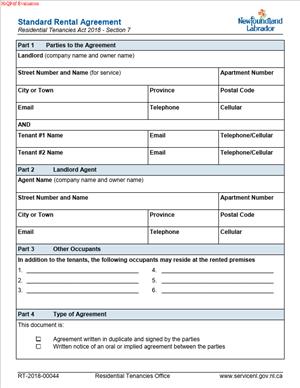
Standard Rental Agreement
Fill out nowJurisdiction: Country: Canada | Province or State: Newfoundland and Labrador
A Standard Rental Agreement is the written contract that sets out the terms between a landlord and a tenant for a residential rental property. It explains who is renting, what is being rented, how much rent is paid, and what rules apply during the tenancy.
If you are about to sign or complete a Standard Rental Agreement, you are entering into a legally significant arrangement. This document controls daily living issues such as rent, repairs, utilities, and notice periods. It can affect your housing stability and financial responsibilities.
In Newfoundland and Labrador, this form is commonly used for residential tenancies regulated by the Residential Tenancies Office. It is designed to capture the essential terms of a rental arrangement in a clear and organized way.
Whether you are a landlord preparing the document or a tenant reviewing it before signing, understanding each section helps you avoid misunderstandings later. Small details in the agreement can shape how disputes are handled and what rights each party can rely on.
This guide walks you through what the form does, when it is used, and how to complete it step by step in a practical way.
What is a Standard Rental Agreement?
Clear definition
A Standard Rental Agreement is a written contract between a landlord and a tenant for the rental of residential property. It sets out the legal and practical terms of the tenancy.
The document usually includes the names of the parties, the address of the rental unit, the rent amount, the payment schedule, the security deposit, and the start date. It may also address utilities, maintenance responsibilities, and any additional terms both parties agree to.
This form creates a structured record of the agreement. Instead of relying on verbal promises, it puts the key terms in writing so both parties can refer back to them if questions arise.
In many cases, this agreement reflects the minimum standards required under provincial residential tenancy rules. It does not replace those rules but works alongside them.
Who typically uses this form?
Landlords use this form when renting out a house, apartment, basement suite, or other residential unit. It allows them to document the conditions under which the property is being rented.
Tenants use the same form when they agree to rent a property. By signing it, they confirm the terms they are accepting, including rent, occupancy limits, and other conditions.
Property managers may also prepare and present the agreement on behalf of a landlord. In those cases, the manager acts as the landlord’s representative, but the legal relationship remains between the landlord and tenant.
Roommates may appear on the agreement if they are co-tenants. In that situation, each listed tenant typically shares responsibility under the same document.
Why might you need this form?
You need this form when starting a new residential tenancy. It creates clarity from the beginning of the rental relationship.
The document helps prevent disputes about rent amounts, due dates, or what is included in the rental price. For example, it can specify whether heat, electricity, or internet is included or paid separately.
It also provides a written record of deposits collected at the start of the tenancy. This can be important at the end of the rental period when the deposit is reviewed or returned.
If a disagreement later arises about notice, repairs, or obligations, the agreement becomes a central reference point. It shows what was agreed to at the outset.
Typical real-life scenarios
- A landlord buys a small rental property and finds a new tenant. Before handing over the keys, both parties sign the agreement to confirm the rent, lease term, and deposit amount.
- A tenant moves to a new city for work and rents an apartment. The agreement outlines the length of the lease and what happens if the tenant wants to move out early.
- Two students decide to share a rental house. Their names are both included on the same document, which sets out that they are jointly responsible for paying the full rent.
- A family rents a home where the landlord agrees to cover water costs but not electricity. The agreement clearly states which utilities are included, reducing the risk of confusion after move-in.
- In another situation, a tenancy starts as a fixed-term lease. When that term ends, the agreement may outline whether it continues on a month-to-month basis under the same conditions.
When would you use a Standard Rental Agreement?
You use a Standard Rental Agreement at the beginning of a residential tenancy. It is typically completed before or on the day the tenant takes possession of the unit.
This document is most common in private residential rentals. That includes apartments in multi-unit buildings, single-family homes, duplexes, and similar properties.
A landlord may prepare a new agreement when renting to a different tenant after a previous tenant moves out. Each new tenancy usually requires its own signed document, even if the property and terms are similar.
It can also be used when renewing or extending a tenancy under new terms. In some cases, parties sign a new agreement instead of relying on the old one if there are changes to the rent or other conditions.
Where multiple tenants share one unit, the agreement is often signed by all occupants who will be legally responsible. This ensures everyone’s obligations are documented in the same place.
This form is not generally used for commercial or business rentals. Those arrangements are governed by different rules and often require more customized contracts.
Legal characteristics of Standard Rental Agreement
A Standard Rental Agreement is a contract. For a contract to be effective, it generally requires clear parties, agreed terms, and signatures showing consent.
The agreement becomes meaningful when both the landlord and the tenant sign it. Signing indicates that each party understands and accepts the listed terms.
The document usually outlines essential elements such as the rental amount, due date, and property address. If these core details are missing or unclear, disputes may arise about what was intended.
Problems can occur if the agreement contains terms that conflict with residential tenancy legislation. In many jurisdictions, including Newfoundland and Labrador, certain tenant rights cannot be waived. If a clause attempts to remove a right provided by law, that clause may not be enforceable.
Incomplete information can also create difficulties. For example, failing to clearly state whether the tenancy is fixed-term or periodic can lead to confusion about notice requirements.
The agreement does not replace statutory protections. Even if a specific issue is not written in the document, applicable residential tenancy rules may still apply.
It also does not guarantee that either party will fulfill its obligations. It sets out responsibilities, but enforcement may require formal steps if a dispute arises.
Is it legally binding?
Yes, a properly completed and signed Standard Rental Agreement is generally legally binding. Once both parties agree and sign, the terms form part of a contract.
Being legally binding means that both landlord and tenant are expected to follow the agreed terms. For example, the tenant agrees to pay rent as stated, and the landlord agrees to provide the rental unit as described.
If one party does not meet its obligations, the other may rely on the agreement as evidence of what was promised. The written form helps show the original understanding between the parties.
However, not every clause in a rental agreement is automatically enforceable. If a term contradicts residential tenancy rules or attempts to remove basic legal protections, that term may not be valid even if signed.
A verbal agreement can sometimes create a tenancy, but a written and signed document provides stronger proof of the terms. That is why the formal written form is commonly used.
How to fill out the Standard Rental Agreement
Step 1 – Identify the landlord and tenant
Start by entering the full legal name of the landlord. If the property is owned by more than one person, list all owners as they appear on official records. If a property manager is acting on behalf of the landlord, the agreement may include both the owner’s name and the manager’s contact information.
Next, enter the full legal names of all tenants who will occupy the unit and share responsibility. Make sure spelling is accurate. The names in this section determine who is legally bound by the document.
Step 2 – Provide the rental unit details
Clearly write the full address of the rental property. Include the unit number if the building contains multiple units. This ensures there is no confusion about which space is being rented.
If the agreement includes parking spaces, storage lockers, or other specific areas, describe them in this section or in the space provided. Precise identification helps avoid later disputes about access or use.
Step 3 – State the tenancy start date and term
Enter the date when the tenancy begins. This is often the date the tenant receives the keys and takes possession.
Indicate whether the tenancy is for a fixed term, such as one year, or continues on a month-to-month basis. If it is fixed-term, include both the start and end dates. These dates affect how and when the tenancy can change or end.
Step 4 – Set out the rent amount and payment details
Write the exact amount of rent to be paid. Specify whether it is due monthly or on another schedule. Include the due date, such as the first day of each month.
Record the accepted methods of payment if the form provides space. This may include a cheque, electronic transfer, or another method. Clear payment terms reduce misunderstandings.
Step 5 – Document the security deposit
Enter the amount of the security deposit collected. This is often limited by residential tenancy rules, so the amount written should reflect those limits.
Include the date the deposit is received. The agreement may also note how the deposit will be handled at the end of the tenancy. Accurate documentation at the beginning can be important when the tenancy ends.
Step 6 – Clarify utilities and services
Indicate which utilities are included in the rent and which are the tenant’s responsibility. This may include heat, electricity, water, or internet services.
If certain services are shared with other units, the agreement may describe how costs are divided. Clear allocation of responsibility helps both parties budget properly.
Step 7 – Outline maintenance and use conditions
Review the section dealing with maintenance and repairs. The agreement may describe general responsibilities, such as keeping the unit clean or reporting damage.
If there are specific rules about smoking, pets, or alterations to the unit, ensure they are clearly written in the appropriate section. These conditions become part of the agreed terms once signed.
Step 8 – Include additional terms if applicable
Some forms provide space for additional agreed-upon terms. Use this area to record any special arrangements, such as permission to use a shed or conditions for yard maintenance.
Additional terms should be written clearly and in plain language. Ambiguous wording can lead to different interpretations later.
Step 9 – Review the entire document carefully
Before signing, read through each section from start to finish. Confirm that names, dates, amounts, and addresses are accurate.
Check that no blank spaces remain where important information should appear. Incomplete sections can create confusion about what was agreed.
Step 10 – Sign and date the agreement
Both the landlord and each tenant should sign the agreement in the designated areas. Enter the date of signing beside each signature if required.
Signing indicates that both parties accept the terms as written. Once signed, each party should keep a copy of the completed document for their records.
Legal terms you might encounter in the Standard Rental Agreement
- Tenancy Term: This refers to the length of time the rental arrangement will last. It may be fixed-term (for example, one year) or periodic (such as month-to-month). The term affects how and when either party can end the agreement.
- Rent Due Date: This is the specific day rent must be paid. The form usually requires you to state the amount and the exact date it is due each month. This date becomes important if there is ever a dispute about late payment.
- Security Deposit: This is money the tenant pays at the start of the tenancy as protection for unpaid rent or damage. The agreement records the amount and conditions for its return. It should clearly state when and how it will be refunded.
- Rental Unit: This describes the property being rented. The form typically requires the full civic address and may include details such as apartment number, parking space, or storage unit. Accuracy here prevents confusion later.
- Additional Occupants: These are individuals who will live in the rental unit but are not named as tenants. The agreement may list them to clarify who is allowed to reside in the unit. This helps avoid disputes about unauthorized occupants.
- Utilities: This section outlines who pays for services such as electricity, heat, water, and internet. The agreement should clearly divide responsibility between landlord and tenant. Vague wording can lead to disagreements.
- Maintenance Responsibilities: This term refers to who is responsible for repairs and upkeep. The document often distinguishes between landlord obligations (such as structural repairs) and tenant obligations (such as keeping the unit clean). Clear wording helps prevent conflict.
- Notice of Termination: This explains how either party must notify the other if they want to end the tenancy. The agreement may refer to required notice periods. These details affect how and when the tenancy can legally end.
- Rules and Regulations: These are specific conditions attached to living in the property. They may include policies about pets, smoking, noise, or common areas. Once included in the agreement, these rules become enforceable terms.
- Joint and Several Liability: If more than one tenant signs, this clause may state that each tenant is responsible for the full rent and obligations. This means the landlord can seek the entire amount from any one tenant if necessary. It is important to understand this before signing.
FAQs
What date should I list as the start of the tenancy?
Enter the exact date the tenant is legally allowed to move in and begin occupying the rental unit. This may or may not be the same day the agreement is signed. Make sure the date matches any written offer or prior communication so there is no gap between possession and payment obligations.
What if the tenant moves in later than the date written in this form?
If the move-in date changes, update the tenancy start date before signing. Do not rely on a verbal change. The date in this document controls when rent begins and when notice periods are calculated, so it must reflect the real arrangement.
Do all tenants have to sign the Standard Rental Agreement?
Yes. Every adult tenant who will be legally responsible for the rent should sign. Check that each printed name matches the signature and any identification used. If someone moves in later and is meant to share legal responsibility, you should update the agreement or create a written amendment signed by all parties.
What happens if a landlord’s representative signs instead of the landlord?
Confirm that the person signing has the authority to act for the landlord. Their name and title should be clearly written beside the signature. If the landlord is a company, ensure the company name appears exactly as intended, and the signer indicates their position.
Can I change a clause in this document before signing?
Yes, but any change must be clearly written into the agreement before both parties sign. Do not rely on side conversations. Cross out the old wording neatly, insert the new wording, and have all parties initial beside the change so it is obvious that everyone agreed.
What should I attach to this form?
Attach any documents referenced in the agreement, such as a list of included appliances, parking details, or house rules. Make sure each attachment is clearly labeled and mentioned in the main body of the document. Both parties should receive copies of everything attached.
What if we make a mistake after we sign?
If you notice an error after signing, correct it in writing as soon as possible. Create a short amendment that identifies the section being corrected and clearly states the new wording. Both parties must sign and date the amendment to make it effective.
Does this agreement need to be filed anywhere to be valid?
In most situations, the agreement becomes binding once both parties sign and exchange copies. You do not usually file the Standard Rental Agreement to make it effective. However, keep a complete signed copy in case it is later required for dispute resolution or official review.
Checklist: Before, During, and After Standard Rental Agreement
Before
- Confirm the full legal names of all landlords and tenants.
- Verify the exact civic address and unit number of the rental property.
- Decide whether the tenancy will be fixed-term or periodic.
- Agree on the monthly rent amount and due date.
- Clarify who will pay for each utility and service.
- Confirm the amount of the security deposit.
- Review any house rules you plan to include.
- Gather any documents you want to attach to the agreement.
During
- Write all names exactly as they appear on identification.
- Double-check the tenancy start date.
- Ensure the rent amount is written clearly in numbers.
- Fill in every blank space or mark it as not applicable.
- Clearly record utility responsibilities.
- Insert any additional terms before signing.
- Review all attachments and reference them in the agreement.
- Have all parties sign and date the document on the same day if possible.
After
- Provide a complete signed copy to each tenant.
- Store your copy in a secure and accessible place.
- Record the rent due date in your calendar.
- Document receipt of the security deposit.
- Keep proof of the first rent payment.
- Create a move-in inspection record if applicable.
- Save copies of any amendments made later.
- Update your contact information in writing if it changes.
Common mistakes to avoid with the Standard Rental Agreement
- Mistake: Leaving blanks in the agreement because you plan to “fill them in later,” which often happens when parties rush the signing; this can create uncertainty or allow someone to insert terms later, so do not forget to complete or strike out every unused space.
- Mistake: Writing informal nicknames instead of full legal names, which happens out of convenience; this can cause enforcement problems if a dispute arises, so do not forget to verify and record complete legal names.
- Mistake: Forgetting to clearly state who pays for utilities because you assume it is obvious; this leads to billing disputes, so do not forget to assign each service specifically.
- Mistake: Failing to attach referenced documents, which often occurs when attachments are discussed but not finalized; this weakens your position if there is disagreement, so do not forget to label and include all attachments.
- Mistake: Allowing only one of several tenants to sign because others are unavailable; this can limit who is legally responsible for rent, so do not forget to obtain signatures from every adult tenant.
- Mistake: Making handwritten changes without having all parties initial them, which happens when last-minute edits are made; this may lead to claims that changes were unauthorized, so do not forget to initial every alteration.
- Mistake: Not giving the tenant a signed copy, often due to oversight after signing; this can create distrust or procedural issues later, so do not forget to distribute complete copies immediately.
- Mistake: Misstating the tenancy start date because of confusion about move-in timing; this affects rent calculations and notice periods, so do not forget to confirm the correct effective date before signing.
What to do after filling out the Standard Rental Agreement
Once the agreement is fully completed and signed, your work is not finished. Proper follow-up protects both parties and reduces future disputes.
First, organize your documents. Place the signed agreement and all attachments together in one file. If you keep digital records, scan the entire package and store it securely.
- Step 1: Make at least one complete copy for each party.
- Step 2: Confirm that every copy includes all pages and attachments.
- Step 3: Provide each tenant with their copy promptly.
- Step 4: Record the tenancy start date and rent due date in your calendar.
- Step 5: Issue a written receipt for the security deposit and first rent payment.
- Step 6: Complete a move-in condition inspection and have both parties sign it.
- Step 7: Set up a system to track rent payments each month.
- Step 8: Store proof of payments and communications in one place.
- Step 9: Update your contact details in writing if they change.
- Step 10: Review the agreement periodically so you remember your obligations.
If the tenancy involves ongoing communication, keep everything in writing. Save emails, letters, and notices. If changes are needed later, prepare a written amendment signed by all parties rather than relying on verbal agreements.
Good recordkeeping is your strongest protection. When questions arise about rent, repairs, or notice periods, you can refer directly to the signed document. Staying organized from the start makes the entire tenancy smoother and more predictable.
Disclaimer: This guide is provided for informational purposes only and is not intended as legal advice. You should consult a legal professional.