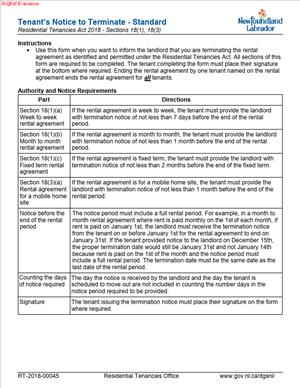
RT 00045 – Tenant’s Notice to Terminate – Standard
Fill out nowJurisdiction: Country: Canada | Province or State: Newfoundland and Labrador
RT 00045 – Tenant’s Notice to Terminate – Standard is the form a tenant uses to formally tell a landlord that they are ending a rental agreement. It is part of the process for moving out in a way that creates a clear written record. If you are about to fill it out, you likely want to make sure you end your tenancy properly and avoid disputes.
This document is not just a courtesy letter. It is a formal notice recognized by the Residential Tenancies Office in Newfoundland and Labrador. It sets out the key details about your tenancy and the date you plan to move out.
When you complete and deliver this form correctly, it creates clarity. Your landlord knows your intended move-out date. You have proof that you gave notice. Both sides can plan for inspections, key return, and final payments.
If you are unsure how much notice is required or what information belongs on the form, understanding the structure of RT 00045 – Tenant’s Notice to Terminate – Standard will help you avoid common mistakes.
What is RT 00045 – Tenant’s Notice to Terminate – Standard?
Clear definition
RT 00045 – Tenant’s Notice to Terminate – Standard is a written notice used by a tenant to end a residential tenancy. It confirms, in writing, that you are terminating your rental agreement and identifies the date the tenancy will end.
The form captures essential information. This typically includes the names of the tenant and landlord, the rental address, and the termination date. It also provides space for your signature and the date you sign the notice.
It is designed to create a clear, dated record. That record can be important if there is later disagreement about when notice was given or when the tenancy ended.
Who typically uses this form?
This form is used by residential tenants in Newfoundland and Labrador who want to end their tenancy under standard circumstances. It applies whether you rent an apartment, house, basement suite, or other residential unit covered by residential tenancy rules.
You might use it if you have a fixed-term lease that is ending and you do not plan to renew. You may also use it if you are in a periodic tenancy, such as month-to-month, and want to move out.
In some cases, co-tenants use the form together. If more than one tenant signed the rental agreement, each tenant may need to be identified in the notice.
Landlords do not use this form to evict tenants. It is specifically for tenants who are choosing to end the tenancy.
Why might you need this form?
You need this form when you want to formally end your rental agreement in a way that aligns with the standard notice process. A verbal conversation with your landlord is usually not enough on its own.
Using the correct document helps reduce confusion. It shows that you gave notice on a specific date and that you identified a specific move-out date.
It can also help protect your security deposit. If there is a dispute later about unpaid rent or insufficient notice, the completed form becomes part of the record.
Filing or delivering the form properly may also be required before either party can raise certain issues with the Residential Tenancies Office.
Typical real-life scenarios
- You accepted a new job in another city. Your current lease is ending soon, and you plan to relocate. You use the form to clearly confirm that you are not renewing and to state your final day in the unit.
- You are in a month-to-month tenancy and have found a new apartment. You calculate the required notice period and complete the document to give written notice within the appropriate timeframe.
- You and your roommate signed a lease together. Both of you have decided to move out at the end of the term. You complete the form to ensure the landlord understands that the entire tenancy is ending.
- Your fixed-term lease is nearing its end. You have decided not to continue renting the unit. Even though the term has a set end date, you provide written notice to confirm your intentions and avoid misunderstandings.
When would you use RT 00045 – Tenant’s Notice to Terminate – Standard?
You would use this form when you, as the tenant, are ending the tenancy under standard conditions. This often means you are giving notice in line with the type of rental agreement you have, such as a fixed-term or periodic agreement.
It is commonly used when a lease is coming to its natural end and you do not want to renew. It may also be used during a periodic tenancy where the agreement continues until either party gives proper notice.
The form can be used whether you rent directly from a property owner or through a property manager acting on the owner’s behalf. What matters is that you are the tenant named in the agreement.
In shared tenancies, the timing and effect of the notice may depend on whether all tenants are leaving or only one. The form helps document who is ending their interest in the tenancy and on what date.
You would not use this form to respond to an eviction notice. It is also not the document for resolving maintenance disputes, rent increases, or deposit claims. Its purpose is specific: to end the tenancy from the tenant’s side.
Legal characteristics of RT 00045 – Tenant’s Notice to Terminate – Standard
This form works as a formal written notice. For it to be effective in general, it must clearly identify the parties, the rental unit, and the termination date. It also needs to be signed and dated by the tenant giving notice.
Timing is central. The notice must align with the required notice period for your type of tenancy. If the termination date does not respect the applicable timeframe, the notice may not take effect as intended.
Delivery is also important. A notice that is filled out but never delivered to the landlord does not usually create legal effect. The method and timing of delivery can influence when the notice is considered received.
Common problems include incomplete information, incorrect dates, missing signatures, or confusion about who is giving notice. Errors in the rental address or tenant names can also cause disputes.
There can be differences depending on whether the tenancy is fixed-term or periodic. In some situations, ending a tenancy before the end of a fixed term may involve additional considerations. The standard form itself does not automatically resolve those issues.
This document does not cancel unpaid rent. It does not automatically release you from obligations that arose before the termination date. It also does not settle disputes about damage or deposits. Those matters are handled separately.
Is it legally binding?
Yes, in general, a properly completed and delivered tenant’s notice to terminate can have legal effect. Once a valid notice is given, the tenancy is expected to end on the stated date, assuming the notice meets timing and content requirements.
The binding nature comes from the rental agreement and the governing residential tenancy framework. When you use the approved form and provide clear notice, you are exercising a recognized right to end the tenancy.
If the form is incomplete, contains incorrect dates, or is not delivered properly, its effect may be challenged. Disputes about notice often focus on timing and proof of delivery.
Once effective, the notice sets expectations for both parties. You are generally responsible for rent up to the termination date. The landlord can prepare to regain possession of the unit after that date.
How to fill out RT 00045 – Tenant’s Notice to Terminate – Standard
Step 1 – Identify the rental unit
Enter the full address of the rental property. Include the unit number if there is one. The address must match the property covered by your rental agreement, so there is no confusion about which tenancy you are ending.
Step 2 – Provide the tenant’s information
Write your full legal name as it appears on the rental agreement. If there is more than one tenant on the agreement and all are ending the tenancy, list each tenant’s name. Make sure the names are spelled correctly.
Step 3 – Provide the landlord’s information
Enter the landlord’s name as stated in your agreement. If you deal with a property manager, include the name used in the tenancy documents. This ensures the notice clearly identifies who is receiving it.
Step 4 – State the termination date
Write the exact date you intend the tenancy to end. Use a complete date, including day, month, and year. Confirm that this date aligns with the required notice period for your type of tenancy.
Step 5 – Review the notice period
Before signing, double-check the timing between the date you are giving notice and the termination date. Ensure the timeframe matches the structure of your rental agreement, such as month-to-month or fixed-term.
Step 6 – Sign and date the form
Sign the document using your usual legal signature. Enter the date you are signing it. The signing date is important because it helps establish when notice was given.
Step 7 – Deliver the notice to the landlord
Provide the completed form to the landlord using a method that creates a clear record of delivery. Keep a copy for yourself. Your copy can be important if there is later disagreement about whether or when notice was given.
Legal terms you might encounter in RT 00045 – Tenant’s Notice to Terminate – Standard
- Termination Date: This is the exact date you state that your tenancy will end. It must comply with the required notice period under residential tenancy rules. On this form, you write the specific calendar date. If you choose the wrong date, your notice may not be valid.
- Notice Period: This refers to the minimum amount of time you must give your landlord before moving out. The length often depends on the type of tenancy, such as monthly or fixed-term. You must count the days carefully to ensure your termination date respects this period.
- Fixed-Term Tenancy: A tenancy that runs for a set period, such as one year. If you are in a fixed-term agreement, ending it early may have consequences unless certain conditions apply. This form records your intention to end the tenancy, but it does not automatically cancel financial obligations tied to a fixed term.
- Periodic Tenancy: A tenancy that continues on a recurring basis, such as month-to-month, without a fixed end date. In this situation, you can usually end the tenancy by giving proper written notice. The termination date must line up with the rental period.
- Service of Notice: This means delivering the completed notice to your landlord. The method of delivery matters. You should be able to show when and how the landlord received it.
- Rental Unit: The specific property you are renting. The form requires a clear description, typically including the full civic address and, if applicable, the unit number. Accuracy here avoids disputes about which tenancy you are ending.
- Joint Tenants: When two or more tenants sign the same tenancy agreement. If you are joint tenants, all tenants may need to agree to terminate. The form must reflect the names of everyone involved, and signatures may be required from each tenant.
- Signature: Your handwritten or legally accepted electronic signature confirms that the information is true and that you intend to end the tenancy. An unsigned form is incomplete and may not be accepted as a valid notice.
- Effective Date: This is the date the tenancy legally ends, which should match the termination date you entered. It marks the point when your right to occupy the rental unit ends and when rent obligations usually stop.
- Proof of Delivery: Evidence that the landlord received the notice. This could include a receipt, a signed acknowledgment, or another record of delivery. Keeping proof protects you if there is a dispute about whether proper notice was given.
FAQs
What date should I put as the termination date?
You must enter a specific calendar date, not a range or estimate. Count the required notice period from the date the landlord receives this document. Make sure the date aligns with your rental cycle if that is required. Double-check the day, month, and year to avoid accidental errors.
What happens if I choose the wrong termination date?
If the date does not meet the minimum notice period, the notice may be considered invalid. That could mean you remain responsible for rent beyond the date you expected to move out. Review your tenancy agreement and count the days carefully before writing the date on RT 00045 – Tenant’s Notice to Terminate – Standard.
Do all tenants need to sign this form?
If more than one tenant signed the original tenancy agreement, check whether you are joint tenants. In many cases, everyone named on the agreement should sign this form to clearly show that the tenancy is ending. If only one tenant signs when multiple tenants are listed, the landlord may question whether the notice applies to the entire tenancy.
How do I prove that I delivered the notice to the landlord?
Keep a copy of the completed document for your records. Deliver it using a method that creates a record of the date and time it was received. If you hand-deliver it, ask for written acknowledgment. If you send it electronically, keep confirmation of transmission and receipt.
Can I email the completed form to my landlord?
Check your tenancy agreement to see if electronic communication is allowed for formal notices. If it is permitted, make sure the email clearly identifies the rental unit and includes the completed RT 00045 – Tenant’s Notice to Terminate – Standard as an attachment. Save a copy of the sent email and any reply confirming receipt.
What if my landlord does not respond after I send the notice?
A landlord’s silence does not automatically invalidate your notice. What matters is whether you properly completed and delivered this form. Keep your proof of delivery and a copy of the signed document. If a dispute arises later, you will need to show that you followed the required steps.
Do I need to attach my tenancy agreement?
This document usually does not require attachments unless you are relying on a specific clause or condition. However, you should review your agreement before completing the form to confirm details such as the rental unit address and tenant names. Keep your agreement with your records in case questions arise.
What changes after the effective date passes?
Once the effective date arrives, your right to occupy the rental unit ends. You are expected to vacate and return possession to the landlord. Your rent obligation typically stops as of that date, unless there are unpaid amounts or other outstanding issues documented separately.
Checklist: Before, During, and After RT 00045 – Tenant’s Notice to Terminate – Standard
Before
- Review your tenancy agreement for notice requirements.
- Confirm whether your tenancy is fixed-term or periodic.
- Calculate the correct notice period and count the days carefully.
- Identify the correct legal name of your landlord.
- Confirm the full civic address and unit number of the rental unit.
- Check whether all joint tenants must agree to terminate.
- Decide on a delivery method that provides proof of receipt.
- Gather a calendar to verify that the termination date aligns with your rental cycle.
During
- Write the full and accurate address of the rental unit.
- Enter all tenant names exactly as they appear on the tenancy agreement.
- Enter the landlord’s correct legal name.
- Clearly state a specific termination date.
- Double-check that the date respects the minimum notice period.
- Ensure all required tenants sign the form.
- Date your signature correctly.
- Make a complete copy of the signed document before delivering it.
After
- Deliver the notice using your chosen method.
- Keep proof of delivery in a safe place.
- Mark the termination date in your calendar.
- Plan your move-out to occur on or before the effective date.
- Arrange a move-out inspection if appropriate.
- Provide a forwarding address to the landlord in writing.
- Keep copies of all communication about your move-out.
- Retain the completed form with your personal records.
Common mistakes to avoid with RT 00045 – Tenant’s Notice to Terminate – Standard
- Mistake: Choosing the wrong termination date because you miscounted the notice period, which can invalidate your notice and extend your rent obligation, so do not forget to count from the expected delivery date.
- Mistake: Leaving out a joint tenant’s signature because you assumed one signature was enough, which can cause disputes about whether the tenancy actually ended, so do not forget to confirm who must sign.
- Mistake: Using an incomplete rental address due to copying errors, which creates confusion about which unit is affected, so do not forget to include the full civic address and unit number.
- Mistake: Failing to keep proof of delivery because you trusted informal communication, which makes it hard to prove notice was given, so do not forget to save written confirmation.
- Mistake: Delivering the notice too late in the rental cycle because you delayed sending it, which can push the effective date forward, so do not forget to act early.
- Mistake: Forgetting to sign and date the form because you focused only on the termination date, which can render the notice incomplete, so do not forget to review all signature lines.
- Mistake: Assuming the landlord must approve the notice before it is valid, which may cause unnecessary delay, so do not forget that proper completion and delivery are what matter.
- Mistake: Not keeping a personal copy because you believed the landlord would retain it, which leaves you without evidence in a dispute, so do not forget to store a signed copy securely.
What to do after filling out RT 00045 – Tenant’s Notice to Terminate – Standard
Once you complete the form, your focus shifts to delivery, documentation, and preparation for move-out. The form itself records your intention. What you do next protects your position.
- Step 1: Make at least one clear copy of the signed and dated form for your records.
- Step 2: Deliver the notice to your landlord using a method that provides confirmation of receipt.
- Step 3: Record the date and method of delivery in your personal notes.
After delivery, confirm that your termination date is clearly marked in your calendar. Work backward from that date to schedule packing, utility transfers, and cleaning. Staying organized reduces last-minute problems.
- Step 4: Save any email confirmations, receipts, or written acknowledgments from the landlord.
- Step 5: Notify utility providers of your move-out date and arrange final readings if required.
- Step 6: Provide your forwarding address to the landlord in writing for future correspondence.
As the termination date approaches, prepare the rental unit for return. Remove all personal belongings. Clean the space thoroughly. Take clear photos of each room to document its condition at move-out.
- Step 7: Arrange a move-out inspection if one is offered or required.
- Step 8: Return all keys, access cards, and garage remotes on or before the effective date.
- Step 9: Confirm in writing that you have surrendered possession of the unit.
- Step 10: Store the completed form and related records with your important documents for future reference.
Keeping detailed records may feel tedious, but it protects you if questions arise later about rent, damage, or notice timing. Treat the completed form as part of a larger file that documents the end of your tenancy.
Disclaimer: This guide is provided for informational purposes only and is not intended as legal advice. You should consult a legal professional.