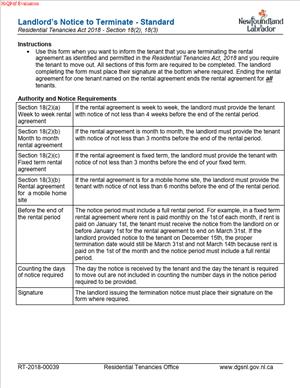
RT 00039 – Landlord Notice to Terminate – Standard
Fill out nowJurisdiction: Country: Canada | Province or State: Newfoundland and Labrador
If you are preparing to end a residential tenancy as a landlord, the RT 00039 – Landlord Notice to Terminate – Standard is the document designed for that purpose in Newfoundland and Labrador. It is the formal written notice used to tell a tenant that their tenancy will be ending.
This form is not just a letter. It is an official document issued by the Residential Tenancies Office. It follows a specific format and requires specific information. If you are about to complete it, you need to understand what each section means and how it affects the tenancy.
The RT 00039 – Landlord Notice to Terminate – Standard is used in standard termination situations. It is different from other termination forms that may apply to special circumstances. Choosing the correct form is the first step in making sure your notice is recognized.
When completed properly, this document sets out the reason for termination, the date the tenant must leave, and key details about the rental unit and tenancy agreement. If completed incorrectly, it may not have the intended effect.
Before you fill it out, it helps to understand when this form is appropriate, what makes it valid, and what information you are expected to provide.
What is RT 00039 – Landlord Notice to Terminate – Standard?
Clear definition
The RT 00039 – Landlord Notice to Terminate – Standard is an official notice used by a landlord to end a residential tenancy agreement. It is a written declaration that the landlord is terminating the rental agreement under permitted circumstances.
This document identifies the landlord, the tenant, the rental premises, the reason for termination, and the effective date. It creates a clear record of the landlord’s intention to end the tenancy.
The form is structured to ensure that all required information is provided. It reduces the risk of missing key details that could make a notice unclear or incomplete.
Who typically uses this form?
This form is typically used by landlords of residential rental units in Newfoundland and Labrador. That includes individual property owners, property managers acting on behalf of owners, and companies that rent residential units.
It is intended for situations where the landlord is initiating the termination. Tenants have separate forms if they wish to end the tenancy themselves.
Property managers may complete the form, but it still reflects the landlord’s legal action. The person signing must have authority to act for the landlord.
Why might you need this form?
You may need this form when a tenancy is ending for a reason permitted under residential tenancy rules. This can include non-payment of rent, breach of the tenancy agreement, or other recognized grounds.
The form provides a standardized way to communicate the termination. It ensures the tenant receives clear notice of what is happening and when.
Using the correct document also creates a record that may be relevant if there is later disagreement about the termination date or reason. Clear documentation often reduces confusion.
Typical real-life scenarios
- A tenant has not paid rent by the required date, and the landlord wants to end the tenancy due to non-payment. The landlord uses the standard termination form to set out the arrears and the date by which the tenant must vacate.
- A tenant has breached a material term of the lease, such as keeping a pet when the agreement prohibits pets. After addressing the issue and deciding to terminate, the landlord uses the form to formally notify the tenant.
- A fixed-term lease is ending, and the landlord does not intend to renew it. The landlord provides written notice using the appropriate termination form to confirm that the tenancy will conclude at the end of the term.
- There has been repeated disturbance or damage to the property, and the landlord determines that termination is necessary. The form is used to explain the grounds and provide the required notice period.
When would you use RT 00039 – Landlord Notice to Terminate – Standard?
You would use this form when you are a landlord ending a residential tenancy under standard circumstances recognized by residential tenancy rules in Newfoundland and Labrador. It applies to residential rental units covered by the provincial tenancy framework.
The timing depends on the reason for termination. Different reasons may involve different notice periods. The form is used once you have determined that termination is permitted and that you are ready to formally notify the tenant.
It is generally used during an active tenancy. This could be during a fixed-term lease or a periodic tenancy, such as month-to-month. The key factor is that a tenancy agreement is in place and you are taking steps to end it.
Landlords commonly use this form when informal communication has not resolved an issue. For example, if rent remains unpaid or a serious breach continues, the next step may be formal written notice through this document.
It may also be used when the tenancy is ending in a routine way, such as at the conclusion of a fixed term, provided the situation fits within the standard termination framework.
You would not use this form for commercial tenancies or for living arrangements that fall outside residential tenancy rules. It is designed specifically for residential landlord-tenant relationships covered by the Residential Tenancies Office.
Legal characteristics of RT 00039 – Landlord Notice to Terminate – Standard
This form has legal significance because it is part of the official residential tenancy process. When properly completed and delivered, it formally notifies the tenant that the landlord is ending the tenancy.
For the notice to be effective, it generally needs to include accurate identifying information. This includes the full names of the parties, the correct rental unit address, and a clear termination date.
The reason for termination must be clearly stated. Vague or incomplete reasons can create confusion and may weaken the notice if later reviewed by an authority.
The termination date must reflect the required notice period for the stated reason. If the date is too soon or inconsistent with the rules for that type of termination, the notice may not have the intended effect.
Service of the notice is also important. The document typically needs to be delivered in a manner recognized under residential tenancy procedures. If the tenant does not properly receive the notice, timing issues can arise.
Common problems include incorrect dates, missing signatures, incomplete addresses, or selecting the wrong reason for termination. Even small errors can create delays or disputes.
This form does not, by itself, physically remove a tenant from the property. It is a notice of termination. If a tenant does not leave by the termination date, further steps may be required under residential tenancy procedures.
There can be differences in how notice periods apply depending on whether the tenancy is fixed-term or periodic. There may also be different requirements depending on the grounds for termination. The form is designed to align with those categories, but the person completing it must ensure the details match the situation.
Is it legally binding?
Yes, the form can be legally binding when it is properly completed and delivered in accordance with residential tenancy procedures. It becomes a formal step in ending the tenancy.
Its binding effect comes from the underlying tenancy rules. The form itself is the vehicle that communicates the landlord’s decision within that legal framework.
If the form contains significant errors, such as an incorrect termination date or missing required information, its effectiveness can be challenged. Accuracy is central to its legal strength.
Once validly issued, the notice sets out a clear termination date. If the tenant does not comply, the notice may be used as part of further proceedings before the Residential Tenancies Office.
It is important to understand that the form does not override the tenancy agreement on its own. It operates within the structure of the existing agreement and applicable tenancy rules. Its binding nature depends on compliance with those rules.
How to fill out RT 00039 – Landlord Notice to Terminate – Standard
Step 1 – Identify the rental unit
Start by entering the full civic address of the rental property. Include the unit number if the property contains multiple units. Accuracy matters here. The address must clearly identify the exact premises covered by the tenancy agreement.
Ensure the spelling and numbers match the tenancy agreement. An incorrect address can create confusion about which unit is being terminated.
Step 2 – Enter the landlord’s information
Provide the full legal name of the landlord as it appears on the tenancy agreement. If the property is owned by a company, enter the full registered business name.
If you are a property manager completing the form, include the landlord’s name as required and add your own contact details where the form requests them. Use a mailing address and contact number where official correspondence can be received.
Step 3 – Enter the tenant’s information
Write the full legal name of each tenant listed on the tenancy agreement. If more than one person signed the lease, each name should appear on the notice.
Names should be consistent with the original agreement. Avoid nicknames or shortened versions. The notice applies to all tenants named in the tenancy.
Step 4 – Specify the reason for termination
Select or write the specific reason for ending the tenancy, as structured in the form. This section is critical. The reason connects directly to the notice period and the validity of the termination.
Be clear and direct. If the termination is for non-payment of rent, state that clearly and include relevant details such as the amount owing and the period it covers, if the form requests it.
If the reason relates to breach of the agreement, describe the breach in the space provided. Keep the explanation factual and focused on what occurred.
Step 5 – Set the termination date
Enter the date on which the tenancy is to end. This is the date the tenant is expected to vacate the rental unit.
The termination date must align with the required notice period for the stated reason. Count the days carefully. Use a calendar to confirm the correct interval between the date of service and the termination date.
Write the full date clearly, including day, month, and year. Ambiguous dates can lead to disputes.
Step 6 – Review notice period details
Before signing, review the form’s instructions regarding notice periods. Confirm that the reason selected matches the length of notice you are giving.
Check that the termination date is not earlier than permitted for the specific ground. If the form includes a section referencing timing rules, read it closely and ensure your entry complies with it.
This review step helps prevent errors that could require the notice to be reissued.
Step 7 – Sign and date the form
Sign the form in the space provided for the landlord or authorized representative. Print your name clearly if required.
Enter the date you are signing the notice. This date may be important for calculating notice periods and establishing when the notice was issued.
If more than one landlord is listed on the agreement, ensure the appropriate party signs according to the form’s instructions.
Step 8 – Arrange for proper delivery
After completion and signing, the form must be delivered to the tenant. The method of delivery can affect when the notice is considered received.
Follow the delivery options described in the residential tenancy procedures or in the form instructions. Keep a record of how and when the notice was delivered.
Retain a copy of the completed and signed form for your records. This copy may be important if there is later disagreement about the content or timing of the notice.
Legal terms you might encounter in RT 00039 – Landlord Notice to Terminate – Standard
- Termination Date: This is the exact date you state the tenancy will end. It must be clear and specific, not vague. The date you enter affects whether the notice is valid, because required notice periods are calculated based on this date.
- Notice Period: The minimum amount of time you must give the tenant before the termination date. The length depends on the reason for ending the tenancy. On this form, you must ensure the termination date provides at least the required number of days.
- Breach of Tenancy Agreement: A violation of a term in the written or verbal rental agreement. Common examples include unpaid rent, damage to the unit, or disturbing other tenants. If you rely on a breach, you should describe it clearly in the space provided.
- Substantial Breach: A serious violation that justifies ending the tenancy. Not every minor issue qualifies. When you select this as a reason, you should be prepared to show how the breach is significant.
- Service of Notice: The method used to deliver the notice to the tenant. This can include personal delivery or other approved methods. Proper service is critical because the notice period usually starts when the tenant receives the document.
- Affidavit of Service: A written statement confirming how and when the notice was delivered. While not always filed immediately, it may be required later to prove the tenant received the notice. Keeping accurate records protects you if the matter is disputed.
- Periodic Tenancy: A rental arrangement that continues month to month or week to week without a fixed end date. The notice period for ending a periodic tenancy may differ from a fixed-term tenancy. You must know which type applies before completing the form.
- Fixed-Term Tenancy: A tenancy with a defined start and end date. Ending a fixed-term tenancy early usually requires a specific legal reason. If you are terminating before the end date, the reason you select on the form must support that action.
- Vacant Possession: The legal right to have the rental unit empty and returned to you. The termination date on the form is the date you expect vacant possession. This term becomes important if enforcement steps are needed.
- Residential Tenancies Office: The government office that oversees disputes and enforcement related to residential tenancies. If the tenant does not leave by the termination date, you may need to apply to this office for further orders.
FAQs
What if I enter the wrong termination date on this form?
If the date does not provide the full required notice period, the notice may be invalid. That means you might have to start over and issue a new document with a corrected date. Double-check the calculation before signing, and confirm that the date reflects the correct number of days from when the tenant will receive it.
Do I need to attach proof of the tenant’s breach when serving RT 00039 – Landlord Notice to Terminate – Standard?
You are not always required to attach evidence when you first serve the notice, but you should have it ready. Keep copies of rent ledgers, written warnings, photos, or complaints that support the reason you selected. If the tenant disputes the notice, the Residential Tenancies Office may ask you to provide that documentation.
What name should I use for the tenant on the notice?
Use the full legal name exactly as it appears on the tenancy agreement. If more than one tenant signed the agreement, list all of them. Mismatched or incomplete names can create confusion and may delay enforcement if you later apply for an order.
Can I email the notice to the tenant?
You must follow an approved method of service. If email is not an accepted method or was not agreed to in writing, it may not count as proper delivery. Check what methods are recognized and record the exact date and method you used.
What happens if the tenant refuses to accept the document?
Refusal does not automatically invalidate service. If you used an approved method and can prove delivery was attempted properly, the notice period may still start. Document the date, time, and circumstances so you can explain what happened if asked.
Does filing RT 00039 – Landlord Notice to Terminate – Standard with the Residential Tenancies Office end the tenancy automatically?
No. Serving the notice is what starts the termination process. Filing with the Residential Tenancies Office is usually a separate step if the tenant does not move out or disputes the notice. The office may schedule a hearing before issuing an order.
What if the tenant fixes the problem after receiving the notice?
Some types of breaches can be corrected within a certain time. If the issue is fully resolved and you accept the correction, you may decide not to proceed further. Keep written confirmation of what was fixed and when, so your records are clear.
Will this document affect the public record or the tenant’s rental history?
The notice itself is a private document between you and the tenant. It generally becomes part of a public record only if a dispute is filed and heard. If that happens, details may be recorded in official decisions or orders.
Checklist: Before, During, and After RT 00039 – Landlord Notice to Terminate – Standard
Before
- Confirm the type of tenancy (fixed-term or periodic).
- Review the tenancy agreement for relevant clauses.
- Verify the legal names of all tenants.
- Calculate the correct notice period based on the reason.
- Gather supporting documents (rent ledger, photos, written complaints).
- Check previous warnings or communications you have sent.
- Decide on an approved method of service.
- Confirm the correct address of the rental unit.
During
- Clearly identify the rental unit address.
- Enter the full legal name of each tenant.
- State the landlord’s full legal name and contact details.
- Select the correct reason for termination.
- Describe the breach or grounds with specific dates and facts.
- Enter a precise termination date.
- Review the form for blank fields or errors.
- Sign and date the document.
- Make copies before serving.
After
- Serve the notice using an approved method.
- Record the date and method of service.
- Complete an affidavit of service if required.
- Store copies of the signed notice and proof of delivery.
- Monitor whether the tenant complies or responds.
- Prepare documents in case a dispute is filed.
- Apply to the Residential Tenancies Office if the tenant does not vacate.
- Update your internal tenant file with all actions taken.
Common mistakes to avoid with RT 00039 – Landlord Notice to Terminate – Standard
- Mistake: Using the wrong notice period because you misread the tenancy type, which happens when landlords assume all tenancies are month-to-month, leading to invalid notices; do not forget to confirm whether the tenancy is fixed-term or periodic before calculating the date.
- Mistake: Listing only one tenant when multiple tenants signed the agreement, which happens when you rely on memory instead of the contract, causing enforcement delays; do not forget to copy every legal name exactly as written.
- Mistake: Giving vague reasons like “lease violation” without details, which happens when you rush the form, making it harder to defend later; do not forget to include dates, actions, and specific clauses breached.
- Mistake: Serving the notice by an unapproved method because it seems convenient, which can invalidate service and restart the timeline; do not forget to verify that your delivery method complies with accepted rules.
- Mistake: Forgetting to sign and date the form, which happens when preparing multiple documents at once, making the notice incomplete; do not forget to check your signature and the date before copying and serving.
- Mistake: Failing to keep proof of service, which often occurs when you trust informal delivery, creating problems if the tenant denies receipt; do not forget to document when, how, and to whom the notice was delivered.
- Mistake: Setting the termination date too early because you calculated from the wrong start date, which can void the notice; do not forget that the notice period usually begins when the tenant receives the document, not when you prepare it.
- Mistake: Ignoring communication after service, which happens when you assume the tenant will leave automatically, leading to missed deadlines for further applications; do not forget to track responses and act promptly if compliance does not occur.
What to do after filling out RT 00039 – Landlord Notice to Terminate – Standard
Once you complete the form, your next actions matter just as much as the wording on the page. The process does not end with your signature.
- Step 1: Make at least two copies of the signed notice, one for your records and one for service.
- Step 2: Review the notice one more time to confirm names, address, reason, and termination date are accurate.
- Step 3: Serve the tenant using an approved delivery method and note the exact date of service.
- Step 4: Record details of service in writing, including time, location, and how delivery occurred.
- Step 5: Place a copy of the notice and proof of service in the tenant’s file.
- Step 6: Mark the termination date on your calendar and set reminders a few days before.
- Step 7: Monitor communication from the tenant and respond in writing where appropriate.
- Step 8: Inspect the unit on or shortly after the termination date if the tenant vacates.
- Step 9: If the tenant does not leave, prepare and submit the required application to the Residential Tenancies Office.
- Step 10: Update your rent records, accounting entries, and property management notes to reflect the pending or completed termination.
Stay organized. Keep every document in chronological order. If a hearing becomes necessary, you will need quick access to the tenancy agreement, your notice, proof of service, and any supporting evidence.
Also, review related documents such as condition reports, payment histories, and written warnings. Make sure your internal records match the information you placed on the notice. Consistency strengthens your position if the matter escalates.
Finally, maintain professional communication. Even after serving a termination notice, clear written communication can reduce conflict and avoid misunderstandings. Keep all exchanges factual and dated.
Disclaimer: This guide is provided for informational purposes only and is not intended as legal advice. You should consult a legal professional.