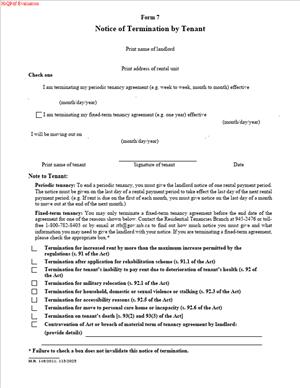
Form 7 – Notice of Termination by Tenant
Fill out nowJurisdiction: Country: Canada | Province or State: Manitoba
The Form 7 – Notice of Termination by Tenant is a written notice used to formally end a residential tenancy in Manitoba. If you are renting a home or apartment and want to move out, this is the document that communicates your decision to your landlord in a clear, official way.
This form is part of Manitoba’s residential tenancy process. It is designed to create a clear record of when you are ending your tenancy and the date you plan to move out. It helps reduce confusion about timelines, rent payments, and possession of the rental unit.
When you complete the Form 7 – Notice of Termination by Tenant properly, you create written proof that you gave notice. That record can matter if there is later disagreement about whether notice was given or whether it was given on time.
If you are about to fill out this form, you likely want to know what information it requires, how it works, and what happens after you submit it. This guide walks you through those points in practical, plain language.
What is Form 7 – Notice of Termination by Tenant?
Clear definition
The Form 7 – Notice of Termination by Tenant is a standard notice used by a tenant to formally end a tenancy agreement. It is not a letter you draft yourself. It is a structured document with specific fields that capture the key details of your tenancy and your intended move-out date.
At its core, this form tells your landlord three things: who you are, which rental unit is affected, and the exact date you are ending the tenancy. It turns your intention to move out into an official notice.
Because it is a standardized document, it promotes consistency. Everyone uses the same format, which reduces misunderstandings about what was said or when notice was given.
Who typically uses this form?
This form is used by residential tenants in Manitoba. That includes people renting apartments, houses, secondary suites, and other residential units under a tenancy agreement.
It may be used by a single tenant or by multiple tenants listed on the same agreement. If more than one person signed the lease, the form often reflects that shared tenancy.
It is generally not used for commercial spaces, such as offices or retail units. Those arrangements usually follow different agreements and processes.
Property managers and landlords receive this form when a tenant chooses to end the tenancy. However, the form itself is completed and signed by the tenant.
Why might you need this form?
You may need this form when you decide to move out at the end of your lease term. It creates a formal record of your decision and your intended last day in the unit.
You might also use it if you are in a month-to-month tenancy and want to end the agreement. In that situation, written notice is typically required, and this form provides the correct structure.
In some cases, a tenant may want to end a tenancy early under circumstances recognized by law. The form documents the tenant’s position and the date they are claiming as the termination date.
Using the correct document can prevent disputes about whether notice was properly given. A casual text or verbal conversation can be harder to prove later.
Typical real-life scenarios
- You found a new job in another city and need to relocate. Your current lease is ending soon, and you want to confirm your move-out date in writing. The form allows you to set out that date clearly.
- You are in a month-to-month tenancy and have purchased a home. You plan your move around the end of a rental period and use the form to officially notify your landlord.
- You share an apartment with a roommate, and both of you signed the lease. You have agreed to move out together at the end of the term. The form documents that joint decision and the end date.
- You are experiencing ongoing issues with the rental unit and have decided to end the tenancy under circumstances that may allow for earlier termination. The form captures your notice and the basis for ending the tenancy, where applicable.
When would you use Form 7 – Notice of Termination by Tenant?
You would use the Form 7 – Notice of Termination by Tenant when you are ready to formally end your tenancy and move out of a residential rental unit in Manitoba. The key factor is that you are the one initiating the end of the tenancy.
This form is commonly used near the end of a fixed-term lease. For example, if your one-year lease is approaching its final months, you may use the form to confirm you will not be renewing and to state your move-out date.
It is also used in periodic tenancies, such as month-to-month agreements. In those cases, notice usually needs to align with a rental period. The form gives a clear written statement of the date you consider the tenancy to end.
If you and your landlord have agreed to end the tenancy on a specific date, the form can still be used to confirm that arrangement in writing. Even when there is agreement, written documentation helps avoid confusion.
The form may also be used in situations involving special grounds for early termination that are recognized under residential tenancy rules. In those cases, the form may include additional information explaining the reason for ending the tenancy before the usual end date.
You would not use this form to evict another tenant or to respond to a landlord’s eviction notice. It is specifically for tenants who are choosing to end their tenancy.
Legal characteristics of Form 7 – Notice of Termination by Tenant
The Form 7 – Notice of Termination by Tenant is a formal legal notice. For it to be effective, it must be completed accurately and delivered in a manner that fits general notice requirements. Key details include the correct names of the parties, the full address of the rental unit, and a clear termination date.
Clarity is critical. If the termination date is missing, unclear, or does not match the rental period structure, disputes can arise. An unclear date may lead to disagreement about when rent stops being owed.
Another common issue is incomplete identification of the rental unit. If the address is wrong or incomplete, the landlord may question whether the notice applies to a specific property.
Timing also matters. Notice periods often depend on the type of tenancy. If a tenant provides less notice than required, the landlord may claim that the tenancy continues beyond the date listed on the form.
Delivery can also affect validity. If the landlord never receives the notice, or receives it later than expected, the effective date may be affected. Keeping a record of when and how the notice was delivered can become important.
This form does not automatically resolve financial matters. It does not determine the return of a security deposit, settle outstanding rent, or address damage claims. Those issues are handled separately.
It also does not, by itself, cancel other agreements you may have signed, such as utility contracts or parking arrangements. Those may require separate steps.
Is it legally binding?
Yes, the Form 7 – Notice of Termination by Tenant can be legally binding when properly completed and delivered. Once a valid notice is given, it generally sets the date the tenancy will end.
It becomes binding because it is a formal written statement of your intention to terminate the agreement. If it meets the required elements and timelines, it creates enforceable expectations about when possession of the unit will return to the landlord.
However, if the form is incomplete, contains errors, or does not meet notice period requirements, its effectiveness may be challenged. In that case, the intended termination date may not be recognized.
The binding effect also depends on the type of tenancy. Fixed-term and periodic tenancies may operate differently. The form reflects your intention, but the surrounding rules determine whether that intention is effective on the date you list.
How to fill out Form 7 – Notice of Termination by Tenant
Step 1 – Identify the rental unit
Start by entering the full address of the rental unit. Include the unit number if there is one. Make sure the address matches what appears on your tenancy agreement so there is no doubt about which property the notice applies to.
Step 2 – Enter the landlord’s name
Write the full legal name of your landlord as it appears on your tenancy agreement or rent receipts. If a property management company is listed as the landlord, use that name exactly as shown in your documents.
Step 3 – Enter the tenant names
List your full legal name and the names of any co-tenants who signed the agreement. If multiple tenants are ending the tenancy together, each person’s name should appear on the form to reflect the shared agreement.
Step 4 – State the termination date
Clearly write the exact date you intend the tenancy to end. Use a complete date format, including day, month, and year. Make sure this date aligns with your rental period and any applicable notice timelines.
Step 5 – Indicate the reason, if required
If the form includes a section asking for the reason for termination, complete it carefully. Some terminations simply state that the tenant is ending the tenancy. Others may require you to indicate a specific ground, especially if ending early under special circumstances.
Provide concise, factual information. Avoid emotional language. The goal is to clearly communicate the basis for ending the tenancy, if the form calls for it.
Step 6 – Review the notice period
Before signing, review the termination date in light of your rental cycle. Confirm that the time between delivering the notice and the listed end date reflects the applicable notice period for your type of tenancy.
This review step helps reduce the risk of disputes about whether sufficient notice was given.
Step 7 – Sign and date the form
Sign your name where indicated. If there are co-tenants, each person may need to sign. Add the date you are signing the form. This date can help establish when the notice was created.
Make sure the signature is clear and matches the name written earlier in the document.
Step 8 – Deliver the notice to the landlord
Provide the completed form to your landlord using a method that creates a clear record of delivery. Keep a copy for your records. Note the date you delivered it and how it was delivered.
Once delivered, your notice sets the process in motion toward the termination date you listed.
Legal terms you might encounter in Form 7 – Notice of Termination by Tenant
- Termination Date: This is the exact date you state your tenancy will end. It is not the date you sign the form or the date you deliver it. The termination date must respect the required notice period and usually aligns with the end of a rental payment period.
- Notice Period: The notice period is the minimum amount of time you must give your landlord before moving out. It is counted from the date the landlord receives the notice, not when you prepare it. If you miscalculate this period, your termination date may not be valid.
- Service of Notice: Service means how you deliver the notice to your landlord. The method of service can affect when the notice is legally considered received. The form assumes you will deliver it in a way that allows you to prove the date it was given.
- Rental Period: The rental period is the recurring cycle for which you pay rent, such as monthly or weekly. Your termination date usually needs to fall on the last day of a rental period. You must check your tenancy agreement to confirm this detail.
- Fixed-Term Tenancy: A fixed-term tenancy runs for a set period, such as one year. If you are in a fixed-term agreement, ending it early may require a specific legal reason or agreement from the landlord. This form records your intention, but it does not automatically override a fixed term.
- Periodic Tenancy: A periodic tenancy continues without a fixed end date, often month-to-month. In this case, giving proper notice according to the rental period is usually enough to end the tenancy. The termination date must align with that ongoing cycle.
- Joint Tenancy: A joint tenancy means more than one tenant signed the agreement together. All tenants may need to be named on the notice. If only one tenant signs, it can create confusion about who is actually ending the tenancy.
- Subtenant: A subtenant rents from a tenant rather than directly from the landlord. If you are a subtenant, your notice obligations may differ. The form captures the relationship between the person giving notice and the rental unit.
- Rental Unit: The rental unit is the specific address and unit number you are renting. This includes any identifiers like apartment number or suite number. Accuracy here prevents disputes about which unit is being vacated.
- Effective Date: The effective date is when the termination legally takes effect. It is usually the same as the termination date stated on the form. If the effective date does not comply with notice rules, the notice may not be enforceable.
FAQs
What date should I put as the termination date?
You should enter the last day you intend to occupy and pay rent for the rental unit. Make sure that the date falls at the end of your rental period, such as the last day of the month for a month-to-month tenancy. Count the required notice period from the day your landlord receives the notice, not the day you sign it, and confirm that the date you write gives enough time.
What happens if I give less notice than required?
If you provide too little notice, the termination date you listed may not be valid. Your landlord could treat the notice as taking effect on a later date that complies with the proper notice period. That may mean you remain responsible for rent beyond the date you originally planned to move out.
Do all tenants need to sign this document?
If the tenancy agreement lists more than one tenant, it is safest for all named tenants to sign. This shows a clear and unified intention to end the tenancy. If only one person signs, it may raise questions about whether the others intend to stay, which can complicate how the landlord responds to the Form 7 – Notice of Termination by Tenant.
Can I change the termination date after I deliver the notice?
Once the landlord receives this form, the termination date is generally considered set. Any change usually requires agreement from the landlord. If you need to adjust the date, communicate in writing and keep a copy of any written confirmation.
How do I prove that my landlord received the notice?
You should use a delivery method that creates a record of the date and time of delivery. Keep copies of the signed document and any proof of service, such as a receipt or written acknowledgment. This helps if there is later disagreement about when the notice period started.
What if my name is spelled differently on the lease and on this form?
Your name on this document should match the name on the tenancy agreement as closely as possible. Small spelling differences can cause confusion about identity. If there has been a legal name change, consider adding the former name in brackets so the record clearly links you to the tenancy.
Does filing this form mean I do not have to pay rent anymore?
No. You remain responsible for rent until the effective termination date stated in the Form 7 – Notice of Termination by Tenant, provided it meets notice requirements. If you move out earlier, but the date on the form is later, you are still generally responsible for rent up to that later date.
Do I need to send this form to the Residential Tenancy Branch?
This document is typically delivered to the landlord, not filed with the Branch at the time you give notice. However, you should keep a copy in case you need to show that proper notice was given. If a dispute arises, the Form 7 – Notice of Termination by Tenant becomes part of the official record.
Checklist: Before, During, and After Form 7 – Notice of Termination by Tenant
Before
- Review your tenancy agreement to confirm whether it is fixed-term or periodic.
- Identify your rental period and the date rent is due.
- Calculate the correct notice period based on your tenancy type.
- Confirm the full legal name of your landlord as shown on the agreement.
- Verify the exact address and unit number of the rental unit.
- Check whether all co-tenants agree to end the tenancy.
- Plan your intended move-out date to align with the end of a rental period.
- Gather contact details for delivering the notice.
During
- Write the full address of the rental unit clearly and completely.
- Enter the landlord’s name exactly as it appears on the lease.
- List all tenant names as shown on the agreement.
- Insert a termination date that respects the required notice period.
- Double-check your date calculations before signing.
- Ensure all required tenants sign and date the form.
- Keep handwriting legible and avoid corrections or cross-outs.
- Make a complete copy of the signed document.
After
- Deliver the notice using a method that allows you to prove receipt.
- Record the date and time the notice was delivered.
- Keep proof of delivery with your copy of the form.
- Continue paying rent up to the termination date.
- Arrange a move-out inspection with the landlord if applicable.
- Provide a forwarding address in writing for future correspondence.
- Document the condition of the rental unit before leaving.
- Retain all records in case of a future dispute.
Common mistakes to avoid with Form 7 – Notice of Termination by Tenant
- Mistake: Choosing a termination date that does not fall at the end of a rental period because you focus on your moving schedule, which can invalidate the notice and extend your rent obligation, so do not forget to align the date with your rent cycle.
- Mistake: Counting the notice period from the day you sign instead of the day the landlord receives it, which happens when delivery timing is overlooked and can shorten the required notice, so do not forget to factor in delivery time.
- Mistake: Leaving out one of the tenants listed on the lease because you assume one signature is enough, which can create uncertainty about who is ending the tenancy, so do not forget to include and obtain signatures from all named tenants.
- Mistake: Using an incomplete or incorrect rental unit address due to copying errors, which can cause disputes about which unit the notice applies to, so do not forget to verify the full legal address and unit number.
- Mistake: Failing to keep proof of delivery because you trust an informal handoff, which can leave you unable to prove when notice was given, so do not forget to retain written evidence of service.
- Mistake: Assuming you can withdraw the notice at any time because your plans changed, which may not be accepted by the landlord, and can lock in your termination date, so do not forget that changes usually require a written agreement.
- Mistake: Ignoring the terms of a fixed-term lease because you believe notice alone ends it, which can expose you to liability for remaining rent, so do not forget to confirm whether your tenancy has a set end date.
- Mistake: Submitting a form with unclear handwriting or crossed-out dates because you rushed, which can lead to misunderstandings or challenges to validity, so do not forget to complete the document neatly and accurately.
What to do after filling out Form 7 – Notice of Termination by Tenant
Once you complete the form, your focus shifts to delivery, documentation, and preparing to move. Treat this stage as seriously as filling out the form itself. Small oversights can create avoidable disputes.
- Step 1: Make at least two copies of the signed form, one for your records and one as a backup.
- Step 2: Deliver the notice to your landlord using a method that provides confirmation of receipt.
- Step 3: Record the exact date the landlord receives the notice and calculate the confirmed effective termination date.
- Step 4: Continue paying rent in full and on time until the termination date written on the form.
- Step 5: Provide your forwarding address in writing so future correspondence, including any deposit matters, can reach you.
- Step 6: Arrange a move-out inspection if this is part of your tenancy process.
- Step 7: Clean the rental unit and remove all personal belongings before the termination date.
- Step 8: Take dated photos or videos of each room to document the condition at move-out.
- Step 9: Return all keys, access cards, and garage remotes to the landlord and note the date of return.
- Step 10: Keep your copy of the notice, proof of delivery, photos, and any written communication together in a secure file.
By staying organized and proactive, you reduce the risk of disagreements about notice, rent owing, or the condition of the unit. Clear records protect you if questions arise later.
Disclaimer: This guide is provided for informational purposes only and is not intended as legal advice. You should consult a legal professional.