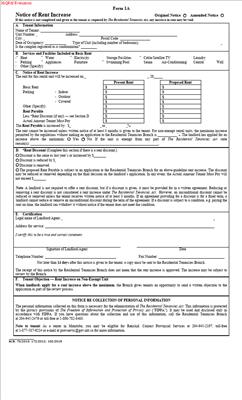
Form 1A – Notice of Rent Increase
Fill out nowJurisdiction: Country: Canada | Province or State: Manitoba
If you are increasing rent for a residential unit in Manitoba, you will likely need Form 1A – Notice of Rent Increase. This document is used to formally notify a tenant that their rent is going up.
Form 1A – Notice of Rent Increase is not just a letter. It is a structured form connected to Manitoba’s residential tenancy system. It sets out the current rent, the new rent, and when the increase takes effect.
You use this form when you want to change the amount a tenant pays on an ongoing tenancy. It creates a written record of the change and shows that proper notice was given.
If you are about to complete this form, you need to understand what it does, what information it requires, and how it fits into the broader rental agreement. This guide walks you through those basics in plain language.
What is Form 1A – Notice of Rent Increase?
Clear definition
Form 1A – Notice of Rent Increase is a written notice used in Manitoba to inform a tenant that the rent for their rental unit will increase on a specific date. It identifies the rental property, the current rent, the new rent, and the effective date of the increase.
The form is designed to create a clear, standardized record of the proposed rent change. It connects the increase to an existing tenancy agreement. It does not create a new lease by itself.
The document focuses only on the rent amount. It does not deal with security deposits, repairs, utilities, or other lease terms unless those items affect how rent is calculated.
Who typically uses this form?
Most often, landlords or property managers complete Form 1A – Notice of Rent Increase. They use it when they want to raise rent for a tenant who continues to occupy the unit.
In some cases, a property owner may fill out the form personally. In larger buildings, an authorized agent may prepare and serve it on behalf of the owner.
Tenants do not complete this form to request an increase. It is a notice given to them. However, tenants receive it and may review the details carefully to understand how their monthly payment will change.
Why might you need this form?
You need this form when you plan to increase rent during an ongoing tenancy. Oral notice is not enough. A written notice provides clarity and proof.
The form helps ensure that key details are not missed. It prompts you to include the rental unit address, the names of the parties, and the exact new amount. This reduces confusion later.
Using the correct form can also prevent disputes. If the notice is incomplete or unclear, a tenant may question its validity. A properly completed document supports transparency.
Typical real-life scenarios
- A landlord has a tenant on a year-to-year lease that is continuing beyond its initial term. The landlord decides to increase the monthly rent for the upcoming period. Form 1A – Notice of Rent Increase is used to communicate the change in writing.
- A property owner faces rising operating costs, such as property taxes and maintenance expenses. To reflect these changes, the owner prepares a rent increase notice for several units in the building, using a separate form for each tenancy.
- A tenant has been renting the same apartment for several years under a periodic agreement. The landlord chooses to adjust the rent to align with current market conditions. The form sets out the new monthly amount and the date it will start.
- A building changes ownership, and the new owner reviews existing rents. If the new owner plans to increase rent for continuing tenants, Form 1A – Notice of Rent Increase is completed and delivered to each affected tenant.
When would you use Form 1A – Notice of Rent Increase?
You use this form when a tenancy is ongoing and you want to change only the rent amount. The tenancy itself continues under the existing agreement, subject to the new rent once the increase takes effect.
It is commonly used in periodic tenancies, such as month-to-month or year-to-year arrangements. It may also be used when a fixed-term lease ends and the tenancy continues under similar terms.
You would not use this form to introduce entirely new lease terms unrelated to rent. It is focused on the financial aspect of the tenancy.
The form is also not used to collect unpaid rent. If a tenant owes arrears, that situation involves different processes and notices. Form 1A – Notice of Rent Increase deals only with future rent.
Landlords often prepare the form several months before the proposed increase date. This allows time for proper notice and for the tenant to review the change.
Legal characteristics of Form 1A – Notice of Rent Increase
Form 1A – Notice of Rent Increase has legal significance because it forms part of the official communication between landlord and tenant. It documents that a rent increase was proposed and sets out specific details.
For the form to be effective, it generally needs to be complete and accurate. The names of the landlord and tenant must be correct. The rental unit must be clearly identified. The current rent and new rent must be stated in clear dollar amounts.
The effective date is critical. The increase must be tied to a specific date. If the date is unclear or conflicts with the required notice period, the increase may be questioned.
Common problems arise when the notice period is too short, when the rent calculation is incorrect, or when required approvals are not addressed. In some situations, rent increases may be subject to limits or additional requirements. The form does not override those rules.
High-level differences can exist depending on the type of rental unit. Some units may be subject to rent regulation, while others may not. The process for increases may vary based on those classifications. The form itself remains a notice, but the surrounding requirements may differ.
Importantly, this document does not end a tenancy. It does not evict a tenant. It does not automatically amend every term of the agreement. It changes the rent amount as of the stated date, assuming all requirements are met.
Is it legally binding?
Form 1A – Notice of Rent Increase becomes legally meaningful when it is properly completed and delivered in accordance with applicable rules. Once effective, the new rent amount forms part of the tenancy agreement.
The document itself does not require the tenant’s signature to be valid as a notice. However, the tenant must receive it properly. Service and timing are central to its effect.
If the form contains serious errors, such as the wrong address or an impossible effective date, its validity may be challenged. Accuracy supports enforceability.
Once the effective date passes and the tenancy continues, the new rent typically applies as part of the ongoing agreement. The binding nature arises from the combination of proper notice and the continuation of the tenancy under the new terms.
How to fill out Form 1A – Notice of Rent Increase
Step 1 – Identify the rental unit
Begin by entering the full address of the rental property. Include the unit number if the property has multiple units. The address must clearly identify the exact space the tenant occupies. This avoids confusion, especially in apartment buildings or multi-unit homes.
Step 2 – Enter the tenant’s full name
Write the legal name of each tenant listed on the tenancy agreement. If more than one person signed the agreement, include all names as they appear in the original document. Consistency with the lease helps confirm that the notice applies to the correct parties.
Step 3 – Provide the landlord’s name and contact details
Enter the full legal name of the landlord or property owner. If an authorized agent is acting on the landlord’s behalf, include the agent’s name as required on the form. Provide contact information in the space indicated so the tenant knows where to direct questions or payments.
Step 4 – State the current rent amount
Clearly write the current rent that the tenant is paying. Use the exact monthly amount stated in the existing agreement. If rent is paid on another schedule, such as weekly, reflect the current amount in the format requested by the form.
Accuracy here is important. The current rent amount serves as the baseline for the increase. Any mistake can create confusion about how much the rent is actually changing.
Step 5 – Enter the new rent amount
Write the new rent that will take effect. Use clear dollar figures and ensure the amount is consistent throughout the form. Double-check your calculation before finalizing this section.
If the form requires you to show the difference between the current and new rent, complete that section carefully. This helps the tenant understand the size of the increase.
Step 6 – Specify the effective date of the increase
Insert the exact date when the new rent will begin. The date must reflect the required notice period and align with the rental payment cycle. For example, if rent is paid monthly, the increase often takes effect on the first day of a rental period.
Ensure the date is written in full, including day, month, and year. This reduces the risk of misinterpretation.
Step 7 – Confirm any required approvals or conditions
Some situations may require confirmation that the rent increase complies with applicable limits or approval processes. If the form includes a section addressing this, complete it as directed.
Read this part carefully. It may ask you to indicate whether approval has been obtained or whether the unit is exempt from certain limits. Provide the information requested without leaving blanks.
Step 8 – Sign and date the form
The landlord or authorized agent must sign the form in the space provided. Print your name if required. Add the date of signing.
The signature confirms that the information in the document is accurate to the best of your knowledge. It also marks the moment the notice is formally issued.
Step 9 – Deliver the notice to the tenant
After completing Form 1A – Notice of Rent Increase, provide it to the tenant using an accepted method of delivery. The method of service can affect when the notice is considered received.
Record the date and method of delivery for your own records. Keep a copy of the completed form. This creates a clear record of what was provided and when the process was completed.
Legal terms you might encounter in Form 1A – Notice of Rent Increase
- Effective Date: This is the date when the new rent amount starts. On this form, you must clearly state the exact day the increase takes effect. The effective date must align with the notice period required for rent increases and usually matches the start of a rental payment period.
- Current Rent: This refers to the amount the tenant is paying right now before the increase. You must enter the exact monthly rent as it appears in the lease or most recent agreement. Do not include security deposits or one-time charges in this figure.
- New Rent: This is the updated amount the tenant will be required to pay starting on the effective date. You must calculate this carefully. Errors here can invalidate the notice or cause disputes.
- Notice Period: This is the required amount of time you must give the tenant before the increase takes effect. The notice period ensures the tenant has enough advance warning. You must make sure the effective date reflects the full required notice period.
- Rental Unit: This describes the specific property being rented. On the form, you must clearly identify the unit, including the full address and unit number if applicable. Accuracy matters, especially in multi-unit buildings.
- Landlord: The person or legal entity that owns or manages the rental property. The name you enter must match the name on the lease or tenancy agreement. If a property manager signs, they must have proper authority.
- Tenant: The person legally responsible for paying rent under the tenancy agreement. You must use the tenant’s full legal name as shown in the agreement. If there are multiple tenants, each should be properly identified.
- Service of Notice: This refers to how you deliver the notice to the tenant. Proper service is essential. If the notice is not delivered according to accepted methods, the rent increase may not be enforceable.
- Rent Increase Guideline: In some cases, rent increases must follow a set percentage limit. If applicable, you must ensure the new rent complies with the permitted amount unless approval for a higher increase has been granted.
- Approval Order: If a rent increase exceeds the standard limit, you may need formal approval. If such approval is required, you should reference it properly when completing this document.
FAQs
How do I calculate the correct effective date for the rent increase?
You start by counting the full notice period required before the increase can take effect. The effective date should fall on the first day of a new rental payment period, such as the first of the month if rent is paid monthly. Double-check that the tenant receives the notice early enough to meet the full notice requirement. If you miscalculate the date, you may have to restart the notice process.
What if I make a mistake in the rent amount on this form?
If you notice the error before delivering the document, correct it and ensure all copies match. If you have already delivered it, you may need to issue a new notice with the correct information. An incorrect amount can create confusion and may make the notice unenforceable. Always verify your math before signing.
Do I need approval before issuing Form 1A – Notice of Rent Increase?
That depends on whether the increase follows the allowable guideline. If your increase exceeds the permitted amount, you typically need prior approval before serving the notice. The form itself records the new amount and effective date, but it does not replace any required approval. Make sure you have written confirmation if approval is necessary.
What names should I use for the tenant and landlord?
Use the full legal names exactly as they appear on the tenancy agreement. Do not shorten names or use nicknames. If there are joint tenants, include all of them. If a corporation owns the property, use the registered corporate name.
How should I deliver this document to the tenant?
You must use a delivery method that qualifies as proper service. Common methods include personal delivery or another legally recognized method. Keep proof of how and when you delivered it. The date of service affects whether your notice period is valid.
What happens if the tenant refuses to accept the notice?
Refusal does not automatically invalidate the notice if you attempted proper service. The key issue is whether you followed an accepted delivery method. Document your attempt carefully. Keep written notes about the date, time, and method used.
Can I increase rent more than once a year?
Rent increases are generally limited to specific time intervals. Before completing this document, confirm that enough time has passed since the last increase. If you issue a notice too soon, it may not be valid. Check your records carefully.
What should I keep for my records after serving the Form 1A – Notice of Rent Increase?
Keep a copy of the signed notice, proof of service, and any approval documents related to the increase. Store these with the tenant’s file. You may need them if a dispute arises or if the tenant questions the validity of the increase.
Checklist: Before, During, and After Form 1A – Notice of Rent Increase
Before
- Confirm the date of the last rent increase for the unit.
- Verify that the proposed increase complies with the allowable guideline.
- Obtain approval if the increase exceeds the permitted limit.
- Review the tenancy agreement for correct tenant names and rent amount.
- Calculate the correct new rent and double-check your math.
- Determine the earliest valid effective date based on the required notice period.
- Confirm the correct legal name of the landlord or owning entity.
- Prepare a clean, legible copy of the form for completion.
During
- Enter the full rental unit address, including unit number.
- Write the tenant’s full legal name exactly as shown on the lease.
- Clearly state the current rent without adding extra charges.
- Insert the new rent amount accurately.
- Double-check that the effective date reflects the full notice period.
- Ensure all required fields are completed without leaving blanks.
- Sign and date the form in the appropriate section.
- Make at least two copies before serving the notice.
After
- Deliver the notice using an accepted method of service.
- Record the date, time, and method of delivery.
- Keep proof of service in the tenant’s file.
- Update your rent ledger to reflect the upcoming change.
- Monitor the effective date to ensure the new amount is applied correctly.
- Respond promptly if the tenant raises questions.
- Retain copies of any approval orders related to the increase.
- Store all documents securely for future reference.
Common mistakes to avoid with Form 1A – Notice of Rent Increase
- Mistake: Entering the wrong effective date because you miscounted the notice period, which happens when you rush the calculation; this can invalidate the increase, so do not forget to count full calendar months properly.
- Mistake: Listing an incorrect rent amount due to simple math errors, often caused by estimating instead of calculating; this can trigger disputes, so do not forget to verify the final figure twice.
- Mistake: Using nicknames or incomplete tenant names because they seem informal and easier; this can create legal ambiguity, so do not forget to match the lease exactly.
- Mistake: Failing to obtain required approval before issuing the notice because you assume the increase is allowed; this can result in rejection or reversal, so do not forget to confirm compliance first.
- Mistake: Serving the notice improperly due to a misunderstanding of delivery rules; this can delay the increase, so do not forget to document how and when you served it.
- Mistake: Leaving sections blank because they seem unimportant; incomplete forms may be challenged, so do not forget to review every line before signing.
- Mistake: Increasing rent too soon after a prior increase because you did not check your records; this can void the notice, so do not forget to confirm timing eligibility.
- Mistake: Forgetting to keep copies because you assume there will be no dispute; without records, you cannot prove service, so do not forget to store signed copies safely.
What to do after filling out Form 1A – Notice of Rent Increase
Once you complete the form, your next steps matter just as much as the information you entered. Proper handling protects you if the tenant questions the increase later.
Start by reviewing the entire document again. Read it slowly. Confirm that the rental address, tenant names, rent amounts, and effective date are all correct. Small errors can cause delays.
Make clear copies before you deliver them. Keep one copy for your records and prepare one for each tenant listed on the agreement.
- Step 1: Sign and date the form if you have not already done so.
- Step 2: Make at least two copies of the completed notice.
- Step 3: Deliver the notice using a recognized service method.
- Step 4: Record the exact date and method of service in your files.
- Step 5: Keep any delivery confirmation or written notes as proof.
- Step 6: Update your internal rent schedule to reflect the new amount starting on the effective date.
- Step 7: Monitor rent payments when the effective date arrives to ensure the correct amount is paid.
- Step 8: Communicate clearly with the tenant if they have questions about the increase.
- Step 9: Retain the notice and related documents for the duration of the tenancy.
- Step 10: If approval was required, keep the approval order attached to your copy of the notice.
You should also prepare for possible tenant responses. The tenant may accept the increase without comment. They may ask questions about how you calculated it. They may raise concerns about timing. Stay organized so you can respond quickly and clearly.
Keep all documents related to the tenancy together. That includes the lease agreement, past rent increase notices, approval documents, and proof of service. Good recordkeeping reduces stress if a disagreement arises.
If the tenant continues paying the old rent after the effective date, review your records immediately. Confirm that the notice was properly served and that the effective date was correct. Clear documentation will help you address the issue calmly and confidently.
Above all, treat the notice as part of a structured process. Accuracy, timing, and documentation are what make the increase enforceable. When you follow each step carefully, you reduce the risk of delays or disputes.
Disclaimer: This guide is provided for informational purposes only and is not intended as legal advice. You should consult a legal professional.