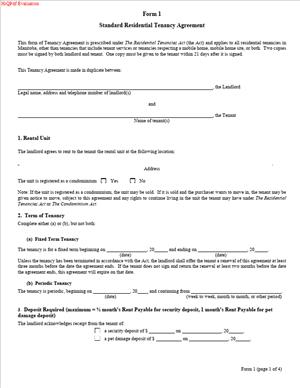
Form 1 – Standard Residential Tenancy Agreement
Fill out nowJurisdiction: Country: Canada | Province or State: Manitoba
The Form 1 – Standard Residential Tenancy Agreement is the written contract used to set the terms of most residential rental arrangements in Manitoba. It records the rights and responsibilities of both a landlord and a tenant in one clear document.
If you are about to rent a house, apartment, basement suite, or condominium unit, this is often the agreement you will be asked to review and sign. If you are a landlord, this is the form commonly used to confirm the rental terms before a tenant moves in.
This form matters because it sets the rules for the tenancy. It outlines rent, deposits, services, occupancy limits, and other key conditions. Once signed, it becomes the foundation of the rental relationship.
Understanding what each section means helps you avoid confusion later. When you know what you are agreeing to, you can complete the document accurately and confidently.
What is Form 1 – Standard Residential Tenancy Agreement?
Clear definition
The Form 1 – Standard Residential Tenancy Agreement is a standardized residential lease document used in Manitoba. It creates a written record of the agreement between a landlord and a tenant for the rental of residential premises.
The form identifies the rental unit, the parties involved, the rental amount, the payment schedule, and other essential terms. It also incorporates rules that reflect Manitoba’s residential tenancy framework.
This agreement is designed to be consistent across most residential tenancies. It reduces misunderstandings by using a structured format with clearly labeled sections.
Who typically uses this form?
Landlords use this form when renting out houses, apartments, duplexes, condominium units, and similar residential properties. Property managers may also prepare it on behalf of property owners.
Tenants use this form when entering into a new rental arrangement. It applies to individuals, couples, families, and unrelated roommates who are renting a residential unit.
In many cases, both parties review and sign the form before the tenant takes possession of the rental unit. Each party typically keeps a copy for its records.
Why might you need this form?
You need this form when creating a new residential tenancy agreement in Manitoba. It is commonly used at the beginning of a rental relationship.
It helps clarify how much rent is due, when it must be paid, and what is included in the rent. It also sets out expectations about utilities, maintenance, and occupancy.
If a dispute arises later, the written agreement becomes an important reference point. It shows what both sides agreed to at the start of the tenancy.
The form also supports transparency. By setting out the terms in writing, it reduces the risk of verbal misunderstandings.
Typical real-life scenarios
- You are moving into an apartment building in Winnipeg. Before receiving the keys, the landlord asks you to review and sign the agreement. The form confirms the monthly rent, the security deposit, and the lease term.
- You are renting out a basement suite in your home. To formalize the arrangement with your new tenant, you complete the form and ensure all services included in the rent are clearly listed.
- You are entering into a fixed-term lease for one year. The agreement specifies the start and end dates, so both sides know when the term expires.
- You are renting a house with two roommates. All tenants are listed on the agreement. This makes it clear who is responsible for paying rent and following the conditions.
When would you use Form 1 – Standard Residential Tenancy Agreement?
You would use this form at the start of most residential rental arrangements in Manitoba. It applies whether the tenancy is for a fixed term or on a month-to-month basis.
Landlords typically prepare the agreement before the tenant moves in. It is signed after both parties agree on the terms, but before possession is given.
Tenants use it when they are securing a rental unit and want written confirmation of the agreed-upon terms. Reviewing the form before signing allows you to understand the financial and practical commitments involved.
This form is commonly used for apartments, single-family homes, townhouses, and similar residential units. It may not apply to certain living arrangements, such as commercial leases or temporary accommodations, which are usually governed by different agreements.
If there are co-tenants, all of their names are generally included in the same agreement. This clarifies that each named tenant is part of the tenancy.
Legal characteristics of Form 1 – Standard Residential Tenancy Agreement
The Form 1 – Standard Residential Tenancy Agreement is structured to reflect Manitoba’s residential tenancy framework. It includes mandatory information such as the names of the parties, the rental address, the amount of rent, and the payment schedule.
For the agreement to function properly, it must be completed accurately. Missing names, unclear rent amounts, or incorrect dates can create confusion. Inconsistent information between sections may also lead to disputes.
Both parties typically sign and date the form. Signatures confirm that the parties agree to the terms set out in the document.
Certain terms may not be enforceable if they conflict with residential tenancy rules. For example, adding conditions that remove basic tenant protections may not have an effect, even if written in the agreement. The form does not allow parties to contract out of fundamental residential tenancy rights.
High-level differences may exist between provinces. In Manitoba, standardized forms are commonly used to promote consistency. Other provinces may use differently numbered forms or differently structured agreements.
This document does not replace communication between the landlord and the tenant. It also does not automatically resolve future disputes. It sets out the agreed terms, but enforcement and interpretation are separate processes.
Is it legally binding?
Yes, the agreement is generally legally binding once it is properly completed and signed by both the landlord and the tenant. A binding agreement usually requires clear terms, mutual agreement, and signatures.
When both parties sign, they confirm that they accept the obligations described in the document. This includes paying rent as stated and complying with the conditions of the tenancy.
If essential information is missing or if one party did not agree to key terms, questions may arise about interpretation. Clear, complete entries reduce that risk.
The agreement remains in effect according to its terms. For a fixed-term tenancy, it usually applies until the stated end date. For a periodic tenancy, it continues according to the agreed rental period unless ended in accordance with applicable rules.
How to fill out Form 1 – Standard Residential Tenancy Agreement
Step 1 – Identify the landlord and tenant
Enter the full legal name of the landlord. If the property is owned by more than one person, list each owner as required. If a property manager is acting on behalf of the owner, ensure the owner’s details are clearly stated where required.
Next, enter the full legal names of all tenants who will be responsible under the agreement. Include every adult occupant who is intended to be part of the tenancy. Accurate names help avoid confusion later.
Step 2 – Provide the rental unit details
Write the complete address of the rental property. Include the unit number if it is part of a larger building. The address should clearly identify the specific premises being rented.
If parking spaces, storage lockers, or other areas are included, ensure they are described in the appropriate section. Clear identification reduces disputes about what is included in the tenancy.
Step 3 – State the term of the tenancy
Indicate whether the tenancy is for a fixed term or on a periodic basis, such as month-to-month. If it is a fixed term, enter the start date and the end date.
Make sure the dates are accurate and consistent. The start date often corresponds with the date the tenant is entitled to move in.
If the tenancy is periodic, specify the frequency of the rental period, such as monthly. This affects how rent is calculated and when notices may take effect.
Step 4 – Set out the rent details
Enter the amount of rent to be paid and the due date. Clearly state whether rent is due on the first day of the month or another specified date.
Indicate how rent is to be paid, such as by cheque, electronic transfer, or another agreed method. The payment method should be clearly described to avoid later disagreements.
If there are additional charges, such as for parking or services, record them in the appropriate section. Ensure that the total financial obligations are transparent.
Step 5 – Record the security deposit
Enter the amount of the security deposit being collected, if applicable. The form may include a specific section for this purpose.
Make sure the amount recorded matches what is actually being paid. Accuracy at this stage supports clear financial records.
Step 6 – Identify included services and utilities
Specify which utilities and services are included in the rent. This may include heat, water, electricity, or internet, depending on the arrangement.
If certain utilities are the tenant’s responsibility, the agreement should reflect that clearly. Clear entries prevent misunderstandings about monthly expenses.
Also record any appliances or furnishings provided with the unit, if the form includes space for this information.
Step 7 – Review additional terms and conditions
Read through any standard clauses included in the form. These may address maintenance, occupancy limits, alterations, and other common matters.
If there is a section for additional terms, ensure any added conditions are written clearly and do not conflict with the main provisions. Ambiguous wording can create disputes later.
Take time to read the entire document from beginning to end. Confirm that all handwritten or typed entries are legible.
Step 8 – Sign and date the agreement
Both the landlord and all listed tenants sign and date the agreement in the designated spaces. Each signature confirms acceptance of the terms.
Ensure the dates beside the signatures are accurate. The signing date may be different from the tenancy start date.
After signing, each party typically keeps a copy of the completed agreement. Keeping a copy allows you to refer back to the terms during the tenancy.
Stop once all sections are complete, signatures are in place, and copies are distributed. The agreement then serves as the written record of your residential tenancy arrangement.
Legal terms you might encounter in Form 1 – Standard Residential Tenancy Agreement
- Fixed-term tenancy: This means the rental has a clear start date and end date written in the agreement. In this form, you must enter both dates. When the end date arrives, the tenancy may end or continue depending on what you and the tenant agree to and what the law provides.
- Periodic tenancy: This is a tenancy that continues month-to-month or week-to-week without a set end date. On this form, you will indicate the frequency of rent payments. The tenancy keeps going until either party properly ends it.
- Security deposit: This is money the tenant pays at the start of the tenancy as protection against damage or unpaid obligations. The form requires you to record the exact amount collected. You must also note when it was paid and keep clear records.
- Rental unit: This is the specific space being rented. In this document, you must describe the unit clearly, including the address and unit number. The description should match how the property is legally identified and how mail is delivered.
- Additional occupants: These are people who will live in the unit but are not signing as tenants. The form may ask you to list them. You should be accurate because occupancy limits and responsibilities can depend on who is living there.
- Included services: These are utilities or services covered by the rent, such as heat, water, electricity, parking, or appliances. The form has a section where you check or list what is included. Be precise so there is no confusion later about who pays for what.
- Late payment charges: This refers to fees that may apply if rent is not paid on time. If the agreement allows for such charges, the terms must be clearly written in the appropriate section. You should not assume they apply unless they are properly set out.
- Assignment or subletting: Assignment means transferring the entire tenancy to someone else. Subletting means renting the unit to another person for part of the term while the original tenant remains responsible. The agreement may outline how consent is handled and what steps must be followed.
- Rules and regulations: These are building or property rules that tenants must follow, such as noise restrictions or garbage disposal procedures. If rules apply, they should be referenced in the form and attached if required. Tenants should know exactly which rules form part of the agreement.
- Joint and several liability: This applies when more than one tenant signs the agreement. Each tenant is individually and collectively responsible for the full rent and obligations. If one tenant fails to pay, the landlord can pursue the others for the full amount.
FAQs
Do all tenants have to sign the Form 1 – Standard Residential Tenancy Agreement?
Yes. Every adult tenant who will be legally responsible for the rent and terms should sign this document. If someone lives in the unit but does not sign, they may not have the same rights or obligations clearly recorded. Make sure the names on the signature lines match the names listed at the beginning of the agreement.
What date should I use as the start date of the tenancy?
You should enter the exact date the tenant has the right to move in and take possession of the unit. This may or may not be the same day the agreement is signed. The start date affects when rent is first due and when notice periods are calculated, so confirm it carefully before writing it down.
What happens if I make a mistake while filling out this form?
If you notice an error before signing, correct it neatly and ensure both parties initial the change. If the mistake is found after signing, you may need a written amendment signed by everyone. Do not rely on verbal agreements to fix errors in this document, as they may not be enforceable or easy to prove.
Can we add extra terms that are not pre-printed in the agreement?
Yes, but any additional terms must be written clearly in the space provided or attached as a separate page. Both parties should review and sign or initial any added pages. Make sure the added terms do not conflict with mandatory residential tenancy rules, as conflicting terms may not be valid.
Do I need to attach anything to this document?
You may need to attach house rules, a list of included appliances, or additional terms. If you reference an attachment in the body of the agreement, ensure it is actually included and clearly labeled. Keep a complete copy with all attachments for your records.
Who keeps the original signed copy?
Each party should receive a complete signed copy of this form. It is common for the landlord to retain the original, but the tenant must receive a full duplicate with all pages and attachments. Store your copy in a safe place because it is the primary record of your rental terms.
What if the rent amount changes later?
This document records the rent agreed to at the start of the tenancy. If rent changes in the future, it generally requires proper notice and documentation. Do not simply cross out the old amount and write in a new one without following the correct process and creating a written record signed by both parties.
Does this agreement need to be filed with the Residential Tenancies Branch?
In most cases, you do not file this agreement at the time of signing. However, it may be required if there is a dispute or if you are asked to provide it during a proceeding. Keep the Form 1 – Standard Residential Tenancy Agreement accessible so you can produce it quickly if requested.
Checklist: Before, During, and After Form 1 – Standard Residential Tenancy Agreement
Before
- Confirm the full legal names of all landlords and tenants.
- Verify the exact address and unit number of the rental property.
- Decide whether the tenancy will be fixed-term or periodic.
- Agree on the rent amount and payment frequency.
- Determine the security deposit amount and method of payment.
- List which utilities and services are included in the rent.
- Prepare any additional rules or attachments you plan to include.
- Review current residential tenancy rules that apply to your situation.
During
- Write clearly and use full legal names without abbreviations.
- Double-check dates for accuracy, especially the start date and term.
- Ensure the rent amount is written correctly and consistently.
- Record the security deposit amount exactly as received.
- Check all boxes that apply regarding included services.
- Attach any additional pages before signing.
- Review the entire document together, page by page.
- Have all required parties sign and date in the correct places.
After
- Provide a complete signed copy to the tenant immediately.
- Store your copy in a secure and organized file.
- Record the rent amount and due date in your accounting system.
- Note the tenancy start and end dates in your calendar.
- Keep proof of the security deposit payment with the agreement.
- Monitor compliance with any attached rules or conditions.
- Update your contact information records for all parties.
- Be prepared to produce the agreement if a dispute arises.
Common mistakes to avoid with Form 1 – Standard Residential Tenancy Agreement
- Mistake: Leaving blanks in key sections because you plan to “fill them in later,” which happens when parties rush the signing; this can create disputes about missing terms, so do not forget to complete every required field before anyone signs.
- Mistake: Writing nicknames or partial names instead of full legal names, often due to informality; this can cause enforcement issues, so do not forget to verify identification and spell names correctly.
- Mistake: Forgetting to attach additional terms that are referenced in the agreement, which happens when documents are prepared separately; this can make those terms unenforceable, so do not forget to physically attach and sign all extra pages.
- Mistake: Misstating the rent amount or payment frequency due to verbal changes at the last minute; this can lead to payment conflicts, so do not forget to confirm the final agreed-upon amount before signing.
- Mistake: Failing to provide a copy to the tenant, often because of oversight after signing; this can lead to complaints or disputes, so do not forget to distribute complete signed copies immediately.
- Mistake: Not clearly indicating whether the tenancy is fixed-term or periodic, which happens when boxes are left unchecked; this can affect notice rights and end dates, so do not forget to select and complete the correct term section.
- Mistake: Collecting a security deposit but not recording it properly in the agreement, often due to separate receipt practices; this can cause accounting and legal problems, so do not forget to enter the exact amount and date received.
What to do after filling out Form 1 – Standard Residential Tenancy Agreement
Once the agreement is signed, your focus shifts to implementation and recordkeeping. The document is now your roadmap for the tenancy. Treat it as a working contract, not just paperwork.
- Step 1: Make at least two complete copies of the signed agreement, including all attachments and additional terms. Each party should receive a full set.
- Step 2: Confirm that all signatures and dates are present. Check that no pages are missing and that handwritten changes are initialed.
- Step 3: Provide the tenant with their copy immediately or within a reasonable time after signing. Delivery can be in person or by another agreed method, but ensure it is complete.
- Step 4: Store your copy in a secure location. Keep both a physical copy and a scanned digital version if possible. Organized records make disputes easier to manage.
- Step 5: Record key details in your calendar or property management system. Include the tenancy start date, end date if fixed-term, rent due dates, and any scheduled inspections.
- Step 6: Issue a separate receipt for the security deposit if required by your internal process. Keep proof of payment attached to your copy of the agreement.
- Step 7: Set up your rent collection method. Confirm how and where rent must be paid and communicate any necessary payment instructions clearly to the tenant.
- Step 8: Conduct a move-in condition inspection if applicable. Document the condition of the unit in writing and with photos. Keep this report with the agreement.
- Step 9: Review your internal policies and ensure they align with what is written in the agreement. If you manage multiple units, update your tenant file index.
- Step 10: Monitor compliance with the terms from day one. If issues arise, refer back to the written agreement before taking any steps.
By following these steps, you reduce misunderstandings and strengthen your position if a disagreement occurs. A properly completed and stored agreement is one of your most important records in a residential tenancy.
Disclaimer: This guide is provided for informational purposes only and is not intended as legal advice. You should consult a legal professional.