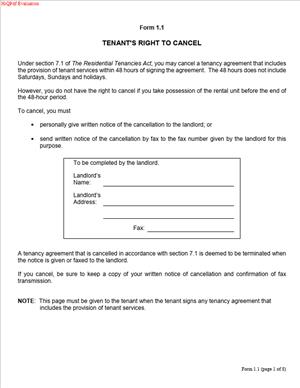
Form 1.1 – Standard Residential Tenancy Agreement (For tenancies that include tenant services)
Fill out nowJurisdiction: Country: Canada | Province or State: Manitoba
The Form 1.1 – Standard Residential Tenancy Agreement (For tenancies that include tenant services) is a written rental contract used in Manitoba when a landlord provides services to a tenant as part of the tenancy. These services go beyond basic utilities and may include meals, personal care, or other support.
You use this form to clearly set out the rights and responsibilities of both landlord and tenant. It explains what the tenant is renting, what services are included, how much rent is, and how the tenancy can end.
This agreement is designed for situations where housing and services are connected. That makes it different from a basic residential lease. The document helps avoid confusion about what is included in the rent and what is not.
If you are about to sign or complete this form, you need to understand each section before writing anything in. The details you enter shape your legal relationship for the duration of the tenancy.
What is Form 1.1 – Standard Residential Tenancy Agreement (For tenancies that include tenant services)?
Clear definition
Form 1.1 – Standard Residential Tenancy Agreement (For tenancies that include tenant services) is a standard written agreement used in Manitoba for rental arrangements where the landlord provides tenant services as part of the tenancy. It sets out the terms of the rental and describes the services included in the rent.
This document combines two key elements. First, it creates a residential tenancy. Second, it lists and describes the services the landlord agrees to provide. These services may be essential to the tenant’s daily living.
The form is structured to make sure both housing details and service details are recorded in one place. It covers rent, security deposits, services, rules, and other core terms.
Who typically uses this form?
This form is commonly used by landlords who operate residential properties that include additional services. Examples may include supportive housing, assisted living settings, or other rental arrangements where tenants receive regular services.
Tenants who require or choose housing that includes services will also use this form. This often includes older adults, individuals with disabilities, or people who prefer housing with structured support.
Property managers or representatives may complete the form on behalf of a landlord. Tenants may sign on their own or through a legal representative, depending on their circumstances.
Why might you need this form?
You need this form when the rental arrangement includes services provided by the landlord. A standard lease may not fully address these added obligations.
The document allows both parties to clearly identify which services are included in the rent. This helps prevent disputes about what the landlord must provide and what the tenant is paying for.
It also creates a written record of the agreement. If questions arise later about payments, services, or responsibilities, the signed form becomes an important reference point.
Without a clear written agreement, misunderstandings can happen more easily. This form organizes the essential terms in a consistent format recognized in Manitoba.
Typical real-life scenarios
- A landlord operates a residential building for seniors and provides daily meals and weekly housekeeping. Each tenant signs this agreement so that the meals and cleaning services are clearly described in writing.
- An individual moves into a supportive housing unit where staff provides medication reminders and personal care assistance. The tenancy and the services are recorded together in this form.
- A property offers furnished rooms and includes laundry service and basic supervision as part of the monthly rent. The landlord uses this agreement to list those services and outline how the rent is calculated.
- A tenant requires mobility support and chooses a rental setting that includes assistance with daily activities. The agreement sets out both the rental terms and the scope of support services provided.
When would you use Form 1.1 – Standard Residential Tenancy Agreement (For tenancies that include tenant services)?
Use this form when establishing a tenancy that includes services in addition to the rental accommodation. It is generally completed before the tenant moves in or when the parties finalize the arrangement. The form records the terms of the tenancy and identifies the services provided as part of the agreement.
A landlord or housing provider may use the form when rent includes ongoing services or support rather than accommodation alone. Depending on the housing arrangement, these services may include meals, housekeeping, laundry, transportation, personal assistance, recreational programming, security, or other agreed services. Clearly identifying each service helps both parties understand the complete rental package.
The agreement should distinguish between services included in the regular rent and optional services available for an additional charge. It should also explain how fees are calculated, when payments are due, and whether any services are subject to eligibility requirements, scheduling limitations, or separate policies. Terms concerning changes, interruptions, or cancellation of services should be included where required.
Tenants use the form to understand what they will receive under the arrangement and what expenses may fall outside the monthly payment. Before signing, the tenant should review the rent, service charges, commencement date, payment schedule, included facilities, rules, and any conditions affecting access to services.
The form may also be appropriate when an existing tenancy is formally changed to add services that were not included in the original agreement. In that situation, the parties should document the new services, related costs, effective date, and effect on the existing tenancy terms. The amendment should comply with applicable residential tenancy, rent-control, consumer-protection, and housing-program requirements.
The landlord and tenant should complete the agreement only after settling all essential terms. Each party should review it carefully, sign where required, and retain a complete copy. Signing records the parties’ agreement, but their rights and obligations take effect according to the stated commencement date and applicable law. The document should not include terms that conflict with legislation or remove rights that cannot legally be waived.
Legal characteristics of Form 1.1 – Standard Residential Tenancy Agreement (For tenancies that include tenant services)
This agreement is a formal contract between the landlord and the tenant. It sets out legally recognized obligations related to rent, occupancy, and services.
For the document to be effective, it must clearly identify the parties, the rental unit, the rent amount, and the services included. Missing or unclear information can lead to confusion or disputes later.
Both parties must sign the agreement. If a signature is missing, the document may not fully reflect mutual consent. Dates are also important because they establish when the tenancy begins and how long it lasts.
Common problems arise when services are described too vaguely. For example, listing “care services” without details can create disagreement about what is actually included. Clear, specific descriptions reduce that risk.
Another issue can occur if additional terms are added that conflict with residential tenancy rules. Not every condition written into a contract is automatically enforceable. Some provisions may not be valid if they contradict mandatory housing standards.
This form does not replace other legal requirements. For example, it does not serve as proof of ownership of the property. It also does not automatically resolve disputes. It simply records the agreement between the parties.
Is it legally binding?
Yes, once properly completed and signed, this agreement is generally legally binding. It represents a contract between landlord and tenant.
It becomes binding when both parties agree to the terms and sign the document. The signatures show acceptance of the obligations described in the form.
The agreement is enforceable to the extent that its terms comply with applicable residential tenancy rules. If a term conflicts with mandatory legal standards, that specific term may not be enforceable, even though the rest of the agreement remains in effect.
A written agreement like this provides stronger evidence of the agreed-upon terms than a verbal arrangement. It helps demonstrate what both parties accepted at the start of the tenancy.
How to fill out Form 1.1 – Standard Residential Tenancy Agreement (For tenancies that include tenant services)
Step 1 – Identify the landlord and tenant
Enter the full legal name of the landlord. If a company owns the property, use its registered name. Then enter the full legal name of each tenant who will be living in the unit. Make sure spellings are accurate, as these names define who is legally responsible under the agreement.
Step 2 – Provide the rental unit details
Write the complete address of the rental unit, including unit or suite number if applicable. This section confirms exactly which premises are being rented. Double-check that the address matches the actual location to avoid confusion.
Step 3 – State the type and term of tenancy
Indicate whether the tenancy is for a fixed term or is periodic, such as month-to-month. If it is a fixed term, enter the start date and the end date. If it is periodic, record the start date and specify the rental period. These dates define how long the agreement is intended to last.
Step 4 – Enter the rent amount and payment details
Write the total rent amount the tenant must pay. Specify how often it is due, such as monthly. Include the exact due date for each payment and the accepted methods of payment. This section should clearly show the full financial obligation.
Step 5 – Record the security deposit
If a security deposit is required, enter the amount collected. Confirm when it was received. The amount should be written clearly to avoid later disagreement about how much was paid at the start of the tenancy.
Step 6 – Describe the tenant services included
List each service provided as part of the tenancy. Be specific. For example, identify meal plans, housekeeping frequency, personal care assistance, or other support. Include details about how often services are provided and any limits that apply. Clear descriptions reduce misunderstandings.
Step 7 – Identify services not included in rent
If certain services are available for an extra charge, note that clearly. This helps separate what is included in the base rent from optional or additional services. Clarity in this section prevents confusion about extra costs.
Step 8 – Outline utilities and other included items
State which utilities are included in the rent and which are the tenant’s responsibility. Also note any included furnishings, appliances, or shared facilities. This section helps both parties understand what comes with the unit.
Step 9 – Add any additional terms
If there are additional terms allowed under the standard structure of the agreement, write them clearly in the space provided. Ensure these terms are consistent with residential tenancy rules and are written in plain language so both parties understand them.
Step 10 – Review the entire agreement
Before signing, read through every section carefully. Confirm that all blank spaces are completed and that the information is accurate. Check names, dates, amounts, and service descriptions one more time.
Step 11 – Sign and date the agreement
Have the landlord and each tenant sign and date the form. Each party should keep a copy of the signed agreement. The signing marks the point at which the written terms become the formal record of the tenancy arrangement.
Legal terms you might encounter in Form 1.1 – Standard Residential Tenancy Agreement (For tenancies that include tenant services)
- Tenant Services: These are services provided by the landlord that go beyond simply renting the unit. They may include meals, housekeeping, laundry, personal care, recreational programs, or supervision. In this form, tenant services must be clearly described so both you and the landlord know exactly what is included in the rent.
- Residential Tenancy Agreement: This is the legally binding contract between you and the landlord. It sets out the rights and responsibilities of both parties. This document also details the specific tenant services that are part of the arrangement.
- Fixed-Term Tenancy: A tenancy that has a clear start date and end date. The agreement ends on the stated date unless you and the landlord renew or extend it. The form requires you to confirm the exact dates if this option is chosen.
- Periodic Tenancy: A tenancy that continues month to month or week to week without a set end date. It renews automatically unless proper notice is given. You must indicate the rental period and confirm when the rent is due.
- Security Deposit: Money paid by you at the start of the tenancy to cover potential damage or unpaid rent. The amount must be recorded in the agreement. The form should show how much was paid and when.
- Rent: The amount you agree to pay for the rental unit and the included tenant services. The form breaks down how much is due, when it must be paid, and how it should be delivered.
- Additional Charges: These are costs not included in the base rent, such as optional services or extra care packages. If any apply, they must be clearly listed. This prevents confusion about what you are required to pay.
- Utilities: Services such as electricity, heat, water, cable, or internet. The agreement must state which utilities are included in the rent and which are your responsibility.
- Rules and Policies: These are building or service-related rules that form part of the agreement. They may cover visitor access, quiet hours, use of common areas, or service schedules. If attached, they become enforceable terms.
- Notice of Termination: A formal written notice to end the tenancy. The agreement does not replace legal notice requirements, but it establishes the type of tenancy, which affects how notice works later.
FAQs
What date should I enter as the start date of the tenancy?
You should enter the exact date the tenant has the legal right to move in and occupy the unit. This may or may not be the same day keys are physically handed over. Make sure the start date matches any related documents, such as a move-in inspection report or service agreement, so there is no dispute later about when the tenancy began.
How detailed do the tenant services need to be in this document?
Be specific. List each service separately, such as daily meals, weekly housekeeping, medication reminders, or 24-hour supervision. Avoid vague phrases like “full services included.” The clearer you are, the easier it is to confirm whether the services are being provided as agreed under the Form 1.1 – Standard Residential Tenancy Agreement (For tenancies that include tenant services).
Who is allowed to sign this form on behalf of the tenant?
The tenant signs if they are capable of entering into a contract. If someone else is signing, such as a legal guardian or person with power of attorney, their authority should be clear. Make sure the name and capacity of the person signing are written clearly so there is no confusion about who is bound by this agreement.
What happens if we forget to list a service that was promised verbally?
If a service is not written in this document, it may be harder to prove it was part of the deal. This form is meant to capture the full agreement in writing. Before signing, review any brochures, emails, or conversations and ensure every promised service is listed in the services section or attached as part of the agreement.
Do I need to attach building rules or service schedules?
If the landlord expects you to follow certain rules or schedules, they should be attached and referenced in the agreement. Attachments should be clearly labeled and initialed if possible. This helps confirm that both parties reviewed them at the time of signing.
Can the rent include both housing and care costs together?
Yes, the rent can be a single combined amount that covers both the unit and the tenant services. The key is clarity. The agreement should clearly state the total amount due and whether any part of it is for specific services, especially under the Form 1.1 – Standard Residential Tenancy Agreement (For tenancies that include tenant services).
What if the tenant’s name is spelled differently on other identification documents?
Use the tenant’s full legal name as it appears on government-issued identification. Consistency matters. If names do not match, it may cause issues later when enforcing the agreement or verifying identity.
Is this form filed with the Residential Tenancies Branch?
In most cases, this document is kept by the landlord and tenant and not automatically filed. However, it may be requested if there is a dispute. Keep a complete, signed copy because the Residential Tenancies Branch may rely on it to confirm what services and terms were agreed to.
Checklist: Before, During, and After Form 1.1 – Standard Residential Tenancy Agreement (For tenancies that include tenant services)
Before
- Confirm the full legal names of all tenants and the landlord.
- Verify the correct address and unit number of the rental property.
- Decide whether the tenancy will be fixed-term or periodic.
- Prepare a detailed written list of all tenant services to be included.
- Confirm the total rent amount and what it covers.
- Determine the security deposit amount and method of payment.
- Gather any building rules or service schedules to attach.
- Review identification for anyone signing on behalf of the tenant.
During
- Write clearly and legibly in every blank space.
- Double-check the start date and, if fixed-term, the end date.
- Record the exact rent amount and due date.
- Specify which utilities are included and which are not.
- List each tenant service separately and in detail.
- Ensure any additional charges are clearly described.
- Review all attachments and confirm they are referenced in the form.
- Have all parties sign and date the agreement on the same day if possible.
After
- Provide a signed copy to the tenant immediately.
- Store the original in a safe and organized file.
- Record the rent amount and due date in your accounting system.
- Schedule delivery of the agreed tenant services.
- Complete a move-in condition report if required.
- Confirm receipt of the security deposit.
- Keep copies of any attached rules or service schedules.
- Monitor compliance with the listed services and terms.
Common mistakes to avoid with Form 1.1 – Standard Residential Tenancy Agreement (For tenancies that include tenant services)
- Mistake: Listing “services included” without details, which often happens when people rely on brochures; this creates confusion about what must be provided, so do not forget to itemize every promised service.
- Mistake: Leaving blanks in rent or deposit sections because the amount is “to be decided later,” which can make the agreement unclear or disputed; do not forget to complete every financial field before signing.
- Mistake: Using nicknames instead of legal names, which happens out of habit and can cause enforcement problems; do not forget to verify names against identification.
- Mistake: Failing to attach referenced rules or schedules, often because they are stored separately; this weakens enforceability, so do not forget to physically attach or clearly incorporate them.
- Mistake: Misstating the tenancy type, which occurs when people assume month-to-month is automatic; this affects notice rights, so do not forget to clearly select and complete the correct option.
- Mistake: Not giving the tenant a signed copy, usually due to oversight at move-in; this can lead to disputes about terms, so do not forget to provide copies immediately.
- Mistake: Combining optional services into mandatory rent without clarification, which can lead to billing disputes; do not forget to separate required and optional charges clearly.
- Mistake: Forgetting to date signatures, which makes it unclear when the agreement took effect; do not forget to include the full signing date beside each signature.
What to do after filling out Form 1.1 – Standard Residential Tenancy Agreement (For tenancies that include tenant services)
Once the agreement is complete and signed, your focus shifts to implementation and recordkeeping. A well-executed agreement only works if both sides understand and follow it.
- Step 1: Make at least two signed copies, one for you and one for the other party.
- Step 2: Confirm that every page, including attachments, is included in each copy.
- Step 3: Provide the tenant with their copy right away and confirm receipt.
- Step 4: Securely store your original signed copy in a dedicated tenancy file.
- Step 5: Record key dates such as the start date, rent due date, and, if applicable, the end date in your calendar.
- Step 6: Enter the rent and service details into your accounting or rent tracking system.
- Step 7: Arrange for the tenant services to begin on the agreed start date.
- Step 8: Complete any required move-in inspections and keep the report with the agreement.
- Step 9: Confirm the security deposit has been properly received and documented.
- Step 10: Review the agreement periodically to ensure ongoing compliance with the listed services.
If questions arise later, return to the written agreement first. It is your primary record of what was promised. If a disagreement develops about services or payments, the signed document will be central to resolving it.
Keep all related documents together. This includes payment receipts, inspection reports, service schedules, and written communications about changes. Organized records protect both you and the tenant and make it easier to respond if the Residential Tenancies Branch becomes involved.
Disclaimer: This guide is provided for informational purposes only and is not intended as legal advice. You should consult a legal professional.