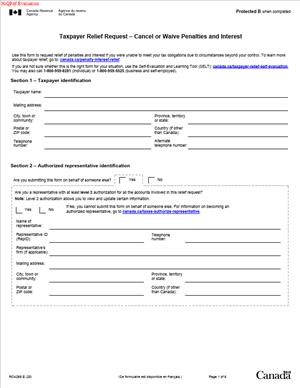
RC4288 E – Taxpayer Relief Request – Cancel or Waive Penalties and Interest
Fill out nowJurisdiction: Country: Canada | Province or State: Federal
If you are dealing with tax penalties or interest, RC4288 E – Taxpayer Relief Request – Cancel or Waive Penalties and Interest is the form used to ask for relief. It is a formal request to have penalties or interest reduced or cancelled due to specific circumstances.
This document is used when you believe the charges are unfair because of events outside your control. It does not erase the tax you owe. It focuses only on penalties and interest.
RC4288 E – Taxpayer Relief Request – Cancel or Waive Penalties and Interest gives you a structured way to explain what happened. It allows you to provide details and supporting documents in one submission.
If you are about to fill out this form, you need to understand what qualifies for relief, how to present your situation clearly, and what the review process generally involves. The strength of your explanation often matters more than the length.
What is RC4288 E – Taxpayer Relief Request – Cancel or Waive Penalties and Interest?
Clear definition
RC4288 E – Taxpayer Relief Request – Cancel or Waive Penalties and Interest is a federal tax form used to request the cancellation or reduction of penalties and interest charges on a tax account. It is not a dispute about the tax amount itself. It is a request for discretionary relief.
The form allows you to describe extraordinary circumstances that prevented you from meeting your tax obligations on time. These may include late filing, late payment, or failure to comply with certain reporting requirements.
This form is part of an administrative process. A tax authority reviews the facts and decides whether your situation meets the criteria for relief. Approval is not automatic.
Who typically uses this form?
Individuals commonly use this form after receiving a notice showing penalties or interest added to their account. This can include employees, self-employed individuals, retirees, or students.
Businesses also use the form. This may include sole proprietors, corporations, partnerships, and organizations with payroll, GST/HST, or corporate tax accounts.
In some cases, a legal representative, accountant, or authorized agent completes the form on behalf of a taxpayer. The request is still made in the taxpayer’s name.
Why might you need this form?
You may need this form if something beyond your control prevented you from filing or paying on time. The relief process is intended for exceptional situations, not routine oversight.
If you experienced serious illness, an accident, or hospitalization during the filing period, penalties and interest may have accumulated while you were unable to manage your affairs. The form provides a way to explain this.
You might also use the form if natural disasters, postal disruptions, or system failures affected your ability to comply. In those cases, you would explain the timing and impact.
Financial hardship can also be a factor. If paying accumulated interest would cause severe difficulty, you can describe your financial situation and provide details to support that claim.
Typical real-life scenarios
- You were hospitalized for several weeks during tax season and missed the filing deadline. As a result, late-filing penalties and interest were applied. You are now recovered and want those charges reviewed in light of your medical emergency.
- Your business records were destroyed in a flood. It took months to reconstruct your accounting information. During that time, you could not file accurate returns, and penalties were assessed.
- You relied on incorrect written information from a tax authority. Based on that information, you filed in a way that later resulted in penalties. You are requesting relief due to the misinformation.
- You experienced severe financial hardship after losing your job. Although you eventually paid the outstanding tax, interest continued to grow. You are asking for interest relief because full payment would create an ongoing financial strain.
When would you use RC4288 E – Taxpayer Relief Request – Cancel or Waive Penalties and Interest?
You would use this form after penalties or interest have already been charged to your account. It is not filed in advance of a deadline. It addresses charges that have already appeared on a notice or statement.
This form is typically used when you accept that the tax is owing but believe the additional charges are unfair under the circumstances. It is not the same as filing a formal objection to reassess the tax itself.
Individuals may use the form after filing a late personal income tax return. Businesses may use it after payroll remittance penalties, GST/HST penalties, or corporate income tax interest have accumulated.
You might also use the form after compliance action has been taken, such as repeated late filings due to ongoing medical issues. In that case, you would explain the broader timeline and how the events affected your ability to comply consistently.
Timing matters. There are general limits on how far back a request can go. Relief is often considered only for penalties and interest within a certain number of years. The relevant period is typically measured from the calendar year in which the request is made.
The form is also used when you believe there were delays caused by administrative actions. For example, processing delays or errors may have contributed to added interest. You would explain the sequence clearly and provide dates.
Legal characteristics of RC4288 E – Taxpayer Relief Request – Cancel or Waive Penalties and Interest
This form is a formal written request for discretionary relief. That means the decision-maker has the authority to approve or deny it based on the facts and internal guidelines. It is not an automatic right.
For the request to be considered valid, it must clearly identify the taxpayer, the tax years or reporting periods involved, and the type of penalties or interest at issue. Missing identification details can delay review.
The explanation must connect specific events to the failure to comply. General statements such as “I was busy” or “I forgot” are unlikely to be persuasive. Clear dates, documentation, and a logical timeline are important.
Common reasons for delay or denial include incomplete forms, lack of supporting documents, unclear descriptions of events, or requests outside the allowable time period. If the request does not explain why the circumstances were beyond your control, it may not meet the criteria.
There can be differences in how relief is assessed depending on the type of tax account involved, such as income tax versus payroll or consumption tax accounts. The overall framework is federal, but internal policies may vary by account type.
This form does not change your tax assessment. It does not reduce the principal tax owing. It also does not automatically stop collection activity while under review. It addresses only penalties and interest.
Is it legally binding?
The form itself is not a contract. By submitting it, you are not entering into an agreement. You are making a formal request for relief.
Once a decision is issued, that decision affects your tax account. If penalties or interest are cancelled, your balance is adjusted accordingly. If the request is denied, the charges remain payable.
Your signature confirms that the information provided is accurate to the best of your knowledge. Providing false or misleading information can have serious consequences. The binding effect relates to the accuracy of your declaration, not to the approval of the request itself.
How to fill out RC4288 E – Taxpayer Relief Request – Cancel or Waive Penalties and Interest
Step 1 – Identify the taxpayer
Enter your full legal name or business name exactly as it appears on your tax records. Include your social insurance number, business number, or trust account number, depending on the type of account involved. Accurate identification ensures the request is matched to the correct file.
If you are submitting the form for a business, include the program account identifier where applicable. Double-check all numbers for accuracy before moving on.
Step 2 – Provide contact information
Enter your current mailing address, telephone number, and any other requested contact details. This is where correspondence about your request will be sent.
If you have moved recently, confirm that the address matches the most up-to-date information on your tax account. Inconsistent contact information can cause delays.
Step 3 – Indicate the tax years or reporting periods
Specify the exact tax years or reporting periods for which you are requesting relief. Be precise. For example, identify a specific calendar year or a particular reporting period for payroll or GST/HST.
If your request covers multiple years, list each one clearly. Avoid broad statements such as “several years.” Clarity helps the reviewer focus on the correct timeframe.
Step 4 – Identify the type of charges
Indicate whether you are asking to cancel or waive penalties, interest, or both. If possible, describe the type of penalty involved, such as late-filing or late-payment penalties.
If you have a notice showing the charges, refer to the details on that notice. This helps ensure your request aligns with what appears on your account.
Step 5 – Explain the circumstances in detail
Provide a clear, chronological explanation of what happened. Start with the event that affected your ability to comply. Include dates and describe how the situation directly led to late filing or payment.
Avoid emotional language. Focus on facts. For example, describe the period of illness, hospitalization dates, or the date a natural disaster occurred, and how long recovery took.
If your request is based on financial hardship, explain your income, essential expenses, and why paying accumulated interest would create serious difficulty. Be specific about the impact.
Step 6 – Describe actions taken to correct the issue
Explain what you did once you were able to address the situation. For example, state when you filed the outstanding returns or made payments toward the balance.
Demonstrating that you took steps to comply as soon as possible can help show that the non-compliance was temporary and caused by exceptional circumstances.
Step 7 – Attach supporting documents
Include copies of documents that support your explanation. This may include medical letters, hospital records, insurance claims, proof of disaster damage, financial statements, or correspondence related to misinformation.
Ensure documents are legible and clearly connected to the tax years in question. Organize them in a logical order so the reviewer can follow your timeline.
Step 8 – Indicate if a representative is involved
If someone is submitting the form on your behalf, provide their name and details as requested. Confirm that proper authorization is in place for them to act for you on your tax account.
If you are completing the form yourself, review this section to ensure no representative information is required.
Step 9 – Review and sign the declaration
Read the declaration carefully before signing. By signing, you confirm that the information provided is complete and accurate to the best of your knowledge.
Sign and date the form. If the request is for a business, ensure the person signing has the authority to do so. An unsigned form may not be processed.
Step 10 – Prepare the submission
Make a complete copy of the form and all attachments for your records. Submit the completed form and supporting documents as instructed in the form’s submission section.
After submission, keep records of the date sent and any confirmation received. This helps you track the progress of your request and respond promptly if additional information is requested.
Legal terms you might encounter in RC4288 E – Taxpayer Relief Request – Cancel or Waive Penalties and Interest
- Taxpayer Relief Provisions: These are the rules that allow the tax authority to cancel or waive penalties and interest in certain situations. On this form, you rely on these provisions to explain why charges should be reduced or removed. You must clearly connect your situation to circumstances beyond your control or other recognized grounds for relief.
- Penalty: A penalty is an extra charge applied when you file late, fail to report income, or do not meet another tax obligation. This form asks you to identify the specific penalties you want reviewed. You need to state the tax year or reporting period for each penalty.
- Interest: Interest accrues on unpaid tax balances and sometimes on penalties. It compounds daily. In this document, you can request cancellation or reduction of interest, but you must explain why it accumulated and why relief is justified.
- Extraordinary Circumstances: These are unusual events that prevented you from meeting your tax obligations. Examples include serious illness, natural disasters, or severe financial hardship. On the form, you must describe what happened, when it happened, and how it directly affected your ability to comply.
- Financial Hardship: This means you cannot pay the full amount owing without affecting your ability to meet basic living expenses. If you claim hardship, you should explain your income, expenses, and debts. Supporting documents are critical here.
- Compliance History: This refers to your past record of filing returns and paying taxes on time. The decision-maker may review your history to see if the issue was isolated or repeated. You should address this if your past compliance has been strong.
- Supporting Documentation: These are documents you attach to prove your explanation. They may include medical letters, bank statements, insurance claims, or correspondence. The form invites you to list and attach these materials.
- Authorized Representative: This is a person you allow to act on your behalf, such as an accountant or tax preparer. If someone is helping you, you must ensure they are properly authorized. The form asks whether a representative is involved.
- Tax Year or Reporting Period: This identifies the specific time frame affected. You must list the exact year or period for each penalty or interest charge. If you miss a period, it may not be reviewed.
FAQs
How do I know which tax years or reporting periods to include?
Look at your account statements or notices that show penalties or interest. Match each charge to a specific tax year or reporting period and list them clearly. If you leave out a year, the reviewer may only assess the periods you listed. Double-check the dates before you submit this document.
Do I need to pay the full balance before submitting RC4288 E – Taxpayer Relief Request – Cancel or Waive Penalties and Interest?
You can submit the request even if you have not paid the full amount. However, interest usually continues to accrue on unpaid balances while your request is under review. If you can make partial payments, note that in your explanation. Keep records of any payments made after filing.
What kind of proof should I attach to support my explanation?
Attach documents that directly support your reason for asking for relief. If you claim illness, include a medical confirmation with dates. If you claim financial hardship, include income details, expense summaries, and statements showing your situation. Make sure each document clearly relates to the time period you listed.
Who must sign this form?
You must sign if you are the taxpayer. If a business is applying, an authorized officer must sign. If a representative completes the form, you still need to confirm that proper authorization is on file so the signature is valid.
What happens after I submit this form?
The tax authority reviews your explanation, your compliance history, and your supporting documents. They may contact you for more information. You will receive a written decision explaining whether penalties or interest were cancelled, reduced, or left unchanged.
Can I request relief for multiple types of charges at once?
Yes, you can request relief for both penalties and interest in the same submission. Be specific about each type of charge and each period. If your reasons differ by year or by type of charge, explain them separately so the reviewer can follow your logic.
Will filing this document stop the collection action?
Submitting a request does not automatically stop collection. You should continue to communicate about payment arrangements if needed. Keep proof that you submitted the request and respond quickly if you receive follow-up letters.
What if I realize I made a mistake after sending it?
If you notice an error or forgot an attachment, send additional information as soon as possible. Clearly reference your original submission and the tax years involved. Keep copies of everything you send so your records stay complete.
Checklist: Before, During, and After RC4288 E – Taxpayer Relief Request – Cancel or Waive Penalties and Interest
Before
- Review all notices showing penalties and interest.
- Confirm the exact tax years or reporting periods involved.
- Gather medical, financial, or other supporting documents.
- Prepare a clear timeline of what happened and when.
- Check your filing history to understand your compliance record.
- Ensure any representative is properly authorized.
- Make copies of recent account statements for reference.
During
- Enter your full legal name and identification numbers accurately.
- List each affected tax year or reporting period separately.
- Specify whether you are requesting relief from penalties, interest, or both.
- Provide detailed explanations tied to dates and events.
- Refer directly to the attached documents in your explanation.
- Keep your language clear and factual.
- Review every field before signing.
- Sign and date the declaration.
After
- Make a complete copy of the signed form and all attachments.
- Submit the package using an accepted method.
- Note the date you sent or uploaded it.
- Monitor your mail or online account for updates.
- Respond promptly to any request for additional information.
- Keep records of any payments made while waiting.
- Store the final decision letter with your tax records.
Common mistakes to avoid with RC4288 E – Taxpayer Relief Request – Cancel or Waive Penalties and Interest
- Mistake: Providing a vague explanation because you assume the reviewer knows your situation, which happens when you rely on past phone calls; this can lead to denial since the written file lacks detail, so do not forget to explain events, dates, and impacts clearly.
- Mistake: Forgetting to list all relevant tax years or reporting periods, often because you focus only on the most recent notice; this may result in partial review only, so do not forget to match each charge to a specific period.
- Mistake: Claiming financial hardship without attaching proof, which happens when you underestimate documentation needs; this weakens your credibility, so do not forget income, expense, and debt details.
- Mistake: Submitting unsigned forms, usually due to rushing; this can delay processing or invalidate the request, so do not forget to sign and date the declaration.
- Mistake: Sending original documents without keeping copies, which happens when you prepare the package quickly; this leaves you without records if items are lost, so do not forget to keep complete copies.
- Mistake: Assuming collection action will stop automatically, which occurs when you misunderstand the process; this can lead to continued enforcement, so do not forget to manage payment arrangements separately if needed.
- Mistake: Mixing multiple unrelated issues into one unclear narrative, often because you want to explain everything at once; this confuses the reviewer, so do not forget to organize your explanation by period and reason.
- Mistake: Ignoring follow-up letters requesting more information, which happens when you think your first submission was enough; this may result in denial for lack of evidence, so do not forget to respond within the stated timeframe.
What to do after filling out RC4288 E – Taxpayer Relief Request – Cancel or Waive Penalties and Interest
Once you complete the form, slow down and review the entire package. Check every date, every tax year, and every attachment. Make sure your explanation matches the documents you included.
- Step 1: Create a complete copy of the signed form and all supporting documents for your records.
- Step 2: Organize the documents in the same order you referenced them in your explanation.
- Step 3: Submit the package using an accepted submission method and keep proof of delivery or confirmation.
- Step 4: Record the submission date in your personal calendar or tax file.
- Step 5: Continue monitoring your tax account for updated balances or correspondence.
- Step 6: If you receive a request for additional information, gather the documents immediately and respond within the stated timeframe.
- Step 7: Keep making payments if you have an arrangement, unless formally told otherwise.
- Step 8: When you receive the decision letter, read it carefully and compare it to the tax years you listed.
- Step 9: Update your records to reflect any cancelled or reduced amounts.
- Step 10: Store the final decision with your permanent tax records in case you need it later.
Stay organized throughout the process. Keep all communication in writing when possible. A clear record protects you and helps you respond quickly if questions arise.
Disclaimer: This guide is provided for informational purposes only and is not intended as legal advice. You should consult a legal professional.