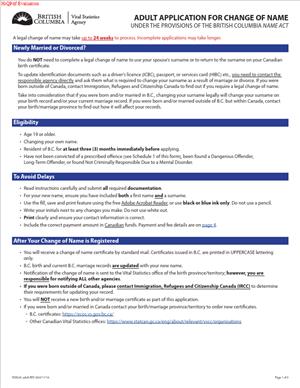
VSA529 – Adult Application for Change Name
Fill out nowJurisdiction: Country: Canada | Province or State: British Columbia
The VSA529 – Adult Application for Change Name is the official form used to apply for a legal name change in British Columbia. If you are preparing to complete this document, you are asking the government to formally recognize a new legal name for you.
This is not just a personal update. A legal name change affects your identification records, government files, and many day‑to‑day documents. Once approved, your new name becomes your legal name for most purposes.
You may be filling out this form because you want your name to better reflect your identity, cultural background, or personal circumstances. You might also be doing it after a life event, such as marriage, divorce, or a long‑term change in how you have been known.
Before you start writing on the form, it helps to understand what it does, how it works, and what information you will need. That way, you can complete it accurately and avoid delays in processing.
What is The VSA529 – Adult Application for Change Name?
Clear definition
VSA529 – Adult Application for Change Name is a government document used to request a legal change of name for an adult in British Columbia. It is submitted to the Vital Statistics Agency for review and processing.
When your application is approved, your new name is legally registered. This registration updates your name in the province’s official records. You can then use the registration to update your identification and other documents.
This form applies to adults, meaning individuals who meet the age requirement set by the province. It is different from forms used for changing a child’s name or correcting minor errors on a birth record.
Who typically uses this form?
Adults who were born in British Columbia and want to change their legal name often use this form. Adults born outside British Columbia but who meet residency requirements may also use it.
You might be an individual changing your first name, middle name, last name, or your full name. Some applicants change only the spelling of a name. Others adopt an entirely new name.
People from many backgrounds use this form. That includes individuals aligning their legal name with their gender identity, people adopting a cultural or ancestral name, and individuals who simply prefer a different name than the one on their birth record.
Why might you need this form?
You need this form when you want your name change to be legally recognized by the province. Informal name changes, such as using a nickname, do not update your government records.
A legal name change allows you to request updated identification, such as a driver’s licence or other provincial records. It also helps ensure your name is consistent across tax records, banking information, and employment documents.
If you have been using a different name for years but never completed a formal process, this application makes that change official.
Typical real-life scenarios
- You may have transitioned and want your legal documents to reflect your gender identity. A formal name change can help reduce confusion and prevent repeated explanations in professional and personal settings.
- You may have divorced and chosen not to continue using a former spouse’s surname. While some name changes after marriage or divorce can be handled through other processes, a full legal change may be necessary in certain situations.
- You may have immigrated to Canada and decided to adopt a name that is easier to pronounce or better fits your current life. A legal change ensures that your official records match the name you actually use.
- You may simply dislike your current name and want something different. Personal preference is often enough reason to apply, provided the application meets the province’s requirements.
When would you use VSA529 – Adult Application for Change Name?
You use this form when you want a formal, registered name change recognized by the government of British Columbia. This is typically done after you have decided on your new name and are ready to update official records.
If you are only correcting a minor spelling error on a birth certificate, a different process may apply. This form is for a deliberate change from one name to another, not for small administrative corrections.
You might use this form before applying for new identification, starting a new job, returning to school, or moving. Many people prefer to complete a legal name change before making other major record updates.
This application is generally used by the person whose name is being changed. Because it is for adults, you complete and sign it yourself, rather than having a parent or guardian sign on your behalf.
Legal characteristics of VSA529 – Adult Application for Change Name
This form is part of a formal government process. It collects identifying details such as your current legal name, your proposed new name, and other personal information needed to assess your request.
For the application to be effective, it must be complete, accurate, and submitted according to the agency’s process. Missing information, inconsistent details, or unreadable entries commonly lead to delays or rejection.
Identity verification is a key part of the process. The agency must be satisfied that you are who you say you are and that the name change is not being requested for an improper purpose. Providing clear and consistent information helps avoid complications.
There are rules about what names can be registered. Names that are misleading, contain numbers or symbols in ways not permitted, or could cause confusion may not be accepted. Each province in Canada has its own legislation and procedures, so processes and requirements can differ across jurisdictions.
This document does not automatically update every record in your life. Even after approval, you will usually need to contact various organizations to update your name in their systems.
Is it legally binding?
When the application is approved and the name change is registered, the change becomes legally effective. Your new name becomes your legal name in British Columbia.
The form itself is a request. It becomes legally significant once it is processed and accepted by the Vital Statistics Agency. Until then, your current legal name remains in effect.
By signing the application, you are confirming that the information you provided is true. Providing false information can lead to the refusal of the application and other consequences. Accuracy and honesty are central to the validity of the process.
How to fill out VSA529 – Adult Application for Change Name
Step 1 – Read the entire form before writing anything
Start by reading the full VSA529 – Adult Application for Change Name from beginning to end. This gives you a clear picture of what information is required. Pay attention to any instructions about printing clearly, using specific ink, or avoiding corrections.
As you read, note the documents or identification details you may need to gather. Having everything ready before you begin helps you complete the form in one sitting.
Step 2 – Provide your current legal name exactly as registered
Enter your current legal name exactly as it appears on your birth certificate or most recent legal name document. Include all first names, middle names, and your last name.
Do not shorten names or use nicknames in this section. Consistency is important. Any mismatch between this form and your existing records may slow down processing.
Step 3 – Enter your proposed new legal name
Clearly print your new full legal name in the space provided. Double‑check spelling and order. This is the name that will be registered if your application is approved.
Think carefully before writing. Changing your name again later usually requires a new application and another review process.
Step 4 – Provide your birth details
Fill in your date of birth, place of birth, and any other birth registration details requested. This information links your application to your existing vital records.
If you were born outside British Columbia, provide the information requested about your place of birth and current residency. Make sure dates are written in the required format.
Step 5 – Complete residency and personal history sections
If the form asks about how long you have lived in British Columbia, answer fully and accurately. You may need to indicate specific time periods.
Some versions of the form ask about previous name changes or marital status. Provide complete information where required. Omitting prior legal name changes can create complications later in the review process.
Step 6 – Review any declarations or statements carefully
Before signing, read each declaration closely. These statements confirm that your information is true and that you understand the nature of the request.
Take your time with this section. Signing means you agree with everything stated in the declaration.
Step 7 – Sign and date the application as instructed
Sign your name in the space provided, using your current legal name unless the form specifies otherwise. Add the date of signing in the required format.
Some applications may require your signature to be witnessed. If the form includes a section for a witness or commissioner, ensure that part is completed according to the instructions on the document.
Step 8 – Review the entire form for accuracy and completeness
Before submitting, read through every section again. Confirm that names are spelled consistently throughout the form.
Check that no required fields are left blank. Make sure dates, addresses, and identification details match your supporting documents.
A careful final review can prevent delays and reduce the chance that your application will be returned for corrections.
Legal terms you might encounter in VSA529 – Adult Application for Change Name
- Applicant: The person applying to change their name. On this form, that is you. You must provide your current legal name and sign the declaration yourself unless the form allows a legally authorized representative.
- Current Legal Name: The exact name that appears on your birth registration or legal documents. This must match government records. Even small differences, like missing middle names, can cause delays.
- Proposed Name: The new name you want to be legally recognized under. You must enter it clearly and completely. This is the name that will appear on your new change of name certificate if approved.
- Birth Registration: The official record of your birth held by the Vital Statistics Agency. The details you enter about your date and place of birth must match this record. If they do not, your application may be flagged for review.
- Residency Requirement: A rule that requires you to live in a certain place before applying. This document asks you to confirm your residence and provide your address history. The agency uses this to confirm you are eligible to apply.
- Declaration: A formal statement at the end of the form where you confirm the information is true. When you sign, you are stating that everything you provided is accurate and complete. False statements can lead to refusal or legal consequences.
- Criminal Record Check: In some cases, you may be required to submit fingerprints or consent to a criminal record review. This helps ensure the name change is not being requested for fraudulent or improper purposes.
- Guarantor: A person who confirms your identity. If required, this person must meet specific criteria and sign part of your application. Their role is to verify that you are who you say you are.
- Supporting Documents: Additional paperwork you must submit with your application. This can include proof of citizenship, immigration status, or identification. The form instructions explain what is mandatory.
- Change of Name Certificate: The official document issued if your application is approved. This certificate proves your legal name has changed. You will use it to update your identification and records.
FAQs
How do I know if I am eligible to apply using this form?
You must meet the residency requirement and be an adult as defined by law. This document asks for your current address and how long you have lived there. Make sure you can prove your residency if requested. If you do not meet the residency rule, your application may be refused before it is processed.
Do I have to use my full current legal name on this form?
Yes. You must enter your name exactly as it appears on your birth registration or most recent legal change of name certificate. Do not shorten or adjust spelling. If your ID and birth record differ, resolve that issue first or explain it clearly in the space provided.
When does my new name become legally effective?
Your new name becomes legal only after the application is approved and the change is officially registered. Submitting this form does not change your name by itself. Wait until you receive confirmation and your change of name certificate before updating records.
What documents do I need to attach to the VSA529 – Adult Application for Change Name?
You typically need proof of identity and proof of status in Canada. The instructions for this form list what is acceptable. If fingerprints or a criminal record check are required, you must complete that process separately and ensure results are properly submitted. Missing attachments are one of the main reasons applications are delayed.
Do I need someone to witness my signature?
Read the signature section carefully. Some declarations must be witnessed or signed in front of an authorized person. If a witness is required and you sign in advance, the form may be rejected. Follow the instructions exactly as written in the signature section.
What happens if I made a mistake on the form after signing it?
If you notice an error before submitting, complete a new form. Do not use correction fluid or cross out large sections unless the instructions allow it. If the form has already been submitted, you may need to contact the agency and follow their correction process, which can delay approval.
Will my previous name still appear in public records after approval?
Your previous name remains part of the official record, even after approval. The change creates a legal link between your old and new names. Certain records may still reference your former name for historical or verification purposes.
How will I know if my VSA529 – Adult Application for Change Name has been accepted?
You will receive official confirmation once the application is processed and approved. This usually includes a change of name certificate. If there is a problem, the agency will typically contact you for clarification or additional documents. Keep your contact details current so you do not miss important notices.
Checklist: Before, During, and After VSA529 – Adult Application for Change Name
Before
- Confirm you meet the residency requirement.
- Gather your birth certificate or prior change of name certificate.
- Collect valid government-issued photo identification.
- Review the list of required supporting documents.
- Check whether a criminal record check or fingerprints are required.
- Ensure your address history for the required period is accurate.
- Read the entire instruction guide carefully.
- Prepare payment in the accepted format if a fee applies.
During
- Print clearly using black or blue ink if completing by hand.
- Enter your current legal name exactly as registered.
- Write your proposed new name consistently in every section.
- Double-check your birth date and place of birth for accuracy.
- Complete all address history fields without gaps in dates.
- Answer all background questions truthfully.
- Review the declaration before signing.
- Sign and date the form only when all sections are complete.
After
- Make a full copy of the completed form and attachments.
- Submit the application using the approved method.
- Keep proof of submission or mailing.
- Monitor your mail or email for follow-up communication.
- Respond quickly if additional information is requested.
- Store your change of name certificate in a safe place.
- Update your identification documents after approval.
- Notify banks, employers, and other institutions of your new name.
Common mistakes to avoid with VSA529 – Adult Application for Change Name
- Mistake: Using a nickname or shortened version of your current legal name because it feels more familiar, which happens when people rely on everyday usage, leading to record mismatches and processing delays; do not forget to copy your name exactly as shown on your official birth record.
- Mistake: Leaving gaps in your address history because you cannot remember exact dates, which often occurs when moving frequently, causing the agency to question residency eligibility; do not forget to account for every month in the required period.
- Mistake: Signing the declaration before reviewing the entire form, which happens when you rush to finish, resulting in overlooked errors that require resubmission; do not forget to review every page before adding your signature.
- Mistake: Submitting photocopies when original documents or certified copies are required, which happens due to a misunderstanding of attachment rules, leading to rejection of the application; do not forget to confirm what format each document must be in.
- Mistake: Inconsistent spelling of your proposed name in different sections, which often occurs when adjusting middle names or hyphenation, causing administrative confusion; do not forget to use the exact same spelling throughout.
- Mistake: Failing to include the required payment or using the wrong payment method, which can happen if you skip the fee section, resulting in the application not being processed; do not forget to verify the correct fee amount and format.
- Mistake: Not updating contact information before submitting, which occurs after a recent move, causing missed correspondence and delays; do not forget to provide a current and reliable mailing address.
- Mistake: Assuming your name is changed immediately after mailing the form, which happens due to a misunderstanding of the process, leading to premature updates with banks or employers; do not forget that the change is legal only after official approval.
What to do after filling out the VSA529 – Adult Application for Change Name
Once you complete the form, slow down. A careful final review can prevent weeks of delay. Read every section again. Confirm that your current legal name and proposed name are spelled correctly and consistently.
- Step 1: Make a complete copy of the signed form for your records.
- Step 2: Make copies of all supporting documents you are submitting.
- Step 3: Confirm you have included payment in the correct format and amount.
- Step 4: Assemble the application package in the order listed in the instructions.
- Step 5: Submit the application using the approved submission method.
- Step 6: Keep any tracking number or receipt as proof of submission.
- Step 7: Check your mail regularly for correspondence from the agency.
- Step 8: Respond promptly if you are asked for additional information.
- Step 9: Wait for written confirmation before using your new name officially.
- Step 10: Once approved, store your change of name certificate in a secure location.
- Step 11: Update your government identification, financial accounts, employment records, and other official documents.
- Step 12: Keep a list of all organizations you notify to ensure your records are consistent everywhere.
Be systematic. Update one category at a time. Start with primary identification documents. Then move to financial institutions, employment records, insurance policies, and professional memberships. Keep copies of confirmation letters or updated cards.
Your change of name certificate is your key document. Protect it. You may need it years later to prove the link between your former and current names. Organized follow-through ensures your new legal name is reflected accurately across all areas of your life.
Disclaimer: This guide is provided for informational purposes only and is not intended as legal advice. You should consult a legal professional.