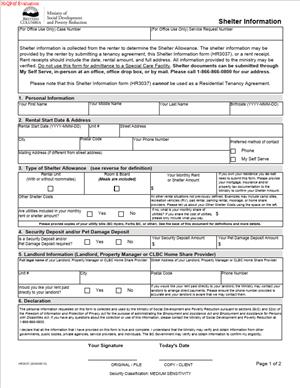
HR3037 – Shelter Information
Fill out nowJurisdiction: Country: Canada | Province or State: British Columbia
If you are completing HR3037 – Shelter Information, you are likely being asked to confirm details about your housing situation. This form is used in connection with income or disability assistance in British Columbia. It focuses on where you live and how much you pay for shelter.
HR3037 – Shelter Information helps the Ministry of Social Development and Poverty Reduction understand your current living arrangement. The details you provide can affect how your shelter costs are assessed as part of your assistance file. Accuracy matters because shelter information often connects directly to benefit amounts.
You might be filling out this document for the first time. Or you may be updating information because your housing situation changed. In either case, the form is meant to capture clear, factual details about your accommodation.
This is not a long agreement filled with legal terms. It is an information form. Still, what you write becomes part of your official record. That makes it important to complete each section carefully and consistently.
Understanding what the form asks for before you start can save time. It also reduces the risk of delays in processing your file.
What is HR3037 – Shelter Information?
Clear definition
HR3037 – Shelter Information is a government form used to record details about your current housing arrangement. It collects information about where you live, who you live with, and what you pay for shelter.
The document is part of an assistance file managed by the Ministry of Social Development and Poverty Reduction. It is used to assess the shelter portion of income assistance or disability assistance. The form focuses on facts, not opinions.
You may be asked to provide your address, type of housing, monthly rent or mortgage amount, and who receives the payment. In some cases, a landlord or homeowner may also need to confirm certain details.
This form does not create a tenancy agreement. It does not replace a lease. It simply records shelter information for administrative purposes.
Who typically uses this form?
This form is commonly used by people applying for income assistance. It is also used by people receiving disability assistance who need to confirm or update their housing details.
You might complete it if you rent an apartment, rent a room, live in a shared house, or pay a mortgage. It can also apply if you live with family and contribute to household expenses.
In some situations, a landlord, property manager, or homeowner may be asked to fill in part of the form. This usually relates to confirming the rent amount or payment arrangement.
Caseworkers and ministry staff use the completed form to review and document your shelter costs. The form becomes part of your assistance record.
Why might you need this form?
You may need HR3037 – Shelter Information when you first apply for assistance. Shelter costs are often assessed separately from other living expenses. The ministry needs clear information to calculate that amount.
You might also need it if you move. A change of address can affect your shelter allowance. Updating your housing details helps keep your file current.
Another reason is a change in rent. If your landlord increases or decreases the amount you pay, the ministry may require updated information.
You may also be asked to complete this form during a file review. Periodic reviews help confirm that your circumstances remain the same as previously reported.
Typical real-life scenarios
- You apply for income assistance after losing your job. As part of the application process, you are asked to complete HR3037 – Shelter Information to show how much rent you pay each month and who your landlord is.
- You move from a shared apartment to a basement suite. Your rent changes, and you now have a different landlord. The ministry requests updated shelter details to adjust your file.
- You live with a family member and pay a set amount toward household expenses. The form is used to record that contribution and clarify your living arrangement.
- You receive a notice that your rent has increased. To reflect the new amount in your assistance file, you are asked to submit updated shelter information.
- You switch from renting to owning a home with a mortgage. The ministry may require confirmation of your monthly housing costs, including mortgage payments, to understand your new situation.
When would you use HR3037 – Shelter Information?
You would use HR3037 – Shelter Information when the ministry needs verified details about your housing. This commonly happens at the start of an application for income or disability assistance.
You may also use it after a move. A new address, a new landlord, or a new rental amount can all trigger a request for updated information.
Another common situation is when your living arrangement changes without a move. For example, someone moves into your home or moves out. If that change affects how shelter costs are shared, the ministry may need revised information.
You might also be asked to complete the form during a scheduled file review. Reviews are used to confirm that the details on record remain accurate.
If you transition between different types of housing, such as from renting to supportive housing or from a private rental to living with family, this document may be used to capture those changes.
In each case, the purpose is administrative. The form helps ensure that your recorded shelter costs match your current reality.
Legal characteristics of HR3037 – Shelter Information
HR3037 – Shelter Information is an official government document. When you sign it, you are confirming that the information provided is true and complete to the best of your knowledge.
For the form to be effective, it generally needs to be filled out clearly and signed where required. Missing signatures, incomplete sections, or inconsistent amounts can slow processing. If a landlord section is required but left blank, the ministry may follow up for clarification.
Accuracy is essential. Differences between the form and other documents, such as a lease or previous filings, can lead to questions. Providing clear, matching information reduces the chance of delays.
In British Columbia, assistance programs have specific rules about how shelter costs are assessed. While the form gathers the facts, the actual calculation of benefits is handled separately under program guidelines. The document itself does not set payment amounts.
It is important to understand what the form does not do. It does not create a rental agreement. It does not approve or deny assistance on its own. It does not replace other required documents in your application or review process.
In some cases, additional proof may be requested, such as a tenancy agreement or rent receipt. The form records information, but it may not be the only document considered.
Is it legally binding?
HR3037 – Shelter Information is not a contract between you and the ministry. It does not create new legal rights or obligations regarding your housing.
However, when you sign the form, you are making a formal declaration about your living situation. Providing false or misleading information on a government form can have consequences within the assistance system.
The form becomes part of your official file. Decisions about your shelter allowance may rely on the details you provide. That gives the document practical importance, even though it is not a private agreement like a lease.
If a landlord or homeowner signs a section of the form, they are confirming specific factual details, such as the rent amount or tenancy status. That confirmation may be used for administrative purposes in assessing your file.
In short, the form is not legally binding in the way a contract is. But it is a formal declaration that carries weight within the assistance process.
How to fill out HR3037 – Shelter Information
Step 1 – Review the entire form before writing
Start by reading all sections of HR3037 – Shelter Information from beginning to end. This gives you a clear picture of what details are required. You can then gather any needed documents, such as your lease, rent receipt, or mortgage statement, before filling anything in.
Step 2 – Enter your personal information
Fill in your full legal name as it appears on your assistance file. Provide your current residential address, including unit number if applicable. Make sure the address matches where you actually live, not a mailing address, unless the form specifically asks for it.
Step 3 – Describe your type of housing
Indicate the type of accommodation you live in. This may include renting an apartment, renting a room, owning a home, or living with family. Choose the option that most accurately reflects your current situation.
If you share accommodation, ensure your description reflects that arrangement clearly. The goal is to show how your housing is structured.
Step 4 – Provide details about shelter costs
Enter the amount you pay each month for shelter. This may include rent or mortgage payments. Use the exact monthly amount rather than an estimate.
If utilities are included in your rent, reflect that as required by the form. If you pay utilities separately, provide the information in the section provided. Keep your figures consistent with any supporting documents.
Step 5 – Identify who receives the payment
Write the name of the landlord, property manager, homeowner, or financial institution that receives your shelter payment. Include contact information if the form asks for it.
Ensure the spelling of names is accurate. This helps avoid confusion if the ministry needs to verify details.
Step 6 – Complete the landlord or homeowner section if required
If the form includes a section for your landlord or homeowner to complete, provide it to them promptly. They may need to confirm the rent amount, tenancy start date, or other housing details.
Check that this section is fully completed and signed before submitting the form. An unsigned landlord section can delay processing.
Step 7 – Review all entries for accuracy
Before signing, read through every answer. Confirm that addresses, dates, and amounts are correct. Make sure nothing is left blank unless the form clearly allows it.
Look for inconsistencies between this form and other documents in your file. Correct any errors before submission.
Step 8 – Sign and date the form
Sign your name in the designated area. Enter the current date. Your signature confirms that the information provided is true and complete to the best of your knowledge.
If there is a co-applicant or spouse required to sign, ensure their signature and date are also included.
Step 9 – Submit the completed form
Submit the completed HR3037 – Shelter Information as instructed in your application or review process. Ensure all required sections and signatures are included at the time of submission.
Legal terms you might encounter in HR3037 – Shelter Information
- Applicant: The person applying for income or disability assistance. On this form, that is usually you. Your name must match the name on your assistance file and any identification you have provided.
- Shelter Costs: The amount you pay to live in your current housing. This may include rent, mortgage payments, pad rent for a manufactured home, or other approved housing charges. You must report the exact monthly amount you are responsible for, not what someone else pays.
- Landlord: The person or company that owns the rental property and collects rent from you. The form may require the landlord’s full legal name, contact details, and sometimes their signature to confirm your rental amount.
- Primary Residence: The place where you normally live. This form is about your main home, not a temporary stay or a property you own but do not live in. The information you provide should reflect your current, ongoing living situation.
- Shared Accommodation: A housing situation where you share rent or housing expenses with others. You must clearly state your portion of the shelter cost, not the total amount for the entire household.
- Subsidized Housing: Housing where rent is reduced because of income level or government assistance. If you live in subsidized housing, you report the amount you actually pay each month, not the market rent.
- Board and Lodging: An arrangement where you pay for a room and meals together. The form may ask you to separate the shelter portion from the food portion, because only the housing cost is considered a shelter expense.
- Arrears: Overdue rent or housing payments. While this form focuses on current shelter costs, you may need to disclose if you are behind on payments, especially if it affects your housing stability.
- Effective Date: The date your current shelter arrangement began. This helps determine when your housing costs changed and how they align with your assistance file.
- Declaration: A statement at the end of the form where you confirm that the information is true and complete. When you sign the declaration, you are confirming accuracy. Providing false or incomplete information can affect your eligibility.
FAQs
Do I need to complete HR3037 – Shelter Information if my rent has not changed?
If you are asked to complete this document, you must fill it out even if your rent has stayed the same. The request usually means your file needs updated confirmation. You should enter your current monthly shelter cost, the date your tenancy began, and confirm your landlord’s information. Do not assume the agency will rely on older records without updated confirmation.
What if I share rent with roommates?
You must report only your portion of the rent. If the total rent is $1,800 and you pay $600, you enter $600 as your shelter cost. Be clear about how many people share the unit and whether your name is on the lease. If your name is not on the lease, you may need to explain your arrangement and confirm who collects your payment.
What happens if my landlord refuses to sign?
Some situations require the landlord to confirm the rental amount. If your landlord refuses, you should still complete your sections accurately and provide alternative proof, such as a tenancy agreement or recent rent receipt. Make sure all contact details are correct so the ministry can verify the information directly if needed.
Can I include utilities in my shelter costs?
You can include utilities only if you are responsible for paying them directly and they are not already included in your rent. You must clearly state what is included in your monthly payment. If your rent includes heat and electricity, do not list them separately. If you pay them separately, be prepared to show bills that match the amounts you enter.
What if I recently moved and do not have a lease yet?
You should still complete this form using the information from your new rental agreement, even if it is verbal. Enter the move-in date and agreed monthly amount. If you do not have a written lease, provide any available proof, such as a deposit receipt or written communication confirming the rent.
How accurate do the dates need to be?
Dates should match your actual move-in date or the date your rent amount changed. Check your lease, rent increase notice, or mortgage documents to confirm the correct date. Incorrect dates can delay processing because they affect how your shelter allowance is calculated.
Will this document change the amount of assistance I receive?
It can. The information you provide about your shelter costs is used to assess your eligibility and the shelter portion of your assistance. If your housing cost has increased or decreased, your benefit amount may be adjusted. That is why it is important to ensure every figure is correct and supported by documentation.
What if I realize after submitting HR3037 – Shelter Information that I made a mistake?
You should report the error as soon as possible. Contact your case worker or the office handling your file and explain what needs correction. Provide updated documents if required. Prompt updates help prevent overpayments, underpayments, or future repayment issues.
Checklist: Before, During, and After HR3037 – Shelter Information
Before
- Gather your lease agreement, rent receipts, or mortgage statement.
- Confirm the exact monthly amount you personally pay.
- Check the date you moved in or when your rent last changed.
- Verify your landlord’s legal name and contact information.
- Review any utility bills you pay separately.
- Make sure your name matches your assistance file and identification.
- Have details ready if you share housing with others.
During
- Read each question carefully before answering.
- Print clearly if completing by hand.
- Enter only your portion of shared shelter costs.
- Double-check dates for accuracy.
- Separate rent from utilities if required.
- Complete every required field; do not leave blanks unless instructed.
- Review the declaration before signing.
- Ensure signatures are included where required.
After
- Make a copy or take a clear photo of the completed form.
- Attach supporting documents such as a lease or receipts.
- Submit the form using the required method.
- Note the date you submitted it.
- Confirm receipt if possible.
- Store copies in a safe place for future reference.
- Monitor your assistance statements for updates.
Common mistakes to avoid with HR3037 – Shelter Information
- Mistake: Reporting the total household rent instead of your share, which happens when you live with roommates; this can overstate your shelter cost and affect your benefit calculation, so do not forget to list only your portion.
- Mistake: Guessing your move-in date because you do not have your lease nearby; this can create inconsistencies in your file, so do not forget to verify dates from a reliable document.
- Mistake: Leaving sections blank when you think they do not apply; incomplete forms may be returned or delayed, so do not forget to write “not applicable” where appropriate.
- Mistake: Forgetting to include required signatures, often because you focus only on financial details; unsigned forms may not be processed, so do not forget to review the declaration page.
- Mistake: Including utilities that are already covered in rent, which can inflate your reported costs; do not forget to confirm what your rent includes before listing extra amounts.
- Mistake: Failing to attach proof of rent when requested, usually because you assume it is already on file; this can delay approval, so do not forget to include current supporting documents.
What to do after filling out HR3037 – Shelter Information
Once you complete the form, pause before sending it. A careful final review can prevent delays. Compare what you entered with your lease, receipts, or mortgage statement. Make sure names, dates, and dollar amounts match exactly.
- Step 1: Review every page for completeness, including signatures and dates.
- Step 2: Attach copies of supporting documents, such as your tenancy agreement or recent rent receipt.
- Step 3: Make a full copy or take clear photos of the entire package for your records.
- Step 4: Submit the form using the submission method provided to you, such as online upload, mail, or in person.
- Step 5: Record the date and method of submission in a notebook or digital file.
- Step 6: If you submit electronically, save any confirmation number or receipt screen.
- Step 7: If you submit by mail, consider keeping proof of mailing.
- Step 8: Follow up if you do not receive acknowledgment within a reasonable time.
- Step 9: Review your next assistance statement to confirm that your shelter information has been updated correctly.
- Step 10: Immediately report any further changes in your housing situation, such as a move or rent increase.
Keep all copies of the form and attachments together in one place. If questions come up later, you will be able to refer to exactly what you submitted. Staying organized protects you from misunderstandings and makes future updates much easier.
Disclaimer: This guide is provided for informational purposes only and is not intended as legal advice. You should consult a legal professional.