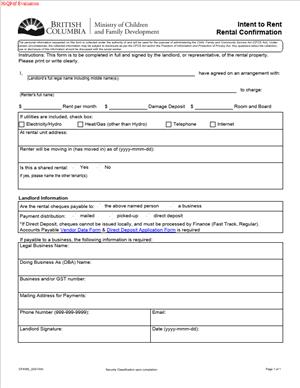
CF4095 – Intent to Rent – Rental Confirmation
Fill out nowJurisdiction: Country: Canada | Province or State: British Columbia
If you are completing CF4095 – Intent to Rent – Rental Confirmation, you likely need to confirm housing details for a government-related process. This form is used in British Columbia and is connected to housing arrangements involving children, youth, or families.
CF4095 – Intent to Rent – Rental Confirmation is not a standard residential tenancy agreement. It does not replace a lease. Instead, it confirms that a landlord intends to rent a specific unit to a named person under stated terms.
You may be filling this out because a ministry worker asked for proof of housing. In many cases, the form supports planning for a child’s placement, family reunification, or financial assistance connected to housing.
This document matters because housing stability is often a key requirement in child and family matters. Clear, accurate information on this form helps decision-makers understand whether appropriate accommodation is available.
What is CF4095 – Intent to Rent – Rental Confirmation?
Clear definition
CF4095 – Intent to Rent – Rental Confirmation is a written confirmation that a landlord or property owner intends to rent a specific residential unit to a named individual. It outlines the basic rental details, such as the address, proposed rent, and expected move-in date.
This form is typically used as supporting documentation in matters handled by the Ministry of Children and Family Development in British Columbia. It serves as confirmation of planned housing, rather than proof of an existing tenancy.
The document usually includes identifying information about the landlord and the prospective tenant. It may also include details about the type of unit and monthly rent.
Who typically uses form CF4095?
This form is commonly completed by a landlord or property manager. The person intending to rent the unit may also be involved in providing their information.
It is often requested by a ministry worker when a parent, guardian, caregiver, or youth needs to demonstrate stable housing. The form can also be used when housing is part of a broader plan involving child safety or family support.
In many cases, the tenant is someone working with child and family services. The landlord’s role is to confirm their intention to enter into a rental arrangement.
Why might you need BC CF4095 form?
You may need this form if you are required to show that you have secured housing before a child can return to your care. Housing suitability is often part of planning in child welfare matters.
The form may also be required if you are applying for financial support related to housing. A ministry office may need written confirmation of the rent amount and rental terms.
Sometimes, the form is used when a youth is transitioning to independent living. In that situation, the confirmation helps establish that appropriate accommodation has been arranged.
The document can also be part of a safety or supervision plan. Stable housing may be a condition in that plan.
Typical real-life scenarios
- A parent is working toward reunification with their child. As part of the process, they must show they have safe and stable housing. A landlord agrees to rent them an apartment and completes the form to confirm the details.
- A youth aging out of care is preparing to move into their first rental unit. The ministry requests written confirmation from the landlord before finalizing support payments.
- A caregiver is relocating to a new residence to better meet a child’s needs. The landlord provides written confirmation of the upcoming tenancy so the ministry can assess suitability.
- A family is moving from temporary housing into a permanent rental. The ministry requires documentation showing the address, rent, and expected move-in date before updating the family’s file.
When would you use CF4095 – Intent to Rent – Rental Confirmation?
You would use this form when a government office asks for written confirmation of an intended rental arrangement. It is typically used before a lease is formally signed or before a tenant has moved in.
This document is often used during planning stages. For example, when a child returns home, housing arrangements need to be confirmed in advance.
It may also be used when financial assistance depends on verified rent amounts. The form helps confirm the expected monthly payment and related details.
Landlords use the form when they are willing to rent to a specific person but need to provide official confirmation for ministry purposes. The tenant uses it to demonstrate that housing is available and ready.
The form is not generally used for private purposes between landlord and tenant alone. Its use is tied to administrative or support processes involving child and family services.
Legal characteristics of CF4095 – Intent to Rent – Rental Confirmation
CF4095 – Intent to Rent – Rental Confirmation is a written statement of intention. It records key facts about a proposed rental arrangement. Its effectiveness depends on accurate, complete information and proper signatures where required.
For the form to serve its purpose, the information must match the actual understanding between the landlord and tenant. Inconsistencies in rent amount, address, or occupancy details can create problems.
Incomplete sections are a common reason for delays. Missing signatures, unclear move-in dates, or unreadable contact information can result in follow-up requests.
This form does not replace a residential tenancy agreement. It does not typically include the full terms and conditions required for a binding lease under residential tenancy laws in British Columbia.
The document also does not transfer possession of the unit. Until a lease is signed and the tenant takes possession under agreed terms, the rental relationship may not be fully established.
Administrative requirements can vary depending on the specific circumstances of the family or youth involved. In some cases, additional documentation may be requested alongside this form.
Is it legally binding?
Whether this form is legally binding depends on how it is completed and the surrounding circumstances. In many cases, it is a confirmation of intent rather than a finalized agreement.
A legally binding tenancy usually requires clear agreement on essential terms, such as the unit, rent, and start date, along with mutual consent. A standard lease agreement typically sets out those terms in detail.
CF4095 – Intent to Rent – Rental Confirmation may show that both parties intend to enter into a tenancy. However, it does not usually contain the full terms found in a residential tenancy agreement.
If the landlord and tenant later sign a formal lease, that lease governs their rights and obligations. The confirmation form mainly serves as evidence that a rental arrangement is planned.
How to fill out CF4095 – Intent to Rent – Rental Confirmation
Step 1 – Enter the property details
Write the full address of the rental unit. Include the unit number if applicable. Ensure the address is complete and accurate, including city and postal code.
This information identifies the exact location being offered. Double-check spelling and numbers to avoid confusion.
Step 2 – Provide landlord information
Enter the landlord’s full legal name. If a property management company is involved, include the company name and the authorized representative’s name where required.
Add current contact details, such as a phone number and mailing address. The ministry may use this information to verify the rental confirmation.
Step 3 – Provide tenant information
Write the full name of the person who intends to rent the unit. Use the same name that appears in ministry records.
Ensure the name is spelled correctly. Any mismatch with other documents can cause delays in processing.
Step 4 – State the proposed rent and payment details
Enter the agreed monthly rent amount. If utilities are included, note that clearly where the form allows.
If the form includes space for a damage deposit or other charges, complete those sections carefully. Make sure the amounts reflect what was actually discussed.
Step 5 – Indicate the intended move-in date
Write the expected start date of the tenancy. This should reflect the date both parties anticipate the tenant will take possession.
Avoid vague entries such as “as soon as possible.” A specific date provides clarity for planning purposes.
Step 6 – Confirm occupancy details
If the form asks how many people will live in the unit, provide the expected number of occupants. Include children if they will reside there.
Accurate occupancy information helps assess whether the housing is appropriate for the household size.
Step 7 – Review all entries for accuracy
Read through the entire form before signing. Check that names, amounts, dates, and addresses are consistent throughout.
Correct any errors neatly. If a change is significant, consider completing a new form to avoid confusion.
Step 8 – Sign and date the form
The landlord or authorized representative signs and dates the form where indicated. The tenant may also be required to sign, depending on the layout of the document.
Use the actual date of signing. Once completed, provide the form to the requesting ministry office or worker as directed in your process.
Legal terms you might encounter in CF4095 – Intent to Rent – Rental Confirmation
- Applicant: This is the person applying for housing or support who intends to rent the property listed in the document. On this form, the applicant’s name must match their identification and any related program or ministry file. Inconsistent spelling or missing middle names can delay processing.
- Landlord: The landlord is the legal owner of the property or the person authorized to act on the owner’s behalf. The form may require the landlord’s full legal name, contact information, and signature. If a property manager signs, their authority to act for the owner should be clear.
- Rental Confirmation: This refers to the landlord’s written confirmation that they intend to rent the specified property to the applicant. It is not necessarily a full tenancy agreement. It confirms key details such as rent amount, unit address, and anticipated move-in date.
- Tenancy Agreement: A tenancy agreement is the formal contract that sets out the full legal terms of the rental relationship. This form is separate from the tenancy agreement. It may confirm that a tenancy is expected, but it does not replace the need for a signed lease.
- Monthly Rent: This is the agreed-upon amount the tenant will pay each month. The form typically requires you to state the exact amount and may separate base rent from additional charges. Accuracy matters because this figure may be used for program eligibility or payment calculations.
- Security Deposit: A security deposit is a sum paid before move-in to cover potential damage or unpaid rent. If referenced, it should clearly state the amount and when it is due. The form may confirm whether the deposit has been paid or is still required.
- Occupancy Date: This is the intended date the tenant will move into the unit. It must be specific, not vague. An incorrect date can affect benefit start dates or payment arrangements.
- Authorized Signatory: This is the person legally allowed to sign on behalf of a landlord, company, or organization. If the landlord is a corporation or agency, the signatory should indicate their title. Signing without authority can invalidate the confirmation.
- Residential Address: This is the full civic address of the rental unit, including unit or apartment number. The address must be complete and accurate. Even small errors, such as a wrong postal code or missing unit number, can create confusion.
- Ministry File or Reference Number: Some forms include a file or case number assigned by the Ministry of Children and Family Development. Including this number ensures the document is matched to the correct individual’s file. Omitting it can slow down processing.
FAQs
Does CF4095 – Intent to Rent – Rental Confirmation replace a lease agreement?
No. This document confirms that a landlord intends to rent a specific unit to you under stated terms. It does not set out all the rights and obligations that would appear in a full tenancy agreement. You still need a signed lease that includes detailed terms such as rules, notice periods, and responsibilities for repairs.
What if the move-in date changes after this form is signed?
If the occupancy date changes, you should update the document or complete a new one showing the correct date. Programs that rely on this form often use the move-in date to calculate when payments begin. Leaving an outdated date can cause delays or incorrect payment timing.
Who is allowed to sign this document on the landlord’s behalf?
The person signing must have authority to bind the landlord. If the property is owned by an individual, that person signs. If it is owned by a company or managed by an agency, the signatory should include their job title and confirm they are authorized. Without proper authority, the confirmation may not be accepted.
What information must exactly match my identification or ministry records?
Your full legal name, date of birth if requested, and any file or reference number must match your official records. If your name appears differently on this form than in ministry files, staff may not be able to link the document to your case. Always check spelling, hyphenated names, and middle names.
Do I need to attach a copy of the lease to this form?
This document is usually separate from the full lease. In some situations, you may be asked to provide the tenancy agreement later for verification. Even if not required immediately, keep a signed copy ready in case it is requested to confirm rent details or terms.
What happens after I submit CF4095 – Intent to Rent – Rental Confirmation?
After submission, the ministry or program staff review the details to confirm eligibility and payment information. They may contact you or the landlord to verify rent, address, or move-in date. If information is missing or unclear, they may ask for corrections before approving support.
Can the rent amount on this document include utilities?
Yes, but the breakdown must be clear. If utilities are included in the monthly rent, that should be stated. If utilities are separate, the base rent should be listed on this form, and any additional estimated amounts should be clearly identified so there is no confusion about total housing costs.
What if the landlord decides not to rent to me after signing this form?
This document confirms intent, not a guaranteed tenancy. If the landlord withdraws before a lease is signed, you may need a new confirmation for a different unit. Inform the relevant office immediately so your file can be updated and any pending payments adjusted.
Checklist: Before, During, and After CF4095 – Intent to Rent – Rental Confirmation
Before
- Confirm the full legal name of the landlord or property owner.
- Verify the complete rental address, including unit number and postal code.
- Confirm the exact monthly rent and what is included.
- Clarify the expected move-in date with the landlord.
- Ask whether a security deposit is required and the amount.
- Locate your ministry file or reference number.
- Ensure your name matches your identification documents.
- Confirm who is authorized to sign on behalf of the landlord.
During
- Write clearly and legibly in all required fields.
- Enter the full civic address without abbreviations that could cause confusion.
- Double-check the rent amount for accuracy.
- Clearly state whether utilities are included or separate.
- Insert the correct intended occupancy date.
- Ensure both you and the landlord review the completed form.
- Have the authorized signatory include their title if applicable.
- Confirm that all required signatures and dates are completed.
After
- Make a copy or scan of the signed form for your records.
- Submit the document using the required method (in person, by email, or by upload if permitted).
- Confirm receipt if possible.
- Monitor your file or account for updates.
- Respond promptly to any requests for clarification.
- Keep a signed copy of your lease once finalized.
- Update the ministry if any rental details change.
- Store the document with your important housing records.
Common mistakes to avoid with CF4095 – Intent to Rent – Rental Confirmation
- Mistake: Leaving sections blank because you are unsure of the answer, which happens when you rush; this can cause processing delays or rejection, so do not forget to confirm every detail before signing.
- Mistake: Listing an incorrect or incomplete address due to copying errors; this can misdirect payments or create file confusion, so do not forget to include the full unit number and postal code.
- Mistake: Using an estimated rent instead of the agreed amount because discussions are ongoing; this may affect eligibility calculations, so do not forget to confirm the final agreed monthly rent.
- Mistake: Having someone sign who is not authorized, which often occurs in managed buildings; this can invalidate the confirmation, so do not forget to verify the signatory’s authority and title.
- Mistake: Failing to update the move-in date after changes, often due to scheduling issues; this can disrupt payment timing, so do not forget to submit a corrected document if dates shift.
- Mistake: Submitting the form without keeping a copy, which happens when you rely on the other party; this leaves you without proof of what was agreed, so do not forget to save a signed copy.
- Mistake: Allowing name discrepancies between this form and official records because of nicknames or spelling shortcuts; this can delay matching to your file, so do not forget to use your full legal name.
- Mistake: Forgetting to include a file or reference number, often overlooked when focusing on rent details; this can slow processing, so do not forget to add all identifying numbers.
What to do after filling out CF4095 – Intent to Rent – Rental Confirmation
Once the form is complete and signed, your next steps are about submission, confirmation, and follow-up. Acting quickly and staying organized will help avoid delays.
- Step 1: Make a clear copy or scan of the fully signed document for your personal records.
- Step 2: Confirm the correct submission method required by the Ministry of Children and Family Development.
- Step 3: Submit the form using the approved channel, ensuring all pages are included.
- Step 4: If submitting electronically, check that the file is readable and not cut off.
- Step 5: Request or keep proof of submission, such as a confirmation email or receipt.
- Step 6: Monitor your email, phone messages, or online account for any follow-up requests.
- Step 7: Respond promptly if you are asked to clarify rent, dates, or signatures.
- Step 8: Finalize and sign your full tenancy agreement with the landlord before moving in.
- Step 9: Provide updated documents if any rental details change before occupancy.
- Step 10: Keep all housing-related documents together in a safe place for future reference.
Stay proactive. If you do not receive confirmation within a reasonable time, follow up politely. Keep communication clear and factual. This form supports your housing arrangement, but it works best when paired with accurate records and timely responses.
Disclaimer: This guide is provided for informational purposes only and is not intended as legal advice. You should consult a legal professional.