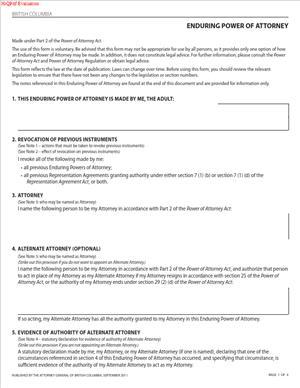
Enduring Power of Attorney
Fill out nowJurisdiction: Country: Canada | Province or State: British Columbia
An Enduring Power of Attorney is a legal document that lets you name someone to manage your financial and legal affairs. It continues to work even if you later lose mental capacity. That “enduring” feature is what sets it apart from many other authorizations.
You may be looking at this document because you want a clear plan in place. Many people complete it while they are healthy. The goal is to avoid confusion or delays later.
This document focuses on money and property decisions. It does not cover personal care or health treatment decisions. Those are usually handled through different agreements.
If you are about to fill out an Enduring Power of Attorney, it helps to understand what the form is designed to do. It also helps to know its limits and what information the document expects from you.
This overview is written for people completing the document on their own. It explains how the form generally works and what each part is asking for.
What is an Enduring Power of Attorney?
Clear definition
An Enduring Power of Attorney is a written agreement where you give another person legal authority to act for you. The person giving the authority is often called the adult or donor. The person receiving the authority is commonly called the attorney.
The authority granted relates to financial and legal matters. This can include managing bank accounts, paying bills, handling investments, or dealing with property.
The word “enduring” means the authority continues if you become mentally incapable. Without that feature, the authority would normally end at incapacity.
The document takes effect based on how it is written. In some cases, it works as soon as it is signed. In other cases, it starts later, such as when incapacity is confirmed.
Who typically uses this form/document?
Adults who want a plan for future incapacity commonly use this document. Age is not the deciding factor. Many people complete it as part of general life planning.
People with significant assets often use it to ensure continuity. This includes business owners, landlords, and people managing investments.
Individuals facing health uncertainty may also use it. The document provides structure during periods when decision-making becomes difficult.
Families sometimes encourage its completion. It can reduce uncertainty when financial decisions must be made quickly.
Why you might need this form/document
Life can change without warning. An accident or illness can interrupt your ability to manage finances.
Without an Enduring Power of Attorney, others may have limited authority to act for you. Even close family members may face delays or procedural barriers.
This document creates clarity. It identifies who can act and what they can do.
It can also reduce conflict. Clear instructions can prevent disagreements about financial decisions.
Typical real-life scenarios
- A person is hospitalized after a sudden injury. Bills still need to be paid, and accounts managed. An Enduring Power of Attorney allows the named attorney to handle those tasks without interruption.
- An adult develops a progressive cognitive condition. Over time, managing finances becomes harder. The document allows a trusted person to step in smoothly.
- A property owner travels or lives abroad. Managing property taxes, repairs, or sales from a distance is difficult. The document allows someone locally to manage those matters.
- A business owner becomes temporarily incapacitated. The attorney can manage payroll, contracts, and routine expenses during recovery.
When would you use an Enduring Power of Attorney?
This document is commonly used when you want ongoing financial decision-making support. It is relevant both for present convenience and future planning.
Some people rely on it immediately after signing. For example, the attorney may help with banking or paperwork right away.
Others create it strictly as a safeguard. In those cases, the document may only be used if capacity changes.
It is often used during periods of declining health. It can also be used during long absences or extended travel.
The attorney’s role is defined by the document. The authority can be broad or limited, depending on how the form is completed.
Legal characteristics of Enduring Power of Attorney
An Enduring Power of Attorney must meet certain formal requirements to be effective. These commonly include written form, proper signing, and witnessing.
Clarity matters. Ambiguous language can create problems when the document is relied on. Financial institutions often look closely at how authority is described.
Problems often arise from incomplete sections. Missing names, unclear dates, or inconsistent terms can delay acceptance.
Jurisdictional rules can differ. While the general concept is similar across regions, signing and witnessing requirements may vary.
This document does not authorize personal or health care decisions. It also does not allow actions beyond what is written in the agreement.
Is it legally binding?
An Enduring Power of Attorney is legally binding once properly completed and signed. Its authority flows from the written agreement and applicable law.
Its effectiveness depends on compliance with formal requirements. If those requirements are not met, third parties may refuse to rely on it.
Once in effect, the attorney’s actions are treated as actions taken on your behalf. This is why precision in the document is important.
The document remains subject to oversight. Misuse or acting outside granted authority can create legal issues.
How to fill out an Enduring Power of Attorney
Step 1 – Document title and identification
The form begins by identifying the document as an Enduring Power of Attorney. This confirms the type of authority being created. You will usually see space for the date and basic identification to distinguish it from other agreements.
Step 2 – Information about you
The form asks for your full legal name and identifying details. This establishes who is granting the authority. Accuracy here helps avoid confusion with others who may have similar names.
Step 3 – Naming the attorney
This section identifies the person who will act on your behalf. The form usually asks for the attorney’s full legal name and contact information. This ensures the right person can be clearly identified.
Step 4 – Alternate or replacement attorneys
Some forms allow you to name a replacement. This person acts only if the first attorney cannot or will not act. Including this information can maintain continuity without rewriting the document.
Step 5 – Scope of authority
The document describes what the attorney is allowed to do. This can range from broad financial management to specific tasks. The wording in this section controls the limits of authority.
Step 6 – Conditions and restrictions
Some Enduring Power of Attorney forms include space for conditions. This can describe when the authority begins or ends. It can also describe actions that are excluded.
Step 7 – When the authority takes effect
This part explains whether the authority starts immediately or later. The language used here affects when the attorney can begin acting. Clear timing reduces uncertainty.
Step 8 – Acknowledgement by the attorney
The form may include a section for the attorney to acknowledge their role. This confirms they understand the responsibility involved. It also links them formally to the document.
Step 9 – Signatures
The signing section records your signature. This is the moment the document is formally executed. The date is usually recorded here as well.
Step 10 – Witnessing
Most Enduring Power of Attorney documents require witnesses. The witnesses confirm that the signing took place properly. Their information is recorded in this section.
Step 11 – Completion review
The final step involves reviewing the completed document. This ensures all sections are filled in and consistent. A complete document is easier for others to rely on.
Legal terms you might encounter in an Enduring Power of Attorney
- Attorney: In this document, the attorney is the person you appoint to act for you. The form usually asks for their full legal name and contact details. This is not a lawyer by default. It is the decision-maker you trust to handle your affairs as written.
- Adult: This term identifies you as the person granting authority. The form may use “adult” instead of “grantor” or “maker.” You will need to confirm your legal name exactly as it appears on identification, so the authority is clear.
- Capacity: Capacity refers to your ability to understand what you are signing and the effects of the document. The form assumes you have capacity at the time you sign. This matters because the authority you grant is meant to continue even if capacity later changes.
- Enduring: Enduring means the authority continues if you later become incapable. This word is often built into the title or opening clause. You do not need to restate it elsewhere, but you must make sure the form clearly indicates this feature.
- Scope of authority: This describes what your attorney is allowed to do. The form may offer broad authority by default, with space to limit or exclude specific powers. What you write here controls the day‑to‑day use of the document.
- Effective date: The effective date tells others when your attorney can start acting. Some forms allow immediate effect, while others allow a future date or a triggering condition. You must select or write this clearly so there is no confusion.
- Restriction or limitation: A restriction narrows what the attorney can do. The form may provide a blank section for special instructions. Anything not written there is generally assumed to be permitted within the main authority.
- Revocation: Revocation is the act of canceling the document. The form may mention that you can revoke it while you have capacity. Understanding this term helps you plan how to update or replace the document later.
- Witness: A witness is the person who watches you sign and confirms your identity. The form may specify who can or cannot be a witness. Improper witnessing can make the document hard to rely on.
- Acknowledgement: This is the attorney’s written confirmation that they accept the role. The form may include a separate section for this. Without acknowledgement, some organizations may hesitate to accept the authority.
FAQs
Do I need to list the exact date when this document starts working?
Yes. You must locate the section that asks when the authority begins and either select an option or write a date. If you leave it blank, people reading the form may assume it is effective immediately or may refuse to rely on it. Make sure the date matches your intent and is readable.
What happens if the name on this form does not exactly match my ID?
This document relies on name matching for acceptance. If the name you write is different from your identification or account records, institutions may delay or reject it. Check spelling, middle names, and suffixes before you sign.
Can I attach extra pages with instructions?
Yes, if the form allows additional instructions or attachments. You must clearly label each attachment and refer to it in the main document. If you do not reference the attachment, others may ignore it.
Does my attorney have to sign on the same day as me?
Not always, but the form usually includes a separate acknowledgement section for the attorney. That section must be completed before the authority is used. Check that the attorney’s signature is dated and complete so there is no gap.
Do I need to register or file this form somewhere?
This depends on how the document is intended to be used. The form itself does not always require filing, but some organizations may ask for a copy to keep on record. You should confirm where it will be presented and follow their intake process.
Can I limit when my attorney can act without rewriting everything?
Yes. Look for the section on conditions or restrictions and write clear limits there. This keeps the rest of the form intact while controlling specific actions. Be precise so readers do not misinterpret your intent.
What if I change my mind after signing?
You can revoke this document while you have capacity. To do that, you must prepare a clear revocation and notify anyone who has a copy. If you later create a new Enduring Power of Attorney, make sure the old one is clearly canceled.
Will this document change public records automatically?
No. This document does not update public records by itself. If the authority is used to make changes, those changes must be recorded separately. Keep copies so there is proof of authority when updates are requested.
Checklist: Before, During, and After Enduring Power of Attorney
Before
- Confirm your full legal name and how it appears on identification.
- Decide who you trust to act and confirm they are willing.
- Think through which powers you want to include or limit.
- Decide when the authority should begin.
- Review who can act as a witness.
- Gather contact details for everyone named.
- Read the entire form once without filling it in.
- Plan where you will store the signed original.
During
- Write clearly and use full names, not nicknames.
- Complete every required field or mark it intentionally.
- Add restrictions in the correct section, not in the margins.
- Check dates for consistency as you fill them in.
- Have the witness present at the correct time.
- Sign using the same name you used elsewhere in the form.
- Ensure the attorney completes their acknowledgement.
- Review each page before final signatures.
After
- Make at least two clear copies of the signed document.
- Provide a copy to the attorney.
- Store the original in a known, safe place.
- Note who has received a copy.
- Confirm acceptance with any organization that will rely on it.
- Update your personal records list.
- Review it periodically for relevance.
- Plan how you would revoke or replace it if needed.
Common mistakes to avoid with Enduring Power of Attorney
- Mistake: Leaving sections blank because they seem optional, which happens when the form looks self‑explanatory, leading to refusal by others, and you should not forget to mark unused sections clearly.
- Mistake: Naming an attorney without confirming willingness, which happens due to assumptions, causing delays or refusal to act, and you should not forget to talk it through first.
- Mistake: Using informal names or abbreviations, which happens for convenience, resulting in name mismatches, and you should not forget to match the identification exactly.
- Mistake: Adding restrictions in the wrong place, which happens when instructions are rushed, creating confusion about authority, and you should not forget to use the designated section.
- Mistake: Skipping proper witnessing, which happens due to timing issues, risking invalidity, and you should not forget to check witness rules before signing.
- Mistake: Not giving the attorney a copy, which happens after filing it away, preventing use when needed, and you should not forget to distribute copies promptly.
- Mistake: Assuming it updates records automatically, which happens due to a misunderstanding, causing rejected requests, and you should not forget that separate record changes are required.
- Mistake: Failing to review it over time, which happens once it is signed, leaving outdated instructions, and you should not forget to reassess periodically.
What to do after filling out the Enduring Power of Attorney
Once the form is complete, your focus shifts to making it usable. A signed document that no one can find or trust is not helpful. Take a few deliberate steps to make sure it works when needed.
Start by checking that all signatures, dates, and names are complete and legible. This is your last chance to catch small errors that cause big delays later. If something looks inconsistent, correct it now rather than explaining it later.
- Step 1: Make high‑quality copies of the entire signed document, including any attachments or acknowledgements.
- Step 2: Give a copy to the attorney and confirm they understand where the original is stored.
- Step 3: Decide where the original will live and tell at least one trusted person how to access it.
- Step 4: Contact any organization that is likely to rely on it and ask about their intake or acceptance process.
- Step 5: Provide copies as requested and note the date and contact person.
- Step 6: Create a simple record listing who has a copy and where the original is kept.
- Step 7: Update your personal planning documents to reflect that this authority exists.
- Step 8: Set a reminder to review the document periodically or after major life changes.
Keep communication open with the attorney so they are not surprised if the document needs to be used. If circumstances change, plan the steps you would take to revoke or replace it. Treat this document as part of an ongoing system, not a one‑time task.
Disclaimer: This guide is provided for informational purposes only and is not intended as legal advice. You should consult a legal professional.