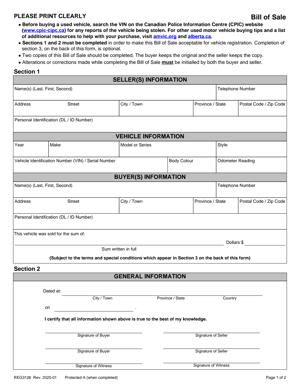
REG3126 – Bill of Sale
Fill out nowJurisdiction: Country: Canada | Province or State: Alberta
The REG3126 – Bill of Sale is a written record that shows ownership of personal property has been transferred from one person to another. In Alberta, this document is commonly used when buying or selling vehicles and other valuable items that require proof of ownership.
If you are about to complete REG3126 – Bill of Sale, you are likely selling or purchasing property and need written confirmation of the transaction. This form helps both sides clearly state what is being sold, for how much, and on what date.
A properly completed REG3126 – Bill of Sale creates a clear paper trail. It can be used to register a vehicle, confirm payment, or resolve disputes about ownership later on. Without it, you may struggle to prove that a transfer actually happened.
This document is typically provided through Alberta registry services and is often requested during vehicle registration or transfer processes. Filling it out carefully reduces delays and avoids confusion at the time of submission.
What is REG3126 – Bill of Sale?
Clear definition
REG3126 – Bill of Sale is a written agreement that records the sale and transfer of ownership of personal property from a seller to a buyer. It identifies the parties, describes the item being sold, and states the purchase price and date of sale.
It serves as evidence that the seller has given up ownership and that the buyer has accepted the item under the stated terms. In Alberta, it is commonly used for private vehicle sales, but it may also apply to other types of personal property.
The document does not transfer ownership by itself in every situation. Instead, it records the transaction and supports other required steps, such as registration or licensing.
Who typically uses this form?
Private sellers use this form when selling a vehicle, trailer, or other registrable property. It allows them to show that they no longer own the item after a certain date.
Buyers use the form to demonstrate that they purchased the item lawfully. It may be required when registering the vehicle in their name.
In some cases, family members transferring ownership between relatives also use this document. Businesses selling used equipment or vehicles to individuals may use it as well.
Anyone involved in a private sale where proof of ownership is necessary may rely on this form to document the transaction.
Why might you need this form?
You may need REG3126 – Bill of Sale to complete a vehicle registration transfer in Alberta. Registry agents often require written proof of purchase before processing changes to ownership records.
You may also need it for tax purposes. The stated purchase price can affect how fees or taxes are calculated at the time of registration.
The form provides protection if questions arise later about payment, condition, or ownership. If a dispute occurs, a signed bill of sale can help clarify what both parties agreed to.
Without a written record, it becomes harder to show when the sale occurred or what was included in the transaction.
Typical real-life scenarios
- You sell your used car to a neighbour. The buyer needs proof of purchase to register the vehicle. You both complete and sign the bill of sale on the day money changes hands.
- You purchase a used trailer from someone you met through an online listing. The registry requires written confirmation of the sale before allowing you to register it in your name.
- You transfer ownership of a vehicle to a family member as part of a separation or estate arrangement. The bill of sale records the transfer and the stated value of the vehicle.
- You sell a piece of farm equipment to another individual. The document records the description of the equipment, the serial number, and the agreed price to avoid later confusion.
- You buy a motorcycle from a private seller. The signed document confirms that the seller is transferring ownership and that you have paid the agreed amount.
When would you use REG3126 – Bill of Sale?
You use this form when ownership of personal property changes hands through a private sale. It is most common when selling or buying a used vehicle that must be registered with Alberta registry services.
The seller uses it at the time of sale to document that they are transferring the item to the buyer. The buyer uses it when applying to register the item in their name.
It is typically completed on the date payment is made, and possession is given. Both parties review the details, confirm the description of the property, and sign the document.
You might also use it when selling an item “as is.” The written agreement records that the buyer accepts the item in its current condition, if that wording is included.
The form can be useful even if registration is not required. For valuable items, it creates a clear written record of the transaction.
In private sales between individuals, there is often no dealership or intermediary. The bill of sale becomes the main written proof of what was agreed.
Legal characteristics of REG3126 – Bill of Sale
REG3126 – Bill of Sale is generally considered a contract. For a contract to be effective, there must be an offer, acceptance, and something of value exchanged, usually money. The document captures these elements in writing.
Clear identification of both parties is important. Full legal names and accurate addresses reduce the risk of confusion about who is involved.
A detailed description of the item being sold is also essential. For vehicles, this often includes the make, model, year, and vehicle identification number. Errors in these details commonly cause delays during registration.
The purchase price must be stated clearly. Leaving it blank or writing unclear amounts can create problems at the time of submission.
Signatures are a key part of the form. Without signatures from both parties, the document may not serve as strong evidence of the agreement.
Common issues include incomplete fields, missing dates, incorrect serial numbers, or inconsistent information compared to registration records. These mistakes can lead to rejection or requests for correction.
Rules and practices may vary slightly across provinces, but in Alberta, registry services typically expect accurate and complete information before processing a transfer.
It is important to understand what this document does not do. It does not guarantee the condition of the item unless specific promises are written into it. It does not automatically clear existing debts or liens on the property. It also does not replace other required documents for registration.
Is it legally binding?
In general, a properly completed and signed REG3126 – Bill of Sale can be legally binding because it records a contract between the seller and the buyer. Both parties agree to the terms and confirm the transfer of ownership for a stated price.
The binding nature depends on accurate information and genuine consent. If one party was misled or key information was false, the agreement could be challenged.
If both parties sign voluntarily, provide accurate details, and exchange payment for the item, the document usually serves as strong evidence of the agreement.
However, the form itself does not prevent disputes. It documents what was agreed, but disagreements about conditions or payment may still arise if expectations were not clearly stated.
How to fill out REG3126 – Bill of Sale
Step 1 – Identify the seller
Enter the full legal name of the seller exactly as it appears on their identification. Include the complete address. This helps confirm who is transferring ownership and avoids confusion with similar names.
Step 2 – Identify the buyer
Write the buyer’s full legal name and current address. Ensure the spelling matches the buyer’s identification. Accurate information is important for future registration and record matching.
Step 3 – Describe the item being sold
Provide a detailed description of the property. For a vehicle, include the year, make, model, body type, colour, and vehicle identification number. For other items, include serial numbers or unique identifiers if available.
Check each number carefully. Even one incorrect digit can cause delays or rejection during registration.
Step 4 – State the purchase price
Enter the agreed sale price in clear figures. Make sure the amount matches what both parties discussed. Avoid leaving this section blank or writing unclear terms.
If the item is being transferred as a gift or for a nominal amount, the stated value should still be written clearly on the form.
Step 5 – Record the date of sale
Write the exact date when the sale takes place. This is usually the day payment is made, and the item changes possession. The date helps establish when responsibility shifts from seller to buyer.
Step 6 – Include any additional terms
If there are specific conditions, such as the item being sold in its current condition, note this in the space provided if applicable. Keep the wording clear and simple so both parties understand what it means.
Only include terms that both parties agree on. Avoid adding informal notes that could create confusion later.
Step 7 – Sign the document
The seller signs to confirm they are transferring ownership. The buyer signs to confirm they are accepting the item and the stated terms. Signatures should be written clearly and match the names provided above.
In some cases, printing names beside signatures can make them easier to read.
Step 8 – Provide copies to both parties
After signing, ensure both the buyer and the seller have a copy of the completed document. Each party keeps its copy for records and future reference, especially during registration or if questions arise later.
Legal terms you might encounter in REG3126 – Bill of Sale
- Consideration: This is the value exchanged for the item being sold. In most cases, it is the purchase price you write on the form. Even if the item is a gift, the form may still require you to state a nominal amount to show that something of value is being exchanged.
- As Is: This phrase means the buyer accepts the item in its current condition. If this wording appears in the document, it limits the seller’s responsibility for defects after the sale. You should only agree to it if you understand that you are accepting the item without guarantees.
- Warranty: A warranty is a promise about the condition or ownership of the item. The form may include space to state whether the seller guarantees that the item is free from defects or liens. If no warranty is written, you should not assume one exists.
- Encumbrance: This refers to any claim, lien, or debt attached to the item being sold. For example, if money is still owed on a vehicle, that debt is an encumbrance. The form may require the seller to confirm that the item is free of encumbrances.
- Legal Description: This is a detailed and specific description of the item being sold. For vehicles, it usually includes the make, model, year, and identification number. Accuracy matters because this description proves exactly what changed hands.
- Transfer of Ownership: This term describes the moment when legal ownership moves from the seller to the buyer. The date you enter on the form often determines when that transfer takes effect. Make sure the date reflects the actual day the sale occurs.
- Signature: A signature confirms that each party agrees to the information in the document. The form may require printed names alongside signatures to ensure clarity. If a person signs on behalf of someone else, their authority should be clear.
- Joint Ownership: This means more than one person owns the item together. If the seller or buyer is more than one person, all owners may need to sign. The way names are written can affect how future ownership rights work.
- Affidavit: In some cases, a sworn statement may accompany the bill of sale. An affidavit is a written statement confirmed by oath or affirmation. If required, it must be signed in front of an authorized witness.
- Purchase Price: This is the exact amount paid for the item. The number you write must match any related transaction records. Inconsistent amounts can cause issues with registration, taxes, or later disputes.
FAQs
Does the sale become effective on the date I sign or the date written on the form?
The effective date is usually the date of sale written on the document. This date should match the actual day the item changes hands. If you sign on a different day, make sure the date entered clearly reflects when ownership transfers.
What if the buyer or seller’s name is spelled differently than on their identification?
Names should match government-issued identification exactly. Small spelling differences can cause problems when registering or transferring the item. Before signing this form, double-check the spelling, order of names, and any middle initials.
Do both parties need to sign REG3126 – Bill of Sale?
Yes, both the seller and the buyer should sign to confirm the agreement. A missing signature can make it harder to prove that both sides accepted the terms. Always confirm that each person signs and prints their name clearly.
Can someone sign on behalf of the seller or buyer?
A person can sign for someone else only if they have proper authority. That authority should be clear and, if possible, documented. The person signing should indicate their role, such as agent or attorney, beside their signature.
What happens if I make a mistake while filling out this document?
Avoid using correction fluid or heavily crossing out information. If you make a small error, both parties should initial the correction. For major errors, it is better to complete a new copy so the record is clear and readable.
Do I need to attach anything to REG3126 – Bill of Sale?
You may need supporting information, such as identification numbers or related ownership documents. Review the form carefully to see if it references attachments. If something is mentioned but not included, the transaction record may be incomplete.
Is this form enough to prove ownership?
This document provides written evidence of the sale. However, you may still need to complete additional steps to update official records. Keep your copy in a safe place in case you need to show proof of purchase.
What should I check before submitting information based on this form to a registry office?
Make sure all required fields are complete and legible. Confirm that dates, names, identification numbers, and the purchase price are consistent. Incomplete or unclear details can delay acceptance or require you to redo paperwork.
Checklist: Before, During, and After REG3126 – Bill of Sale
Before
- Confirm the full legal names of the buyer and seller.
- Gather accurate details about the item, including identification numbers.
- Verify that there are no outstanding debts or claims on the item.
- Agree clearly on the purchase price and payment method.
- Review whether any warranties or “as is” terms will apply.
- Prepare valid identification for both parties.
- Check if additional documents may be needed for registration.
- Decide on the exact date of sale.
During
- Write all information clearly and legibly.
- Double-check spelling of names against identification.
- Accurately record the full description of the item.
- Enter the correct purchase price in numbers and words if required.
- Confirm the date of sale matches the actual transfer.
- Review the completed document together before signing.
- Ensure all required parties sign and print their names.
- Initial any minor corrections made on the form.
After
- Make at least one copy for each party.
- Store your copy in a safe, dry place.
- Complete any required registration or transfer steps promptly.
- Confirm that official records reflect the new ownership.
- Keep proof of payment with your copy of the form.
- Update insurance information if applicable.
- Retain related correspondence or receipts.
- Monitor for confirmation that the transfer has been accepted.
Common mistakes to avoid with REG3126 – Bill of Sale
- Mistake: Leaving sections blank because you think they are optional, which often happens when you are unsure what to enter; this can lead to rejection or disputes later, so do not forget to review every field and fill in or properly mark all required spaces.
- Mistake: Writing an incomplete description of the item due to rushing, which can create confusion about what was sold; this may cause problems with registration or proof of ownership, so do not forget to include all identifying details.
- Mistake: Recording the wrong purchase price to simplify taxes or paperwork, which can trigger legal or financial consequences; do not forget that the amount should reflect the true sale price.
- Mistake: Failing to confirm that the item is free of encumbrances because you assumed it was paid off; this can leave the buyer responsible for someone else’s debt, so do not forget to verify ownership status.
- Mistake: Not matching names exactly to identification, which often happens when nicknames are used; this can delay processing or invalidate records, so do not forget to check spelling carefully.
- Mistake: Allowing only one party to sign because you trust each other, which weakens proof of agreement; this can make enforcement difficult, so do not forget to obtain all required signatures.
- Mistake: Making messy corrections without initials because you noticed an error after writing, which raises questions about authenticity; this can cause rejection, so do not forget to initial any changes or redo the form.
- Mistake: Forgetting to keep a copy after the sale because you believe the other party will store it; this leaves you without proof if issues arise, so do not forget to make and securely store your own copy.
What to do after filling out REG3126 – Bill of Sale
Once the document is fully completed and signed, your next steps matter. The form records the agreement, but you must make sure the transaction is properly reflected in your records and, if required, in official systems.
Start by reviewing the document one more time. Look at names, dates, identification numbers, and the purchase price. Make sure everything is readable. If you notice a serious mistake, prepare a clean new copy and sign again.
- Step 1: Make at least two clear copies of the signed document, one for you and one for the other party.
- Step 2: Attach any supporting documents that relate to the sale, such as proof of payment or prior ownership papers.
- Step 3: If the item must be registered or ownership must be updated, submit the required information promptly.
- Step 4: Confirm that the receiving office accepts the information and does not require corrections.
- Step 5: Store your copy in a secure place, such as a home file or secure digital archive.
- Step 6: Keep proof of payment together with your copy of the document.
- Step 7: Update your personal records to reflect that you no longer own the item, or that you now do.
- Step 8: If insurance applies, notify the insurer about the change in ownership.
- Step 9: Monitor any follow-up correspondence to ensure there are no outstanding issues.
- Step 10: Retain the document for several years in case questions arise about the transaction.
Taking these steps protects you. A completed and properly handled bill of sale gives you a clear record of what was sold, when it was sold, and who was involved. Good recordkeeping reduces misunderstandings and gives you confidence that the transaction is fully documented.
Disclaimer: This guide is provided for informational purposes only and is not intended as legal advice. You should consult a legal professional.