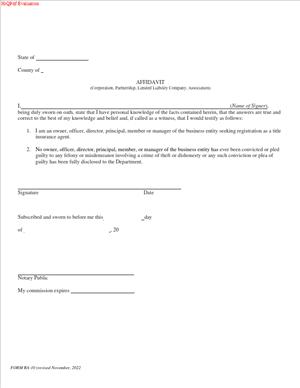
Affidavit (Corporation, Partnership, Limited Liability Company, Association)
Fill out nowJurisdiction: Country: United States | Province/State: Illinois
What is an Affidavit (Corporation, Partnership, Limited Liability Company, Association)?
An affidavit is a written statement of facts that you swear or affirm are true. It carries the same weight as testimony in court. When the signer represents a business entity, the affidavit confirms facts about the entity and the matter at hand. This form is tailored for corporations, partnerships, limited liability companies (LLCs), and associations operating or filing in Illinois.
In this context, the “affiant” is the person who signs on the entity’s behalf. The affiant must have personal knowledge of the facts. They also need authority to speak for the entity. For a corporation, that’s often an officer. For an LLC, it is a manager or managing member. For a partnership, it is a general partner. For an association, it is a president, secretary, or other authorized officer.
You use this affidavit when a court, agency, bank, title company, counterparty, or other third party needs sworn proof of facts related to your entity. The facts vary by situation. Common topics include the entity’s legal status, the authority of the affiant to act, the existence and amount of a debt, business records details, notice or service facts, or conditions relevant to a transaction.
Typical usage scenarios include litigation, real estate closings, lending, procurement, licensing, insurance, and compliance. In a court case, you might file this affidavit to verify the business’s standing or to authenticate records. In a real estate closing, you might confirm entity authority and the absence of liens. A lender may ask for an affidavit to confirm your entity’s identity and the affiant’s authority to sign loan documents. A public agency may require an affidavit in a bid package to confirm organizational status or a lack of conflicts.
If your entity is the landlord in an eviction, you may submit an affidavit to confirm ownership and rent due. If your entity sues for an unpaid account, you may provide an affidavit of account to prove the balance. If you are claiming an insurance loss, an affidavit may confirm facts of the loss and your capacity to make the claim. The form adds credibility because it is sworn before a notary. Illinois law requires proper notarization for an affidavit unless a specific rule allows a verified statement instead. When you sign, you assume legal responsibility for the truth of each statement.
In short, this affidavit is a sworn tool that helps your entity speak clearly and credibly in legal and transactional settings. It consolidates key facts, places them under oath, and signals that you are ready to stand behind them.
When Would You Use an Affidavit (Corporation, Partnership, Limited Liability Company, Association)?
You use this affidavit whenever a third party needs sworn facts from your entity. The trigger is usually a court rule, a contractual requirement, or a due diligence checklist. In Illinois, courts and agencies routinely ask for affidavits to verify facts outside live testimony.
If your corporation files or defends a lawsuit, you might use an affidavit to support a motion or to authenticate business records. For example, your accounts receivable manager can swear to the balance due, attach the ledger, and confirm how the records are kept. The affidavit allows the court to consider the facts without live testimony at that stage.
In a commercial lease dispute, a property manager for your LLC may swear to the lease, the rent ledger, and the notices served. That sworn statement can support possession or damages. If you are the landlord entity, you may need the affidavit to show authority to act and the facts of default. If you are the tenant entity raising defenses, you might submit an affidavit to prove repair issues, rent abatements, or communications with the landlord.
At a real estate closing, a title company may require an affidavit of organization and authority. Your managing member can swear that the LLC exists, is in good standing, and authorized the deal. They confirm there are no undisclosed liens or pending bankruptcy. That helps clear title issues and allows the closing to proceed.
If your association is applying for a grant, the agency may require an affidavit to confirm nonprofit status and the signer’s authority. The board secretary can swear to the bylaws and attach a resolution authorizing the grant application. That clarifies who can bind the organization.
In lending, a bank may request an affidavit to confirm identity, authority, and the absence of adverse changes. Your corporate officer can swear that the financial statements are accurate and that no default has occurred. The lender relies on that sworn assurance in underwriting.
In procurement, you may submit an affidavit to confirm your entity is not barred from public contracts, has disclosed conflicts, and meets eligibility criteria. The affiant is often a top officer with access to compliance records.
In insurance, an adjuster may request a sworn account of loss. Your operations director can swear to the damage, attach photos and reports, and confirm the policyholder’s entity details. The affidavit speeds review and payment.
In tax or licensing matters, agencies may request affidavits to verify owners, managers, and business locations. Your member or partner can swear to the ownership structure and attach organizational documents.
In summary, you reach for this affidavit whenever your entity needs to put key facts in sworn form. Typical users include business owners, officers, managers, general partners, association officers, property managers, and in-house counsel.
Legal Characteristics of the Affidavit (Corporation, Partnership, Limited Liability Company, Association)
An affidavit is legally binding because you swear or affirm to its truth before a notary. The oath triggers penalties if you lie. That risk of perjury gives weight to the statements. In Illinois, a valid affidavit has a written statement of facts, the affiant’s signature, and a proper jurat by a notary. The jurat is the notary language that says you signed and swore to the contents on a specific date. The notary’s seal and commission details also appear.
For an entity affidavit, enforceability depends on two things: the oath and the affiant’s authority. The oath makes the facts sworn. The affiant’s authority lets the entity speak through that person. Authority can come from statute, bylaws, an operating agreement, a partnership agreement, or a board or member resolution. If needed, you attach a resolution or excerpt from governing documents to prove authority. This avoids challenges that the affidavit is not properly authorized.
Courts consider affidavits as evidence in many settings. They often support motions, authenticate records, and establish foundational facts. A sworn business records affidavit can help you avoid hearsay objections because it shows how records are kept in the regular course of business. The court can then consider the records with fewer evidentiary hurdles. That said, be precise. If you lack personal knowledge, say so. Do not state legal conclusions. Stick to facts you observed or managed.
Notarization matters. The notary must witness your signing or take your oath. In Illinois, an affidavit uses a jurat that includes “subscribed and sworn before me” or similar language. The notary must add their signature, seal, commission expiration date, and other required information. A defective notarization can undermine the affidavit. If the notary is an interested party, the affidavit can be challenged. Choose a neutral notary. You may use in-person or approved remote notarization if you meet all technical rules. For remote notarization, ensure the platform and process satisfy Illinois requirements. Keep the notarial certificate with the finished document.
If a court rule allows a verified statement instead of an affidavit, you may file a verification under penalty of perjury. However, if the form you have is an affidavit, complete the notarization step. Do not assume a verification will substitute unless the rule expressly allows it.
Confidential information deserves care. Avoid including full Social Security numbers, full bank account numbers, or other sensitive data unless required. Use the last four digits if identification is needed. If exhibits include private data, consider redactions. Courts have rules for confidential filings. Follow them if you submit the affidavit to a court.
Finally, an affidavit is not a contract. It does not by itself create obligations beyond the oath. But it is evidence that can be used against your entity. False statements can lead to sanctions, fees, or criminal exposure. Review every line for accuracy before you sign.
How to Fill Out an Affidavit (Corporation, Partnership, Limited Liability Company, Association)
1) Confirm the purpose and audience
Start by clarifying why you need the affidavit and who will read it. Is it for a court, a title company, a lender, or an agency? The purpose shapes what facts you include, the exhibits you attach, and how detailed you need to be. If the affidavit will support a motion, check any local rules on format and timing.
2) Choose the right affiant
Pick someone with direct knowledge and authority. For a corporation, that may be the CFO or another officer. For an LLC, a manager or managing member works. For a partnership, use a general partner. For an association, use an officer listed in your bylaws. If the person only has partial knowledge, limit the statements to what they know. If you must cover multiple topics, consider multiple affidavits by different people.
3) Gather core entity information
Collect the entity’s exact legal name as registered, the entity type, and the state of organization. Confirm the principal office address. Identify the registered agent and registered office if relevant. Have proof of authority ready, like a recent resolution, operating agreement excerpt, or minutes. If a “good standing” proof is requested, obtain a current certificate. Bring the documents you will reference as exhibits, like contracts, ledgers, notices, or photos.
4) Set up the document caption
If filing in court, use the case caption at the top: court name, case number, parties’ names, and division. If the affidavit is for a transaction, use a clear heading such as: “Affidavit of [Name], [Title], on behalf of [Entity Name].” Add the jurisdiction line if requested, for example: “State of Illinois, County of [Name].” This shows where the oath occurs.
5) Title and introductory paragraph
Give the document a clear title that matches its use, such as “Affidavit of Authority,” “Affidavit of Business Records,” or “Affidavit of Account.” In the opening paragraph, identify the affiant by name, age (if needed), title, and relationship to the entity. State that you have personal knowledge and are competent to testify. Example: “I, Jordan Lee, Manager of ABC Logistics LLC, being first duly sworn, state as follows.”
6) Identify the entity and authority
State the entity’s exact legal name, type (corporation, LLC, partnership, or association), and state of organization. Include the principal office address. Then confirm your authority. Example: “I am authorized to make this affidavit for and on behalf of ABC Logistics LLC by virtue of my position as Manager and a resolution adopted on [date].” If a resolution exists, attach it as an exhibit and reference it: “See Exhibit A.”
7) Present the facts in numbered paragraphs
Use short, numbered paragraphs. One fact per paragraph. Stick to dates, names, amounts, and processes. Avoid legal conclusions like “breach” or “negligence” unless required. Instead, describe the facts that lead to those conclusions. If you rely on records, say how they are kept in the regular course of business, when they are made, and by whom. If you refer to attachments, label them as exhibits and cite them precisely: “Attached as Exhibit B is a true and correct copy of the lease dated May 1, 2023.”
8) Tailor the content to the purpose
- For identity and authority: state formation date, current status, and that the entity is active. Identify the governing body that authorized the action.
- For business records: describe your role in maintaining records, the system used, and that entries are made at or near the time by someone with knowledge.
- For debts or accounts: state the opening balance, payments, credits, charges, and the current balance due as of a specific date.
- For real estate: state the property address, legal description reference, ownership facts, liens you know of, and any pending suits affecting title.
- For service or notice: state when, where, how, and to whom you sent the notice, and attach a copy and proof of delivery.
9) Attach exhibits correctly
Mark exhibits with letters or numbers. Include a brief cover page or stamp on each exhibit: “Exhibit A – Member Resolution dated [date].” Refer to each exhibit in the body. Ensure every exhibit is legible. Redact sensitive data that is not required. If you include totals or summaries, check the math twice.
10) Add any required clauses
Include a clause that the statements are based on your personal knowledge. Include a clause that the exhibits are true and correct copies. If you used estimates, say so and explain the method. If you need to reserve or limit the scope of your statements, add a clear sentence, such as: “This affidavit addresses only the facts stated herein. It does not purport to address all matters in the case.”
11) Close with a verification sentence
End the body with a final statement such as: “I declare under oath that the foregoing is true and correct to the best of my knowledge and belief.” This aligns with the sworn nature of the document and tees up the notary jurat.
12) Sign only in front of the notary
Do not sign in advance. In Illinois, you must sign and swear before a notary for an affidavit. Bring a government ID. The notary will check your identity, administer an oath, and watch you sign. They will complete the jurat that says, “Subscribed and sworn before me on [date], by [name].” The notary will apply a seal and include their commission details. Ensure the jurat names the county where the notarization occurs and includes the notary’s signature and commission expiration date.
13) Consider remote notarization if needed
If you cannot meet in person, Illinois allows remote notarization when you follow the required procedures and use an approved platform. Confirm that the recipient accepts remote notarizations. Some courts and title companies still prefer in-person notarization. If you go remote, keep the session record and any platform confirmations with your file.
14) Review for accuracy and completeness
Check names, dates, addresses, and amounts. Make sure the entity name matches your formation documents exactly. Verify that all exhibits referenced are attached. Confirm page numbers and exhibit labels. Watch for internal consistency: the dates in the body should match your exhibits. Correct typos. A small error can slow your case or closing.
15) Use the right format and page setup
Use clear fonts and standard margins. Number each page. Include a footer with the entity name and date if helpful. If the affidavit will go to court, look at any local format requirements, like page limits or caption rules. If page limits apply, move lengthy detail to exhibits.
16) Add signature block and capacity
Under the jurat, include your printed name, title, and entity name. Example:
“[Signature]
Jordan Lee, Manager
ABC Logistics LLC”
Your capacity (officer, manager, general partner, secretary) must appear so the reader understands your role.
17) Keep originals and produce copies
Keep the original notarized affidavit in a safe place. Provide copies as requested by the court, title company, lender, or agency. If you file electronically, scan in color to capture the notary seal clearly. Some recipients require the original by mail. Confirm their preference and deadlines.
18) Common pitfalls to avoid
Do not speculate. Do not include hearsay unless you explain the business records basis. Do not overstate authority. If your authority depends on a resolution, attach it. Do not bury the key facts. Put critical points early in the affidavit. Do not include unnecessary personal data. Redact as allowed. Do not sign outside the notary’s presence.
19) When to use multiple affidavits
If your affidavit becomes long or mixes topics, break it into separate affidavits. For example, use one affidavit to authenticate records and another to address the facts of default. If two different people have knowledge of different pieces, have each person sign their own affidavit. This keeps the record clean and credible.
20) When to update or supplement
If something material changes after you sign, prepare a supplemental affidavit. State what is new and why it matters. Attach updated exhibits. Do not alter a signed affidavit. Keep the original intact and add a new sworn statement to address the change.
By following these steps, you create a clear, credible affidavit that meets Illinois requirements and the needs of your audience. You show who you are, why you can speak for the entity, and what facts you know. You back up those facts with records. You sign under oath before a notary. That is what most courts, agencies, and counterparties expect, and it is what makes your affidavit useful.
Legal Terms You Might Encounter
- Affiant means the person who swears the affidavit. In this form, you are the affiant if you sign on behalf of the entity. You must have the authority to speak for the entity.
- Notary public is the official who verifies your identity and witnessing. The notary completes the notary block on the form. You sign in the notary’s presence.
- Oath or affirmation is the promise that your statements are true. You can choose either. The form is valid with an oath or an affirmation.
- Capacity is the role in which you sign. Examples include president, manager, partner, or authorized agent. List the exact title that gives you authority.
- Authorized signatory means you have permission to sign for the entity. Your operating agreement, bylaws, or resolution may grant that authority. The form often asks you to state this.
- Entity name is the legal name on state records. Use the exact name, including punctuation and suffixes. Do not use a trade name unless the form asks for it.
- Registered agent is the person or business that receives legal papers. The form may ask for the agent’s name and address. Use the current agent on file.
- Principal place of business is your main office location. This is typically the physical address where you manage operations. The form may need this address.
- Articles refer to your formation document. For corporations, it is the articles of incorporation. For LLCs, it is the articles of organization. The form may ask you to reference these.
- Good standing means your entity is active and compliant. You have filed the required reports and paid the fees. You may need to state that the entity is in good standing.
- Perjury is lying under oath. The form includes a perjury warning. False statements can lead to penalties or case harm.
- Jurat is the notary section that states you swore to the truth. It includes the date, your name, and the notary’s details. The notary completes it after you sign.
- Acknowledgment is a notary act confirming that you signed voluntarily. Some affidavits require a jurat, not an acknowledgment. Use the notary act as the form specifies.
- Exhibit is an attachment that supports your statements. Label exhibits clearly, such as “Exhibit A.” Reference each exhibit in the affidavit.
FAQs
Do you need to sign in front of a notary?
Yes. Affidavits require in-person notarization unless the form allows approved remote notarization. Bring a valid photo ID. Do not sign before meeting the notary.
Do you need a corporate seal?
Usually no. Most forms do not require a seal. If the form has a seal line, use it only if your entity maintains a seal. The notary seal is separate and required.
Who can sign for an LLC or corporation?
Someone with authority. For an LLC, this could be a manager or member. For a corporation, this could be an officer or authorized agent. Your governing documents should confirm this authority.
Can you use an electronic signature?
Not for the signature that is notarized. The notary must witness your wet signature unless remote notarization is allowed and used. Copies or scanned versions may be used after notarization if accepted by the recipient.
Do you need to attach documents?
Attach only what supports your statements. Label each attachment as an exhibit. Reference each exhibit within the affidavit. Do not attach confidential materials unless required.
What if you make a mistake after notarizing?
Do not alter the notarized page. Prepare a new affidavit if the error is material. If minor, ask whether a supplemental affidavit is acceptable. Follow the recipient’s rules for corrections.
Does the affidavit expire?
The signature does not automatically expire. But the facts may become stale. Some recipients set a deadline for recent affidavits. Check any filing or response deadlines.
Do you need the exact legal name of the entity?
Yes. Use the name from state records. Include the correct suffix, such as Inc., LLC, or LLP. Mismatched names can trigger delays or rejections.
Checklist: Before, During, and After the Affidavit
Before signing
- Confirm the exact legal entity name from state records.
- Verify your title and authority to sign for the entity.
- Gather the entity’s formation date and jurisdiction.
- Locate the principal business address and mailing address.
- Confirm the registered agent’s name and address.
- Identify the correct capacity to list (e.g., president, manager).
- Collect any facts you will swear to (dates, amounts, events).
- Prepare exhibits (contracts, minutes, invoices, letters).
- Label exhibits clearly (Exhibit A, Exhibit B, etc.).
- Confirm any case, file, or matter number required.
- Note the recipient’s filing or response deadline.
- Review notary requirements (in-person or remote, allowed ID).
- Bring a valid photo ID and payment for any notary fees.
- Print the affidavit on clean, single-sided pages if required.
- Arrange a quiet, uninterrupted signing time with a notary.
During signing
- Check that the entity name matches state records exactly.
- Confirm your name and title match your ID and authority.
- Read each statement and confirm it is accurate and complete.
- Ensure dates are correct and consistent across pages.
- Reference each exhibit where appropriate in the text.
- Attach exhibits and label them before notarization.
- Fill all blanks. Write “N/A” where a field does not apply.
- Avoid cross-outs. If unavoidable, initial any clear corrections.
- Sign only in the notary’s presence.
- Use the designated signature line and capacity line.
- Print your name clearly below your signature if requested.
- Date the affidavit where indicated.
- Let the notary complete the jurat without guidance.
- Check the notary seal, signature, and commission expiry.
- Review the final pages for completeness before leaving.
After signing
- Make a clean copy for your records, including exhibits.
- File the affidavit with the correct office or recipient.
- Follow any specific filing method (e-file, mail, in-person).
- Pay any filing fee if required by the recipient.
- Obtain proof of filing or delivery and save it.
- Notify internal stakeholders of the filing status.
- Store the original in a secure, accessible place.
- Calendar any follow-up deadlines or hearing dates.
- Track whether the recipient accepts or rejects the filing.
- If rejected, note the reason and correct promptly.
- Update your internal checklist to prevent repeat issues.
Common Mistakes to Avoid
Using the wrong entity name or suffix
- Consequence: Rejection or delay. Don’t forget to match state records exactly.
Signing in the wrong capacity
- Consequence: Validity challenged. Don’t forget to use your current authorized title.
Leaving blanks or omitting exhibits
- Consequence: Incomplete filing. Don’t forget to fill every field and attach labeled exhibits.
Signing outside the notary’s presence
- Consequence: Notarization invalid. Don’t forget to sign only in front of the notary.
Mixing acknowledgment and jurat requirements
- Consequence: Notary block rejected. Don’t forget to use the notary act the form requires.
Using a trade name instead of the legal name
- Consequence: Confusion or mismatch. Don’t forget to use the legal name, not a DBA.
What to Do After Filling Out the Form
- Verify completeness. Confirm the entity name, your title, dates, exhibits, and notary block. Do this before submitting copies.
- Choose the filing method. Check whether the recipient accepts in-person, mail, or electronic filing. Follow any page, format, or size rules.
- File by the deadline. Submit the affidavit to the required office, court, or counterparty. Include any cover page or case number if needed.
- Serve or share copies. If another party must receive the affidavit, send a copy promptly. Use a trackable method, and keep proof of delivery.
- Monitor acceptance. Confirm the recipient accepts the affidavit. Save any receipt, file stamp, or acknowledgment.
- Address rejections quickly. If the filing is rejected, note the exact reason. Fix the issue and refile as soon as possible.
- Handle amendments. If facts change or you discover an error, prepare a new or supplemental affidavit. Reference the original affidavit and date. Sign and notarize again.
- Distribute internally. Share a copy with your legal team and leadership. Store the original in your records system.
- Update records. Log the filing in your matter file. Note the date, recipient, and any deadlines tied to the affidavit.
- Plan for follow-up. Calendar hearings, responses, or production dates linked to the affidavit. Assign ownership for next steps.
- Protect sensitive data. Redact personal data if allowed and if not needed. Keep unredacted originals secure.
- Maintain retention. Follow your document retention policy. Keep the affidavit and related proof as long as needed for the matter.
- Confirm consistency. Make sure future filings use the same entity name and addresses. Consistency reduces challenges.
- Prepare a reference pack. Keep a packet with your entity name, formation details, authority documents, and recent affidavits. This saves time on future filings.
- Ensure training. Brief anyone who may sign on behalf of the entity. Share this checklist and common pitfalls.
Disclaimer: This guide is provided for informational purposes only and is not intended as legal advice. You should consult a legal professional.