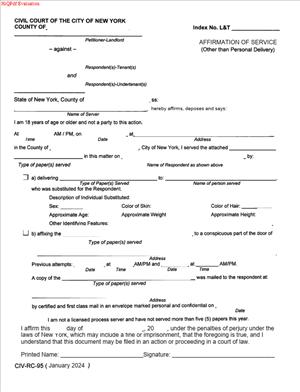
Form CIV-RC-95 – Affirmation of Service (Other than Personal Delivery)
Fill out nowJurisdiction: Country: USA | Province or State: New York
CIV-RC-95 – Affirmation of Service (Other than Personal Delivery) records how court papers were served without direct personal delivery. This form belongs to the New York City Housing Court.
Serving papers and documenting service are separate tasks. Service gives another person notice through an authorized procedure. The affirmation creates a written record of the actions taken.
The person completing and signing the affirmation must have a proper factual basis for the statements made. Preparing the case papers does not necessarily qualify you to affirm their delivery.
Before completing the form, gather the papers served, delivery notes, mailing records, and case information. Describe what actually happened—not what you intended to arrange.
What is CIV-RC-95 – Affirmation of Service (Other than Personal Delivery)?
Clear definition
This form is a written statement about service other than direct personal delivery in a New York City Housing Court matter. The signer affirms the truth of the facts stated.
“Service” means providing legal papers through a recognized procedure. Someone’s awareness of a case does not necessarily establish that the required procedure occurred.
“Other than personal delivery” does not authorize any convenient alternative. Depending on the papers and circumstances, an authorized method may require several actions, such as leaving papers and mailing another copy.
The affirmation documents those actions; it does not authorize them. Follow the actual form’s fields and instructions rather than assuming every possible method appears on it.
Who typically uses this form?
Self-represented tenants, property owners, and others handling Housing Court papers may encounter this document. However, being a party to the case and being the person who serves papers are different roles.
The person who performed service typically supplies the facts and signs. Eligibility to serve depends on the applicable requirements. If someone else served your papers, you may help organize the information, but you cannot substitute assumptions for that person’s account.
Why might you need this form?
The court may need evidence showing how notice was provided. Your application or response explains what you want the court to consider; the affirmation explains how the relevant papers were served.
It also preserves details that may become difficult to remember, including apartment numbers, dates, and the identity of someone who accepted papers. If service is disputed, these details help identify the disagreement without automatically resolving it.
Typical real-life scenarios
An eligible person leaves papers with someone other than the intended recipient, where that method is authorized. The affirmation records who accepted them and the circumstances.
A permitted procedure requires both leaving papers and mailing a copy. The account distinguishes those events, especially when they occur on different dates.
A court order authorizes a particular alternative arrangement. Whether this form fits depends on its wording and the court’s requirements.
When would you use CIV-RC-95 – Affirmation of Service (Other than Personal Delivery)?
You would generally complete this document after the service actions being affirmed have occurred. A planned delivery or prepared envelope is not a completed service event.
Select the form based on the actual method used. Its title distinguishes its purpose from proof of direct personal delivery.
The case stage also matters. Papers beginning a proceeding and papers exchanged during an existing case may have different service requirements. A method permitted for one document is not automatically available for another.
When assembling a filing package, keep proof of service separate from the underlying request or defense. The affirmation concerns procedural facts, not who should win the housing dispute.
Multiple recipients may require distinct accounts. Sharing an address does not mean one narrative adequately documents service on everyone.
An unsuccessful attempt also differs from completed service. Visiting an address without completing an authorized procedure does not necessarily establish service, even if the recipient later hears about the case.
Legal characteristics of CIV-RC-95 – Affirmation of Service (Other than Personal Delivery)
An affirmation of service is an evidentiary document. Its usefulness depends on accurate case identification, recognizable document descriptions, understandable service details, and the signer’s factual knowledge.
The account must reflect the limits of that knowledge. Someone who delivered papers may not know whether another person completed a separate mailing.
Checking a box cannot transform an unsuccessful attempt into completed service. Likewise, recording a mailing does not establish that mailing alone was authorized.
Inconsistent dates, incomplete addresses, vague document descriptions, and missing signatures can create uncertainty. Internal contradictions are especially important: a signing date should not precede an event described as already completed.
Clerical acceptance is different from legal sufficiency. A document may enter the court file without resolving whether service was valid. Requirements also vary by court, proceeding, and document type.
An affirmation and an affidavit may have different execution requirements. Read the printed declaration and signature instructions rather than relying only on the document’s title.
This form does not establish unpaid rent, resolve repair allegations, or determine possession. Nor does it cure defective service merely by describing it accurately.
Is it legally binding?
The affirmation is not a negotiated contract. It is a formal factual statement that can carry legal consequences.
The signer takes responsibility for the account under the declaration printed on the form. Knowingly false statements can expose the signer to consequences associated with false affirmations.
A properly completed document may support a finding that service occurred as described. Its weight depends on the facts, the signer’s knowledge, and other evidence. The other party may challenge it, and the court determines its legal effect.
How to fill out CIV-RC-95 – Affirmation of Service (Other than Personal Delivery)
Step 1 – Read the entire form before entering information
Review the method descriptions, conditional fields, declaration, and signature area. These steps organize your review but do not replace the actual form’s wording or assume a particular layout.
Step 2 – Gather the papers and service records
Collect the documents actually served, delivery notes, mailing records, and case information. Distinguish final papers from drafts and completed actions from the original service plan.
Step 3 – Enter the court and case information
Copy the court designation, party names, and index number from the relevant case papers. Preserve the parties’ existing roles; arranging service does not turn a respondent into a petitioner.
Step 4 – Identify the person making the affirmation
Provide the requested information about the person whose actions are described. Answer any questions about age, party status, or qualifications accurately rather than assuming availability establishes eligibility.
Step 5 – Identify the papers served
Use the documents’ actual titles and any requested identifying dates. Include accompanying materials where required. Avoid “court papers” when the form requests a specific description.
Step 6 – Identify the intended recipient
Distinguish the person or entity being served from anyone who physically accepted the papers. Keep multiple recipients’ accounts clear rather than implying one delivery covered everyone.
Step 7 – Record the location accurately
Include the requested apartment, unit, floor, or business information. Record where the event occurred, not a preferable address discovered later. Distinguish delivery and mailing addresses when they differ.
Step 8 – Enter the actual dates and times
Separate attempts, completed delivery or placement, mailing, preparation, and signing. Use supported facts. Do not turn uncertain recollections into falsely precise entries simply to fill a blank.
Step 9 – Describe the method that actually occurred
Select only language matching the events and instructions. Describe actions rather than merely stating service was “proper.” If the form does not fit, investigate instead of changing the facts.
Step 10 – Add recipient or attempt details where requested
Supply requested information about people encountered and earlier attempts. Distinguish observations from statements others made, such as a person’s claim about their relationship to the intended recipient.
Step 11 – Complete any applicable mailing information
Record the requested mailing date, destination, contents, and method. Preparing an envelope is not mailing it. If someone else mailed the papers, respect the signer’s limits of knowledge.
Step 12 – Review unused fields and additional pages
Follow instructions for inapplicable sections. If continuation pages are permitted, connect them clearly to the case and relevant entry. Extra pages do not replace required fields or execution language.
Step 13 – Compare the completed account with the records
Check titles, recipients, addresses, dates, and method selections against supporting records. Resolve contradictions between checked boxes and written explanations before presenting the statement for signature.
Step 14 – Read the declaration and complete the signature area
The affirmant must review the complete statement and declaration before signing. Enter the actual signing date without backdating, and follow the form’s execution requirements.
Step 15 – Check the final version for submission
Confirm legibility, page order, and consistent case identifiers. Preserve a matching copy, including continuation pages. Follow applicable filing instructions; submission is separate from completing service.
Legal terms you might encounter in CIV-RC-95 – Affirmation of Service (Other than Personal Delivery)
- Affirmation: A written statement declared true under the document’s penalty language. Here, it addresses service facts rather than arguments about the housing dispute.
- Service of process: Formal delivery of legal papers through an authorized procedure. Awareness of a case alone does not establish compliance.
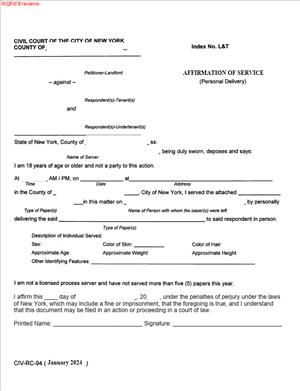
- Personal delivery: Generally, handing papers directly to the intended recipient. If that occurred, confirm that you selected the appropriate proof-of-service form.
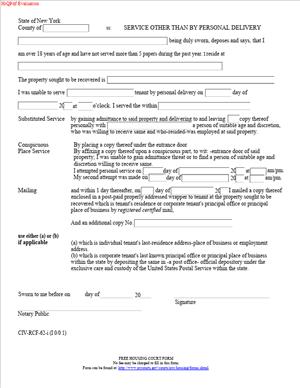
- Substituted service: Generally, leaving papers with another qualifying person and completing required additional steps. Not everyone present at an address necessarily qualifies.
- Conspicuous-place service: A method involving placement at a qualifying location and other required actions. The informal phrase “nail-and-mail” does not explain every requirement.
- Due diligence: Efforts required before certain alternative methods become available. Specific attempts, dates, times, and observations matter more than a general claim of difficulty.
- Person of suitable age and discretion: A person who qualifies to receive papers under the applicable method. Do not invent their age, role, or relationship.
- Deponent or affirmant: The person making the factual statement. Typing or organizing the form does not establish knowledge of the service events.
- Index number: The court case identifier. Compare the complete number, including any year or suffix, with the relevant papers.
- Proof of service: The record showing how papers were served. Filing it neither delivers the underlying papers nor guarantees a finding of sufficient service.
FAQs
What date should you use if delivery, mailing, and signing happened on different days?
Record each event under its own label. Delivery, mailing, and signing dates are not interchangeable.
When service becomes legally complete may depend on the method, filing, and applicable rules. Preserve the actual dates and do not calculate a response deadline solely from the signature date.
Can you sign this form if someone else delivered the papers?
Do not sign as though you performed someone else’s actions. Identify who made attempts, left papers, and completed mailing.
If different people performed different steps, confirm how their statements should be documented. Being a party, manager, assistant, or preparer does not establish firsthand knowledge of another person’s actions.
What should you do if the recipient’s name differs from the case caption?
Keep case identification consistent with existing papers unless a correction is authorized. Separately record relevant information the server learned.
Compare the papers and service notes. Do not assume someone giving a different name was the intended recipient. A significant identity mismatch may require attention beyond completing this form.
What attachments should you include with this document?
Follow the form’s instructions and applicable filing requirements. Clearly identify continuation pages and the entries they supplement.
Do not automatically attach every photograph, tracking record, or note. Retain supporting materials unless required or appropriate for submission. Confirm how additional pages become part of the signed affirmation.
How should you handle an unknown name, age, or other recipient detail?
Distinguish observations, estimates, and statements made by others. If a name was refused or unknown, preserve that fact rather than inventing one.
Do not use unexplained blanks to conceal missing information. Confirm whether the available facts satisfy the selected method; additional wording cannot replace a missing service requirement.
Does a filing receipt mean the court has approved the service?
A receipt generally confirms a filing event, not a ruling on service. Check the case number, document description, date, and filing status.
“Uploaded,” “received,” and “accepted” may describe different stages. Even acceptance does not necessarily establish legal sufficiency. Review any rejection notice before deciding what needs correction.
What happens if you discover an error after signing or filing this form?
Compare the signed document with original records and identify whether the problem is clerical or factual.
Do not overwrite the signed version or quietly replace a filed document. Confirm the correction procedure and any signature requirements. Preserve both versions. Corrected proof cannot make an omitted service action occur retroactively.
What information from this document becomes part of the court record?
The filed affirmation ordinarily becomes part of the case record, including relevant addresses, dates, descriptions, and identifying information.
Review the form and attachments for unnecessary sensitive information. Follow applicable privacy or redaction requirements without omitting required facts. Do not assume all materials will be publicly online or remain confidential.
Checklist: Before, During, and After CIV-RC-95 – Affirmation of Service (Other than Personal Delivery)
Before
- Confirm the form matches the papers and method used.
- Gather service notes, relevant attempts, and mailing records.
- Verify the caption and complete index number.
- Identify everyone who performed service-related actions.
- Confirm document titles and recipients.
- Check continuation-page, filing, and timing requirements.
During
- Separate observations, estimates, and others’ statements.
- Distinguish attempt, delivery, mailing, and signing dates.
- Record precise locations and recipient details.
- Connect each mailing to the appropriate papers and recipient.
- Explain unknown information honestly.
- Have the affirmant review all pages before signing.
After
- Retain the complete signed version.
- Save submission receipts and verify filing status.
- Preserve supporting records and any rejection notices.
- Keep corrected versions distinguishable from earlier filings.
- Update the case timeline.
- Monitor notices, deadlines, and questions about service.
Common mistakes to avoid with CIV-RC-95 – Affirmation of Service (Other than Personal Delivery)
- Mistake: Treating nonpersonal methods as interchangeable. The broad title does not authorize every indirect delivery method. Connect the actual events to the requirements for the papers involved.
- Mistake: Combining recipients into a vague narrative. A shared address does not eliminate the need to identify whose service each action concerns. Confirm whether separate proof is needed.
- Mistake: Copying details from another case. Reused files may retain incorrect dates, units, document titles, or descriptions. Compare every reused entry against current records.
- Mistake: Presenting assumptions as observations. Someone answering a door does not automatically establish residence or relationship. Identify information supplied by others.
- Mistake: Substituting a mailing receipt for the narrative. Tracking may not establish contents or connection to the delivery event. Complete the requested mailing details.
- Mistake: Adding facts after signature. Later changes can create uncertainty about what was affirmed. Handle substantive changes through an appropriately reviewed and signed document.
- Mistake: Assuming corrected proof cures defective service. Fixing the written account cannot supply an omitted delivery or mailing action.
- Mistake: Keeping only an editable draft. Preserve the signed form, attachments, submission confirmation, and later corrections as distinct records.
What to do after filling out CIV-RC-95 – Affirmation of Service (Other than Personal Delivery)
Treat the signed affirmation as a fixed record. Preparation, submission, acceptance, and legal sufficiency are separate stages. Your records should show which stages are complete.
Step 1: Preserve the signed version.
Copy every signed page and attachment. Inspect scans for missing pages, cut-off text, and unreadable dates. Retain original signature pages when available.
Step 2: Assemble the submission copy.
Arrange the form and required continuation pages in order. Remove unrelated drafts, notes, and duplicates. Keep supporting evidence separately unless it belongs in the filing.
Step 3: Confirm the filing destination and method.
Verify the correct case and permitted submission channel. Do not assume that emailing a general court contact places the document in the case record.
Step 4: Check timing separately from document accuracy.
Identify the applicable filing deadline and any rules connecting filing with completion of service. Record the deadline’s source and seek clarification rather than guessing.
Step 5: Submit and capture the transaction details.
Retain the exact file or papers submitted and any available confirmation. A dispatch record may establish something different from proof that the court received the document.
Step 6: Verify acceptance or identify a return.
Match the filing status to your case and document. Save rejection explanations and determine the requested correction. Do not label a pending submission as accepted.
Step 7: Organize the supporting service records.
Keep original logs, mailing records, and relevant evidence accessible. Distinguish contemporaneous notes from later summaries and event dates from filing dates.
Step 8: Update your internal documents.
Revise your timeline and task list. Mark superseded drafts clearly while preserving signed versions. Ensure anyone helping with the case knows which version was filed.
Step 9: Track the next case event.
Review notices governing appearances, responses, and submissions. Filing proof of service does not eliminate other obligations or independently establish every deadline.
Step 10: Prepare to answer a specific question about service.
Keep relevant dates, addresses, recipient details, and mailing records easy to locate. If a question reveals an error, preserve the existing document and investigate the correction procedure.
Use precise status labels such as “signed,” “submitted,” “accepted,” “returned,” or “corrected.” Avoid “all done” when filing questions or case obligations remain unresolved.
Disclaimer: This guide is provided for informational purposes only and is not intended as legal advice. You should consult a legal professional.