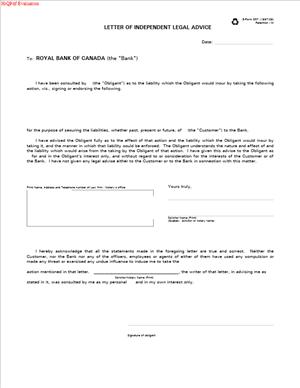
857 – Letter of Independent Legal Advice
Fill out nowJurisdiction: Country: Canada | Province or State: Federal
What is a 857 – Letter of Independent Legal Advice?
Form 857 is the Bank’s standard “Letter of Independent Legal Advice” used across Canada. It confirms that you met with your own lawyer, separate from the Bank, and received advice about a specific transaction and the documents you are signing. It is most often required when you agree to take on risk for someone else’s loan, sign a guarantee, give collateral, sign a mortgage on a home you do not own, or postpone your personal or family property rights. The letter documents that you understood the nature and consequences of the transaction, and that you signed voluntarily.
Who typically uses this form?
Individuals who are not the primary borrower often need it. Common users include guarantors, indemnitors, pledgors, co-signers, and non-borrowing spouses or partners giving consent to a mortgage. Directors or shareholders who guarantee a corporate loan also use it. In some cases, a borrower who faces a higher risk of undue influence may be asked to get independent legal advice as well.
You may need this form if the Bank has concerns that you could later claim you did not understand the documents, or that you signed under pressure. The letter helps reduce that risk. For you, it is a safeguard. You get a clear explanation of the documents and the personal exposure they create. For the Bank, it strengthens the enforceability of the security and your commitments.
Typical usage scenarios include a parent guaranteeing an adult child’s business line of credit, a spouse consenting to a mortgage on a family home they do not own, or a shareholder pledging personal assets to secure a corporation’s loan. It also arises when you assign collateral, such as investment accounts or life insurance, or when you agree to postpone your claim against a borrower in favour of the Bank. The letter is not the loan or the security itself. It is a supporting certificate that sits in the Bank’s file and confirms the advice you received.
The Bank uses this form to verify independence. Your advising lawyer is not acting for the Bank. They act only for you. The letter records that independence and attaches a schedule of the specific documents reviewed. It is tailored to the transaction. It includes your name and role, the borrower’s name, a description of the security, and the property address if a mortgage is involved. It is signed by you and certified by your lawyer.
When Would You Use a 857 – Letter of Independent Legal Advice?
You would use this form when the Bank makes it a condition of funding or acceptance of your signature. This often happens if you are not the direct beneficiary of the loan but are providing security or support. For example, a parent guarantees a child’s equipment loan. The parent does not receive the loan funds. The parents’ liability can be large and long-lasting. The Bank will require the parent to obtain independent legal advice and deliver Form 857.
Another common scenario involves spousal consent. Your partner is the sole registered owner of the home. They are arranging a refinancing. You are not on title and not a borrower, but you have family law or homestead rights. The Bank needs your informed consent to the mortgage and a postponement of your rights. Form 857 confirms you received advice about giving that consent and the impact if the borrower defaults.
Corporate lending often triggers this form. A small corporation borrows to expand. The Bank requires a personal guarantee from each director and a general security over company assets. Each director signs a guarantee and postponement of claims. The Bank wants to be sure each director understands that the guarantee could make them personally liable. Form 857 verifies the advice and independence.
You may also use this form when assigning or pledging collateral. You might assign an investment account to secure a personal line of credit. You could pledge life insurance as security for a commercial loan. If the implications are material, the Bank may require independent legal advice and the corresponding letter.
Real estate transactions commonly involve Form 857. A co-signer joins a mortgage to help a borrower qualify, without a beneficial ownership interest in the property. The Bank often requires proof that the co-signer understands the risks. Form 857 documents that conversation.
The form also appears when a person with limited English or limited financial sophistication signs a complex security. In those cases, independent legal advice helps ensure understanding, reduces the chance of future dispute, and confirms voluntariness. The Bank may also request it if there is a perceived imbalance of power between parties, such as a dependent adult co-signing for a caregiver’s loan.
Legal Characteristics of the 857 – Letter of Independent Legal Advice
Form 857 is not the loan agreement, guarantee, or mortgage. It is a lawyer’s certificate and a client acknowledgment. The letter is legally significant because it is evidence that you received independent legal advice before signing related security documents. It helps the Bank enforce the security if there is a dispute. If you later claim you did not understand the documents, the letter stands as contemporaneous proof that a lawyer reviewed the risks with you, in private, and confirmed your capacity and consent.
Is it legally binding?
In most transactions, the letter itself does not create the debt or the security interest. Those obligations arise from the main documents, such as the guarantee or mortgage. However, the letter is binding as an evidentiary statement. You and your lawyer sign it. You acknowledge that you received advice and understood the consequences. Your lawyer certifies their independence and the advice given. Courts consider such certificates persuasive. They help defeat defences like undue influence, misrepresentation, unconscionability, or non est factum.
What ensures enforceability?
Several features work together. First, the letter requires the advising lawyer to be independent of the Bank and the borrower. Independence means they act only for you, with no conflict. Second, the letter lists the exact documents reviewed. It avoids ambiguity about what the advice covered. Third, the lawyer confirms that they met with you alone, verified your identity, and explained the nature and effect of the documents. Fourth, the form records that you signed voluntarily and were not pressured. Fifth, the letter is dated and signed in close proximity to the signing of the security, preserving a clear timeline.
General legal considerations apply. The laws that affect family property, homestead, dower, exemptions, and land registration are provincial. The core banking obligations, guarantees, and insolvency concerns have national relevance. Form 857 is designed for use across Canada. Your lawyer will tailor their advice to your province’s rules. If a spouse or partner must release or postpone rights, your lawyer will explain those provincial implications. If you are guaranteeing a corporate debt, your lawyer will explain joint and several liability and the survival of obligations after changes in the corporation. If the security includes a collateral mortgage, your lawyer will explain how the charge can secure present and future indebtedness.
The letter also serves as a professional record for your lawyer. It shows that they met professional standards for giving independent legal advice, including ensuring capacity, addressing language or translation needs, and advising on alternatives and risks. Because it is a formal certificate, lawyers take care to document the advice, their independence, and the client’s understanding.
How to Fill Out a 857 – Letter of Independent Legal Advice
Follow these steps to complete Form 857 accurately and avoid funding delays.
1) Confirm the requirement and your role.
- Ask the Bank which party must obtain independent legal advice. It could be you as guarantor, your spouse giving consent, or a director signing a guarantee.
- Confirm the specific documents to be covered. Examples include a guarantee, mortgage, or charge, postponement of rights, assignment of collateral, or a co-borrower agreement.
2) Retain an independent lawyer.
- Choose a lawyer who is not acting for the Bank, the borrower, or any other party in the transaction. They must act only for you.
- Book a meeting. Plan to meet privately. Bring government-issued photo ID and the draft documents.
3) Gather the document package.
- Obtain the draft security documents from the Bank or the borrower’s counsel. Ask for the latest versions.
- Collect any schedules that describe the property, collateral, or credit details.
- Bring the blank Form 857 provided by the Bank, if available. If not, your lawyer can request it from the Bank contact.
- Prepare any translation or interpreter support, if needed. The meeting should be in a language you understand.
4) Identify the parties and the transaction on the form.
- At the top of the form, enter the date and the Bank file or reference number, if provided.
- Enter your full legal name and address as the “Client” receiving advice. If you have a different name on ID, note it for your lawyer’s verification.
- Enter the borrower’s full legal name. If the borrower is a corporation, include the exact corporate name.
- Enter the property address and legal description if a mortgage or charge is involved.
- Enter a short description of the credit (for example, “Term loan up to $250,000” or “Collateral mortgage securing all present and future indebtedness”).
5) Describe your capacity and the documents reviewed.
- State your role: guarantor, indemnitor, pledgor, non-borrowing spouse or partner, co-signer, or co-borrower.
- In the schedule to the letter, list each document reviewed with its title and date. Be specific. Examples:
- Guarantee and Postponement of Claims, dated [date].
- Mortgage/Charge of Land on [property address], principal amount [amount], dated [date].
- Spousal Consent and Postponement of Rights, dated [date].
- Assignment of Investments / Life Insurance, dated [date].
- Banking agreement or security agreement, dated [date].
- If the form includes a “Schedule A – Documents Reviewed,” attach it and ensure it matches the main file.
6) Work through the client acknowledgments with your lawyer.
- Your lawyer will explain the nature and effect of each document. They will cover your potential liability when obligations end and what happens on default.
- They will explain that the Bank can enforce your obligations even if you do not receive any loan proceeds.
- If the security is a collateral mortgage, they will explain that it can secure present and future debts up to the stated principal amount.
- If you are a spouse or partner, they will explain the effect of consenting to the mortgage and postponing your rights.
- You will confirm on the form that you understand the risks, have had the opportunity to ask questions, and are signing voluntarily.
7) Complete the lawyer’s certificate of independence.
- The lawyer will enter their full name, firm name, address, phone number, and law society membership number.
- They will check a box or insert a statement that they do not act for the Bank or the borrower and that they act only for you.
- They will confirm they verified your identity and met with you alone.
- They will certify that they reviewed the listed documents, explained them to you, and believe you understood the advice.
8) Signatures and execution.
- Sign the client acknowledgment section in ink unless the Bank has approved a digital signature process.
- Initial each page and any changes. Use the same initials that match your signature.
- Your lawyer signs and dates the certificate section. They add their law society number and, if required, their stamp.
- If a witness line appears for your signature, follow the form’s directions. Usually, the lawyer acts as the witness.
- Keep dates consistent. The letter should be dated the same day as your advice meeting. It should be on or before the date you sign the related security.
9) Attach schedules and exhibits.
- Attach Schedule A listing the documents reviewed. Double-check titles and dates.
- Attach Schedule B if the form requests a legal description of the property. Use the exact description from the draft mortgage or title search.
- Attach any additional pages referenced in the form, such as a translation declaration if used.
10) Deliver the completed form to the Bank.
- Ask whether the Bank requires the original wet-ink letter, an electronic original, or a scanned copy pending delivery.
- Your lawyer should send the executed Form 857 and all schedules to the Bank contact or as directed in the Bank’s instructions.
- Keep a copy for your records. Your lawyer will keep a copy in their file.
11) Coordinate signing of the main documents.
- After completing Form 857, sign the guarantee, mortgage, or other security as directed.
- Ensure the names and capacities match exactly across all documents. Consistency avoids rejection or delays.
- If the Bank requires the letter before funding, confirm that it has been received and approved.
12) Avoid common errors.
- Do not leave blanks in names, dates, or property details. Incomplete letters are returned.
- Do not list incomplete or incorrect document titles on the schedule. Your advice must match the actual documents.
- Do not let a non-independent person attend your advice meeting. The discussion must be private.
- Do not sign with a nickname if legal documents use your full legal name. Use the same signature across all documents.
- Do not backdate the letter. Accuracy matters, and backdating can jeopardize enforcement.
13) Understand the lasting effect.
- Your liability under a guarantee can survive renewals or changes to the borrower’s credit. Ask your lawyer to explain any continuing obligations.
- A collateral mortgage can secure future borrowing up to the registered amount. Understand how that works.
- A spousal consent and postponement can limit your rights if the borrower defaults. Know the consequences before signing.
14) Plan for costs and timelines.
- You are responsible for your independent legal advice costs. Ask your lawyer for an estimate.
- Book your meeting early. The Bank may need the completed letter to schedule funding.
- If remote signing is necessary, confirm the Bank’s requirements in advance. Your lawyer can coordinate the process.
Real-world example: You are a non-borrowing spouse. Your partner is refinancing the home. The new mortgage will pay out debts and provide a line of credit. You are asked to sign a consent and postponement. You meet your own lawyer, who reviews the mortgage charge, the consent, and the postponement. The lawyer explains that if your partner defaults, the Bank can enforce the mortgage against the home, ahead of your rights. You sign the consent only after understanding the impact. Your lawyer certifies the advice on Form 857, attaches the list of documents reviewed, and sends it to the Bank. The Bank receives the letter, confirms compliance, and completes the refinancing.
Another example: You are a shareholder-director. The company obtains a $500,000 term loan. The Bank requires your personal guarantee and postponement of your claim against the company. Your lawyer explains that your liability could be the full outstanding amount, plus costs, if the company defaults. You learn that your guarantee can be called even if the company’s assets are insufficient. You sign the guarantee and your lawyer certifies the advice using Form 857. The Bank relies on that letter to proceed.
In short, Form 857 records that you had an independent, private consultation with a lawyer, that you understood the documents, and that you signed freely. Fill it out carefully, list every document reviewed, and ensure your lawyer’s certificate is complete. Doing so protects you and helps the Bank advance the transaction without delays.
Legal Terms You Might Encounter
- Independent legal advice (ILA) means a lawyer who is not acting for the lender gives you private, conflict-free advice about what you are signing. In the 857 – Letter of Independent Legal Advice, the lawyer confirms they met with you, explained the documents, and that you understood the legal and financial consequences before you signed. This protects you and gives the lender comfort that you are acting freely and knowingly.
- Conflict of interest is when a lawyer’s duties to two clients could pull in different directions. For this form, your lawyer cannot also represent the lender, your spouse, your business partner, or anyone else whose interests may differ from yours. The 857 letter usually includes a statement that no conflicts exist and that the advice was independent.
- Capacity refers to your ability to understand the nature and effect of the documents. The lawyer will assess whether you understand the risks, obligations, and alternatives. In the letter, the lawyer confirms they are satisfied with your capacity. If the lawyer has doubts, they will not sign the 857 or may require further steps before proceeding.
- Undue influence means improper pressure that overpowers your free will, such as a relative, partner, or business associate pushing you to sign. The 857 confirms that the lawyer met with you without anyone else present, that you were not coerced, and that you made your own decision. If someone insists on staying in the meeting, the lawyer may refuse to issue the letter.
- Guarantee is your promise to pay someone else’s debt if they don’t. If the underlying deal involves a guarantee, the 857 confirms that your lawyer explained the scope of your liability, when the lender can demand payment, and how long the guarantee lasts. You also learn whether your liability is limited or unlimited.
- Security or collateral is what the lender can take or sell if the loan is not repaid. This could be a home, business assets, or investment accounts. The 857 confirms your lawyer explained what assets secure the loan, how defaults work, and the lender’s remedies if payments are missed.
- Mortgage or charge is a security interest registered against property to secure repayment. If the transaction includes a mortgage, the 857 confirms you understand the property being charged, the priority of the charge, and the consequences of default. Your lawyer may also check the legal description and names to match the mortgage and the 857.
- Covenants are promises you make in the loan, guarantee, or security documents. Common covenants include maintaining insurance, paying taxes, or not selling assets without consent. The 857 confirms your lawyer reviewed these obligations with you and that you understand what could trigger a default.
- Identity verification is the process of confirming who you are. The lawyer must review your identification and satisfy professional rules before signing the 857. The letter will usually note that the lawyer verified your identity and met with you in person or by approved remote means.
- Limited scope retainer means the lawyer’s role is narrow—often limited to explaining the specific documents and risks, not negotiating terms or advising on your broader finances. The 857 usually states that the advice was limited to the documents presented and did not include tax, accounting, or business advice. If you need more, ask your lawyer to expand the scope before they sign.
FAQs
Do you need your own lawyer, or can the lender’s lawyer advise you?
You need your own lawyer. Independent advice means your lawyer only acts for you. The lender’s lawyer cannot give you ILA. Suppose you share a lawyer with a co-borrower or guarantor; that also defeats independence. Book a separate lawyer to review your documents and sign the 857.
Do you need to bring all loan documents to the ILA meeting?
Yes. Bring the draft loan agreement, any guarantee, security, or mortgage documents, schedules, and the 857 – Letter of Independent Legal Advice. If you are unsure which documents apply to you, ask the lender for a complete package. Your lawyer can’t advise you properly without seeing the documents you are asked to sign.
Do you have to meet in person for ILA, or can you meet by video?
It depends on your lawyer’s professional rules and the lender’s requirements. Some lawyers can verify identity and provide ILA by video using approved procedures. Some lenders insist on in-person meetings. Confirm the meeting format early so you don’t delay funding.
Do you pay the legal fees for ILA?
Usually yes. You pay your own lawyer for the ILA meeting, document review, and signing the 857. Ask for an estimate before the appointment. Fees vary with complexity, the number of documents, and whether you need rush service.
Do you need a separate ILA if you are a spouse, co-borrower, or guarantor?
Often yes. Each person taking on obligations may need independent advice and their own 857. If you and your spouse are both signing, expect the lawyer to meet with each of you separately. The lender may reject a single letter that covers multiple people if independence is not clear.
Do you need a new 857 if the loan terms change after your meeting?
If the terms change in a material way—such as the loan amount, interest rate, security, or guarantee limit—you may need updated ILA and a new 857. Tell your lawyer about any changes before closing. The lender can refuse a letter that does not match the final documents.
Do you have to sign the 857 before or after signing the loan documents?
Your lawyer usually signs the 857 after advising you and before you sign the final loan, guarantee, or mortgage. The point is to confirm you understood the obligations before you commit. Follow the sequence your lender and lawyer set to avoid rework.
Do you need originals, or will a scanned copy of the 857 be accepted?
Many lenders accept scanned copies for review and funding, but they may still require the original either immediately or post-closing. Ask the lender what delivery format they need and where the original should be sent. Keep a clean digital copy for your records.
Checklist: Before, During, and After the 857 – Letter of Independent Legal Advice
Before signing
- Gather the full document set: draft loan agreement, guarantee, security or mortgage, schedules, and the 857 – Letter of Independent Legal Advice.
- Confirm roles: Are you a borrower, guarantor, indemnitor, or pledgor? Clarify your exact obligations.
- Prepare identification: Two pieces of valid ID, including one government-issued photo ID. Confirm acceptable forms with your lawyer.
- Collect property details: Legal description, civic address, title number, and any recent title search if a mortgage or charge is involved.
- Corporate signers: Bring corporate records (articles, certificate of status), director resolutions, signing authority evidence, and ownership details.
- Spousal considerations: If spousal consent or a spousal guarantee is involved, bring marriage or separation details relevant to property rights and obligations.
- Financial context: A clear summary of the loan purpose, amount, interest rate, term, repayment schedule, and any limits on the guarantee.
- Prior commitments: Any existing loans, liens, or guarantees that might impact this transaction.
- Communication from the lender: Approval letter, conditions precedent checklist, and any special ILA wording the lender requires.
- Meeting logistics: Confirm in-person or remote meeting, fees, payment method, and delivery instructions for the signed 857.
During signing
- Verify names and roles: Your legal name, spelling, and capacity (individual or corporate) must match across all documents and the 857.
- Match key terms: Loan amount, guarantee limit, collateral description, and property legal description must be accurate and consistent.
- Confirm independence: The 857 should state that your lawyer does not act for the lender or any other party and met with you alone.
- Capacity and voluntariness: The letter should record that you understood the documents and were not under undue influence.
- Scope of advice: Ensure the 857 reflects what the lawyer explained—obligations, risks, defaults, and the consequences for your assets or credit.
- Document list: The 857 should reference the specific documents reviewed (e.g., loan, guarantee, security, mortgage) and their dates or versions.
- Identification and witnessing: Your lawyer should verify your ID and record the method. Sign where indicated, with proper witnessing as required.
- Execution details: Date, place, and method of the meeting (in-person or remote) should be complete and legible on the 857.
- Contact details: The lawyer’s full name, firm name, address, phone number, and law society number should appear, usually on letterhead.
- Copies: Ensure your lawyer keeps the original if required for delivery, and that you receive a clear copy for your records.
After signing
- Delivery to the lender: Follow the lender’s instructions. Some require the lawyer to send the original directly. Confirm the recipient and address.
- Confirm receipt: Ask for written confirmation that the lender received and accepted the 857. This helps prevent closing delays.
- Align with closing checklist: Make sure the 857 is marked as complete on any funding or conditions precedent checklist.
- Monitor changes: If any loan term changes before funding, pause and ask your lawyer whether the 857 needs to be updated.
- Retain records: Save a scanned copy of the signed 857 with your loan documents. Store the original safely if it is returned to you.
- Note future obligations: Set reminders for insurance, tax payments, reporting, and any covenants you agreed to in the underlying documents.
- Protect privacy: Share the 857 only with parties who need it for the transaction. Avoid sending it broadly by email without secure methods.
Common Mistakes to Avoid 857 – Letter of Independent Legal Advice
Using the same lawyer as the other party
- Don’t forget that independence is mandatory. If your lawyer also acts for the lender or a co-borrower, the lender may reject the 857. You risk delays and may need to pay for a second appointment with a new lawyer.
Arriving without complete documents
- Don’t show up with only the 857. Without the loan, guarantee, and security documents, your lawyer cannot advise you. The lawyer may refuse to sign, and you may miss funding timelines.
Letting someone else sit in on your meeting
- Don’t allow a spouse, family member, or business partner to attend the advice session. Their presence can undermine independence and raise undue influence concerns. Your lawyer may end the meeting and reschedule.
Signing with name or capacity errors
- Don’t sign if your name, corporate role, or property description is wrong. Errors cause rework, registration issues, and closing delays. Fix them before your lawyer signs the 857.
Ignoring last-minute changes
- Don’t assume small changes are harmless. A higher loan amount, new collateral, or revised guarantee limit may require an updated ILA. If you ignore changes, the lender can reject the letter and postpone funding.
What to Do After Filling Out the Form 857 – Letter of Independent Legal Advice
Confirm delivery and acceptance
- Ask your lawyer to send the signed 857 as instructed by the lender. Confirm whether a scanned copy is enough for funding and whether the original must follow.
- Request written confirmation that the lender has accepted the 857 without conditions.
Coordinate with the closing timeline
- Align the 857 with the closing checklist. Many lenders will not release funds without the letter.
- If the closing date moves, confirm whether the 857 remains valid or needs to be refreshed.
Address changes promptly
- If the lender updates the loan amount, interest, security, or guarantee terms after your meeting, pause. Ask your lawyer if a new 857 is required.
- If an additional person becomes a co-borrower or guarantor, they may need a separate ILA and their own letter.
Distribute and store copies
- Keep a clean digital copy of your loan documents. Use a clear file name and store it securely.
- Share only with parties who need it for the transaction—typically the lender and your lawyer. Avoid forwarding widely.
Plan for post-closing obligations
- Add reminders for payments, insurance, tax obligations, and any reporting or financial covenants.
- Keep contact details for your lender and lawyer in case questions arise later.
Know when to seek further advice
- If you consider refinancing, releasing or adding collateral, or changing guarantors, ask whether a new ILA and a new 857 are needed.
- If you face financial difficulty, speak with your lawyer early about your obligations under the documents you reviewed.
Correcting errors
- If you or your lawyer notices a typo or a missing detail on the 857, contact the lender immediately. They may accept a corrected re-issue or an addendum.
- Do not alter the signed letter yourself. Corrections should come from your lawyer on firm letterhead.
Retention and recordkeeping
- Keep the 857 for as long as your obligations under the loan, guarantee, or security remain. It can help resolve disputes about whether you understood the risks.
- If you move or change email addresses, update your records so you can locate the document quickly.
Disclaimer: This guide is provided for informational purposes only and is not intended as legal advice. You should consult a legal professional.