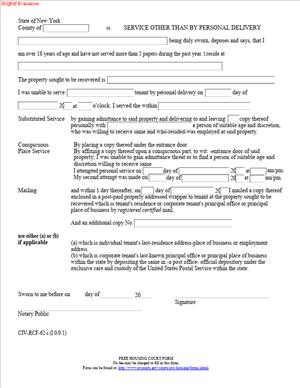
CIV-RCF-62-i – Service Other Than by Personal Delivery
Fill out nowJurisdiction: Country: United States | Province or State: New York
What is a CIV-RCF-62-i – Service Other Than by Personal Delivery?
This is a Civil Court of the City of New York instruction form. It guides you on serving court papers when you cannot hand them directly to the other side. It explains what methods you can use, what details you must record, and how to prove service to the court.
You use this form when personal delivery is not possible or not required. It covers two everyday methods. First, “substituted service,” where you leave the papers with a person of suitable age and discretion. Second, “conspicuous place service,” often called “nail and mail,” where you affix the papers to the door and then mail them. It also covers service by another court‑approved method when the judge authorizes it.
Who typically uses this form?
Self‑represented litigants who need to serve a summons, petition, or motion. Small law firms want a clear checklist for process servers. Process servers who must document their efforts to serve. Landlords, tenants, consumers, small businesses, and collection litigants use it often. The form ensures your service follows New York City Civil Court rules.
You need this form because proper service is not optional. The court cannot act on your case until you show valid service. This form gives the court the facts it needs to decide that issue. It also gives the other side notice in a way the law accepts. If you skip steps, your case can be delayed or dismissed. If you do it right, you keep your case on track.
Typical usage scenarios
You sued a customer who moved and will not answer the door. You started a commercial case, and the registered agent is not available. You filed a nonpayment case, and the tenant avoids you. You filed a motion, and the attorney refuses to accept service by email. In each case, you tried personal service but could not complete it. This form helps you shift to a lawful alternative and document every step.
When Would You Use a CIV-RCF-62-i – Service Other Than by Personal Delivery?
You use this form when direct hand‑to‑hand service cannot be made with reasonable effort. That situation occurs more than you might expect. People travel, work late hours, or simply refuse to open the door. Businesses may have limited hours or a trained receptionist to deflect process servers. In those cases, New York allows alternative methods that still give fair notice.
Substituted service fits when someone at the home or workplace can accept papers. This could be a co‑tenant, a roommate, a door attendant, or a receptionist. The person must be of suitable age and discretion. The server must note the name or description of the person, the date, and the time. The server must then mail a copy to the same address. You would use this method when someone reliable is present and the location is correct.
Conspicuous place service fits when repeated attempts at personal service fail. It is used after you try it at different times and on different days. The server then affixes the papers to the door or slips them under the door. The server must also mail a copy to the last known address. This method aims to reach someone who is avoiding service or is not present.
You also use this form when the court authorizes a tailored method. That can include email, text, social media, or service to a family member. Those orders are case‑specific. The form helps you state what the judge allowed and how you complied. You attach a copy of the order if you use such a method.
Typical users include landlords, tenants, debt buyers, consumers, small business owners, and contractors. Attorneys and process servers use it as well. If you are a plaintiff, petitioner, or a moving party, you will likely rely on this form at least once. If you are a defendant who needs to serve a third party, you will use it too.
Legal Characteristics of the CIV-RCF-62-i – Service Other Than by Personal Delivery
This form supports a legally significant act: service of process. Service is how the court gains power over the person or business. The form is usually completed as an affidavit by the server. It is signed before a notary. That oath makes the statements binding. False statements expose the signer to penalties for perjury. The court relies on this affidavit to confirm that service followed the rules.
What makes it enforceable is compliance with the required steps. The law requires that the server be at least 18 and not a party to the case. The papers must be delivered in a specific way, at a confirmed address, within set time limits. When using substituted service, you must also mail a copy. When using conspicuous service, you must show persistent attempts first. You must then file proof of service with the court on time. Service is considered complete only after filing proof and waiting the required period. The form leads you through each of those points.
Several legal considerations matter. First, address accuracy. If the address is wrong, service fails. Confirm with current records before you serve. Second, due diligence. You must attempt service at varied times and days. Early morning, evening, and weekend attempts show a real effort. Third, detail. The court needs dates, times, locations, descriptions, and mailing facts. Vague entries can lead to challenge and delay. Fourth, server independence. You cannot serve your own papers. A friend who is over 18 may serve, but cannot be a party to the case. Professional process servers must follow licensing rules when serving for pay.
There are special rules for corporate and government defendants. A business can be served through an officer, director, managing agent, or registered agent. Government entities have exact service requirements. If your case involves those parties, confirm the proper agent and address before you serve. Note those details in the form. If the court orders an alternative method, follow that order exactly. Attach the order to your affidavit.
Finally, timelines matter. There are deadlines to serve and to file proof of service. Filing proof late can delay your case. In many cases, service is only complete days after you file proof. That affects answer deadlines and hearing dates. Use a calendar and track those dates. The form helps you compute and document them.
How to Fill Out a CIV-RCF-62-i – Service Other Than by Personal Delivery
Follow these steps in order. Work with your server to capture exact facts. Write clearly. Use short, factual statements. Do not guess. If you do not know a detail, find it before you file.
1) Confirm you can use this form
Decide which method fits your facts. If you can complete personal delivery, do that. If not, choose substituted service or conspicuous place service. Use substituted service if someone responsible is present at the address. Use conspicuous service only after several failed attempts at different times and days. If the judge authorized a special method, follow that order. This form helps you report what you did.
2) Gather case and party information
Collect the exact case caption as it appears on your papers. That includes the court name, county, index or docket number, and the names of all parties. Write the plaintiff or petitioner’s name exactly. Write the defendant’s or respondent’s name exactly. If a business is involved, use its full legal name. If you served a registered agent, record that agent’s name and title. Note the court part or room if assigned.
3) Identify the papers you served
List each document by full title. For example, “Summons and Complaint,” “Notice of Petition and Petition,” or “Order to Show Cause and Supporting Affidavit.” Include any attachments. State the number of pages if the form asks. The court needs to know exactly what was served.
4) Confirm server qualifications
Enter the server’s full name, home or business address, and contact phone. Confirm that the server is at least 18 and not a party to the case. If the server is a professional, note their business name. If the server holds a license for a paid service, it should follow licensing rules. For one‑time service by a friend, no license is required. The server must be available to testify if service is challenged.
5) Document personal service attempts
Before using alternate methods, document your attempts. The server should try at different times and on different days. Early morning, evening, and weekend attempts are typical. In the form, list each attempt with date, exact time, and full address. Add a short result note, such as “No answer,” “Door attendant refused access,” or “Lights on, no response.” If a neighbor or doorman confirms the person lives there, note that statement. If the address is a workplace, confirm business hours. If the address appears vacant, state what you observed.
6) Choose and record the alternate method
Select the method that matches your facts. Check the correct box or fill in the correct section.
For substituted service, state that you delivered to a person of suitable age and discretion. Record the recipient’s name if given. If they refused to give a name, write “name refused” and provide a full physical description. Note the recipient’s relationship to the defendant, if known, such as roommate, spouse, receptionist, or doorman. Write the exact address, date, and time.
For conspicuous place service, state that you affixed the papers to the door or slipped them under the door. Write exactly where you placed them, such as “taped to front door at eye level.” Provide the address, date, and time. Conspicuous service should follow prior failed attempts. If the form has a due diligence section, complete it in detail.
For a court‑ordered method, describe exactly what the order allows. For example, “Service by email to john@example.com on [date].” Attach a copy of the order as an exhibit. Follow all conditions in the order, including any mailing or posting requirements.
7) Record mailing details
Most alternative methods require mailing a copy. Mail the same papers to the defendant’s last known address. If you served at the home, mail to that home. If you served at the workplace, mail it to that workplace. Use first‑class mail with proper postage. Do not include any markings that reveal a lawsuit. The server should mail within the required timeframe after delivery or posting. In the form, list the date of mailing, the address used, the city and zip code, and the type of mail. Keep a certificate of mailing or a postal receipt if available. If you mailed to more than one address, list each mailing on its own line.
8) Describe the defendant and the location
If the server saw the defendant, include a physical description. If not, describe the person who accepted service. Include gender, approximate age, height, build, skin tone, hair color, and any distinguishing features. Describe the premises if helpful, such as “brown door, Apt 4B, third floor walk‑up,” or “Office suite 1203, receptionist desk by entrance.” These details support credibility and help the court evaluate the efforts made.
9) Attach supporting exhibits
Attach any helpful items as exhibits. Common exhibits include a log of attempts, photos of the door posting, a building directory photo, a business card of the receptionist, or a certificate of mailing. Label each exhibit clearly, such as “Exhibit A: Attempt Log” or “Exhibit B: Mailing Receipt.” Refer to each exhibit in your affidavit by label. Do not attach original government IDs or sensitive data. Keep copies for your records.
10) Complete the affidavit section
The server must complete the affidavit section in full. This includes their name, the method used, the dates and times of delivery and mailing, the addresses, and the document titles. The affidavit must be signed in front of a notary. The notary will check ID and complete the notary block. The server should not sign until the notary is present. The notary will add the date, venue, and notary information.
11) Calculate completion and filing dates
Service by these methods is not complete on the delivery day. It becomes complete only after you file proof of service and a set number of days pass. The form often reminds you of this. Compute these dates and write them down. File the affidavit of service with the clerk within the required time. File it within the set number of days after the later of the delivery or mailing. If you file late, you may need court permission to extend the time. Do not wait. File as soon as you can.
12) File proof of service with the court
Bring the signed and notarized affidavit to the clerk’s office. File the original and keep a stamped copy for your records. If your case is e‑filed, upload the affidavit through the system. Check that the upload is accepted and visible. Confirm that the caption and party names match the case exactly. If you used a court‑ordered method, file the order with your proof.
13) Serve multiple defendants or addresses
Use a separate affidavit for each person or entity served. If you served one person at home and at work, report each mailing properly. If you served more than one defendant, do not combine their service details. Keep the records clear and separate. This avoids confusion and helps the court review each service.
14) Special notes for businesses and agents
When serving a business, identify the person who accepted service and their role. For example, “Jane Smith, Managing Agent,” or “John Doe, Registered Agent.” If you cannot reach an officer or agent, you may be able to leave papers with a person in charge and then mail. State the facts fully. For large buildings, note the floor and suite number. For a registered agent, use the exact address on file. Confirm it before you serve.
15) Review for common errors
Check that all dates are correct and consistent. Confirm that the address is complete and precise. Ensure each attempt record has a date, time, and result. Confirm that the mailing date is within the required timeframe. Make sure the notary block is complete and legible. Do not leave blanks. If a fact is unknown, explain why and what you did to find it.
16) Correcting mistakes
Do not alter a signed affidavit. If you find an error before filing, destroy the draft and prepare a new one. If you discover an error after filing, prepare a supplemental affidavit that corrects the record. If deadlines are at risk, ask the court for more time. Be transparent and factual. The court values clear and honest corrections.
17) Keep records
Keep a complete copy of all service papers. Keep your attempt log, mailing receipts, and any photos. Organize them by defendant and date. If service is challenged, you will need them. Bring them to court if asked.
18) After service, track next steps
Mark the date when the service becomes complete. Calculate the defendant’s deadline to respond. This depends on how you served and on the type of case. Calendar any hearings and appearances. If the defendant does not respond, you may move for default. You will need your filed proof of service to proceed.
19) If the court orders a different method
Sometimes, even diligent efforts fail. In that case, you may ask the court to approve a different method. If the court grants it, follow the order exactly. Serve by the approved method. Document how and when you did so. Then complete this form to report the details. Attach the order and any proof, such as sent emails or delivery confirmations.
20) Final checklist before filing
Read the entire affidavit aloud. Confirm every fact is true and complete. Check names and addresses for an exact match to your pleadings. Confirm the method matches your actual steps. Confirm the notary block is complete. File promptly and keep a stamped copy.
By following these steps, you give the court what it needs. You also protect your case against a service challenge. You show good faith, diligence, and accuracy. That is the goal of this form. It is about proper notice, fair process, and keeping your case moving.
Legal Terms You Might Encounter
- Plaintiff and Defendant: The plaintiff is the person or business that started the case. The defendant is the person or business being sued. On this form, you name the party you served (usually the defendant) and confirm how service happened when you didn’t hand papers directly to that person.
- Index Number or Docket Number: This is the court’s tracking number for your case. You must enter it exactly as it appears on your court papers. The court uses it to match your completed affidavit to the right case file.
- Process Server: This is the person who delivers court papers. In this context, the server is the person who completes and signs the affidavit. The server cannot be a party to the case. The server must be an adult and follow all service rules the court requires.
- Personal Delivery: Personal delivery means handing the papers directly to the person being served. If service did not occur this way, you use this form to document an approved alternative method instead.
- Substituted Service: This method involves delivering the papers to a person of suitable age and discretion at the defendant’s home or actual place of business, and then mailing a copy. This form captures who accepted the papers, where, when, and how the mailing was done.
- Conspicuous Place Service (sometimes called “nail and mail”): This method involves affixing the papers to the door or a visible place at the defendant’s residence or business after due diligence, and then mailing a copy. This form requires exact details about the attempts you made first, where you posted the papers, and the mailing steps you completed.
- Due Diligence: These are reasonable efforts to attempt personal delivery before you use conspicuous place service. The form will ask for dates, times, and places of your attempts. You should record varied attempts, such as different days and times, to show real effort.
- Affidavit of Service: This is a sworn statement describing how service was performed. On this form, the server swears to the facts of delivery and mailing. The affidavit must be signed and notarized. It becomes the official proof the court relies on to confirm service.
- Suitable Age and Discretion: This describes a person at the service address who is old enough and responsible enough to accept papers for the defendant. On the form, the server will describe that person and their relationship to the defendant, if known.
- Notarization: This is the process of signing the affidavit in front of a notary public. The notary verifies the server’s identity and witnesses the signature. The court will not accept this form without a proper notarization.
- Mailing Requirements: For substituted and conspicuous place service, mailing is required. The form will ask for the mailing date, address, and method. When serving a natural person, the envelope should usually be marked “Personal and Confidential,” with no outward notice that it is from a lawyer or about a lawsuit. The affidavit must reflect these details.
- Actual Place of Business / Dwelling / Usual Place of Abode: These are specific types of addresses used for service. The form asks where the service occurred and requires you to identify if it was a work address or a home address. Accuracy matters because mailing rules can depend on which type of address you used for delivery or posting.
FAQs
Do you need to use this form if you personally handed the papers to the defendant?
No. If you achieved personal delivery to the defendant, you use the personal delivery affidavit, not this one. This form is only for substituted service or conspicuous place service, plus the required mailing.
Do you need to be the one who fills out and signs this form?
Only the person who performed the service should complete and sign this affidavit. If you hired a process server, they fill it out, sign it, and get it notarized. You can file it with the court, but you should not sign it unless you actually performed service.
Do you have to mail by certified mail?
No. For these methods, first-class mail is typically used, not certified. The mailing rules focus on where and how you mail, and what appears on the envelope. Certified mail can cause delays or returns. Follow the standard first-class mailing and document it on the form.
Do you need to try multiple times before using the conspicuous place service?
You should make reasonable attempts at different times and days before posting. There is no fixed number, but one weekday morning attempt is usually not enough. Record every attempt, including date, time, address, and result. List those attempts on the form to show due diligence.
Do you mail to the same address where you delivered or posted the papers?
You typically mail to the last known residence or actual place of business, depending on the method and where you delivered or posted. When unsure, mail to the appropriate address type tied to your delivery or posting method. Then record the exact mailing address and date on the form.
Do you need to describe the person who accepted the papers?
Yes. For substituted service, describe the person of suitable age and discretion who accepted the papers. Note gender, approximate age, height, weight, skin tone, hair, and relationship to the defendant, if known. The form includes space for a physical description.
Do you need to file this affidavit with the court?
Yes. File the original notarized affidavit with the court clerk. Keep a copy for your records. For substituted or conspicuous place service on a natural person, service is considered complete a set number of days after you file proof. Filing promptly helps avoid delays.
Do you use this form to serve a business?
You can use this form to document service other than personal delivery on a business if an authorized alternative method applies. The details will differ from service for a natural person. Clearly identify the business name, the person served, their capacity if known, and the address. Follow the mailing rules that fit the method used.
What if you learn the address was wrong after you already filed?
You cannot fix a bad address with this form. If the service was invalid, you must re-serve at a correct address and complete a new affidavit. File the new affidavit. Do not alter or reuse a filed affidavit. Keep your prior filing as a record of what occurred.
Can you sign the affidavit and then get it notarized later?
No. The server must sign in front of the notary. If the server signed earlier, they must re-sign before the notary. The notary will complete their section and apply their seal or stamp. The court may reject any affidavit that is not properly notarized.
Checklist: Before, During, and After the CIV-RCF-62-i – Service Other Than by Personal Delivery
Before signing
- Confirm the case caption and index or docket number exactly as shown on your court papers.
- Verify the defendant’s correct name and service address. Confirm whether it is a home or business address.
- Decide which non-personal method you used: substituted service or conspicuous place service.
- For substituted service, note who accepted the papers and their role or relationship, if known.
- For conspicuous place service, list all personal delivery attempts with dates, times, and results.
- Confirm the exact date and time you delivered or posted the papers.
- Prepare mailing details: the exact mailing address, the mail class used, and the date of mailing.
- Prepare the envelope format used for mailing. For a natural person, ensure you use “Personal and Confidential” and no outward lawsuit or attorney identification.
- Gather any postal proof you have, such as a receipt or a postage transaction record.
- Arrange a notary. The server must sign the affidavit in front of a notary public.
During signing
- Double-check the court location and the part of the court handling your case.
- Verify that the defendant’s name, address, and the case number are accurate and match the served papers.
- Select the correct service method on the form. Do not select more than one unless the form allows it.
- Enter the exact service date and time. Be consistent with the mailing date and time.
- For substituted service, fill in the full description of the person who accepted the papers. Include approximate age, height, weight, hair, and skin tone. Add any known relationship to the defendant.
- For conspicuous place service, list each prior attempt at personal delivery with date, time, and outcome. Make sure attempts reflect different times and days.
- Fill in the mailing section fully. Include the date mailed, the address used, and that you used first-class mail.
- Confirm that the envelope labeling was correct for a natural person addressee.
- Review the affidavit for blanks, cross-outs, and inconsistencies. Make clean corrections if needed, then initial them if appropriate.
- Sign only in front of the notary. Provide a valid ID if requested. Ensure the notary completes their section and applies a seal or stamp.
After signing
- Make at least two copies: one for you and one for your attorney, if you have one.
- File the original notarized affidavit with the court clerk promptly. Use in-person filing or the court’s filing system if your case is eligible.
- If you served a natural person by substituted or conspicuous place service, note the completion-of-service date that follows your filing. This date often controls the defendant’s time to respond.
- Calendar any response deadlines based on when the service is considered complete.
- Save proof of mailing and any postal receipts with your copy of the affidavit.
- Monitor for returned mail. Keep any returned envelopes sealed and note the date they came back.
- If you discover an error in the affidavit, prepare a corrected affidavit. Re-execute it in front of a notary and refile. Do not alter a document already on file.
Common Mistakes to Avoid
- Don’t forget the mailing step. For substituted or conspicuous place service, delivery, or posting is not enough. You must also mail a copy as required. If you skip the mailing, the service may be invalid, and the case can be delayed or dismissed.
- Don’t let the party to the case serve the papers. The server must be a non-party adult. If a party serves, the court can reject service and deny a default request. Use a qualified server and document their information clearly.
- Don’t leave out due diligence details. If you used conspicuous place service, you must show prior attempts at personal delivery. A vague statement like “tried to serve” is not enough. Inadequate detail can result in challenges to service.
- Don’t use the wrong envelope markings. For a natural person, mark the envelope “Personal and Confidential” and avoid any indication of a lawsuit or attorney. Incorrect markings can risk rejection and may undermine proper service.
- Don’t mix up dates or addresses. Inconsistent dates, wrong addresses, or mismatched locations on the affidavit raise red flags. The court may order a hearing on service or deny relief. Cross-check every date, time, and address before notarizing.
- Don’t forget notarization, or use an improper notary. If the server does not sign in front of a notary, the affidavit is defective. The court may refuse it. Re-sign before a notary and ensure the notary completes all fields.
What to Do After Filling Out the Form
- File the original notarized affidavit with the court clerk as soon as possible. Filing completes the record of service. If you served a natural person using substituted or conspicuous place service, service is considered complete a set number of days after filing. Track that completion date, because it starts the defendant’s time to respond.
- Confirm the filing method that applies to your case. If your case is eligible for electronic filing, follow that system’s steps. If not, file in person at the clerk’s office. Bring your case number and an extra copy to be stamped for your records.
- Update your calendar. Note the completion-of-service date and the expected response deadline. If you have another deadline in your case, such as a motion return date or a conference, confirm that your service timing works with that schedule.
- Keep all documentation organized. Store the notarized affidavit copy, proof of mailing, and any returned mail together. Label them with the case number and the defendant’s name. You may need these if service is challenged or when you request a default.
- Prepare for possible challenges. If the defendant disputes service, the court may hold a hearing. Your server should be prepared to testify to the details recorded in the affidavit. Clear records of attempts, delivery or posting, and mailing dates help resolve disputes.
- Handle multiple defendants separately. Each defendant needs their own service and their own affidavit. Do not combine defendants on one affidavit unless the form specifically instructs otherwise. File each affidavit under the correct case number and party name.
- Correct errors the right way. If you discover a mistake after filing, do not alter the filed affidavit. Complete a new affidavit that accurately describes service, sign it before a notary, and file the corrected version. If the service was invalid, re-serve and then file the new affidavit.
- Coordinate with next case steps. If you are seeking a default, you will need proof of timely and valid service. Keep the filed affidavit ready to include with your request. If the defendant answers, move forward with the case schedule and keep your service proof on hand.
- Maintain confidentiality on mailings. For a natural person, keep future mailings discreet in the same way you handled the service mailing. Avoid any labels or markings that identify the correspondence as legal papers on the envelope’s exterior.
- Check addresses for future filings. If the mail is returned or you learn of a new address, update your records. Future notices or motions should use the best-known address. When serving again, follow the same standards and document service with the proper affidavit form.
Disclaimer: This guide is provided for informational purposes only and is not intended as legal advice. You should consult a legal professional.