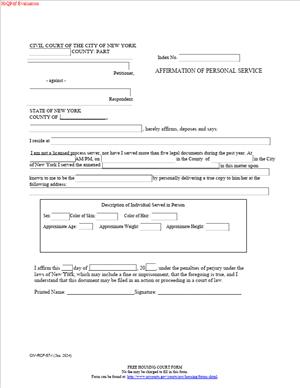
CIV-RCF-57 – Affirmation of Personal Service
Fill out nowJurisdiction: United States | New York
What is a CIV-RCF-57 – Affirmation of Personal Service?
This form is a sworn statement that proves you completed personal service. “Personal service” means you handed court papers directly to the person named. The Civil Court of the City of New York uses this form to confirm that delivery.
You use this form to show the court that service happened, when it happened, and how. It identifies who you served, where you served them, and what you served. It also records details that support proper service. That includes a physical description of the person you served and the exact time and address.
This is an “affirmation,” not an “affidavit.” An affirmation is a signed statement made under penalty of perjury. It does not need a notary. But not everyone may sign an affirmation. In New York, only certain people are allowed to affirm instead of notarize. If the person who served the papers is not allowed to affirm, use the Affidavit of Service version instead. If you are unsure, ask the clerk or use the affidavit and have it notarized.
Who typically uses this form?
Attorneys and their staff often use it when they personally deliver papers. Licensed process servers may use the affidavit version instead. Self-represented litigants use it only if they are permitted to affirm. Remember, for many filings, you cannot serve your own initiating papers. The server must be an adult who is not a party to the case.
Why would you need this form?
The court requires proof of service. Without it, a judge may not consider your request. The respondent can also challenge improper service. This form gives the court a clear record and helps avoid delays. It supports default judgments when the other side does not appear. It also helps resolve service disputes quickly.
Typical usage scenarios
- A summons and complaint in a Civil Court action.
- A notice of petition and petition in a housing case.
- A motion, cross-motion, or opposition papers.
- An order to show cause and supporting papers.
- A subpoena to testify or produce documents.
- Post-judgment papers, such as information subpoenas.
For each of these, the proof must match the method used. If you hand-deliver, use the Affirmation of Personal Service. If you serve by mail or posting, use the correct form for that method. Use one affirmation per person served, unless the form clearly allows multiple recipients. Accuracy matters. The court relies on your statement to confirm jurisdiction and notice.
In short, the CIV-RCF-57 records a clean, complete account of personal service. You file it with the court as proof. It becomes part of the case record and will be reviewed if service is questioned.
When Would You Use a CIV-RCF-57 – Affirmation of Personal Service?
Use this form whenever you complete personal delivery of court papers in a Civil Court case. You would choose personal service when rules require it or when you need certainty. Hand-delivery is often the most reliable method. It puts papers in the person’s hands and starts deadlines quickly.
For example, a landlord may have a process server hand-deliver a notice of petition and petition. The process server would then complete this affirmation. A tenant filing an order to show cause might arrange for a friend, who is an adult and not a party, to hand-deliver papers to the landlord’s attorney. That friend would complete this affirmation if allowed to affirm, or use an affidavit if not. A small business owner might have a staff member (not a party) hand-deliver a motion to the opposing attorney’s office. The staff member would complete the affirmation and file it.
Attorneys often use personal service when time is tight. If a motion return date is close, personal delivery avoids mailing delays. After delivery, the server completes this form the same day while the details are fresh. Many attorneys also use personal service to deter claims of non-receipt.
You might also use personal service for subpoenas. Hand-delivery supports enforcement if the witness does not appear. The affirmation helps the court enforce the subpoena and consider sanctions if needed.
If you are serving a corporation or limited liability company, personal service means delivery to an authorized person. That could be an officer, managing agent, or registered agent. The affirmation should identify who accepted service and their role. If you deliver to a law office, the affirmation should note the name of the person who accepted and their title.
If you are serving someone who is evasive, personal service can be tricky. A licensed process server often handles this. If the server succeeds in hand-delivery, this form documents the result. If personal delivery fails, you may need another method or a court order. Use this form only when hand-delivery actually occurred.
Always match the method to the rules for your paper. Initiating papers often requires strict service. Some papers can be served by mail. Do not use this affirmation for mail service or posting. Use it only when you hand-deliver to the named person or an authorized recipient.
Legal Characteristics of the CIV-RCF-57 – Affirmation of Personal Service
This form is a sworn declaration under penalty of perjury. When the server signs it, they attest that the facts are true. The court treats it as competent proof if completed correctly. It is legally binding because it creates a record that supports jurisdiction and notice. Judges rely on it when deciding motions, defaults, and enforcement.
Enforceability comes from three features. First, it names the case and the parties served. Second, it sets out the date, time, and place of service. Third, it includes details that support identification and compliance. That usually includes a physical description and the exact address. These details show the server had personal knowledge and followed the rules.
Because this is an affirmation, it does not require a notary. But only authorized individuals may use an affirmation. If the person who served is not allowed to affirm, they must sign an affidavit before a notary. The court can reject a non-compliant affirmation, so choose the correct format.
When filed, this form creates a presumption of proper service. The other side can challenge it. They can submit a sworn denial or request a hearing. At a hearing, the server may testify and explain the details. Clear, consistent statements in the affirmation make your position stronger. Vague or incorrect details can undermine service.
False statements carry serious consequences. They can result in sanctions or perjury charges. They can also lead to dismissal of your case or your motion. Take care to ensure accuracy. Have the server complete the form right after delivery. Keep any notes, receipts, or logs that support the statement.
Finally, timeliness matters. You should file the affirmation promptly after service. Some parts have specific filing windows. Filing delays can push back your hearing or return date. They can also affect default requests. File early and keep a copy for yourself.
How to Fill Out a CIV-RCF-57 – Affirmation of Personal Service
Follow these steps to complete the form correctly. Use black or blue ink. Print clearly. Do not leave required fields blank. If a line does not apply, write “N/A.”
1) Complete the court caption.
- Court name: Civil Court of the City of New York.
- County: Enter the county where the case is filed.
- Part or Housing Part: If known, enter the part.
- Index, docket, or LT number: Enter the case number.
- Case title: List the names as they appear on your papers. Use “Plaintiff/Petitioner” and “Defendant/Respondent” labels.
2) Identify the papers served.
- List the exact documents you delivered. For example: “Summons and Complaint,” “Notice of Motion with Exhibits,” “Order to Show Cause,” or “Subpoena.”
- Include dates on the documents if shown. For instance: “Notice of Motion dated May 2, 2025.”
- If you served multiple items, list each one.
3) Name the person you served.
- Write the full name of the person who received the papers.
- If you served an authorized agent or a lawyer, include their name and title. Example: “Jane Smith, receptionist authorized to accept for John Doe, Esq.”
- If the person refused a name, write “Name refused.” Then add a detailed physical description.
4) Record the date and time of service.
- Enter the calendar date, including month, day, and year.
- Enter the exact time, including AM or PM.
- Use the local time of the service location.
5) Record the exact address of service.
- Enter the full street address, apartment or suite number, city, and ZIP code.
- If the service took place at a workplace, include the business name if known.
- If service occurred in a lobby or public area, note that location.
6) Confirm the method: personal delivery.
- Check or write that this was a personal delivery to the person named.
- If delivered to an authorized agent, state the person’s role and relationship to the recipient.
- Do not use this form for mail or substituted service. Use the correct form for those methods.
7) Include a physical description of the person served.
- Record approximate age, height, weight, skin tone, hair color, and gender presentation.
- Note distinguishing features, if any, such as glasses, facial hair, or tattoos.
- Add clothing description if helpful. Example: “Blue shirt, black jacket.”
8) Note language or confirmation details if relevant.
- If you confirmed identity by asking the person’s name, state that.
- If you asked the person to identify their role, state what they said.
- If translation was needed, note the language used.
9) Add business details if you are a licensed process server.
- Include your full name and business address.
- If you hold a process server license, include your license number.
- If your office maintains a service log, keep it consistent with this form.
10) State military status only if the form asks for it.
- If the form has a box about military service, follow the prompt.
- Do not guess. Mark “Unknown” if you do not know.
11) Confirm the age and non-party status of the server.
- The server must be at least 18.
- For initiating papers, the server cannot be a party to the case.
- If you are serving later motions, follow the service rules for those papers.
12) Complete the affirmation statement.
- Read the penalty of perjury statement.
- Ensure every detail is accurate.
- By signing, you affirm the truth of the statement.
13) Sign and date the form.
- The person who served must sign. No one else can sign for them.
- Print your name clearly below the signature.
- Enter the date and the city where you signed.
14) Attach any supplemental schedules if needed.
- If the form has limited space for descriptions, attach a page.
- Label the page “Attachment to Affirmation of Personal Service.”
- Reference the case caption and number in the attachment.
15) Make copies.
- Keep a copy for your records.
- Provide a copy to your attorney if you have one.
- You will file the original with the court, unless directed otherwise.
16) File the affirmation.
- File it in the same case. File it as soon as possible.
- If your paper has a return date, file before that date.
- If you e-file, upload the form in the correct document category. Name the file clearly.
17) Check completeness before filing.
- Confirm that the case number and party names match your papers.
- Confirm the date, time, and address are correct.
- Confirm the signature and printed name are present.
18) Prepare for challenges.
- Keep notes from the service. Record details immediately.
- Save any delivery receipts, building logs, or photos if you have them.
- If service is disputed, you may need to testify.
Practical tips
- Have the server complete the form right after service. Memory fades fast.
- Exact times matter. Use your phone clock at delivery.
- If the recipient evades service, do not guess. Do not use this form unless you actually handed the papers to a proper recipient.
- If you served multiple people, complete a separate form for each.
- If you are not allowed to affirm, use an affidavit before a notary.
- If you served at a residence, record apartment numbers and buzzer IDs.
- If you served at an office, record the floor and suite.
Common errors to avoid
- Missing case number or wrong county.
- Listing the wrong person as served.
- Using the wrong method on the wrong form.
- Leaving out the time or apartment number.
- Signing by someone who did not serve the papers.
- Forgetting to file the form with the court.
By following these steps, you produce solid proof of personal delivery. The court can then act on your papers with confidence. Proper service clears the path to your hearing, motion, or judgment.
Legal Terms You Might Encounter
- Personal service means you hand the papers directly to the person you are serving. For this form, it means the server put the documents in the recipient’s hands. The form records that direct handoff, including the date, time, and exact location.
- Affirmation is a written statement signed under penalty of perjury. It does not need a notary. On this form, the server affirms that the facts of service are true. If the court accepts the affirmation form for your case type, you do not need an affidavit.
- Affidavit is a sworn statement signed in front of a notary. Some cases may require an affidavit of service instead of an affirmation. If you used CIV-RCF-57, you are telling the court that an affirmation is allowed for your service. Make sure you use the version the court expects.
- Proof of service is any document that shows how, when, and where service happened. This form is your proof of service for personal delivery. The court relies on it to confirm that the defendant or respondent received the papers.
- Caption is the case heading at the top of your papers. It includes the court name, party names, and index or docket number. The caption on this form must match the caption on the papers you served. If it does not match, the clerk may reject it.
- Index number or docket number is your case’s unique number. You place it in the caption on this form. It ties your proof of service to the correct case file. Always double-check the number for accuracy.
- Nonparty means the server is not a party to the case. The person who serves cannot be a plaintiff, defendant, petitioner, or respondent in the matter. This form includes a statement confirming that the server was over 18 and not a party.
- Process server is someone who performs the service of legal papers. In some situations, the server must be licensed. If the server is licensed, the form may include a space for a license number or other ID. If not, the server still must meet the nonparty and age requirements.
- Service on a corporation or business means delivering to a person who may legally accept for the business, such as an officer or authorized agent. If the server handed papers to that person, the form must name who received them and their role or relationship to the business.
- Description of the person served is a brief physical description that helps confirm identity. The form may ask for approximate age, height, weight, hair color, and other identifiable details. This description supports the server’s statement that they served the right person.
- Penalty of perjury is the legal risk you take if the statement is false. When the server signs the affirmation, they promise that the facts are true. False statements can lead to sanctions, fines, or other penalties.
- Service method refers to how the papers were delivered. This form is only for personal delivery. If you used a different method, like delivery to someone else at the residence or mailing, use the proof of service form that matches that method.
FAQs
Do you need to notarize the CIV-RCF-57?
No. An affirmation does not require notarization. The signature is made under penalty of perjury. Make sure the court accepts this affirmation for your case type. If your case requires a notarized affidavit, use the appropriate affidavit form instead.
Who can sign this form?
Only the person who actually performed the personal service can sign it. The server must be 18 or older and not a party in the case. If a professional process server performed service, they must sign this form or their own proof of service form.
Do you file this form with the court?
Yes, you typically file it as proof that the service happened. File it in the same case and using the same filing method you use for your other documents. File promptly so your case can move forward without delays. Keep a copy for your records.
Can you use this form if you were served by mail or substituted service?
No. This form is only for personal delivery to the named person. If you used any other method, use a proof of service form that matches that method. The form must reflect exactly how the service occurred.
Do you need the exact time and place of service?
Yes. You must list the correct date, time, and full address of delivery. Write the specific apartment, suite, or floor if needed. The details on the form must match the server’s notes.
Do you need a physical description of the person served?
Yes, if the form asks for it. A brief description helps confirm identity. Use approximate age, height, build, hair color, and other features. If you served a business representative, list their name and role if known.
Can you use one affirmation for multiple recipients?
No. Use a separate affirmation for each person you served. Each form should detail one recipient, one set of documents, and one service event. If you served on different dates, complete separate forms for each date.
What if you realize you made a mistake after filing?
Prepare a corrected proof of service that accurately reflects what happened. File it as soon as possible and notify the other side if required. If the service was defective, consider re-serving and then filing a new proof of service that matches the corrected service.
Checklist: Before, During, and After the CIV-RCF-57 – Affirmation of Personal Service
Before signing
- Confirm the service method was personal delivery to the named person.
- Verify the server is over 18 and not a party to the case.
- Collect the exact date and time of service from the server’s notes.
- Record the full service address, including apartment or suite.
- Gather the case caption and index or docket number exactly as shown on your case papers.
- List the titles of the documents served (for example, summons and complaint, notice of motion).
- If the service was on a business, identify the person who accepted the service and their role, if known.
- Get a brief physical description of the person served, if required.
- If a professional process server performed service, obtain any license or ID details that the form requests.
- Make sure you have the server’s full contact information.
During signing
- Confirm the party names, court, and index or docket number match your case papers.
- Check that the person named in the form is the exact person who was served.
- Verify the date, time, and full address entries for accuracy and completeness.
- List the documents served by their exact titles and number of pages if the form asks.
- Add the physical description in the space provided, if required.
- Include the server’s name, age confirmation, and nonparty status.
- If applicable, include the process server’s license number or other identifying information.
- Review the penalty of perjury statement and ensure the server understands it.
- Have only the actual server sign and date the form.
- Review the entire form once more for completeness and legibility.
After signing
- Make at least two copies: one to file and one to keep.
- File the original form with the court in your case. File promptly.
- If your case uses electronic filing, submit it using that system.
- If required, mail or deliver a copy to the other side.
- Save the server’s notes, GPS records, or receipts with your copy.
- Calendar any future deadlines that depend on service, such as response dates.
- If the court rejects the filing, correct the issue and refile quickly.
Common Mistakes to Avoid CIV-RCF-57 – Affirmation of Personal Service
Serving the papers yourself as a party in the case
- Consequence: Service may be invalid, and the court can reject your proof. You may need to re-serve and lose time.
- Don’t forget: The server must be over 18 and not a party.
Using this form when you did not personally hand the papers to the person
- Consequence: The proof will not match the method used. The court may find service defective.
- Don’t forget: Pick the proof of service form that matches the actual method.
Leaving out the exact time, date, or full address of service
- Consequence: The court may reject the form or disregard your proof. Your deadlines may be affected.
- Don’t forget: Record service details immediately and transfer them carefully to the form.
Mismatched case information or party names
- Consequence: Your proof may not link to the correct case. The clerk may not accept it.
- Don’t forget: Copy the caption and index or docket number exactly as they appear on your papers.
Having someone other than the actual server sign the form
- Consequence: The form becomes unreliable and can be challenged or rejected.
- Don’t forget: Only the person who served the papers can affirm the service.
What to Do After Filling Out the Form CIV-RCF-57 – Affirmation of Personal Service
- File the affirmation with the court. File it in the same case where the papers belong. Use the filing method your case requires. If the court accepts electronic filings, submit it there. If not, bring or mail it to the clerk’s office as instructed for your case.
- Serve a copy if required. Some situations require you to provide a copy of your proof of service to the other side. If that applies to your case, mail or deliver a copy after filing. Keep proof of mailing or delivery.
- Update your case file. Keep a clean copy of the filed affirmation in your records. Attach the server’s notes and any supporting items, like GPS logs or delivery receipts, if available. Label everything with the case number and date.
- Confirm the next deadlines. Service often triggers response times, hearing dates, or motion schedules. Count the calendar from the date service was completed or proof was filed, as your rules require. Put the dates on your calendar.
- Monitor the docket. Check that your filing appears in the case file. Make sure the clerk recorded it with the correct case number and party names. If you do not see it, follow up with the clerk’s office.
- Be ready to respond to challenges. If the other side disputes service, the court may schedule a hearing. Bring the server, their notes, and any supporting documentation. The details on the form should match the server’s testimony.
- Amend if you spot an error. If you discover a mistake, prepare a corrected affirmation or the proper proof of service form that reflects what actually happened. File it quickly. Do not alter an already-signed form. Use a new, accurate one.
- Re-serve if needed. If the court finds service defective, arrange proper service as soon as possible. Use a qualified nonparty server. Then, complete and file a new proof of service form that matches the corrected service method.
- Coordinate with other filings. If your filing triggers a hearing or motion schedule, confirm you have all required supporting documents ready. Organize exhibits, notices, and proposed orders as needed. The proof of service should align with all related filings.
- Maintain consistent records. Keep all service documents together: the affirmation, any affidavits, mailing receipts, photos, descriptions, and notes. If a dispute arises, complete records help resolve it quickly.
Disclaimer: This guide is provided for informational purposes only and is not intended as legal advice. You should consult a legal professional.