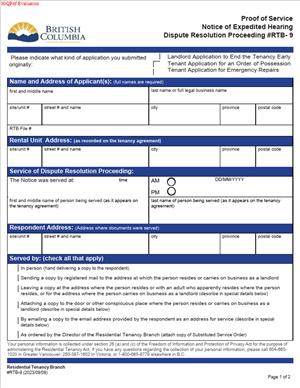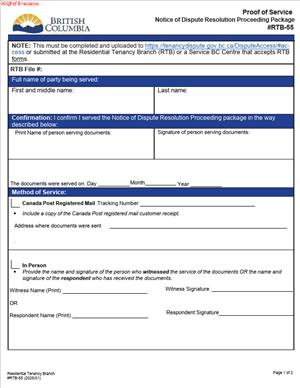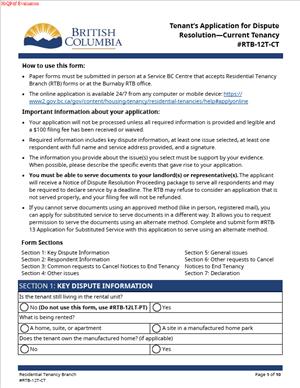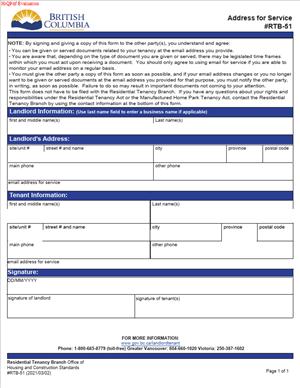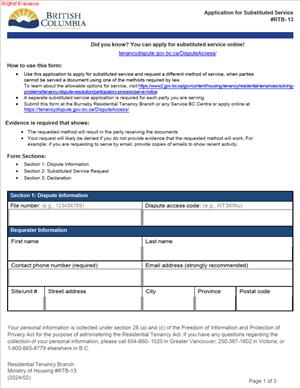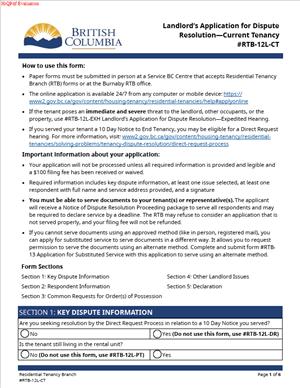
RTB 9 – Proof of Service Notice of Expedited Hearing Dispute Resolution Proceeding
Fill out nowJurisdiction: Country: Canada | Province or State: British Columbia
RTB 9 – Proof of Service Notice of Expedited Hearing Dispute Resolution Proceeding records how hearing documents were delivered to another party. Its purpose is to provide evidence of service, not to explain the underlying tenancy dispute.
An expedited hearing uses a shortened process for certain urgent disputes. Accurate delivery records help the decision-maker assess whether the other party received notice and had an opportunity to participate.
You may encounter this form as a landlord, tenant, representative, or person who delivered the hearing package. Before completing it, gather the hearing documents, file information, delivery notes, and supporting records.
Arranging delivery is not the same as proving service. The form connects the delivery account to a particular proceeding, recipient, and package.
What is RTB 9 – Proof of Service Notice of Expedited Hearing Dispute Resolution Proceeding?
Clear definition
This is a proof-of-service document for an expedited residential tenancy dispute resolution proceeding in British Columbia. “Service” means delivering documents through a method recognized for that process.
The form identifies the proceeding and records who served documents, who received them, and how delivery occurred. Depending on its fields, it may also capture dates, locations, declarations, and supporting details.
It differs from the hearing notice: the notice informs the recipient about the proceeding, while proof of service describes its delivery. It is not a tenancy agreement or settlement and does not record negotiated obligations.
Who typically uses this form?
The applicant—the party requesting a decision—may need this form after arranging delivery of an expedited hearing package. Depending on the dispute, the applicant may be a landlord or tenant.
Another person may deliver the documents. Keep the applicant’s role separate from the server’s role so the account does not imply firsthand knowledge someone lacks.
A representative may organize the paperwork, but the declaration determines whose statement and signature are required. The recipient may also review the form if service is disputed.
Why might you need this form?
The decision-maker may need more than an assurance that documents were sent. A clear account supports an assessment of the method, timing, recipient, and materials delivered.
Service evidence can matter whether or not the recipient attends. Attendance does not necessarily resolve questions about when particular materials arrived; absence may make your delivery record especially important.
Preparing the form can also expose gaps, such as conflicting dates or an unidentified recipient, before the hearing.
Typical real-life scenarios
- A landlord asks someone else to deliver the package. The form separates the applicant’s identity from the server’s account.
- A tenant uses postal delivery. The mailing receipt and later tracking events describe different stages, which should remain distinct.
- Several respondents receive documents at different times. Each recipient needs an identifiable delivery account.
- The recipient says some materials were missing. The package description and retained copy may help clarify what was delivered.
- An initial attempt fails before a later delivery succeeds. The unsuccessful attempt must not be described as completed service.
When would you use RTB 9 – Proof of Service Notice of Expedited Hearing Dispute Resolution Proceeding?
Generally, complete the service account after the delivery event. You can prepare identifying information beforehand, but the method, date, recipient, and outcome must reflect what actually happened.
This form belongs to the expedited hearing process. It is not a general delivery certificate for every tenancy document. Notices ending tenancies, ordinary hearing packages, and expedited hearing packages may have different requirements.
Completion, signing, and submission are separate actions. Keeping a signed copy does not necessarily place it in the hearing file. Likewise, the deadline for delivering the package may differ from the deadline for submitting proof.
Use the hearing-specific instructions and any service order to check the applicable requirements. A communication method used during the tenancy is not automatically acceptable for formal hearing documents.
Where delivery involved several attempts or the recipient disputes what happened, preserve a chronology. Distinguish completed delivery, unsuccessful attempts, and unresolved details rather than treating them as one event.
Legal characteristics of RTB 9 – Proof of Service Notice of Expedited Hearing Dispute Resolution Proceeding
The form has an evidentiary function: it presents facts about service for the decision-maker to evaluate. Its value depends on accuracy, a clear connection to the proceeding, and relevant supporting information.
A complete form and legally sufficient service are separate matters. An accurate account may describe delivery that did not meet applicable requirements. An incomplete account may make effective delivery difficult to establish.
Direct knowledge is important. A server can describe their own actions and observations; an applicant repeating the server’s report has a different basis of knowledge.
Identification connects the account to the correct file, recipient, and documents. Timing also requires precision: preparation, dispatch, actual receipt, and receipt under procedural rules may involve different dates.
Supporting records have limits. A mailing receipt may establish dispatch without proving package contents. A photograph may show a location without identifying the recipient. An acknowledgment may confirm receipt without establishing completeness.
Missing signatures, inconsistent dates, unclear methods, and unmatched attachments can prompt questions or reduce the account’s evidentiary weight. A polished appearance does not compensate for inaccurate statements or invented details.
Service rules vary by jurisdiction and proceeding. This form does not authorize an alternative method, correct defective delivery automatically, or prove the underlying tenancy allegations.
Is it legally binding?
The form is not binding like a contract or settlement. Its legal importance comes from its use as evidence in a formal proceeding.
Signing connects the signer to the statement described in the declaration. Read that wording carefully rather than treating the signature as an administrative formality.
The recipient may challenge the account, and filing acceptance does not establish that every statement is true. Inaccurate or misleading statements may affect credibility and have consequences within the proceeding.
Ultimately, the decision-maker determines the significance of the service evidence. The form itself does not guarantee that service was valid or that the hearing will proceed.
How to fill out RTB 9 – Proof of Service Notice of Expedited Hearing Dispute Resolution Proceeding
Step 1 – Confirm the document matches your proceeding
Compare the title with your hearing materials. Confirm that the form concerns an expedited hearing. Read all pages, declarations, and instructions before entering information.
Step 2 – Gather the records behind your account
Collect the hearing package, file details, delivery notes, receipts, acknowledgments, and proceeding-specific instructions. Identify which facts the records establish and which require confirmation from the server.
Step 3 – Enter the proceeding identifiers
Copy the requested file number and identifying details accurately. Include unit information where relevant. Keep the rental property address distinct from any separate delivery or mailing address.
Step 4 – Identify the relevant parties
Use the names shown in the proceeding. Distinguish applicants, respondents, recipients, and representatives. If an organization is involved, do not silently substitute an informal contact name for the named party.
Step 5 – Identify who performed the delivery
Name the person who actually carried out the delivery. Preparing the package, buying postage, and handing over documents may involve different people; do not combine their actions.
Step 6 – Describe the documents delivered
Identify the materials actually included, using the form’s fields. Compare your description with the retained package. If evidence or other documents travelled separately, preserve that distinction.
Step 7 – Record the actual delivery method
Complete the section matching what happened, not what you planned. Do not select an inaccurate option to make an event fit. Check whether the method was permitted for this proceeding.
Step 8 – Add the date and requested timing details
Enter the date requested by each field and a time where required and supported. Keep dispatch, delivery, collection, and signing dates separate. Match tracking events to their actual descriptions.
Step 9 – Describe the recipient and location accurately
Provide the requested location and recipient information. Distinguish the intended party from anyone else who accepted the package. Describe identity or relationships only to the extent you actually know them.
Step 10 – Match supporting records to the account
Attach or identify records as permitted. Check names, addresses, dates, and reference numbers against the form. Use complete, legible copies and avoid overstating what an attachment proves.
Step 11 – Separate different recipients and delivery events
Make each recipient’s account distinguishable using the form’s permitted structure. Identify different dates, methods, and outcomes rather than compressing several events into a general statement.
Step 12 – Review gaps and inconsistencies
Compare the completed fields with supporting records. Correct transcription errors and investigate conflicting details. Do not invent precision where a fact remains unknown or uncertain.
Step 13 – Read the declaration and complete signing
Confirm that the declaration matches the signer’s role and knowledge. Complete the required signature and date fields in an accepted format. Keep any separate witness confirmation distinct.
Step 14 – Prepare the completed record for submission
Check submission instructions and timing. Assemble the signed form and attachments in readable order. Retain an exact copy of the submission and any filing confirmation.
Legal terms you might encounter in RTB 9 – Proof of Service Notice of Expedited Hearing Dispute Resolution Proceeding
- Service: Delivery through a method recognized for the proceeding. Sending documents and establishing legally sufficient service are separate issues.
- Proof of service: Information supporting an account of when, how, and to whom documents were delivered, including the completed form and relevant records.
- Expedited hearing: An accelerated process for a dispute qualifying for urgent consideration. Follow the hearing-specific timetable rather than assuming ordinary deadlines apply.
- Applicant: The party who started the proceeding. The applicant is not necessarily the person who delivered the documents.
- Respondent: The party against whom the application was brought. Evidence concerning one respondent does not automatically establish service on others.
- Server: The person who carried out delivery. Their firsthand observations should remain distinct from information others learned afterward.
- Deemed receipt: A rule treating documents as received on a specified date. That date may differ from actual dispatch or receipt.
- Substituted service: An alternative delivery method authorized for particular circumstances. An unsuccessful attempt alone does not authorize a different method.
- Declaration: The signer’s formal statement about the recorded information. Its wording determines whose confirmation is required.
- Supporting evidence: Records that help establish delivery facts, such as confirmations, relevant correspondence, or witness accounts. Each item should clarify a specific issue.
FAQs
Which date should you enter if sending, receipt, and signing happened on different days?
Follow each field’s wording. A sending date records dispatch; a delivery date records delivery; a signature date records signing.
Do not replace an actual event date with a calculated receipt date unless the field requests it. Check the applicable instructions or service order when determining when service takes effect.
Can you sign this form if someone else delivered the documents?
Read the declaration to identify whose statement is required. Preparing paperwork or representing the applicant does not create firsthand knowledge of delivery.
Obtain the server’s account while details are fresh. Do not sign another person’s name, identify yourself as the server when you were not, or present their observations as your own.
What should you do if the recipient’s name does not match the hearing notice?
Distinguish a spelling error, an informal name, and delivery to a different person. Keep the proceeding name consistent with the official record while accurately explaining any delivery-related difference.
Do not silently alter names to make the account appear consistent. If the proceeding names the wrong party, check the separate correction process.
What attachments should you include with this form?
Follow the form and hearing instructions, then select records supporting relevant delivery facts. A tracking confirmation may establish a date or destination without proving package contents.
Use clear labels, preserve timestamps, and check readability. Exclude unrelated tenancy evidence. Keep originals unchanged and check applicable privacy or redaction requirements.
What if you cannot remember the delivery time or another requested detail?
Look for contemporaneous messages, delivery records, notes, or witness information. Distinguish what they establish from what you infer.
Do not invent an exact time. Identify estimates or missing details where the form permits. If a required field remains unresolved, seek procedural clarification about recording the gap.
Does submission mean the decision-maker has accepted that service was valid?
No. A submission confirmation generally records receipt by a filing system or office, not a decision on service.
Check the file number, document name, and any deficiency message. Even after administrative acceptance, you may need to answer questions about the method, timing, recipient, or contents.
Can you correct this form after you have submitted it?
Check the procedure for submitting a correction and whether it must be shared. Clearly identify what changed, why, and which earlier statement it affects.
Retain the original and corrected versions. Do not backdate signatures or silently replace the earlier account. Keep a later delivery event distinct from a correction to an earlier event.
What does this form change in the case record or public record?
It adds a service account to the proceeding record. It does not amend the application, change the hearing date, rename parties, or decide the dispute.
Do not assume filing makes everything public or guarantees confidentiality. Check access rules and include required delivery details without unrelated private information.
Checklist: Before, During, and After RTB 9 – Proof of Service Notice of Expedited Hearing Dispute Resolution Proceeding
Before
- Obtain the current form, hearing instructions, and any service order.
- Identify every respondent and relevant delivery event.
- Separate planned arrangements from completed delivery records.
- Compare the retained package with what was actually delivered.
- Ask the server to preserve notes, messages, and receipts.
- Arrange scanning or submission assistance before time becomes short.
During
- Copy proceeding identifiers directly from the hearing documents.
- Distinguish applicant, respondent, server, recipient, and signer.
- Record observable facts rather than assumptions about receipt or understanding.
- Separate sending, delivery, confirmation, and signing dates.
- Match attachments to the statements they support.
- Review uncertainty and declaration wording before signing.
After
- Save the complete signed form and all attachments.
- Open the exact submission files to check readability and completeness.
- Submit through an accepted channel and retain confirmation.
- Check that confirmation identifies the correct proceeding and documents.
- Preserve originals and monitor for deficiency notices.
- Keep the final version and supporting records accessible for the hearing.
Common mistakes to avoid with RTB 9 – Proof of Service Notice of Expedited Hearing Dispute Resolution Proceeding
- Mistake: Treating an attempted visit as completed delivery. Record the outcome, not merely the effort. Distinguish failed attempts from later completed events.
- Mistake: Assuming one account covers every respondent. A shared address does not establish identical delivery facts. Identify what happened for each relevant person.
- Mistake: Listing intended rather than actual package contents. Compare the statement with the retained package and reliable dispatch information.
- Mistake: Treating tracking as proof of every requirement. Explain what it establishes and which facts require other evidence.
- Mistake: Signing another person’s delivery account without checking the declaration. Identify the actual server and the proper signer.
- Mistake: Combining several events into an unclear narrative. Keep dates, methods, recipients, outcomes, and attachments associated with the correct event.
- Mistake: Uploading an unsigned draft or incomplete scan. Inspect every page of the exact file selected for submission.
- Mistake: Assuming filing resolves disputed service. Retain the underlying evidence and prepare to explain gaps or inconsistencies at the hearing.
What to do after filling out RTB 9 – Proof of Service Notice of Expedited Hearing Dispute Resolution Proceeding
The completed form is one part of hearing preparation. Preserve the record, submit it correctly, and monitor unresolved procedural issues.
Step 1: Create a fixed copy of the signed record.
Save all pages in a format preserving their appearance. Use a clear filename distinguishing the final version from drafts. Keep any paper original accessible.
Step 2: Organize the supporting material.
Arrange records in the sequence of the delivery account. Label separate files clearly and check that dates, page edges, and confirmation details remain visible.
Step 3: Confirm the submission route and timing.
Check the accepted channel, file restrictions, and deadline. Do not assume a method used for an earlier application accepts later documents. Seek procedural clarification if necessary.
Step 4: Submit the final version and capture the result.
Select the correct proceeding and save the acknowledgment or receipt. Keep filing confirmation separate from evidence of delivery to the other party: these establish different events.
Step 5: Check for administrative problems.
Read responses for missing pages, unsupported formats, incorrect file numbers, or requests for information. Address the identified issue rather than sending repeated unexplained copies.
Step 6: Confirm any additional sharing requirements.
Check whether the proof or attachments must also reach another participant. Uploading does not necessarily deliver them to everyone. Record any additional delivery separately.
Step 7: Update your internal case documents.
Record submission details and mark drafts as superseded. Ensure anyone helping with the case uses the same final version and knows which tasks remain outstanding.
Step 8: Prepare to explain the account at the hearing.
Identify the source of each key fact. Separate personal observations from information supplied by others. Check arrangements early if the server or a witness may need to participate.
Step 9: Preserve corrections and later developments.
Keep original evidence intact and record what new information changes. Follow the correction and sharing procedure. Do not let a later delivery silently replace the earlier history.
Step 10: Keep the record available until the matter is finished.
Store the form, attachments, receipts, and correspondence securely with a backup. Keep monitoring communications and retain records in case they’re needed for further proceedings.
Your practical endpoint is a record you can retrieve and explain: the version submitted, its supporting evidence, and any unresolved issues.
Disclaimer: This guide is provided for informational purposes only and is not intended as legal advice. You should consult a legal professional.