
A practical guide to ending a tenancy in BC, from choosing your notice date to keeping a clear move-out record.
Ending a tenancy in BC takes more than booking a truck and returning the keys. Your lease, notice date, delivery method, and move-out records all matter. A missed step can leave a disagreement about rent, damage, or your deposit.
Start by identifying how your tenancy will end. Then prepare the notice or agreement that matches that route. Keep the inspection and deposit paperwork with it.
This guide concerns residential tenancies covered by BC’s Residential Tenancy Act. It provides general information, checked on October 27, 2026. Confirm current rules and forms before acting.
Before ending a tenancy in BC, check your agreement
Find your signed lease, addenda, rent records, and any later written changes. Read them together. Note the rent due date, tenancy type, named tenants, and landlord’s address for service.
A month-to-month tenancy renews each month. A fixed-term tenancy has a stated term, such as one year. These labels affect your options, but a printed end date does not always require you to leave.
The province explains that most fixed-term tenancies continue month to month. A landlord generally cannot make you sign a new fixed-term lease to stay. Limited exceptions allow a valid requirement to vacate.
If you are ending a tenancy in BC, also check whether this law covers your housing. Sharing a kitchen or bathroom with the owner is an important exclusion. A roommate agreement with another tenant can raise different issues from a lease with the landlord.
Write down any uncertainty before choosing a date. For example, is your agreement still fixed term? Did everyone sign one lease? Is the email address listed for legal service? These questions are easier to resolve before you send a notice.

Calculate the notice date before making plans
For an ordinary monthly tenancy, the landlord must receive at least one month’s written notice. The effective date must fall on the day before rent is due. This is not simply a rule requiring 30 days.
When you leave at the end of a fixed term, ordinary notice must also respect the fixed-term end date. Delivery time matters because sending a document and receiving it are different events.
Planning the date for ending a tenancy in BC
Suppose rent is due on the first of each month. You want the tenancy to end November 30. Your landlord ordinarily needs to receive your notice by October 31. If they receive it November 1, November 30 is too early under the ordinary monthly rule.
When ending a tenancy in BC, work backwards from the intended end date. First identify the correct rental period. Then allow for the delivery method. Finally, leave time to fix a problem before the deadline.
Keep three dates separate in your notes: the date you sign, the date you send, and the date of receipt. Use the actual dates. Do not backdate a letter because you meant to send it earlier.
If rent is due on another day, do not copy a month-end example without checking it. Seek guidance where the fixed-term date and rent cycle do not line up.
Understand your options during a fixed-term lease
Ending a tenancy in BC before the fixed term expires requires a closer look. Ordinary one-month notice does not, by itself, provide a penalty-free early exit.
A vacate clause is a term requiring departure at the end of the fixed term. BC restricts these clauses, including to certain landlord or close-family occupancy situations and subleases. Do not assume every move-out clause is valid.
Agreeing on an earlier end date
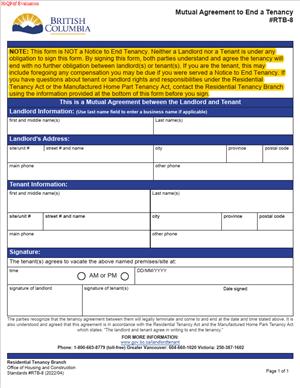
You and the landlord may agree in writing to end the tenancy. RTB-8 — Mutual Agreement to End a Tenancy records that choice.
Neither side can force the other to sign. A mutual agreement can affect compensation that would otherwise follow a landlord’s notice. Read it before agreeing, especially if the landlord says they need the home back.
For ending a tenancy in BC by agreement, keep a complete copy showing the property, parties, signatures, and agreed date. Discuss rent, access, and inspection arrangements clearly. Do not assume an agreement to leave settles every separate money dispute.
Consider assignment or subletting
An assignment transfers the tenancy to another tenant. A sublet is temporary and usually involves your return. They have different effects on your responsibilities.
Obtain the landlord’s written permission before using either route. Where at least six months remain in a fixed term, the landlord cannot unreasonably refuse consent. A refusal may require RTB review rather than moving someone in without permission.
If your goal is ending a tenancy in BC permanently, describe that goal clearly. Calling an arrangement a sublet does not make it a complete release. Keep the approval and transfer documents with your lease.
Check special legal routes
Eligible tenants facing family or household violence, or qualifying long-term-care circumstances, may use a special early-ending process. It requires the proper notice and an eligibility statement completed by an authorized verifier.
The official RTB-49 is for that special process. It is not a general lease-expiry form or a landlord-use vacate-clause form. Read the current official version and verification instructions.
A serious landlord breach of a material term can also provide a route. A material term is central to the agreement. The tenant must first give written notice of the failure and a reasonable opportunity to correct it. Get help assessing this route; ordinary complaints do not automatically justify immediate departure.
Understand possible rent-loss claims
Leaving early without an agreed or lawful route may create a claim for financial loss. The landlord must take reasonable steps to reduce the loss, such as trying to rent the unit again. The remaining lease balance is not automatically an award.
For ending a tenancy in BC early, retain messages about prospective tenants, viewing dates, and the property’s availability. Keep your rent receipts too. These records can help explain the timing and amounts if a claim follows.
Prepare a clear written notice and prove delivery
For ordinary tenant notice, you can write a letter. Include your name, signature, signing date, rental-unit address, and the effective date. A landlord’s eviction form serves a different purpose.
When ending a tenancy in BC, keep the wording direct. Make clear that you are giving notice to end the tenancy on the stated date. A message asking whether you might move is harder to distinguish from a discussion.
Check the unit number and legal names against the lease. Keep the notice separate from a long list of complaints. You can preserve other issues in a separate record without obscuring the notice.
Use an allowed service method
Service means delivering a legal document in an accepted way. Options include giving it to the landlord or their agent, or mailing it to a permitted address. Email requires an address provided for service. A routine email exchange alone may not establish that purpose.
Text messages are not an accepted way to serve the notice. The province also warns against sliding it under a door. Check the permitted method for the specific document.
Before ending a tenancy in BC by email notice, review the lease and any address-for-service document. Save the signed attachment and the complete sent email. Keep any acknowledgement without treating silence as an acknowledgement.
Allow for deemed receipt
Deemed receipt is the date the law treats a document as received. Mail is generally deemed received five days after mailing, unless earlier received. Permitted email service is generally deemed received on the third day, unless earlier received.
For ending a tenancy in BC, do not mail a notice on the last day you need it received. Record the method, destination, sending date, and evidence of receipt. Keep postal tracking and delivery notes with the signed notice.

Received an Eviction Notice in BC? Dispute Deadlines, Evidence, and Hearing Preparation
Check the effect on co-tenants
When several people share one tenancy agreement, one tenant’s valid notice can end the tenancy for everyone. A written mutual agreement with a co-tenant can also affect the whole tenancy. Remaining tenants should discuss a new agreement with the landlord.
Ending a tenancy in BC is therefore a household issue as well as an individual decision. Tell co-tenants before serving notice. Distinguish a shared lease from separate room leases.
Suppose two friends signed one agreement. One accepts a job elsewhere. They should not assume the departing person can simply remove their name. Review how the tenancy will end and what agreement will govern anyone staying.
Prepare the rental unit and inspection records
Ending a tenancy in BC includes documenting how you leave the property. Plan the cleaning, inspection, and key return alongside the move itself.
The unit must be left reasonably clean and without damage beyond reasonable wear and tear. Normal aging differs from damage. Take photos after removing your belongings so the condition is visible.
Unless you agree otherwise, the standard move-out time is 1 p.m. on the last tenancy day. Record any different arrangement in writing. Return keys and access devices, and keep a simple record of what you handed over.
Attend the condition inspection
The landlord must offer at least two inspection opportunities and complete a condition report. Participation matters: failures in the inspection process can affect deposit rights.
For ending a tenancy in BC, keep the move-in and move-out records together. RTB-27 — Condition Inspection Report provides a standard format. An alternative report must meet the legal requirements.
Read every entry before signing. Record disagreement accurately rather than signing a description you believe is wrong. Check whether a signature also authorizes a specific deposit deduction.
If the proposed appointment is impossible, reply promptly with workable times. Preserve the exchange. An unanswered scheduling message can be difficult to explain later.
Keep useful photos and copies
Photograph each room, then take closer images of disputed areas. Capture appliances, floors, walls, and anything noted during inspection. Retain the original files. A broad photo can show location; a close photo can show detail.
Your file for ending a tenancy in BC should make sense to someone who was not present. Use clear filenames and short descriptions. Do not change a photo to hide an issue.
The landlord must provide the signed move-out report promptly, and within 15 days after the later of inspection completion and receiving your written forwarding address.
Give a forwarding address and track your deposit
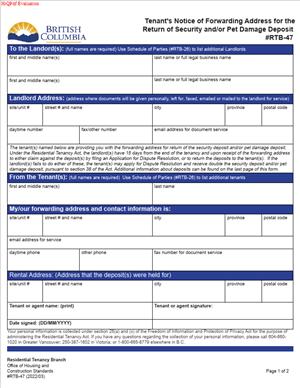
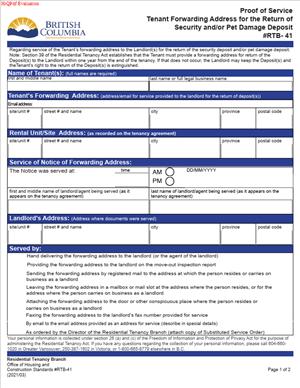
Ending a tenancy in BC does not finish the deposit process. Give the landlord a forwarding address in writing and preserve proof of service.
RTB-47 — Tenant’s Notice of Forwarding Address can organize that information. Keep a copy and record when and how it was delivered.
Subject to statutory exceptions, the landlord generally has 15 days after the later of the tenancy ending and receiving the written forwarding address. They must return the deposit with applicable interest or apply to retain it. Written consent to a deduction and existing orders can affect the position.
When ending a tenancy in BC, do not assume handing over keys starts every deadline. Keep the address-service record separate. A tenant who fails to provide a written forwarding address within one year can lose deposit-return rights.
If a dispute develops, identify whether the deposit direct-request process or a participatory hearing fits. Some former-tenant claims use RTB-12T-PT. Check the current application and service instructions.
For the detailed deposit procedure, read the BC security deposit return guide. This article’s focus is preparing a sound departure record.
Keep a simple money record
Create a short list of amounts paid and amounts still disputed. Show the payment date, purpose, amount, and supporting receipt. Keep rent, deposits, and any proposed deduction on separate lines.
For example, you may agree that a key was lost but dispute a wall-repair charge. Record each issue clearly. Save the inspection notes and messages explaining the difference. Do not turn a partial agreement into a statement that every charge was accepted.
If you receive a refund, keep the payment record with your deposit receipt. If only part is returned, note what remains unpaid and why you believe it is due. A clear calculation is more useful than a folder of unexplained bank screenshots.
A practical checklist for ending a tenancy in BC
Use one folder for the full move. Arrange it in date order so you can follow the events without searching several devices.
- Confirm tenancy coverage, rent due date, fixed term, and named parties.
- Identify the legal route and check the earliest valid end date.
- Prepare the signed notice or written agreement.
- Use a permitted delivery method and retain evidence of receipt.
- Discuss the effect on anyone sharing the tenancy agreement.
- Arrange the inspection and respond to appointment proposals.
- Clean, photograph the unit, and preserve the inspection report.
- Return access devices and record any agreed handover details.
- Serve the forwarding address and keep its delivery proof.
- Track payments, deposit responses, and any remaining disputes.
If you need forms, RunSensible Forms helps users find, complete, validate, and download legal documents. Choose the document by its purpose and confirm the current official version. RunSensible is not a law firm or government agency.

Conclusion
Ending a tenancy in BC works best when the legal date and practical move are planned together. Review the agreement, choose the correct route, give valid written notice, and keep proof of delivery.
Then complete the inspection, return access devices, and provide your forwarding address. A clear record helps both parties understand what happened. Seek individual advice where coverage, safety, compensation, or an early exit is disputed.
Frequently Asked Questions
These common questions about ending a tenancy in BC concern ordinary residential tenancies. Special agreements and existing orders can change the answer.
Does a fixed-term lease end automatically on its printed date?
Usually, it continues month to month unless a valid legal route ends it. If you want to leave at term-end, check the ordinary notice rules. A lawful vacate clause or sublease may require a different analysis.
Can I give notice by text message?
Text is not an approved service method. Use a permitted method and preserve evidence of delivery. For email, verify that the recipient provided that address for service. Do not rely only on the fact that you have exchanged informal messages.
Is one month’s notice the same as 30 days?
No. For ordinary monthly notice, the effective date must meet both the minimum notice period and rent-cycle requirements. Work from the rent due date. Add delivery time before deciding when to send the notice.
Does one month’s notice let me leave a fixed term early?
Not automatically. For ending a tenancy in BC early, consider a written mutual agreement, approved assignment, or applicable special legal route. Leaving without one may expose you to a loss claim. The facts and mitigation efforts matter.
Do all co-tenants have to sign before notice affects everyone?
A valid notice from one co-tenant can end a shared tenancy for all. Check whether you share one agreement or have separate agreements. Anyone hoping to stay should discuss a new tenancy with the landlord before relying on that plan.
Is RTB-49 the form for leaving when my lease expires?
No. The official RTB-49 supports eligible early endings involving violence or long-term care. It requires an authorized verifier. Ordinary term-end notice and a mutual agreement use different documents and procedures.
Can the landlord keep my deposit simply because I moved out?
Moving out alone does not authorize a deduction. The deposit rules consider the written forwarding address, timing, inspection obligations, agreements, and orders. Keep proof of these events before assessing whether a return or claim is overdue.
Must I complete all ten forms listed below?
No. They serve different purposes and users. Some support the move, some belong to a landlord’s inspection process, and others concern a later dispute. Select only the documents that fit your circumstances and the current official instructions.
Resources
Official sources checked October 27, 2026. The Act page displayed a consolidation current to October 20, 2026. Website summaries and form revision labels can lag; check the official document at the point of use.
- Residential Tenancy Act — https://www.bclaws.gov.bc.ca/civix/document/id/complete/statreg/02078_01
- Residential Tenancy Regulation — https://www.bclaws.gov.bc.ca/civix/document/id/complete/statreg/10_477_2003
- Options for a tenant to end tenancy — https://www2.gov.bc.ca/gov/content?id=C4125C28E3794A4089771D78A6C37E4F
- Tenancy agreements — https://www2.gov.bc.ca/gov/content/housing-tenancy/residential-tenancies/starting-a-tenancy/tenancy-agreements
- Breaking a lease as a tenant — https://www2.gov.bc.ca/gov/content/housing-tenancy/residential-tenancies/ending-a-tenancy/breaking-a-lease
- Mutual agreement to end a tenancy — https://www2.gov.bc.ca/gov/content/housing-tenancy/residential-tenancies/ending-a-tenancy/mutual-agreement
- Subletting and assigning tenancies — https://www2.gov.bc.ca//gov/content/housing-tenancy/residential-tenancies/during-a-tenancy/subletting-assigning-tenancy
- Types of rental housing situations — https://www2.gov.bc.ca/gov/content/housing-tenancy/residential-tenancies/calculators-and-resources/tenancy-laws-rules/tenancies-types
- Communication during a tenancy — https://www2.gov.bc.ca/gov/content/housing-tenancy/residential-tenancies/during-a-tenancy/communication
- Moving out of rental units — https://www2.gov.bc.ca/gov/content/housing-tenancy/residential-tenancies/ending-a-tenancy/moving-out-of-rental-units
- Tenancy deposits and fees — https://www2.gov.bc.ca/gov/content?id=BC74652E526B4BFCAEC4329D8325D1B5
- Policy Guideline 13 — Rights and Responsibilities of Co-Tenants — https://www2.gov.bc.ca/assets/gov/housing-and-tenancy/residential-tenancies/policy-guidelines/gl13.pdf
- Policy Guideline 30 — Fixed Term Tenancies — https://www2.gov.bc.ca/assets/gov/housing-and-tenancy/residential-tenancies/policy-guidelines/gl30.pdf?bcgovtm=CSMLS
- Official RTB-49 — Ending Fixed-Term Tenancy Confirmation Statement — https://www2.gov.bc.ca/assets/gov/housing-and-tenancy/residential-tenancies/forms/rtb49.pdf
- Complete and file the participatory hearing application — https://www2.gov.bc.ca//gov/content/housing-tenancy/residential-tenancies/solving-problems/tenancy-dispute-resolution/participatory-process/complete-and-file-application
- Tenancy forms — https://www2.gov.bc.ca/gov/content/housing-tenancy/residential-tenancies/calculators-and-resources/tenancy-forms
- Policy Guideline 42 — Digital Evidence — https://www2.gov.bc.ca/assets/gov/housing-and-tenancy/residential-tenancies/policy-guidelines/gl42.pdf
Disclaimer: The content provided on this blog is for informational purposes only and does not constitute legal, financial, or professional advice.
Contents