Know how to respond to an eviction notice in BC, protect your filing deadline, and prepare a clear case.
An eviction notice in BC can put your housing at risk. Start by identifying the notice and checking your deadline to dispute it. The date to apply is often much earlier than the proposed move-out date.
The Residential Tenancy Branch (RTB) resolves many disputes between tenants and landlords. An arbitrator is the person who hears the case and makes the decision. If you want a notice cancelled, you generally need to apply for dispute resolution within the required period. Arguing with the landlord does not replace that application.
This guide covers ordinary residential tenancies under BC’s Residential Tenancy Act. It provides general legal information, not advice for your case. Rules, fees, and forms can change. The information was checked on October 6, 2026.
What to Check When You Receive an Eviction Notice in BC
Read every page of your eviction notice in BC before deciding what it means. Keep the original and make a clear copy. Save the envelope, email, or photo showing how it arrived.
Write down these details in a separate note:
- The full notice title and form number.
- The landlord’s stated reason for ending the tenancy.
- The date the notice was signed.
- How and when it was delivered.
- The effective date, which is the proposed tenancy end date.
- Whether every page was included.
- Whether you received a hearing package or an order as well.

An eviction notice in BC is different from an Order of Possession. The notice starts a process. An order is an official direction about possession of the rental unit. A hearing package gives instructions for a proceeding. Each document needs its own response.
Check whether the RTB has authority over your housing. For example, accommodation where you share a kitchen or bathroom with the owner is excluded from the Act. Manufactured home park tenancies follow a different statute. Ask for help if you are unsure which system applies.
Do not assume a spelling error or wrong date settles the case. The Act allows some notices to be amended, and some incorrect effective dates are automatically corrected. Keep the problem in your notes and protect the dispute deadline.
Find the Deadline to Dispute the Notice
The dispute period for an eviction notice in BC depends on the type of notice. A longer notice period does not mean you can wait until the move-out date to apply.
Use this starting guide for an eviction notice in BC. Confirm the current form, receipt date, and applicable rules before relying on a calculated deadline.
| Notice received | Main reason | Time to apply to dispute after receipt |
|---|---|---|
| 10 Day Notice | Unpaid rent or qualifying unpaid utilities | 5 days |
| One Month Notice | Cause, such as specified tenancy breaches | 10 days |
| Two Month Notice | Tenant no longer qualifies for a subsidized rental unit | 15 days |
| Three Month Notice | Landlord or purchaser occupancy | 21 days |
| Four Month Notice | Demolition, specified conversions, or caretaker use | 30 days |
BC’s current landlord-occupancy and purchaser-occupancy notices are three-month notices. They have a 21-day dispute period. Older articles may describe earlier requirements. Check the generation or service date if an older notice is involved.
Major renovations follow a different path. The landlord must apply to the RTB for permission to end the tenancy for qualifying renovations or repairs. Do not treat a renovation application as an ordinary notice you must cancel using the table above.
These periods also do not cover every manufactured home park situation. Check the separate rules for those tenancies.
Check how your eviction notice in BC was served
Service means formally delivering a legal document. Receipt rules can affect when the dispute clock starts.
BC’s government guidance generally treats a mailed notice as received on the fifth day after mailing. A notice attached to the door or left in a mailbox is generally received on the third day. Email also has a three-day receipt rule, but the landlord must have an authorized email address for service.
A text message is not a permitted way to serve an eviction notice. Keep any text you receive, however, and seek help promptly. A dispute about service should not become a reason to ignore the matter.
Record both the delivery date and the date you actually found or opened the notice. Use the RTB’s notice-dispute calculator and ask about uncertain receipt facts. Do not choose whichever date gives you the most time.
Decide What Response Fits Your Situation
The right response to an eviction notice in BC depends on the reason given and the result you want. You may dispute the notice, take an available corrective step, or plan a lawful move.
If the notice concerns unpaid rent
Under section 46, paying all overdue rent within five days after receiving the notice makes that notice ineffective. Alternatively, you may apply to dispute it within that period. Paying only part of the arrears does not meet the full-payment rule.
If you believe the rent was already paid, gather proof. Match the payment to the rental period. A bank transfer record should show more than an outgoing amount. Save evidence identifying the recipient and whether the payment was accepted.
Continue dealing with rent obligations while the dispute proceeds. A pending application does not itself authorize you to stop paying rent. Repair concerns should be addressed through the appropriate legal process.
An eviction notice in BC for unpaid utilities needs separate attention. Check the agreement, the charges, and any written demand. Do not assume every utility bill automatically qualifies for a 10 Day Notice.
If you disagree with another reason
Read the exact grounds selected on the notice. A complaint about noise, damage, occupancy, or a tenancy term may involve different facts.
For example, a noise allegation may raise questions about the date, source, severity, and people affected. A damage allegation may turn on when the damage happened and who caused it. Avoid answering every issue with the same broad denial.
For landlord or purchaser occupancy, focus on the stated purpose and supporting facts. Explain any contradictions using records. Your suspicion alone is not proof that the intended occupancy is dishonest.
If you are discussing a settlement
You can talk about an agreement while preparing your response. Keep the filing deadline visible during those talks. A landlord saying they will “look into it” is not a confirmed cancellation.
Before agreeing to move, read the full terms. Clarify the date, rent, compensation, deposits, and any withdrawal of claims. Get advice if the proposed agreement gives up rights you do not understand.
An eviction notice in BC should remain in your working file even if discussions seem promising. Keep records of what was actually agreed.
Apply to Cancel the Notice Before the Deadline
If you want to dispute an eviction notice in BC, use the correct RTB application process. The online system requires a Basic BCeID. Paper applications are also available through the locations identified by the RTB.
For a current tenancy, the paper application is RTB-12T-CT. RunSensible’s tenant application for a current-tenancy dispute can help you prepare the relevant document. Submit through an accepted RTB channel.
Identify the notice you want cancelled. Include its date, reason, and relevant details. Check the landlord’s legal name and the rental address against your records.
Before submitting, check that:
- You selected the request to cancel the correct notice.
- Your description matches the notice you received.
- Your contact details are current.
- Your supporting documents are readable.
- You have copies of the application and attachments.

When Can I Withhold Rent in Canada
For a dispute involving a 10 Day Notice, the RTB’s evidence guidance says to submit evidence when applying. Start collecting payment records immediately.
After applying, save the confirmation and monitor your email, including junk mail. Check your application status and any request for further action. Preparing a draft or opening an online account does not mean an application is complete.
When a tenant applies on time to dispute an eviction notice in BC, the notice is put on hold pending the decision. That protection depends on following the process, including service and attendance.
Plan for the fee or request a waiver
The participatory hearing application fee is $100. Eligible applicants may request a waiver for low income or qualifying extraordinary expenses. Ask about the correct route and supporting documents.
RunSensible’s RTB filing-fee waiver application supports preparation of the paper request. The RTB decides eligibility. A waiver request does not extend your notice-dispute deadline.
If you want the landlord to repay your filing fee, include that request in the application. Reimbursement is not automatic.
Serve the Hearing Package and Keep Proof
Applying is followed by service. The RTB provides a Notice of Dispute Resolution Proceeding package. It identifies the parties, process, and hearing or conference details.
The regular guidance requires service within three days after the package becomes available. Follow the notice letter and any specific directions. Include the evidence you filed with the application.
Service rules for the hearing package differ from rules for an eviction notice in BC. For example, a tenant should not assume posting the package on the landlord’s door is allowed. Use an accepted method for your particular documents and recipient.
Keep service records for your eviction notice in BC and your hearing package in separate groups. This helps you explain which document was delivered on each date.
The proof-of-service form for the proceeding package helps record service. Keep receipts, tracking, email records, or witness evidence as appropriate. Follow the RTB’s deadline for providing proof.
If ordinary service cannot be completed, ask about substituted service. This means permission to use an alternative method. Explain why the proposed method will reach the recipient; do not simply improvise.
Build Evidence Around the Reason for Eviction
For an eviction notice in BC, a clear evidence file is more useful than a large collection of unrelated complaints. Organize your material around the facts that matter to the stated grounds.
Start with a short timeline. Give each entry a date, a factual description, and a document reference. Keep facts separate from your conclusions.
| Issue to explain | Useful records to consider | Question the records should help answer |
|---|---|---|
| Rent allegedly unpaid | Receipts, payment confirmations, rent ledger | Was the claimed rent paid, and for which period? |
| Alleged noise or misconduct | Dated communications, firsthand statements | What happened, when, and who observed it? |
| Alleged damage | Inspection records, dated photographs | What was the condition before and after the event? |
| Intended occupancy | Notice, relevant messages, documented contradictions | What supports or challenges the stated purpose? |
| Disputed service | Envelope, complete email, delivery notes | How and when was the notice delivered? |
These are preparation examples. They are not a guarantee that any item proves a defence.
Example: organize a rent-payment dispute
Suppose the landlord claims September rent was not paid. You have an accepted transfer confirmation and a message acknowledging it.
Label the transfer “September rent payment.” Label the message with its date. In your timeline, explain the connection between them. If the landlord’s ledger shows a different amount, identify that difference and ask for an explanation.
Avoid submitting six months of banking without pointing to the relevant transaction. Keep the original record and prepare a clearly marked working copy.
Example: respond to a misconduct allegation
Suppose the notice refers to a disturbance on a particular evening. You disagree about who caused it.
Gather records for that event. A witness who was present may help explain what they observed. A later message may show that the complaint referred to another unit. Explain how each item relates to the allegation.
Do not ask a witness to repeat your version. Ask them to describe their own knowledge. If you do not know a fact, say so.
Make digital files usable
Give files clear names and preserve their originals. Keep complete message threads where context matters. Check that photographs, recordings, and documents open correctly.
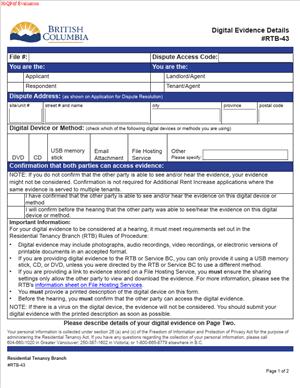
The RTB’s guidance says not to submit website links instead of the actual evidence. Save the relevant information in a usable file. For digital devices, follow the instructions for access and RTB-43.
RunSensible’s digital evidence details form can help identify files and explain their relevance. It does not replace the evidence itself.
Meet the Correct Evidence Deadline
If you apply to cancel an eviction notice in BC, you are the applicant. The landlord is the respondent in that application.
For regular participatory hearings, applicant evidence must generally be received at least 14 days before the hearing. Respondent evidence must generally be received at least seven days before it. Both the RTB and the other party must receive the evidence.
The landlord’s responsibility to justify the notice does not make you the respondent. Treat those roles and the burden of proof as separate questions.
The RTB says to exclude the receipt day and hearing day when counting the evidence interval. Allow time for service and check the current instructions. Special processes, including expedited hearings and 10 Day Notice disputes, need separate attention.
Create a calendar entry for each deadline. Include the hearing-package service date, proof-of-service date, evidence receipt deadline, and hearing. Do not label them all simply “eviction deadline.”
Prepare to Explain Your Case at the Hearing
A hearing about an eviction notice in BC is usually held by telephone. Follow the access instructions in your own proceeding package.
Prepare a short set of speaking notes. State which notice you dispute, the result you request, and your main reasons. Add the file names or page numbers you will refer to.

For example: “I ask that the rent notice be cancelled. The claimed September rent was paid. My payment confirmation and the landlord’s acknowledgement are in the evidence package.”
Adapt any example to the truth of your case. Do not read statements that your records do not support.
For an eviction dispute, the landlord must justify the notice. The arbitrator may ask the landlord to explain it first. You still need to answer the allegations and direct attention to your evidence.
Check the following before the call:
- Your phone is charged, and the access details are available.
- You have a quiet place and time set aside.
- Your application, notice, evidence, and service records are within reach.
- Your witnesses know how to attend.
- You have requested any needed interpreter or accommodation in advance.
Listen carefully and answer the question asked. Avoid interruptions. If you need to check a record, explain that briefly. Keep notes of directions given during the hearing.
Understand the Decision and Your Next Steps
The outcome of a dispute over an eviction notice in BC depends on the evidence and law. The notice may be cancelled or upheld. Read the written decision and any separate order carefully.
If the landlord receives an Order of Possession, use the date in that order. Do not assume you have another full notice period. Make a housing backup plan while waiting for the hearing.
Review consideration has limited grounds and short deadlines. An Order of Possession generally has a two-day review application period after receipt. If several review periods apply, the shortest controls. Disagreement with the result alone is insufficient. Judicial review is a different court process.
A landlord cannot physically remove you using a notice alone. Enforcement of possession requires the proper court process and a court-approved bailiff. Seek urgent help if someone threatens a lockout or removal without that process.
Keep the decision, order, and record of receipt together. If you move, separately organize inspection, forwarding-address, and deposit records. RunSensible’s BC security deposit return guide explains that later process.
Conclusion
Respond to an eviction notice in BC by identifying the notice, confirming receipt, and protecting the application deadline. Then serve the required package, organize relevant evidence, and prepare to explain your position.
Keep each deadline separate and retain proof of each step. RunSensible Forms can help you find and prepare relevant documents. It is not a law firm, government agency, or official filing service. The RTB decides the dispute.
Frequently Asked Questions
Does the date on an eviction notice in BC mean I must leave without a hearing?
It is the proposed tenancy end date, not proof that an arbitrator has decided the case. If you want the notice cancelled, apply within the dispute period. Ignoring it can have serious consequences. A separate order may create different obligations.
Can I wait while the landlord considers withdrawing my eviction notice in BC?
Keep your filing deadline active. A conversation or promise to reconsider does not replace an application. If the notice is withdrawn, retain clear written proof and confirm the proper steps for any application already filed.
What if I miss the deadline for an eviction notice in BC?
Seek help immediately. The RTB can extend statutory time limits only in exceptional circumstances, and cannot extend a notice-dispute application deadline beyond the notice’s effective date. Gather records explaining what prevented a timely application. An extension is not guaranteed.
Am I the respondent because the landlord started the eviction?
If you apply to cancel the notice, you are the applicant in that case. The landlord is the respondent, although the landlord must justify the notice. A separate landlord application can put you in a different role. Check each file.
Can I send the hearing package by text message?
Do not assume texting is valid service. The allowed methods depend on the document. Follow the proceeding package and RTB instructions. If ordinary service is impossible, ask about an order for substituted service.
Can someone help me at the hearing?
Yes. Depending on your needs, an assistant, agent, advocate, interpreter, or lawyer may help. Their roles differ. Arrange support early and clarify who may speak or settle. Request interpretation or accessibility assistance before the hearing.
Does uploading evidence mean the landlord has received it?
No. Submission to the RTB and service on the other party are separate steps. Keep copies and proof of delivery. Check the deadline for receipt, not just the date you sent or uploaded the files.
Resources
- Residential Tenancy Act — BC Laws
https://www.bclaws.gov.bc.ca/civix/document/id/complete/statreg/02078_01 - Types of evictions — BC government
https://www2.gov.bc.ca/gov/content/housing-tenancy/residential-tenancies/ending-a-tenancy/evictions/types-of-evictions - Receiving an eviction notice — BC government
https://www2.gov.bc.ca/gov/content/housing-tenancy/residential-tenancies/ending-a-tenancy/evictions/receiving-an-eviction-notice - Disputing an eviction — BC government
https://www2.gov.bc.ca/gov/content/housing-tenancy/residential-tenancies/ending-a-tenancy/evictions/disputing-an-eviction - Dispute Landlord Notice Calculator — RTB
https://www.housing.gov.bc.ca/rtb/WebTools/DisputeLandlordNotice.html - Complete and file the participatory hearing application — BC government
https://www2.gov.bc.ca/gov/content/housing-tenancy/residential-tenancies/solving-problems/tenancy-dispute-resolution/participatory-process/complete-and-file-application - Dispute resolution fees and fee waivers — BC government
https://www2.gov.bc.ca/gov/content/housing-tenancy/residential-tenancies/solving-problems/tenancy-dispute-resolution/participatory-process/fees-and-fee-waivers - Serve notice for dispute resolution — BC government
https://www2.gov.bc.ca/gov/content/housing-tenancy/residential-tenancies/solving-problems/tenancy-dispute-resolution/participatory-process/serve-notice-for-dispute-resolution - Prepare and serve evidence — BC government
https://www2.gov.bc.ca/gov/content/housing-tenancy/residential-tenancies/solving-problems/tenancy-dispute-resolution/participatory-process/prepare-serve-evidence - Prepare for a participatory hearing — BC government
https://www2.gov.bc.ca/gov/content/housing-tenancy/residential-tenancies/solving-problems/tenancy-dispute-resolution/participatory-process/prepare-for-hearing - At the participatory hearing — BC government
https://www2.gov.bc.ca/gov/content/housing-tenancy/residential-tenancies/solving-problems/tenancy-dispute-resolution/participatory-process/at-participatory-hearing - After the dispute resolution hearing — BC government
https://www2.gov.bc.ca/gov/content/housing-tenancy/residential-tenancies/solving-problems/tenancy-dispute-resolution/participatory-process/after-the-hearing - Review, clarify or correct decisions and orders — BC government
https://www2.gov.bc.ca/gov/content/housing-tenancy/residential-tenancies/solving-problems/tenancy-dispute-resolution/review-clarify-correct-decisions-orders - Evictions — Tenant Resource & Advisory Centre
https://tenants.bc.ca/your-tenancy/evictions/ - Preparing for a Hearing — Tenant Resource & Advisory Centre
https://tenants.bc.ca/your-tenancy/preparing-for-a-hearing/
Disclaimer: The content provided on this blog is for informational purposes only and does not constitute legal, financial, or professional advice.
Contents