Your landlord has kept your security deposit after you moved out. You may have received a list of charges, an estimate, or nothing at all. What should you do first?
Start with the date you gave up the home. Then check what the landlord sent within 10 days. Keep the lease, inspection reports, photos, and every message about the deposit. Those records can show what was paid, what happened at move-out, and whether a deduction makes sense.
In Alberta, a landlord may have a valid claim for certain unpaid costs. But a landlord cannot simply keep a deposit without following the rules. This guide explains those rules and the steps a tenant can take through the Residential Tenancy Dispute Resolution Service, or RTDRS. It provides general legal information, not advice about your case.
Start With the Alberta Security Deposit Timeline
The date you gave up possession matters. Write down when you moved out and returned the keys. The landlord’s 10-day duty is tied to giving up possession of the rental premises. If the tenancy’s end date and the key-return date differ, keep proof of both.
What must happen to the security deposit within 10 days?
If there are no deductions, the landlord must return the full security deposit, plus any interest owed, within 10 days after you gave up possession. If there are deductions, the landlord must give you a statement of account and return any balance within that period. The statement should show the amounts charged and why. There is another lawful path when costs cannot yet be fixed. The landlord can send an estimate of deductions within 10 days and return the amount that will not be used. An estimate is a temporary accounting of the security deposit. It is not a reason to hold the whole deposit without explanation.
When does the 30-day rule apply?
If the landlord first provides an estimate, the tenant must receive a final statement and any money still owing within 30 days after the tenancy ends. Check both events: the initial 10-day estimate and the later final accounting. A landlord cannot treat an estimate as a permanent replacement for a final statement.
For example, suppose you gave up possession on June 30. Your landlord emails an estimated cleaning charge and returns the undisputed balance within the first 10 days. The landlord still needs a final statement and any further refund within the applicable 30-day period. Check the dates and proof of delivery before deciding whether a rule was missed.

If nothing arrives in the first 10 days, Alberta recommends writing to the landlord at once about the security deposit. Ask for the security deposit and a statement of account. Keep a copy of the request and proof that you sent it. A missed deadline is important evidence, but it does not automatically tell you how much an officer will award.
Check the Amount and Any Interest
A security deposit, also called a damage deposit, is usually paid when the tenancy begins. In Alberta, it cannot exceed one month’s rent at the start of the tenancy. The landlord cannot raise that deposit when rent later rises. Find your receipt, bank transfer, lease, and any later agreement so you know the amount originally held.
Interest needs a separate check. Alberta set the prescribed security deposit interest rate at 0% for 2026. That does not erase interest that may have accrued in earlier years. The government’s rate page lists 1.6% for 2024 and 0.5% for 2025. An agreement may require a higher rate, and a written agreement can affect whether interest is paid each year or compounded until the end. Use Alberta’s interest calculator and the dates you paid and recovered the deposit.
Do not guess at a security deposit interest total. A tenancy spanning several calendar years may have different rates for different days. If you claim unpaid interest, show your calculation and the dates used. Also check whether your landlord already paid interest during the tenancy.
Review Each Deduction Against the Lease and the Facts
Read the security deposit statement of account line by line. Does it name a specific cost? Can you match it to a lease term, bill, invoice, inspection record, or photo? An item labelled only “damage” or “cleaning” gives you little to check. Ask for the details in writing.
Unpaid rent, agreed utility charges, cleaning, and repairs may become issues at move-out. The right to deduct depends on the facts and the legal requirements. Alberta says a tenant may challenge charges that were not specified in the agreement, charges for normal wear and tear, or damage and cleaning deductions made without compliant inspection reports.
Normal wear is different from damage
Normal wear and tear is change from ordinary use, even when someone took reasonable care. Damage is a separate question about harm beyond that ordinary use. A worn path on an old carpet and a large burn mark, for example, call for different evidence. The age and starting condition of an item can matter. Do not assume a photo of an imperfect unit proves who caused the condition.
Ask the landlord to identify the condition, the claimed cause, the work done, and the amount spent. Compare the move-in and move-out reports. Check dated photos against the dates of the tenancy. If the landlord replaced an old item, ask how the charge reflects the actual loss rather than treating a used item as new.
Inspection reports can change the deposit question
Alberta requires written move-in and move-out inspection reports. Inspections must take place within the prescribed window around taking or giving up possession. The landlord must give the tenant a copy immediately after the inspection. The reports have required statements and signatures, including a way for a tenant to record disagreement.
If the inspection report requirements were not met, Alberta says the landlord cannot deduct damage or cleaning costs from the security deposit. That does not prevent the landlord from bringing a separate claim for those costs. It also does not mean every other kind of deduction is automatically invalid. Keep these questions separate when you prepare your claim.
If you attended the move-out inspection and disagreed with a line, keep the report and your written objection. If you were not invited or never received a report, write down what happened. A landlord may inspect without the tenant only after following specific rules for offering two inspection times. Your own dated photos and a witness can help explain the home’s condition, but they do not replace the required report.
Build a Clear Evidence File Before You Dispute the Deposit
The strongest security deposit file tells a simple story in date order. You paid a certain amount. You gave up possession on a known date. The landlord returned an amount, made certain deductions, or sent nothing. Your documents show why you disagree. RTDRS accepts documents, photos, recordings, and hearing testimony as forms of evidence, subject to its submission rules.
Collect the records you have:
- The lease, renewals, and any written terms about utilities, cleaning, or fees.
- Proof of the deposit payment and any interest already paid.
- Move-in and move-out inspection reports, including pages showing signatures or disagreement.
- Dated photos or videos from both ends of the tenancy.
- The notice that ended the tenancy, key-return message, and written forwarding address.
- The statement of account, estimate, receipts, invoices, and any refund.
- Messages requesting an explanation or payment, with the landlord’s replies.
- Proof of service and copies of any papers later filed in the dispute.
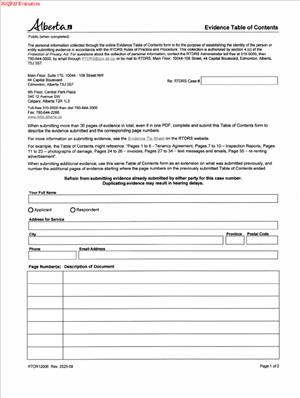
Use labels that a stranger can understand: “Move-in inspection — September 2024,” not “IMG_3021.” An Evidence Table of Contents can help you put the documents in order. Check RTDRS’s current forms and evidence instructions before submitting files. Do not send a large collection of unlabeled images and expect the officer to reconstruct the timeline for you.
Make a one-page accounting
Write the original deposit, interest you believe is owing, money already returned, each deduction, and the balance you seek. Put “disputed” beside each charge you challenge. Show your arithmetic. If part of a charge is fair, say which part you accept and which part you contest.
Here is a hypothetical example. A tenant paid a $1,200 deposit. The landlord returned $700 and kept $500 for carpet and cleaning. The tenant accepts $100 for documented cleaning but disputes the $400 carpet charge. The tenant would explain that calculation and attach the relevant reports and photos. These numbers are examples, not a prediction of what RTDRS would order.
Keep the story accurate, including weak points
Do not say there was no inspection if one occurred and you only dispute its accuracy. Do not say no money was returned if the landlord paid part. Acknowledge the facts that can be verified, then explain the disagreement. If you lack the move-in report, ask for it and note when you asked. If a photo has no reliable date, say so.
If roommates paid the deposit together, gather the lease and payment records before deciding who should apply or receive any refund. If a company managed the rental, confirm who the legal landlord is. RTDRS warns that an order is issued against the exact name on the application. Its naming guidance describes how to check individual and business names.
Ask the Landlord for an Explanation and Payment
Write a short, factual message about the security deposit before filing. Alberta specifically recommends a written request if the first 10 days pass without a deposit, statement, or estimate. Even if you received a statement, a written reply can narrow the dispute.
Your message can include:
- The rental address and the date you gave up possession.
- The amount of the security deposit you paid.
- The refund and statements you received, with dates.
- The charges you dispute and the reason for each objection.
- A request for missing reports, receipts, a final statement, or the remaining payment.
- A reliable forwarding address or agreed way to receive a reply.
For example: “I gave up possession on June 30 and paid a $1,200 deposit. I received your estimate on July 6, but I have not received a final statement. Please send the final accounting, the move-out report, and any remaining balance.” Adapt the facts and do not threaten a legal result you cannot support.
Keep the sent email, letter, delivery record, or message screenshot. If you speak by phone, send a brief written follow-up recording what was said. Do not agree to a deduction merely because you asked for evidence. If the landlord sends proof, review it fairly and update your accounting.

Landlord’s Notice to Enter: Free Templates and Rules
Apply to RTDRS if the Deposit Dispute Remains
RTDRS is Alberta’s residential tenancy dispute tribunal. It can decide a security deposit dispute. It can consider a tenant’s claim for return of a security deposit when the tenancy and claim fall under its law. Alberta also describes court as a possible route. Check that your accommodation is covered before starting. RTDRS says applications must be made within two years of discovering a potential claim, and claims must be $100,000 or less. A short deposit deadline and the longer time to bring a claim answer different questions; do not confuse them.
Prepare the tenant’s application
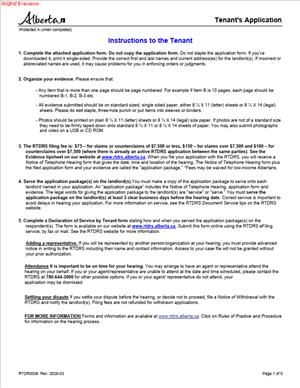
State the remedy you want and the amount you seek. Name the landlord correctly. Explain when the tenancy ended, what the landlord sent, what was returned, and which deductions you dispute. Attach the proof that supports those points. RunSensible’s Tenant’s Application page helps you locate the document; confirm the current version and filing instructions with Alberta’s official forms page.
If your claim includes other related losses, describe them separately and check whether RTDRS can hear them together. If a landlord has already filed against you, defence evidence alone will not give you a money award on your own claim. RTDRS says you must file your own application if you want compensation. Tell RTDRS about a court case involving the same matter; its application guidance asks applicants to address that issue.
Check the filing fee and waiver
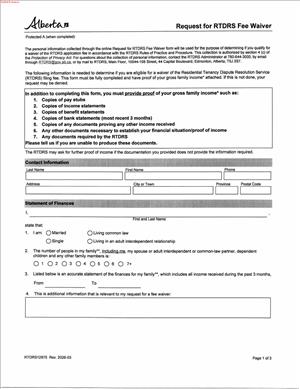
As of September 2026, RTDRS lists a $75 filing fee for a claim of $7,500 or less and $150 for a claim over $7,500. The fee structure began April 1, 2026. Eligible applicants may request a fee waiver and must provide income proof under the current instructions. Most deposit-only claims will fall in the lower fee tier, but check the total amount claimed and the posted fee before paying.
File, then serve the complete package
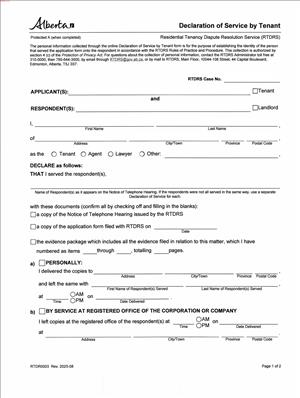
Alberta offers an RTDRS eFiling service for applications and evidence. Filing starts the process; it does not by itself notify the landlord. After processing, RTDRS sends the filed application package and a Notice of Telephone Hearing. Serve a complete copy on each respondent. The person who served it completes the appropriate Declaration of Service by Tenant.
The public RTDRS guide says to serve at least three clear days before the hearing. It excludes the service date, hearing date, weekends, and holidays from that count. Check the current rules and the directions on your hearing notice, especially because the RTDRS rules publication lists a September 2026 update. Do not plan service for the last possible day. Official service guidance explains approved methods.
Tenants can serve a landlord personally, by registered mail to an address described in RTDRS guidance, or by email when prior email communication or agreement exists and delivery can be shown. A corporation can be served at its registered office under the published guidance. Keep delivery proof and the exact papers sent. If ordinary service fails after reasonable attempts, ask RTDRS about an order allowing another method. The substitutional service declaration supports that request; it does not itself grant permission.
Prepare for the telephone hearing
Keep your application, landlord’s response, numbered evidence, lease, and calculation beside you. Be ready to answer a simple set of questions: How much did you pay? When did you give up possession? What did you receive within 10 days? Did the landlord send an estimate and then a final statement? Which deductions do you dispute and why?
Speak from the records. Point the officer to the page or file that supports each point. Let the landlord explain a charge, then answer it with your evidence. If a new document arrives, check how to submit and share it under the current rules. RTDRS says late evidence may not be accepted. The hearing guidance and evidence resources can help you prepare.
Understand the Order and the Next Step
An RTDRS hearing can result in an order granting all, some, or none of the amount sought. The officer may decide that a charge was supported, unsupported, or outside the deposit deduction rules. Read the actual order for the amount, the named parties, and any directions. Keep a copy with your evidence and proof of service.
An order is not the same as receiving payment. If the landlord pays, keep proof and confirm the amount matches the order. If payment does not arrive, use RTDRS’s hearings and orders guidance and its after-order resources to identify the next enforcement step. Ask RTDRS or an Alberta legal professional if you are unsure which step applies.
If the landlord files a separate damages claim, read it even if you won a deposit dispute. The landlord’s claim and the right to deduct from the security deposit are related but not identical. Respond within the directions given for that case. Do not assume a procedural problem with the inspection reports resolves every other issue between you.
Avoid These Common Mistakes
- Counting only from the lease end date. Record when you gave up possession and when the tenancy ended; each can matter to a different part of the accounting.
- Treating an estimate as a final bill. Check for the final statement and any further refund within the 30-day period.
- Assuming every late payment means a full refund. Explain the missed rule, the amounts, and each contested deduction. RTDRS decides the remedy.
- Ignoring inspection reports. Missing or non-compliant reports can block damage and cleaning deductions from the deposit, even when the landlord alleges a separate loss.
- Using the property manager’s trade name without checking the landlord. An order against the wrong party can be hard to use.
- Sending evidence to RTDRS but not serving the landlord. Follow the current directions for sharing the filed package and later evidence.
- Assuming 0% interest in 2026 means zero interest for the whole tenancy. Check earlier calendar years and any higher agreed rate.
The best approach is modest and precise. Ask for an accounting, organize the timeline, identify the exact amount disputed, and give the other party fair notice. Alberta’s deposit guidance and RTDRS instructions should control if a form page or an older article differs.

Conclusion
To recover an Alberta security deposit, begin with the possession date and the landlord’s 10-day response. If you received an estimate, check the final 30-day statement and refund. Compare each deduction with the lease, inspections, and real costs. Then ask the landlord in writing for missing money or proof.
If the dispute remains, RTDRS may hear a tenant’s claim for return of the security deposit. File the right application, serve the full package, and explain your evidence clearly at the hearing. Check the current Alberta rules, forms, fees, and service directions before filing. RunSensible Forms can help you locate and prepare relevant documents; it is not a law firm, tribunal, government agency, or official filing service.
Frequently Asked Questions
How long does an Alberta landlord have to return a security deposit?
If no deductions are made, the landlord must return the security deposit and any interest owing within 10 days after you give up possession. If there are deductions, the landlord must provide a statement and any remaining balance within 10 days, or provide an estimate and the undisputed money, followed by a final statement and any remaining refund within 30 days after the tenancy ends. What if I did not receive an inspection report?
Ask for both move-in and move-out reports. Alberta says a landlord cannot deduct damage or cleaning costs from the security deposit if inspection requirements were not met, although the landlord may pursue a separate claim for those costs. Keep your photos and messages about any inspection. Can a landlord deduct for normal wear and tear?
Alberta says normal wear and tear is not a proper basis for keeping the security deposit. Describe the item’s condition at move-in and move-out. Use reports and dated photos to distinguish ordinary aging from a specific incident of damage.
Is interest owed if I moved out in 2026?
The prescribed security deposit interest rate is 0% for 2026. Interest may still be owing for earlier parts of the tenancy, such as 2024 or 2025, or under a higher agreed rate. Check the dates and any past interest payments with Alberta’s interest calculator.
Can I apply to RTDRS after I have moved out?
Yes, RTDRS lists return of a security deposit as a tenant remedy. Check whether your tenancy is covered and whether your claim meets the published time and amount limits. RTDRS says applications must be made within two years of discovering a potential claim.
Can I email the RTDRS papers to my landlord?
RTDRS’s tenant service guidance allows email where the parties have previously communicated by email or agreed to it, and you can show delivery. Keep the message and proof of receipt. If those conditions do not fit, use another approved method or ask RTDRS about substitutional service.
What if my landlord claims costs greater than the deposit?
The landlord may seek the additional amount through a separate legal claim. A tenant may still dispute whether a deduction from the security deposit was allowed or supported. Read any application served on you, respond with your evidence, and file your own application if you want an award on your own claim.
Resources
- Government of Alberta, Ending a tenancy: https://www.alberta.ca/ending-a-tenancy
- Government of Alberta, Common problems: landlords and tenants: https://www.alberta.ca/common-problems-landlords-and-tenants
- Government of Alberta, Starting a tenancy: https://www.alberta.ca/starting-a-tenancy
- Government of Alberta, Annual security deposit interest rate: https://www.alberta.ca/annual-security-deposit-interest-rate
- Government of Alberta, Inspection Reports: https://www.alberta.ca/system/files/custom_downloaded_images/sa-inspection-reports.pdf
- Government of Alberta, RTDRS: How to apply: https://www.alberta.ca/rtdrs-apply
- Government of Alberta, RTDRS: Hearings and orders: https://www.alberta.ca/rtdrs-hearings-and-orders
- Government of Alberta, RTDRS: Forms and documents: https://www.alberta.ca/rtdrs-forms-documents
- Government of Alberta, RTDRS: Overview and 2026 fees: https://www.alberta.ca/residential-tenancy-dispute-resolution-service
- Government of Alberta, RTDRS Rules of Practice and Procedure, September 2026 listing: https://open.alberta.ca/publications/residential-tenancy-dispute-resolution-service-rules-of-practice-and-procedure
Disclaimer: The content provided on this blog is for informational purposes only and does not constitute legal, financial, or professional advice.
Contents