
Moving out can be expensive. A tenant may need the old deposit to pay for the next home. A landlord may also believe that rent or repair costs remain unpaid. British Columbia law gives both sides a process for resolving that conflict.
The basic BC security deposit return rule is simple. After a tenancy ends and the landlord receives the tenant’s forwarding address in writing, the landlord usually has 15 days to return the deposit with interest or apply to the Residential Tenancy Branch to claim against it. The later of those two events starts the clock.
The details matter. Inspection reports, written consent, service dates, and prior orders can change the result. A sound BC security deposit return plan starts with a complete paper trail. This guide explains the general process under British Columbia’s Residential Tenancy Act. It does not provide legal advice for any specific dispute.
How BC security deposit return rules work
A security deposit is money held by the landlord during a tenancy. It may cover unpaid rent or damage caused by the tenant. It is often called a damage deposit.
The landlord does not own this money simply because it is in their account. The law controls when the landlord may keep it. A tenancy agreement also cannot say that the landlord automatically keeps the deposit when the tenancy ends.
Security deposits and pet damage deposits
A landlord may charge a security deposit of no more than half of the first month’s rent. The amount is based on the rent when the tenancy begins. A later rent increase does not increase the original deposit.
If pets are allowed, the landlord may also charge a pet damage deposit. It can be no more than half of one month’s rent, regardless of the number of pets. A certified guide or service dog does not require a pet damage deposit.
The two deposits have different purposes. A security deposit may respond to unpaid rent or tenant-caused damage. A pet damage deposit is generally limited to damage caused by a pet unless the tenant agrees otherwise.
Interest forms part of the repayment
A BC security deposit return may include interest. The rate can change by calendar year. The province lists a 2026 rate of 0%, but earlier years may have positive rates. For example, it lists 0.95% for 2025, 2.7% for 2024, and 1.95% for 2023.
A long tenancy may cross several yearly rates. Use the province’s Deposit Interest Calculator instead of guessing. For BC security deposit return purposes, the landlord should calculate interest on the full deposit before returning it, asking for a deduction, or applying to keep it.
The 15-day BC security deposit return deadline
Section 38 of the Residential Tenancy Act sets the main deadline. The landlord has 15 days after the later of:
- the date the tenancy ends; and
- the date the landlord receives the tenant’s forwarding address in writing.
Within that period, the landlord must usually return the deposit with applicable interest or apply to the RTB to claim against it. The deadline does not always begin on move-out day. If the written address arrives later, the receipt date controls.
A BC security deposit return timeline example
Suppose a tenancy ends on June 30. The tenant personally gives the landlord a written forwarding address on July 2. The later event is July 2, so the 15-day period runs from that date.
Service method also matters. A document sent by mail or left at an address may be treated as received several days after it was sent. Keep the receipt, tracking record, email agreement, witness statement, or other proof. Use the RTB’s current service rules when calculating a date.

The forwarding address has a one-year limit
A tenant should not wait. Section 39 says the tenant’s right to the deposits ends if the tenant does not give a written forwarding address within one year after the tenancy ends. The landlord may then keep the deposits.
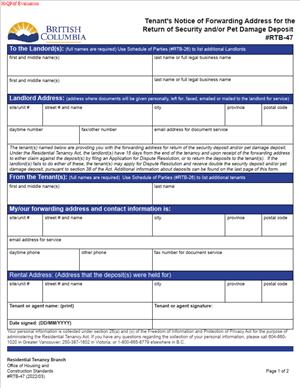
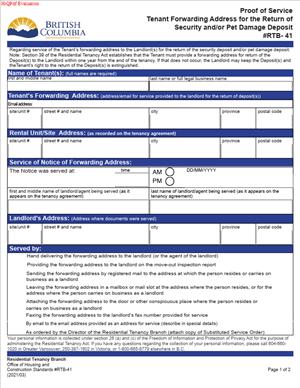
RTB-47, Tenant’s Notice of Forwarding Address, creates a clear record. A letter or a move-out condition report containing the address may also work. Whatever method is used, save a copy and proof of service. RTB-41 records how and when the address was served.
Condition inspections protect both sides
Condition inspections help show what changed during the tenancy. The landlord and tenant should inspect the unit at move-in and move-out. They record the unit’s condition on RTB-27, the Condition Inspection Report.
The landlord must offer the tenant at least two opportunities to take part in the inspection. RTB-22 can document a final opportunity to schedule one. The landlord must complete and sign the report and give the tenant a copy.
The tenant should attend, take dated photos, read the report, and add any disagreement before signing. Signing a report does not require the tenant to agree to a deduction. Consent to keep money should be clear, written, and specific.
Inspection failures can affect BC security deposit return rights. A tenant who does not properly participate may lose the right to the return of a deposit in some cases. A landlord who fails to meet the inspection and reporting rules may lose the right to claim against the deposit for damage. The landlord may still pursue a separate damage claim, but the deposit itself may no longer be available for that purpose.
For a strong BC security deposit return record, keep:
- the signed tenancy agreement;
- proof that each deposit was paid;
- move-in and move-out inspection reports;
- dated photos or videos;
- repair, cleaning, and key-return records;
- the written forwarding address;
- proof showing when each document was served; and
- messages about proposed deductions or repayment.
When a landlord may deduct from a deposit
A landlord cannot make a BC security deposit return deduction based only on an invoice or personal belief. At the end of the tenancy, the tenant may agree in writing that the landlord can keep a stated amount. Without that agreement, the landlord normally needs an RTB order.
A prior RTB order can also matter. The Act allows a landlord to retain an unpaid amount that the director previously ordered the tenant to pay. The facts and wording of the order should be checked carefully.
Written consent should identify the exact amount
A tenant may agree that $120 can be kept for a specific repair. The landlord should then return the balance and deal with interest as required. A general statement such as “landlord may deduct damages” may not prove informed agreement to a final amount.
Tenants should not sign a blank deduction authorization. Landlords should not rely on a verbal conversation when the Act calls for written agreement. Both sides should keep the same signed record.
Normal wear is not the same as damage
Normal wear is the expected decline from ordinary use over time. Examples may include light carpet wear or faded paint. Damage involves more than ordinary aging, such as a broken door or a large burn in flooring.
The line depends on the evidence, the age of the item, and the facts. A condition report, photos, invoices, and maintenance history can help an RTB decision-maker assess a claim. Neither side should assume that a security deposit automatically pays every turnover cost.
When a tenant may claim double the deposit
The double-deposit rule is a major part of the BC security deposit return process. Under section 38(6), a landlord who does not comply with the 15-day duty may lose the right to claim against the deposits and may have to pay double the applicable amount.
Section 38.1 allows a tenant to request an order for double the portion at issue when the landlord did not apply within the required period, no relevant order permits retention, and no written agreement permits the deduction. An RTB decision-maker applies the law to the documents.
Double repayment is not a late fee that the tenant adds informally to a BC security deposit return demand. The tenant asks the RTB for a monetary order. If part of the deposit was validly retained by written agreement, the claim may concern only the remaining portion.
For example, assume a $700 deposit and a written agreement allowing a $100 deduction. If the landlord keeps the remaining $600 without returning it or applying in time, the tenant may seek the remedy that applies to that $600 portion. The final amount depends on the Act, interest, the evidence, and the RTB order.
Using a direct request for a BC security deposit return
A direct request is a document-only RTB process for certain disputes. In a BC security deposit return direct request, there is no hearing and no verbal testimony. An adjudicator decides the matter from the application and written evidence, so missing documents can be decisive.
The RTB says a tenant may use the deposit direct-request route after 20 days have passed since the tenancy ended and the landlord has the written forwarding address. This 20-day application point should not be confused with the landlord’s 15-day statutory deadline. The direct-request material accounts for the response period and delivery.
The tenant must also confirm that the landlord has not applied to keep the deposit and that no outstanding RTB order permits retention. A tenant who agreed to a deduction cannot use a direct request to recover that agreed amount. If the landlord has filed a claim, the tenant may need a cross-application or the regular participatory process.
BC security deposit return direct-request checklist
The current paper application identifies these core documents:
- The tenancy agreement.
- RTB-12T-DR, Tenant’s Application for Direct Request for Return of Security and/or Pet Damage Deposit.
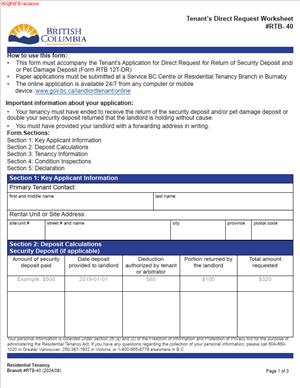
- RTB-40, Tenant’s Direct Request Worksheet.
- RTB-41, proof that the forwarding address was served.
- A copy of the written forwarding address, such as RTB-47, a letter, or the move-out report.
- Proof that the deposits were paid, such as receipts or transfer records.
- Other evidence that supports the amount claimed.
Use full legal names that match the tenancy agreement. If there are extra parties, RTB-26 may be required. An incorrect party name can create trouble when an order must later be enforced.
Filing, fees, and service
Tenants can apply online with a basic BCeID or submit the paper application in person at an accepting Service BC location or the RTB office in Burnaby. The current direct-request filing fee is $100. A person with very low income or extraordinary expenses may apply for a fee waiver using RTB-17. The tenant can also ask to recover the filing fee in the application.
After the RTB prepares the Notice of Direct Request Proceeding package, the applicant must serve it on each respondent no more than three days after it is ready. RTB-50 records service of the package. Use only a permitted service method and upload the required proof.
If ordinary service is not possible, the tenant may need to request substituted service. Do not assume that a text message, social-media message, or email is valid. Email service generally needs an address provided for service or other legal authority.
A practical BC security deposit return timeline
| Stage | What to do | Key timing point |
|---|---|---|
| Before move-out | Arrange the inspection and gather records | Landlord should offer at least two inspection opportunities |
| Tenancy ends | Return keys and document the unit | Save dated photos and the completed condition report |
| Forwarding address | Give it in writing and prove service | Must be provided within one year after tenancy ends |
| Landlord response | Return deposits with interest or apply to claim | Usually within 15 days after the later triggering event |
| Direct request | Check eligibility and file a complete written record | RTB says tenants may apply after the 20-day point |
| Proceeding package | Serve every respondent and prove service | No more than three days after the package is ready |
| Monetary order | Request payment and keep proof of service | Court enforcement may follow if the order is not paid |
The table summarizes general BC security deposit return steps. Service rules can shift the date a document is treated as received. A prior order, written deduction agreement, inspection failure, or landlord application can also change the route.
Common mistakes tenants should avoid
Giving only a phone number or email
The Act requires a forwarding address in writing. An email address alone may not be enough as the place where the deposit can be sent. Use a clear mailing address and a recognized service method.
Counting 15 days from move-out in every case
The clock begins after the later of tenancy end or the landlord’s receipt of the written address. A later address or deemed-service date can move the deadline.
Treating the deposit as the last month’s rent
A tenant cannot apply a deposit to rent without the landlord’s written permission. Doing so may create rent arrears even if the tenant believes the landlord owes the deposit back.

RTB Monetary Order Enforcement in BC: Monetary Orders, Corrections, and Review Applications
Filing a BC security deposit return request without proof
A direct request is decided on paper. Include the agreement, payment proof, address notice, service proof, worksheet, and other required records. Do not expect to explain missing evidence at a hearing, because this route has no hearing.
Agreeing to deductions too quickly
Ask for the amount, reason, photos, and invoices. A tenant may agree to a fair deduction, but the consent should identify the exact sum. Once given, that agreement affects what can be claimed through a direct request.
Common mistakes landlords should avoid
Missing the 15-day response period
A landlord who wants to claim against a deposit should not wait for repair work or a final invoice if that delay risks the statutory deadline. The landlord can apply within the required time and provide evidence through the proper process.
Making an automatic deduction
A lease clause does not let the landlord automatically keep the money. The landlord needs the tenant’s written agreement at the end of the tenancy, a relevant prior order, or a new RTB order.
Skipping inspection steps
Failure to offer inspection opportunities, complete the report, or give the tenant a copy can end the landlord’s right to claim against the deposit for damage. Detailed photos alone may not cure a failure to follow the statutory inspection process.
Ignoring deposit interest
A proper BC security deposit return includes interest when the regulations require it. Even when the current year’s rate is 0%, earlier years in a longer tenancy can produce interest.
Assuming a property sale ends responsibility
When a rental property changes owners, the new landlord generally becomes responsible for returning the deposits. The former and new owners should address the transfer in their closing records. The tenant should be told who holds the money.
What happens after the RTB issues a monetary order
A BC security deposit return order does not move money by itself. The successful tenant should serve the decision and monetary order as required and make a clear written demand for payment. Keep proof of delivery and any reply.
If the landlord does not pay, the tenant may be able to file the RTB monetary order in the Provincial Court of British Columbia and use court enforcement procedures. Enforcement is a separate stage. The correct step depends on whether the order is final, whether a review or correction request exists, and what property or income may lawfully be reached.
RunSensible’s guide to RTB monetary-order enforcement explains that later process. A tenant facing a large amount, a complex ownership structure, or an insolvent landlord may wish to get legal help.
BC security deposit return checklist
For tenants:
- Attend both condition inspections.
- Keep the tenancy agreement and deposit receipts.
- Take dated move-out photos.
- Give a complete forwarding address in writing.
- Use a permitted service method.
- Save proof of service.
- Mark the 15-day response deadline.
- Check whether the landlord filed an RTB claim.
- Wait until the RTB’s direct-request eligibility point.
- File every required form and item of evidence.
- Serve the proceeding package within the stated period.
For landlords:
- Offer at least two inspection times.
- Complete and deliver the condition report.
- Record the date the written address is received.
- Calculate the deadline from the later triggering event.
- Calculate interest using the official tool.
- Return the undisputed amount promptly.
- Obtain specific written consent for a deduction or apply to the RTB.
- Keep invoices, photos, rent records, and service proof.
- Use a pet deposit only for its permitted purpose unless the tenant agrees otherwise.

Conclusion
The BC security deposit return process depends on dates and documents. A landlord generally has 15 days after the later of tenancy end or receipt of the written forwarding address to return the deposits with interest or apply to claim against them.
Tenants should protect their claim with inspection records, a written address, and proof of service. Landlords should respond before the deadline and avoid automatic deductions. If the requirements for double repayment are met, the tenant can ask the RTB for a monetary order through the correct process.
Rules, fees, forms, and service methods can change. Check the current RTB instructions and form versions before filing. For advice about a specific dispute, contact a qualified British Columbia legal professional or tenant-support service.
Frequently Asked Questions
How long does a landlord have to return a security deposit in BC?
The general BC security deposit return deadline is 15 days after the later of the tenancy ending or the landlord receiving the tenant’s forwarding address in writing. Within that time, the landlord usually must repay the deposit with interest or apply to the RTB to claim against it.
Why does the RTB direct-request process refer to 20 days?
The Act gives the landlord 15 days to respond. The RTB says a tenant may submit a direct request after the 20-day point, which allows for the response window and delivery. Follow the current instructions and calculate service dates carefully.
Is double repayment automatic when a landlord is late?
The Act says a non-compliant landlord must pay double the applicable deposit amount, but the tenant may need an RTB monetary order to enforce that right. The RTB will review the dates, agreements, orders, and evidence.
Can a landlord keep a deposit for cleaning or damage?
Not by decision alone. The tenant may agree in writing to a specific deduction, or the landlord can apply for an RTB order. Inspection records and evidence help distinguish tenant-caused damage from normal wear.
Does a BC security deposit return include interest in 2026?
The province lists the 2026 deposit interest rate as 0%. A tenancy that began earlier may still have interest from prior years. Use the official calculator for the full period.
What happens if the tenant never gives a forwarding address?
If the tenant does not provide a written forwarding address within one year after the tenancy ends, section 39 says the tenant’s right to the deposit ends. The landlord may then keep it.
Can a tenant use the security deposit as the final month’s rent?
Only with the landlord’s written permission. A tenant who withholds rent without that permission may create a separate rent debt.
What if the landlord has already applied to keep the deposit?
The tenant may not qualify for the document-only direct-request route. The tenant can still seek return of the deposit, and the RTB may handle the matters together through a cross-application or participatory process.
Resources
- Residential Tenancy Act, SBC 2002, c. 78: https://www.bclaws.gov.bc.ca/civix/document/id/complete/statreg/02078_01
- Tenancy deposits and fees — Province of British Columbia: https://www2.gov.bc.ca/gov/content/housing-tenancy/residential-tenancies/starting-a-tenancy/deposits-fees
- The direct request process — Province of British Columbia: https://www2.gov.bc.ca/gov/content/housing-tenancy/residential-tenancies/solving-problems/tenancy-dispute-resolution/direct-request-process
- Complete and serve the direct request application — Province of British Columbia: https://www2.gov.bc.ca/gov/content/housing-tenancy/residential-tenancies/solving-problems/tenancy-dispute-resolution/direct-request-process/complete-and-serve-the-direct-request-application
- Condition inspections during tenancy — Province of British Columbia: https://www2.gov.bc.ca/gov/content/housing-tenancy/residential-tenancies/during-a-tenancy/condition-inspections-during-tenancy
- Tenancy forms listed by number — Province of British Columbia: https://www2.gov.bc.ca/gov/content/housing-tenancy/residential-tenancies/calculators-and-resources/tenancy-forms/forms-listed-number
- Deposit Interest Calculator — Residential Tenancy Branch: https://www.housing.gov.bc.ca/rtb/WebTools/InterestOnDepositCalculator.html
- Dispute resolution fees and fee waivers — Province of British Columbia: https://www2.gov.bc.ca/gov/content/housing-tenancy/residential-tenancies/solving-problems/tenancy-dispute-resolution/participatory-process/fees-and-fee-waivers
Disclaimer: The content provided on this blog is for informational purposes only and does not constitute legal, financial, or professional advice.
Contents