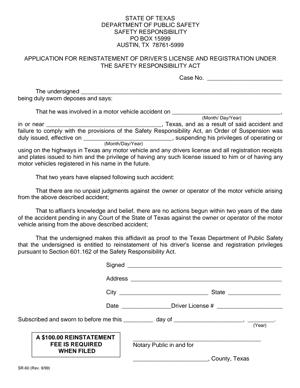
SR-60 – Application for Reinstatement of Driver’s License and Registration under the Safety Responsibility Act
Fill out nowJurisdiction: Country: United States | Province or State: Texas
If your Texas driver’s license or vehicle registration has been suspended under financial responsibility laws, the SR-60 – Application for Reinstatement of Driver’s License and Registration under the Safety Responsibility Act is the form used to request reinstatement. It is part of the process for getting back your driving privileges after a suspension related to an accident or failure to show financial responsibility.
This form connects directly to the Safety Responsibility Act in Texas. That law generally requires drivers involved in certain accidents to show they can cover damages or that they had proper insurance at the time. If you did not meet those requirements, your license and registration may have been suspended.
The SR-60 is not a traffic ticket and not a court appeal. It is an administrative filing handled through the state’s driver licensing authority. You complete it to show that conditions for reinstatement have been satisfied.
If you are about to fill out this form, you likely want to know what information is required, what it accomplishes, and what problems to avoid. This guide walks through each part in clear, practical terms so you can understand what you are submitting and why it matters.
What is SR-60 – Application for Reinstatement of Driver’s License and Registration under the Safety Responsibility Act?
Clear definition
The SR-60 – Application for Reinstatement of Driver’s License and Registration under the Safety Responsibility Act is an official Texas Department of Public Safety form used to request restoration of a suspended driver’s license and vehicle registration. The suspension must be tied to the Safety Responsibility Act.
In simple terms, it is a request to lift a suspension that happened because of an accident and a failure to show proof of financial responsibility, such as liability insurance, or failure to resolve damages from that accident.
The form gathers identifying information and confirms that certain legal or financial conditions have been met. It allows the licensing authority to review your situation and determine whether your driving privileges can be reinstated.
Who typically uses this form?
Most people who use this form are drivers whose license and vehicle registration were suspended after a motor vehicle accident. The suspension usually occurs when a driver did not have valid liability insurance at the time of the crash or did not resolve claims for damages.
You might also use this form if a judgment was entered against you for damages arising from an accident and your license was suspended because that judgment was not satisfied.
In some cases, vehicle owners who were not driving but were legally responsible for the vehicle may also be involved in the reinstatement process. The form focuses on the person whose driving privileges were suspended.
Why might you need this form?
You need this form when the state has already suspended your license and registration under the Safety Responsibility Act, and you now want to restore those privileges.
Reinstatement generally requires proof that specific conditions have been met. That may include paying a judgment, entering into an approved installment agreement, filing proof of financial responsibility for the future, or resolving claims with other parties.
The SR-60 serves as your formal request for review. Without submitting the proper application, your suspension typically remains in effect, even if you have resolved the underlying issue.
Typical real-life scenarios
- You were involved in a traffic accident where property damage exceeded a certain amount. At the time of the accident, you did not have valid liability insurance. After receiving notice from the state, your license and registration were suspended. Once you obtain proper coverage and address any claims, you use this form to request reinstatement.
- You were found legally responsible for damages after an accident, and a court entered a monetary judgment against you. Because the judgment was not paid, your driving privileges were suspended. After paying the judgment or arranging a legally recognized payment plan, you complete the form to start the reinstatement process.
- You had insurance at the time of the accident but failed to provide timely proof. As a result, a suspension was placed on your record. After gathering documentation that shows you were insured on the date of the crash, you may submit the application along with supporting documents.
- You co-owned a vehicle involved in an accident, and financial responsibility requirements were not met. Your registration was suspended along with the driver’s license of the person operating the vehicle. After resolving liability or meeting financial requirements, the reinstatement process may involve this form.
When would you use SR-60 – Application for Reinstatement of Driver’s License and Registration under the Safety Responsibility Act?
You use the SR-60 – Application for Reinstatement of Driver’s License and Registration under the Safety Responsibility Act after a suspension has already taken effect. It is not used to prevent a suspension before it happens. It is used once the suspension is in place and you are eligible to seek reinstatement.
Timing matters. The state typically sends a notice of suspension that explains why your license and registration were suspended and what conditions apply. After you meet those conditions, the form becomes relevant.
This form is commonly used by individual drivers. In some situations, business owners whose company vehicles were involved in an accident may also need to address registration issues connected to financial responsibility laws. The focus, however, remains on the person whose driving privilege is suspended.
You would not use this form for unrelated suspensions, such as those based on unpaid traffic tickets, certain criminal convictions, or administrative license revocations for other reasons. Each type of suspension generally has its own reinstatement process and documentation.
If your suspension specifically references the Safety Responsibility Act or failure to comply with financial responsibility requirements after an accident, this form is typically part of the reinstatement path.
Legal characteristics of SR-60 – Application for Reinstatement of Driver’s License and Registration under the Safety Responsibility Act
This form is an administrative request. It does not decide fault in an accident. It does not reopen a court case. Its purpose is to demonstrate that the statutory requirements for reinstatement have been satisfied.
For the application to be effective, it must be complete and accurate. That usually means providing your full legal name, driver’s license number, current contact information, and details related to the suspension. Missing or inconsistent information can delay processing or result in rejection.
Supporting documentation is often required. For example, proof of insurance filings, evidence that a judgment has been satisfied, or confirmation of an installment agreement may need to accompany the form. Submitting the application without required attachments can prevent reinstatement.
High-level procedures are similar across many states with financial responsibility laws, but details differ. In Texas, the Safety Responsibility Act sets specific thresholds and documentation standards. The SR-60 is tailored to those requirements and may not serve the same function in other jurisdictions.
It is also important to understand what the form does not do. It does not automatically reinstate your license upon submission. Approval depends on review and confirmation that all legal conditions have been met. It does not waive fees, erase accident records, or cancel outstanding court obligations.
Is it legally binding?
The form itself is not a contract between you and another person. It is an official statement and request made to a government agency. When you sign it, you are typically certifying that the information provided is true and correct.
That certification carries legal weight. Providing false or misleading information on a government document can have consequences. In that sense, your signature is legally significant because it affirms the accuracy of what you submit.
However, the form does not create a new financial obligation by itself. Any payment duties, installment plans, or judgments arise from separate legal processes. The SR-60 reflects that those obligations have been addressed or arranged in a way that satisfies reinstatement requirements.
How to fill out SR-60 – Application for Reinstatement of Driver’s License and Registration under the Safety Responsibility Act
Step 1 – Review the suspension notice
Start by carefully reading the suspension notice you received. Identify the reason for the suspension and any listed requirements for reinstatement. Make sure the suspension is specifically tied to the Safety Responsibility Act. This context helps you understand what information and documents you will need.
Step 2 – Gather personal identification details
Collect your driver’s license number, full legal name, date of birth, and current mailing address. The information on the form should match state records. If your name or address has changed, ensure that the details you provide are consistent with official identification documents.
Step 3 – Confirm the accident information
Locate details about the accident connected to the suspension. This may include the date of the crash, location, and names of other involved parties. Enter this information exactly as requested on the form. Accuracy helps the agency match your application to the correct case file.
Step 4 – Address financial responsibility requirements
Determine what financial responsibility condition applies in your case. This may involve proof that damages were paid, a judgment was satisfied, or a payment arrangement was approved. Ensure that any required proof is available in written form before completing the application.
Step 5 – Attach required supporting documents
Include copies of all documents that demonstrate compliance with reinstatement conditions. These might include proof of insurance filings, receipts showing payment of damages, or court documents confirming satisfaction of a judgment. Attach only what is required and make sure copies are clear and legible.
Step 6 – Review reinstatement fees
Many reinstatements involve administrative fees. Check the amount listed in your suspension notice or instructions associated with the form. Prepare payment in the accepted format if a fee is required as part of the submission.
Step 7 – Read the certification statement carefully
Before signing, read the certification section in full. This section typically confirms that all statements are true and that you understand the legal significance of the application. Make sure every entry on the form is complete and correct.
Step 8 – Sign and date the form
Sign your name exactly as it appears on your driver’s license or official identification. Enter the current date. An unsigned or undated form is commonly rejected or returned without processing.
Step 9 – Submit the application and track your status
Submit the completed form, supporting documents, and any required fee according to the instructions provided with the document. After submission, monitor your mail or official correspondence for confirmation, additional requests, or notice of reinstatement.
Legal terms you might encounter in SR-60 – Application for Reinstatement of Driver’s License and Registration under the Safety Responsibility Act
- Safety Responsibility Act: This is the law that requires drivers to show they can pay for damages or injuries they cause in a crash. On this form, it explains why your license and registration were suspended. Your application is essentially asking the state to lift that suspension after you meet the law’s requirements.
- Financial Responsibility: This means proof that you can cover costs if you cause an accident. On the form, you may need to confirm that you now have valid insurance or another approved form of coverage. The state reviews this before deciding whether to reinstate your driving privileges.
- Suspension: A suspension is a temporary withdrawal of your driving privileges. The form will reference the date your suspension started and the reason. You must make sure the dates and cause listed match your official notice.
- Reinstatement Fee: This is the payment required to restore your license and vehicle registration. The form may ask you to confirm payment or attach proof. Your application will not move forward without the correct fee.
- Judgment: A judgment is a court decision ordering you to pay money after an accident. If your suspension resulted from an unpaid judgment, the form may require proof that the judgment has been satisfied or settled.
- Release of Liability: This is a document signed by the other party in an accident stating that you have resolved claims against you. If your suspension was related to a crash, you may need to attach a signed release showing that the issue has been settled.
- SR-22 Certificate: This is a certificate filed by an insurance company to confirm you carry the required coverage. If the state requires ongoing proof of insurance, the form may reference this certificate. It must remain active for the full required period.
- Compliance Period: This refers to the time during which you must maintain proof of financial responsibility. The form may not spell out the entire period, but your reinstatement may depend on staying compliant for a set number of years.
- Driver License Number: This is your unique identification number issued by the state. The form uses it to match your application to your driving record. Any error in this number can delay processing.
- Motor Vehicle Registration: This refers to your legal authorization to operate a specific vehicle. The form may apply not only to your personal license but also to the registration of vehicles in your name. Both can be suspended under the same law.
FAQs
Do I need to complete every section of this document?
You must complete every section that applies to your situation. If a section does not apply, follow the instructions on whether to leave it blank or mark it as not applicable. Incomplete sections can cause delays because the agency cannot process a partially filled application.
What if my name is different from what appears on my suspension notice?
Your name on this form should match your current legal name and your driving record. If it has changed due to marriage, divorce, or court order, you may need to provide supporting documents. Make sure the driver’s license number matches your record so the agency can correctly identify you.
How do I know if I need to provide proof of insurance?
Check your suspension notice carefully. If it mentions financial responsibility requirements or an insurance filing requirement, you must ensure your coverage is active and properly reported. This document may not be approved unless your insurance status meets the required standard at the time of review.
Can I submit SR-60 – Application for Reinstatement of Driver’s License and Registration under the Safety Responsibility Act before I pay what I owe?
You can submit the application, but it will not be approved until all required payments are made. If your suspension relates to a judgment or unpaid damages, proof of payment or settlement must be resolved first. The reviewing agency checks your record before granting reinstatement.
What date should I use when confirming accident information?
Use the exact accident date listed on your suspension notice or official crash report. Entering the wrong date can prevent your application from matching the correct case in the system. Double-check the month, day, and year before submitting.
Who is allowed to sign this form?
You must sign if you are the driver whose license was suspended. If someone is signing on your behalf, they must have legal authority to do so, such as a valid power of attorney. The signature confirms that the information you provided is true and complete.
How will I know if my application has been accepted?
After submission, the agency updates your driving record once your reinstatement is processed. You can confirm by checking your official record status or receiving written confirmation. Do not assume approval until you receive clear notice or see that your driving privileges have been restored.
What changes once this document is approved?
If the SR-60 – Application for Reinstatement of Driver’s License and Registration under the Safety Responsibility Act is approved, your driver’s license status should change from suspended to eligible or valid. Your vehicle registration status may also be updated. However, you must still maintain any ongoing insurance requirements during the compliance period.
Checklist: Before, During, and After SR-60 – Application for Reinstatement of Driver’s License and Registration under the Safety Responsibility Act
Before
- Review your suspension notice for the exact reason and effective dates
- Confirm whether a court judgment or unpaid damages are involved
- Verify that your insurance coverage is active if required
- Gather your driver’s license number and personal identification details
- Check whether an SR-22 certificate has been filed, if applicable
- Confirm the total reinstatement fee amount
- Collect supporting documents such as releases or proof of payment
- Make sure your mailing address is current on your driving record
During
- Enter your full legal name exactly as it appears on your license
- Carefully write your driver’s license number without transposing digits
- Confirm the accident date and related details match official records
- Answer all required questions completely and truthfully
- Attach copies of supporting documents, not originals unless required
- Review the certification statement before signing
- Sign and date the form in the correct location
- Double-check that all required sections are completed
After
- Make a complete copy of the signed form and attachments
- Submit the application using the approved submission method
- Pay the reinstatement fee and keep proof of payment
- Monitor your driving record status for updates
- Keep your insurance policy active without lapse
- Store confirmation notices with your personal records
- Follow up if you do not receive a status update within a reasonable time
- Update your vehicle registration documents once reinstated
Common mistakes to avoid with SR-60 – Application for Reinstatement of Driver’s License and Registration under the Safety Responsibility Act
- Mistake: Entering the wrong driver’s license number because you rely on memory instead of checking your card, which can delay processing or link your application to the wrong record, so do not forget to verify every digit directly from your license.
- Mistake: Submitting the form without resolving an outstanding judgment because you assume payment arrangements are enough, which can result in automatic denial, so do not forget to provide proof that the judgment has been satisfied or legally settled.
- Mistake: Letting your insurance lapse during review because you believe coverage is only needed at submission, which can trigger another suspension, so do not forget to maintain continuous coverage if required.
- Mistake: Leaving sections blank without confirming they are optional, which can cause the application to be returned as incomplete, so do not forget to review each question and follow instructions for non-applicable items.
- Mistake: Forgetting to sign and date the certification statement because you focus only on attachments and fees, which makes the application invalid, so do not forget that your signature is required for processing.
- Mistake: Sending original court or settlement documents without keeping copies, which can create problems if documents are lost, so do not forget to retain a complete set for your records.
- Mistake: Assuming reinstatement is immediate after mailing the form, which can lead you to drive while still suspended, so do not forget to confirm your status officially before driving.
- Mistake: Using outdated contact information on the form because you recently moved, which can prevent you from receiving approval notices, so do not forget to verify your current mailing address.
What to do after filling out SR-60 – Application for Reinstatement of Driver’s License and Registration under the Safety Responsibility Act
Once you finish the form, slow down and review everything line by line. Small errors cause the biggest delays. Confirm your identification details, dates, and attachments are complete.
- Step 1: Make a full copy of the signed form and every attachment for your personal records.
- Step 2: Confirm that any required insurance certificate has been properly filed and is active.
- Step 3: Verify the total reinstatement fee and prepare payment in the accepted format.
- Step 4: Submit the application using the approved submission method and note the date you sent it.
- Step 5: Keep proof of submission, such as a receipt, confirmation page, or mailing record.
- Step 6: Monitor your driving record status periodically to see if the suspension has been lifted.
- Step 7: Watch for written confirmation or official notice that your license and registration are reinstated.
- Step 8: Do not drive until your status clearly shows valid or eligible.
- Step 9: Maintain any required insurance filing for the full compliance period to avoid another suspension.
- Step 10: Store all documents, receipts, and confirmation letters in a safe place in case questions arise later.
Stay organized. Keep your coverage active. Check your record before you get back on the road. Taking these extra steps helps ensure your reinstatement is smooth and lasting.
Disclaimer: This guide is provided for informational purposes only and is not intended as legal advice. You should consult a legal professional.