DL-14A – Texas Driver License or Identification Card Application
Fill out nowJurisdiction: Country: United States | Province or State: Texas
If you are applying for a Texas driver license or state identification card, you will likely complete the DL-14A – Texas Driver License or Identification Card Application. This is the official application form used when you apply in person at a driver license office.
The DL-14A – Texas Driver License or Identification Card Application collects your personal information, driving history details, and eligibility statements. It is a required part of the licensing or identification process.
You use this form whether you are getting your first license, renewing, replacing a lost card, or updating information such as your name or address. It helps the state confirm your identity and determine what type of card you qualify for.
Before you sit down to fill it out, it helps to understand what information is requested, why each section matters, and what can cause delays. This guide walks you through the form in plain language so you know what to expect.
What is DL-14A – Texas Driver License or Identification Card Application?
Clear definition
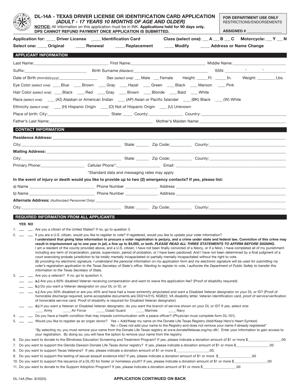
The DL-14A – Texas Driver License or Identification Card Application is a state-issued application form used to request a Texas driver license or identification card. It is part of the official record that supports your license or ID issuance.
The form gathers identifying details such as your full legal name, date of birth, Social Security number, residence address, and physical description. It also includes questions about your driving history, medical conditions that may affect driving, and certain legal matters.
When you complete and sign this document, you are confirming that the information you provided is true and accurate. The completed form becomes part of your driver record.
Who typically uses this form?
You use this form if you are applying for your first Texas driver license. This often includes teenagers who have completed required driver education and adults who are newly licensed.
You also use it if you are moving to Texas from another state and want to obtain a Texas license. In that case, the form helps transfer your driving status into the Texas system.
If you are applying for a Texas identification card instead of a driver license, you will still complete this form. It covers both types of credentials.
People who are renewing, replacing a lost or stolen card, correcting information, or updating a name after marriage or another legal change also complete this form as part of the process.
Why might you need this form?
You need this form anytime you are requesting a new driver license or identification card from the state. It is the formal application that starts or updates your record.
The form allows the licensing authority to verify your identity and confirm that you meet eligibility requirements. Without a properly completed application, your request cannot move forward.
It also serves as a legal statement. By signing, you confirm that you understand the responsibilities tied to holding a driver license or ID card.
In many cases, the form is completed electronically at the office. However, the information requested is the same as what appears on the standard application document.
Typical real-life scenarios
- You are a 16-year-old applying for your first provisional driver license. You go to a driver license office with your parent or guardian and complete the application as part of your testing appointment.
- You recently moved to Texas for work. You have a valid license from another state, but you now need a Texas license. You complete the application to transfer your driving privileges.
- Your wallet was stolen, and your driver license was inside. To get a replacement card, you complete the form again so a new license can be issued.
- You legally changed your name after marriage or through a court order. You fill out the form to update your license so it reflects your new legal name.
- You no longer drive but need a state-issued photo ID for banking, travel, or identification purposes. You complete the same application to obtain a Texas identification card instead of a driver license.
When would you use DL-14A – Texas Driver License or Identification Card Application?
You use this form whenever you are applying in person for a driver license or identification card in Texas. It applies to both first-time applications and updates to an existing record.
New drivers complete the form before taking required tests. This includes vision, knowledge, or driving exams, depending on the situation.
Adults who are new residents of Texas use the form to apply for a Texas-issued license after establishing residency. The form captures prior licensing information and helps determine eligibility.
You also use it when renewing a license in person. While some renewals may occur by other methods, in-person renewals typically involve reviewing and confirming the information contained in the application.
If you are replacing a damaged, lost, or stolen card, you complete the form again. The state needs a current application on file before issuing a replacement.
Individuals applying for a learner license, provisional license, commercial license, or identification card all complete versions of this same application. The type of credential you request affects the supporting documents and testing requirements, but the application form itself remains central to the process.
Legal characteristics of DL-14A – Texas Driver License or Identification Card Application
This form is an official government document. It becomes part of your driver record once submitted and accepted.
For the application to be effective, it must be complete, accurate, and signed. Missing information, incorrect Social Security numbers, mismatched names, or inconsistent answers can delay processing or result in rejection.
Identity verification is closely tied to the form. The information you enter must match the supporting documents you present, such as proof of identity, lawful presence, and residency. Differences in spelling, order of names, or dates of birth may require clarification before approval.
The form includes declarations about medical conditions that may affect driving. Answering these questions truthfully is important because inaccurate responses can create legal and safety issues later.
It also includes questions about prior license suspensions, revocations, or cancellations. If your driving privilege has been restricted, that status may affect the type of license you can receive.
In some situations, additional steps may apply, such as parental consent for minors or extra documentation for commercial licenses. While the application form is the same basic document, the overall process can vary depending on your age and license type.
The form does not, by itself, grant you a license. It is a required step in the application process, but approval depends on meeting eligibility standards, paying required fees, and completing any necessary testing.
Is it legally binding?
Yes, in the sense that your signature on the form is a legal certification that the information you provided is true and correct to the best of your knowledge.
When you sign the application, you are making a formal statement to a government agency. Providing false information can have consequences, including denial of the application or other legal issues.
The form also creates an official record. Once processed, the information becomes part of your driver history, which may be referenced for renewals, law enforcement inquiries, or administrative reviews.
However, the form itself is not a contract between you and another private party. It does not create a negotiated agreement. Instead, it is a sworn application that supports the state’s decision to issue or deny a driver license or identification card.
How to fill out DL-14A – Texas Driver License or Identification Card Application
Step 1 – Select the type of application
Begin by indicating the type of credential you are applying for. This may include an original driver license, renewal, replacement, learner’s license, or identification card. Choose the option that matches your situation so your request is processed correctly.
Step 2 – Provide your full legal name and personal details
Enter your full legal name exactly as it appears on your identity documents. Include your date of birth, place of birth, and gender as requested. Make sure spelling and dates match your official records.
Step 3 – Enter your Social Security number and contact information
Provide your Social Security number if required. Also list your current residence address in Texas and any mailing address if different. Double-check numbers and street names for accuracy.
Step 4 – Describe your physical characteristics
Fill in the requested physical details, such as height, weight, eye color, and hair color. These details appear on your driver license or ID card and help confirm your identity.
Step 5 – Answer eligibility and history questions
Carefully read each question about your driving history, prior licenses, suspensions, revocations, and cancellations. Answer each one truthfully. If the form asks about medical conditions that could affect driving, respond accurately based on your current situation.
Step 6 – Provide information about previous licenses
If you have held a driver license in another state or country, list the required details. This may include the state, license number, and status. Accurate information helps prevent delays in verifying your record.
Step 7 – Review organ donor and voter registration sections if included
Some versions of the application include options related to organ donation or voter registration. Read these sections carefully and make selections as prompted. These choices are typically optional but require a clear response.
Step 8 – Confirm citizenship or lawful presence information
Complete the section that asks about your citizenship or lawful presence status. Ensure your answers align with the documents you are presenting at the office. Consistency between your form and your documents is important for approval.
Step 9 – Read the certification statement
Before signing, read the certification statement near the end of the application. This section explains that you are affirming the truthfulness of your responses and understanding the responsibilities associated with a driver license or ID card.
Step 10 – Sign and date the application
Sign your name in the designated area. Use your usual legal signature. Enter the date of signing. For minors, a parent or guardian may also need to sign in the appropriate section.
Step 11 – Submit the completed form in person
Provide the completed application to the licensing representative during your appointment. The staff will review your answers, compare them with your supporting documents, and guide you through the remaining steps of the process, such as vision screening, testing, photograph capture, and fee payment.
Legal terms you might encounter in DL-14A – Texas Driver License or Identification Card Application
- Lawful Presence: This refers to your legal authorization to be in the United States. On this form, you confirm your citizenship status or provide information about your immigration category. The agency uses this information to determine whether you qualify for a driver license or identification card and for how long it may be valid.
- Principal Residence Address: This is the physical address where you actually live. It cannot be a post office box. The address you list becomes part of your driving record and determines where official mail about your license will be sent.
- Mailing Address: This is the address where you want to receive correspondence if it is different from your residence address. You must clearly indicate if it differs. Errors here can delay delivery of your card or official notices.
- Organ Donor Designation: This section allows you to indicate whether you want to be listed as an organ donor. Your selection may be printed on your license or ID card. It becomes part of the record connected to your identification.
- Voter Registration: The application may offer you the opportunity to register to vote or update your voter registration. If you select “yes,” certain information from this document may be shared with election officials. Your response affects your public voter record.
- Medical Certification: Commercial driver applicants may need to provide medical certification information. This confirms that you meet certain health standards to operate commercial vehicles. If required, the certification status affects your driving privileges.
- Class of License: This refers to the type of driving privilege you are requesting, such as a standard passenger vehicle license or a commercial class. The class determines what types of vehicles you are legally allowed to operate. Choosing the wrong class can lead to restrictions or testing requirements.
- Restriction: A restriction limits how or when you may drive. For example, you may be required to wear corrective lenses. Restrictions appear on your driving record and on your license card.
- Endorsement: An endorsement adds a specific driving privilege to your license, such as operating certain vehicle types. Endorsements usually require additional testing or qualifications. They appear as coded entries on your license.
- Certification Statement: This is the declaration you sign at the end of the application. By signing, you confirm that all information you provided is true and correct. False statements can result in denial, suspension, or legal consequences.
FAQs
Do I need to complete every section of DL-14A – Texas Driver License or Identification Card Application?
You must complete all sections that apply to your situation. If a section does not apply, follow the instructions on the document, which may require you to mark “not applicable” or leave it blank. Skipping required fields can cause delays or rejection when you submit this form.
What name should I enter if my documents show slightly different versions?
Enter your full legal name exactly as it appears on your primary identity document. If your middle name is spelled out on one document and abbreviated on another, use the version shown on your legal proof of identity. Inconsistent names can trigger additional review and may require extra documentation.
What happens if I make a mistake while filling out this document?
Do not use correction fluid or scribble over errors. If you are completing a paper copy, it is usually better to start over with a clean form. Clear and legible answers help ensure your information is entered correctly into the official record.
Do I have to provide my Social Security number on this form?
If you have been issued a Social Security number, you are generally required to provide it. The number is used to verify your identity and match existing records. If you do not have one, you must follow the instructions on this document regarding alternative documentation.
When does the information I provide become part of my official driving record?
The information becomes part of your record after the agency processes and accepts your application. Your signature certifies the information at the time you sign. Updates such as a name change or address change typically take effect once your application is approved.
Can someone else sign the DL-14A – Texas Driver License or Identification Card Application for me?
In most cases, you must sign your own application. If the applicant is a minor or has a legal guardian, additional signatures may be required in specific sections. The signature confirms that the statements made on this form are true and complete.
What documents should match the details I enter on this form?
Your proof of identity, lawful presence, and residency documents must match the personal details you list. This includes your full legal name, date of birth, and residence address. Any differences can result in a request for additional proof before your application is accepted.
Will my address and organ donor choice be visible to the public?
Your residence address becomes part of your driving record, but public access to that information is limited by law. Your organ donor choice may appear on your license or ID card itself. You should review these sections carefully before signing because they directly affect what is printed on your card.
Checklist: Before, During, and After DL-14A – Texas Driver License or Identification Card Application
Before
- Gather your primary identity document showing your full legal name and date of birth.
- Collect proof of lawful presence if applicable.
- Assemble documents that confirm your residence address.
- Locate your Social Security card or official record of your number.
- Review any prior driver license or identification card information.
- Confirm whether you need a specific class of license, endorsement, or restriction removed.
- Check whether you need to update your name, address, or other personal details.
- Bring any required medical certification if applying for a commercial license.
During
- Read each question carefully before writing your answer.
- Print clearly and use black or blue ink if completing by hand.
- Enter your full legal name exactly as shown on your identity documents.
- Double-check your Social Security number before moving to the next section.
- Provide both residence and mailing addresses if they differ.
- Answer all eligibility and history questions honestly.
- Review organ donor and voter registration selections carefully.
- Read the certification statement completely before signing.
After
- Review the entire form for missing fields or unclear answers.
- Confirm that your signature and date are included where required.
- Make a copy or take a clear photo of the completed form for your records.
- Submit the form in person if required.
- Present all supporting documents when requested.
- Pay any applicable fees and obtain a receipt.
- Ask for confirmation that your application has been accepted for processing.
- Keep any temporary license or identification document issued to you.
Common mistakes to avoid with DL-14A – Texas Driver License or Identification Card Application
- Mistake: Writing a nickname instead of your full legal name because it feels familiar, which can cause identity verification problems and delays; do not forget to match your name exactly to your official documents.
- Mistake: Entering an outdated address because you recently moved and forgot to update your records, which may result in your card being mailed to the wrong place; do not forget to use your current principal residence address.
- Mistake: Transposing digits in your Social Security number due to rushing, which can trigger record mismatches or rejection; do not forget to double-check each number carefully.
- Mistake: Skipping eligibility or history questions because they seem minor, which can be treated as providing incomplete information; do not forget that every required question must be answered truthfully.
- Mistake: Failing to review the organ donor or voter registration sections, which can lead to unintended selections being recorded; do not forget to confirm your choices before signing.
- Mistake: Forgetting to sign and date the certification statement, often because you focus on earlier sections, which makes the application invalid; do not forget that your signature is required for processing.
- Mistake: Bringing incomplete supporting documents due to misunderstanding requirements, which can force you to reschedule your visit; do not forget to verify that each document matches the information on the form.
- Mistake: Selecting the wrong class of license because you are unsure of vehicle categories, which may require additional testing or corrections later; do not forget to confirm the correct license class before submitting.
What to do after filling out DL-14A – Texas Driver License or Identification Card Application
Once you finish the form, pause before you submit it. A careful review now can prevent delays later. Check every section against your supporting documents. Make sure names, numbers, and dates match exactly.
- Step 1: Review each page line by line and confirm all required fields are complete.
- Step 2: Verify that your signature and the date are present wherever required.
- Step 3: Make a clear copy or take a photo of the completed application for your personal records.
- Step 4: Organize your supporting documents in the same order as the information requested on the form.
- Step 5: Visit the appropriate office location to submit the application in person if required.
- Step 6: Present your documents when asked and respond clearly to any verification questions.
- Step 7: Pay any required fees and keep the payment receipt in a safe place.
- Step 8: Ask whether you will receive a temporary license or identification document and how long it will be valid.
- Step 9: Confirm the expected processing time and how your permanent card will be delivered.
- Step 10: Once you receive your card, review it immediately to ensure all printed information is correct.
- Step 11: If you notice an error on the issued card, contact the issuing office promptly to request a correction.
After submission, store your copy of the application and receipt with your important records. If you updated your name or address, consider updating related records such as vehicle registration, insurance policies, and employer files. Keeping all records consistent helps prevent confusion later.
Disclaimer: This guide is provided for informational purposes only and is not intended as legal advice. You should consult a legal professional.