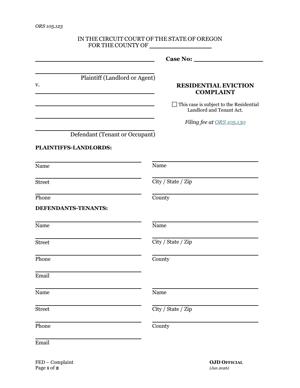
Residential Eviction Complaint
Fill out nowJurisdiction: Country: United States | Province or State: Oregon
A Residential Eviction Complaint is the document that starts a formal eviction case in court. It is filed by a landlord to ask the court to remove a tenant from a rental property. This form begins the legal process and tells the court why the landlord believes the tenancy should end.
If you are preparing to file a Residential Eviction Complaint, you are likely a landlord or property owner. You may also be a property manager acting on the owner’s behalf. This document is submitted to the Circuit Court of the State of Oregon.
For tenants, this form is important because it explains the claims being made against them. It sets out the reasons for eviction and the type of relief the landlord is requesting. Understanding what it says helps you prepare your response.
The Residential Eviction Complaint matters because eviction is a court process. A landlord cannot remove a tenant simply by asking them to leave. The court must review the filing, and both sides have the opportunity to be heard.
What is a Residential Eviction Complaint?
Clear definition
A Residential Eviction Complaint is a formal court document filed by a landlord to begin an eviction lawsuit. It identifies the parties, the rental property, and the legal grounds for eviction. It also asks the court for a judgment restoring possession of the property to the landlord.
This form is not the same as a notice to terminate tenancy. A notice is usually delivered before court involvement. The complaint is filed after the notice period has passed or when a specific legal basis allows immediate filing.
The document becomes part of the official court record. Once filed, it triggers deadlines and court procedures that both parties must follow.
Who typically uses this form?
Landlords most often use this form. This includes individual property owners who rent out a house, apartment, or room. It can also include companies that own residential rental properties.
Property managers may prepare and file the complaint on behalf of the owner. In that case, the complaint typically identifies the property owner as the plaintiff and may note the manager’s role.
In some situations, a representative such as an attorney completes and submits the document. However, many landlords fill it out themselves, especially in straightforward cases involving unpaid rent.
Tenants do not file a Residential Eviction Complaint. They receive it after it has been filed and served.
Why might you need this form?
You may need this form if a tenant has not paid rent and the required notice period has expired. Nonpayment is one of the most common reasons for filing.
You may also need it if a tenant has violated a material term of the rental agreement. This might include keeping unauthorized occupants, damaging the property, or engaging in prohibited conduct.
Another reason can be staying in the unit after a fixed-term lease ends, if no new agreement is in place. In that situation, the landlord may seek possession through the court.
This form is also used when a tenant remains in the property after receiving a termination notice based on specific legal grounds. The complaint explains that the notice was given and that the tenant did not move out as required.
Typical real-life scenarios
- A tenant stops paying rent for two consecutive months. The landlord delivers a written notice giving the tenant time to pay or move out. The tenant does neither. The landlord then files a Residential Eviction Complaint to recover possession of the unit.
- A tenant repeatedly violates the lease by keeping a pet in a building where pets are not allowed. After giving written notice and an opportunity to correct the issue, the landlord still sees no change. The complaint is filed to end the tenancy.
- A fixed-term lease ends, and the tenant remains in the apartment without signing a new agreement. The landlord decides not to continue renting to the tenant. The landlord files the complaint to formally regain possession.
- A tenant allegedly causes serious damage to the property. The landlord claims the behavior is grounds for termination under the rental agreement. After providing notice as required, the landlord files the complaint when the tenant stays in the unit.
When would you use a Residential Eviction Complaint?
You use a Residential Eviction Complaint after the required preliminary steps have occurred. In many situations, this means a written notice has already been delivered to the tenant. The complaint is filed when the tenant has not complied with that notice.
The timing depends on the reason for eviction. For unpaid rent, landlords often wait until the payment deadline in the notice has passed. For lease violations, the landlord may wait until a correction period ends or until the tenancy termination date stated in the notice.
This form is used when you are seeking possession of the rental property through the court system. It is not used to collect rent alone without seeking eviction. While claims for unpaid amounts may be included, the primary focus is on regaining possession.
You would not use this form to handle disputes unrelated to possession. For example, disagreements about security deposits or repair costs are typically handled in separate proceedings.
Landlords, property owners, and authorized agents are the typical parties who initiate this filing. Tenants become defendants in the case once the complaint is served.
Legal Characteristics of Residential Eviction Complaint
A Residential Eviction Complaint is a court pleading. That means it must meet certain formal requirements. It generally includes the names of the parties, the address of the rental property, the legal basis for eviction, and a request for relief.
To be effective, the information in the complaint must be accurate and consistent with the prior notice given to the tenant. If the complaint states a reason that does not match the notice, it can create problems in court.
Proper filing with the correct court is also essential. In Oregon, eviction cases are handled in the Circuit Court. The document must be submitted according to court procedures, including payment of any required filing fee or submission of a fee waiver request.
Service of the complaint on the tenant is a key step. The tenant must receive formal notice of the lawsuit. If service is not completed correctly, the court may delay the case or dismiss it.
Common issues that lead to rejection or delay include incomplete information, incorrect party names, wrong property address, or failure to attach required supporting details. Small errors can affect how smoothly the case moves forward.
Procedures and timelines can vary between states. While the overall concept of an eviction complaint is similar across the United States, notice periods, hearing schedules, and allowable grounds for eviction differ by jurisdiction. Always make sure the form matches the court where the property is located.
A Residential Eviction Complaint does not physically remove a tenant. Only a court judgment, followed by enforcement through authorized officers, can result in removal. Filing the complaint is the beginning of the process, not the end.
Is it legally binding?
A Residential Eviction Complaint becomes legally significant once it is properly filed with the court. It initiates a formal legal case. The court then has authority to review the claims and issue orders.
The document itself does not automatically end the tenancy. It sets out allegations that the landlord must prove if the tenant contests the case. The judge evaluates the information and any evidence presented.
If the court enters a judgment in favor of the landlord, that judgment is legally binding. It may grant possession of the property and, in some cases, a money award. If the court dismisses the case, the eviction does not proceed under that filing.
The legal effect therefore, depends on proper completion, filing, and service, followed by a court decision.
How to fill out a Residential Eviction Complaint
Step 1 – Identify the court
At the top of the form, enter the name of the Circuit Court for the county where the rental property is located. This ensures the case is filed in the correct jurisdiction. Include the county name exactly as it appears in court records.
Step 2 – Name the parties
List the landlord or property owner as the plaintiff. Use the full legal name, whether it is an individual or a business entity. Then list each tenant as a defendant. Include all adult occupants named on the rental agreement, if applicable.
Step 3 – Provide the property address
Enter the complete address of the rental property. Include unit or apartment numbers if relevant. The address must match the rental agreement and any prior notices provided to the tenant.
Step 4 – State the grounds for eviction
Indicate the reason for the eviction. This may include nonpayment of rent, lease violations, or expiration of a fixed-term tenancy. Briefly describe the facts that support the claim, such as the amount of unpaid rent or the specific lease term that was violated.
Step 5 – Confirm prior notice
Include information about the written notice given to the tenant, if required. State the date the notice was delivered and the type of notice provided. The details should align with the reason listed for eviction.
Step 6 – Request relief from the court
In the section asking for relief, specify that you are seeking possession of the premises. If the form allows, you may also state any unpaid rent or other amounts claimed. Ensure the figures are clear and accurate.
Step 7 – Review for accuracy
Carefully read through the entire document before signing. Check names, dates, addresses, and amounts. Confirm that the information matches your records and the rental agreement.
Step 8 – Sign and date the form
Sign your name where indicated and enter the date of signing. By signing, you confirm that the information provided is true to the best of your knowledge. If you are signing on behalf of a business, include your title or role.
Step 9 – File the complaint with the court
Submit the completed Residential Eviction Complaint to the appropriate Circuit Court clerk. Pay the required filing fee or provide the necessary paperwork if requesting a fee waiver. After filing, follow the court’s procedures for service so the tenant receives formal notice of the case.
Legal terms you might encounter in a Residential Eviction Complaint
- Plaintiff: The person or entity filing the complaint. In most eviction cases, this is the landlord or property owner. This name must match the lease and any prior eviction notice exactly, because the court will compare the names for consistency.
- Defendant: The tenant or occupant you are asking the court to remove. Every adult tenant listed on the rental agreement should usually be named. If you leave someone out, the court’s judgment may not apply to that person.
- Premises: The rental property at issue. This section asks for the full street address, including the unit number if there is one. The address must be precise so the court and sheriff know exactly which property is involved.
- Grounds for eviction: The legal reason you are asking for possession of the property. This might include nonpayment of rent, violation of lease terms, or holding over after the lease ends. You must clearly state the specific reason because the court will only consider the grounds you list.
- Notice to terminate: The written notice you gave the tenant before filing the complaint. The form typically requires you to confirm the date the notice was delivered and how it was served. The court uses this to determine whether you followed the required pre-filing steps.
- Service of process: The formal delivery of court papers to the defendant. After filing, the complaint must be served according to court rules. Proper service is critical because the court cannot move forward without proof that the tenant was notified.
- Summons: A court-issued document that tells the defendant they are being sued and explains when they must respond. The summons is usually filed and served together with the complaint. It sets the timeline for the first court appearance.
- Judgment for possession: The court’s order giving the landlord the right to regain control of the property. If the judge rules in your favor, this judgment allows you to move to the next enforcement step. It does not automatically remove the tenant; further action may be required.
- Damages: Money you claim the tenant owes, such as unpaid rent, late fees, or other charges allowed under the rental agreement. If you request damages, you should state the amount clearly and ensure it matches your records.
- Attorney fees and costs: Certain forms allow you to request reimbursement for filing fees or legal expenses. You must specifically ask for these in the complaint if you want the court to consider awarding them.
FAQs
What exact date should I list as the reason for eviction?
You should enter the specific date the problem occurred or the date the rent became overdue, depending on your grounds. If you are claiming nonpayment, use the first date the rent was unpaid under the lease. Make sure this date matches your notice and your payment records so the court sees a consistent timeline.
Do I need to attach a copy of the lease to this form?
If the form has a section asking you to reference the rental agreement, you should review whether the court requires a copy at filing or at the hearing. Even if not required at the time of filing, bring a copy to court. The judge may ask you to confirm the lease terms you rely on.
How do I list multiple tenants on the Residential Eviction Complaint?
Write the full legal name of each adult tenant exactly as it appears on the lease. If there are additional occupants not on the lease, check whether the form provides space to include “all other occupants.” Do not use nicknames or incomplete names because that can limit who is covered by the court’s order.
What happens if I make a small typo in a name or address?
Small clerical errors can cause delays if they create confusion about who or what property is involved. If you notice a mistake before filing, correct it neatly and clearly. If you discover it after filing, you may need to submit a corrected document so the court record accurately reflects the parties and premises.
How do I prove that I gave the required notice before filing?
You will usually confirm on this document the date and method of delivery. Keep a copy of the signed notice and any proof of delivery, such as a certificate or written acknowledgment. The court may ask you to testify about how and when you served the notice.
Can I ask for unpaid rent and possession at the same time?
Yes, if the form provides space to request both possession of the property and a money award. You must clearly state the amount claimed and ensure it matches your accounting records. If you leave the damages section blank, the court may only address possession.
What if the tenant pays after I file the complaint?
Payment after filing does not automatically dismiss the case. You must decide whether to continue or resolve the matter. If you reach an agreement, you may need to notify the court or appear at the scheduled hearing to explain the resolution.
Does filing this form immediately remove the tenant from the property?
No. Filing starts the court process. The tenant has the right to appear and respond. Only after a court decision and any required enforcement steps can the tenant be legally removed.
Checklist: Before, During, and After Residential Eviction Complaint
Before
- Review the lease agreement for exact names and terms.
- Confirm the amount of unpaid rent or other violations.
- Prepare and properly deliver the required written notice.
- Record the date and method of notice delivery.
- Gather copies of payment ledgers and communication records.
- Verify the full and correct property address, including unit number.
- Check that the notice period has fully expired before filing.
During
- Write each party’s full legal name clearly and accurately.
- Enter the complete property address without abbreviations that cause confusion.
- State the specific grounds for eviction in plain, factual language.
- List the exact amount of money claimed, if any.
- Confirm the date and type of notice you provided.
- Review every blank line to ensure nothing required is missing.
- Sign and date the complaint where indicated.
- Prepare the required number of copies for filing.
After
- File the complaint with the appropriate court clerk.
- Pay the required filing fee or submit a fee waiver request if eligible.
- Obtain the issued summons from the court.
- Arrange for proper service of the complaint and summons.
- Keep proof of service for your records.
- Mark the hearing date on your calendar.
- Organize your evidence in a folder for court.
- Monitor any response filed by the tenant.
Common mistakes to avoid with Residential Eviction Complaint
- Mistake: Naming only one tenant when multiple adults signed the lease, which often happens because you focus on the primary contact; this can limit enforcement against others, so do not forget to list every responsible party.
- Mistake: Using an incomplete or outdated property address, which happens when you copy from memory; this can create confusion in enforcement, so do not forget the full legal address and unit number.
- Mistake: Stating the wrong amount of rent owed because your ledger is not updated; this can damage credibility in court, so do not forget to reconcile payments before filing.
- Mistake: Filing before the notice period fully expires, often due to miscounting days; this can result in dismissal, so do not forget to calculate deadlines carefully.
- Mistake: Leaving sections blank that require confirmation of notice, which happens when you rush; this can delay acceptance by the clerk, so do not forget to complete every required field.
- Mistake: Failing to sign and date the complaint, usually an oversight; the court may reject the filing, so do not forget your signature where indicated.
- Mistake: Assuming filing alone removes the tenant, which happens due to misunderstanding the process; this leads to frustration, so do not forget that a court judgment and enforcement steps are required.
What to do after filling out the Residential Eviction Complaint
Once you complete the form, slow down and review it one more time. Check names, dates, amounts, and the property address. Make sure your statements match your lease and your written notice.
- Step 1: Make at least two copies of the signed complaint, one for your records and one for service on each defendant.
- Step 2: File the original with the court clerk and pay the filing fee or submit any required fee request forms.
- Step 3: Obtain the issued summons from the clerk, which must be served together with the complaint.
- Step 4: Arrange for proper service according to court rules, using an authorized person to deliver the documents.
- Step 5: Secure written proof of service and file it with the court if required.
- Step 6: Calendar the first appearance or hearing date listed on the summons.
- Step 7: Prepare your evidence, including the lease, notice, payment ledger, photos if relevant, and communication records.
- Step 8: Bring multiple copies of all documents to the hearing, organized and easy to reference.
- Step 9: Attend the hearing on time and be ready to explain the timeline clearly and calmly.
- Step 10: After the court issues a decision, follow the instructions in the judgment for next steps, including any enforcement procedures if possession is granted.
Keep all documents together in a secure folder. Update your internal records to reflect the filing date and any court deadlines. If the tenant responds or files paperwork, read it carefully and note any response deadlines. Staying organized and proactive will help you move through the process with fewer delays.
Disclaimer: This guide is provided for informational purposes only and is not intended as legal advice. You should consult a legal professional.