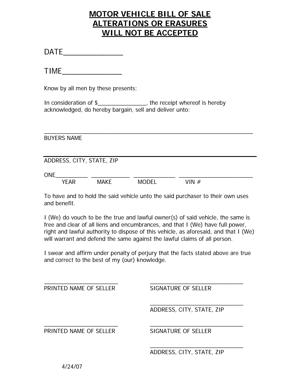
Motor Vehicle Bill of Sale Alterations or Erasures Will Not Be Accepted
Fill out nowJurisdiction: Country: United States | Province or State: Colorado
The Motor Vehicle Bill of Sale Alterations or Erasures Will Not Be Accepted is a strict vehicle transfer document that must be completed without any corrections, cross-outs, or erased information. When you see this warning printed on a form, it means the document can be rejected if it contains visible changes.
You are likely dealing with this form when buying or selling a vehicle and preparing paperwork for title transfer. It often accompanies or serves as the bill of sale that confirms the transaction details between buyer and seller.
This matters because a vehicle title transfer depends on clean, accurate paperwork. If the document is rejected due to alterations, the transfer process can be delayed. That delay may affect registration, taxes, or proof of ownership.
Understanding how this form works before you start filling it out helps you avoid simple mistakes. When corrections are not allowed, careful completion becomes essential.
What is Motor Vehicle Bill of Sale Alterations or Erasures Will Not Be Accepted?
Clear definition
The Motor Vehicle Bill of Sale Alterations or Erasures Will Not Be Accepted is a vehicle sale document that records the transfer of ownership and states clearly that any changes to the written information will invalidate the form. It functions as a formal record of the agreement between buyer and seller.
This document typically includes identifying details about the vehicle, the parties involved, and the sale terms. The key feature is the no-alterations rule. If you cross out a mistake, use correction fluid, or erase text, the submission may be refused.
The purpose of this rule is to protect the integrity of the transaction. Clean documents reduce the risk of fraud, disputes, or conflicting information about the sale.
Who typically uses this form?
You may use this form if you are selling a private vehicle to another individual. Private sellers often rely on a bill of sale to confirm the transfer price and date of sale.
Buyers also use the document when applying for title and registration. The bill of sale supports the information listed on the title application.
In some situations, dealerships or businesses may use similar versions of this document. However, the no-alterations language is most relevant in private-party sales where paperwork is completed by hand.
Lenders or family members involved in gifting or transferring a vehicle may also rely on this form to document the change in ownership.
Why might you need this form?
You may need this form to prove that a sale occurred on a specific date and for a specific amount. This can affect taxes, registration fees, or liability for the vehicle.
It also provides written evidence of the agreed purchase price. If questions arise later, the document shows what both parties confirmed at the time of signing.
The no-alterations rule increases confidence in the accuracy of the information. A clean document is less likely to raise concerns during review.
In many vehicle transactions, the bill of sale is part of a larger filing process. If this document is rejected, the rest of your submission may be delayed.
Typical real-life scenarios
- You sell your used car to a neighbor. You complete the bill of sale by hand at your kitchen table. Because the form states that alterations or erasures will not be accepted, you must write carefully and avoid mistakes.
- You purchase a vehicle from a private seller you met through an online listing. When you go to register the car, you submit the bill of sale along with the title. If the price line has been crossed out and rewritten, the clerk may not accept it.
- You transfer a vehicle to a family member as part of a divorce settlement or estate matter. Even though money may not change hands, the document must clearly reflect the transfer without visible corrections.
- You buy a vehicle that has a complex identification number. If you accidentally miswrite one digit and try to correct it, the entire document may need to be redone. The no-alterations rule means starting fresh instead of fixing the mistake on the same page.
When would you use Motor Vehicle Bill of Sale Alterations or Erasures Will Not Be Accepted?
You would use the Motor Vehicle Bill of Sale Alterations or Erasures Will Not Be Accepted during the sale or transfer of a motor vehicle when a clean, unaltered record of the transaction is required. This usually happens at the time of signing, when both parties are present and finalizing the agreement.
You may also use it when preparing paperwork for submission to a motor vehicle office. The form becomes part of your filing package to complete the ownership transfer.
Buyers often rely on the document immediately after purchase to support their title application. Sellers may keep a copy to show the date they transferred possession and responsibility.
In situations involving older vehicles, rebuilt vehicles, or vehicles with high value, accuracy is especially important. Any unclear or altered information can slow review and create additional questions.
You might also encounter this form when a prior document was rejected. In that case, a new, clean version must be completed without any visible corrections.
Legal characteristics of Motor Vehicle Bill of Sale Alterations or Erasures Will Not Be Accepted
This document generally becomes effective when both buyer and seller sign it. Signatures indicate agreement on the vehicle details, sale price, and date of transfer.
For the form to be considered valid in most situations, it must contain accurate identifying information. This commonly includes the vehicle identification number, make, model, year, and the full names of both parties. Missing or inconsistent information can create problems.
The no-alterations language is a key characteristic. If the document shows erasures, correction fluid, overwritten numbers, or crossed-out lines, it may be rejected during review. The reasoning is that visible edits create uncertainty about which information is correct.
Problems often arise when handwritten numbers are unclear. For example, a “5” may look like an “8.” If someone attempts to darken or reshape a number after writing it, the form may appear altered.
Jurisdictional practices can vary. Some states may allow minor corrections if both parties initial the change, while others require a completely new document. When a form clearly states that alterations or erasures will not be accepted, the safer assumption is that any visible change may invalidate it.
It is also important to understand what this document does not do. It does not replace a certificate of title. It does not automatically transfer registration. It does not guarantee that the vehicle is free of liens unless that information is clearly stated and verified separately.
The document records the transaction. The official transfer of ownership typically depends on additional filings and acceptance by the appropriate office.
Is it legally binding?
In general, a properly completed and signed bill of sale can be legally binding as a record of the transaction between buyer and seller. It reflects mutual agreement on key terms such as price and date.
The Motor Vehicle Bill of Sale Alterations or Erasures Will Not Be Accepted can serve as binding evidence of the agreement if it is filled out accurately and signed voluntarily by both parties. Clear, unaltered information supports its credibility.
If the document contains visible changes despite the warning, its acceptance may be questioned. A rejected submission does not automatically void the underlying agreement, but it can weaken the document’s reliability as proof of the exact terms.
Enforceability often depends on completeness and clarity. Missing signatures, blank fields, or inconsistent vehicle details can limit its effectiveness as evidence of the transaction.
How to fill out Motor Vehicle Bill of Sale Alterations or Erasures Will Not Be Accepted
Step 1 – Review the entire form before writing
Read the full document from top to bottom before entering any information. Identify every field you must complete. Confirm that you have accurate vehicle details and the correct spelling of names. This preparation reduces the risk of mistakes that cannot be corrected.
Step 2 – Enter the vehicle information carefully
Write the vehicle identification number exactly as it appears on the title or vehicle. Double-check each digit before moving to the next field. Then enter the make, model, year, and any other requested details clearly and legibly.
Step 3 – Provide buyer and seller information
Fill in the full legal names and addresses of both parties. Write clearly and avoid abbreviations unless the form specifically allows them. Confirm that each name matches the identification or title documents to prevent inconsistencies.
Step 4 – State the purchase price and date of sale
Enter the agreed sale amount in the space provided. Write numbers neatly and confirm they are correct before lifting your pen. Then record the exact date of the transaction. Accuracy here is important for tax and registration purposes.
Step 5 – Review all entries for errors
Before anyone signs, review every line of the form. Check for spelling mistakes, missing numbers, or unclear handwriting. If you find any errors, complete a new blank form instead of attempting to correct the existing one.
Step 6 – Sign and date the document
Both buyer and seller sign in the designated areas. Use consistent signatures that match other legal documents. Add the date of signing if required, and confirm that all required signature lines are complete.
Step 7 – Make clean copies after signing
Once the document is fully completed and signed without alterations, create copies for both parties. Ensure the copies clearly show all information and signatures. Keep the original in a safe place if it is needed for submission.
Legal terms you might encounter in Motor Vehicle Bill of Sale Alterations or Erasures Will Not Be Accepted
- Alteration: An alteration is any change made to the document after information has been written in. This includes crossing out numbers, overwriting letters, or adding words in the margins. On this form, any alteration can cause rejection because it creates doubt about the accuracy of the sale details.
- Erasure: An erasure happens when information is removed, often by using correction fluid, scratching out text, or digitally modifying a printed entry. Even if you rewrite the correct information, visible erasures may make the document invalid. The rule exists to prevent disputes over what was originally agreed.
- Consideration: Consideration refers to the value exchanged for the vehicle, usually the purchase price. In this document, it appears as the sale amount you enter. The number must be clear and accurate because tax authorities and registration offices rely on it.
- Vehicle Identification Number (VIN): The VIN is the unique 17-character code assigned to the vehicle. You must copy it exactly as it appears on the vehicle and title. A single incorrect digit can delay registration or void the document’s acceptance.
- Odometer Disclosure: This is the statement of the vehicle’s mileage at the time of sale. It helps prevent fraud and protects both buyer and seller. If you correct or alter the mileage entry, the document may be rejected.
- Execution Date: The execution date is the date both parties sign the document. It confirms when the agreement became effective. If this date is unclear or altered, it can create confusion about ownership transfer.
- Signature Block: The signature block is the section where the buyer and seller sign and print their names. It confirms consent to the terms listed. Any changes to a printed name or signature line can raise concerns about authenticity.
- As-Is Sale: An as-is sale means the buyer accepts the vehicle in its current condition without warranties unless otherwise stated. If this language appears on the form, it defines responsibility for repairs after the sale. It does not replace the need for accurate entries elsewhere on the document.
- Notarization: Notarization is the act of having a notary verify the identity of the signers. Some transactions require this step for added protection. If notarization is required, the notary section must be completed without corrections.
FAQs
What happens if I make a small mistake while filling out the “Motor Vehicle Bill of Sale Alterations or Erasures Will Not Be Accepted”?
If you make even a small error, such as writing the wrong digit in the VIN or purchase price, you should not cross it out or use correction fluid. Instead, start over with a new, clean copy. This document clearly states that alterations or erasures will not be accepted, so any visible correction can cause rejection by the receiving office.
Can I fix a typo by initialing next to the correction?
Initialing next to a crossed-out word may work on other contracts, but not on this document if it prohibits alterations. Even if both parties agree and initial the change, the form may still be refused. The safer approach is to complete a new version with no visible corrections.
What if the VIN or odometer reading does not fit in the space provided?
Do not squeeze numbers into the margin or write over printed lines. If the space is too small, print clearly within the designated area or obtain another copy with enough room. Overlapping text or crowding characters can look like an alteration and lead to processing delays.
Do both the buyer and seller need to sign on the same day?
Check the execution date you enter. Ideally, both parties sign on the same date listed on the form. If signatures occur on different days, make sure the date written matches when each person signs, and confirm that no dates are crossed out or rewritten.
Is notarization required for this document?
Look at the signature section to see if there is a notary block. If there is a space for a notary’s seal and signature, you must leave that area blank until you are in front of the notary. Do not pre-sign or alter that section, as changes there can invalidate the certification.
What if the buyer’s or seller’s name is misspelled?
Names must match the identification and title exactly. If you notice a spelling error after writing it down, do not attempt to correct it on the same page. Prepare a new copy so the name appears clean and consistent with official records.
Can I attach a separate sheet if I run out of space?
You can attach additional information if needed, but reference it clearly and ensure the main form remains clean and unchanged. Do not write “see attached” and then cross out earlier wording. Make sure any attachment is signed and dated consistently with the main document.
What does the receiving office check before accepting this form?
The office typically checks for complete vehicle details, clear purchase price, matching names, readable signatures, and no visible corrections. They also compare the VIN and odometer reading to title records. If they see erasures, overwritten numbers, or correction marks, they may reject the document and require a new one.
Checklist: Before, During, and After Motor Vehicle Bill of Sale Alterations or Erasures Will Not Be Accepted
Before
- Review the vehicle title to confirm the exact VIN and owner name.
- Verify the current odometer reading directly from the dashboard.
- Confirm the agreed purchase price in writing with the other party.
- Print a clean, high-quality copy of the form.
- Use a pen with dark, permanent ink.
- Ensure both parties have valid identification available.
- Check whether notarization will be required.
During
- Write slowly and clearly in block letters.
- Enter the VIN carefully, double-checking each character.
- Record the purchase price without abbreviations or symbols not requested.
- Fill in the full legal names of the buyer and seller.
- Confirm the date before writing it down.
- Review every line before signing.
- Sign only after all information is complete and correct.
After
- Make clear photocopies or digital scans for both parties.
- Provide the buyer with the original if required for registration.
- Keep your copy in a safe place with related sale documents.
- Confirm whether the buyer has submitted the document for registration.
- Store proof of payment with your copy of the form.
- Update your personal records to show the vehicle was sold.
- Remove insurance coverage if you are the seller.
- Follow up if you receive notices related to the vehicle after the sale.
Common mistakes to avoid with Motor Vehicle Bill of Sale Alterations or Erasures Will Not Be Accepted
- Mistake: Crossing out a wrong number and writing the correct one above it, which happens when you rush, can cause rejection because the form prohibits alterations, so do not forget to start over with a fresh copy.
- Mistake: Using correction fluid to fix a typo, often done to save time, can make the document look tampered with and invalid, so do not forget that any covered text may void acceptance.
- Mistake: Guessing the VIN instead of verifying it on the vehicle, which happens when the title is not nearby, can lead to registration refusal, so do not forget to confirm all 17 characters directly.
- Mistake: Leaving blank spaces in required fields, often due to uncertainty, can delay processing or create disputes, so do not forget to complete every mandatory line.
- Mistake: Signing before reviewing all entries, which happens when parties feel rushed, can lock in incorrect details, so do not forget to double-check everything before adding your signature.
- Mistake: Writing nicknames instead of full legal names, often out of habit, can cause mismatches with official records, so do not forget to use names exactly as shown on identification.
- Mistake: Forgetting to include the full purchase price, sometimes by omitting cents or writing unclear numbers, can create tax or reporting issues, so do not forget to write the amount clearly and completely.
- Mistake: Adding side notes in the margins to clarify terms, which seems helpful at the time, can be treated as unauthorized changes, so do not forget to keep all information within the designated fields.
What to do after filling out the Motor Vehicle Bill of Sale Alterations or Erasures Will Not Be Accepted
Once you complete the document without errors or corrections, your focus shifts to protecting yourself and finalizing the transfer properly. A clean form is only part of the process. You must also handle copies, submissions, and record updates.
- Step 1: Review the entire document one final time with the other party present. Confirm the VIN, purchase price, date, and names match the title and identification exactly.
- Step 2: Ensure both parties sign and date in the correct spaces. If notarization is required, wait to sign until you are in front of the notary.
- Step 3: Make at least two clear copies immediately after signing. Each party should keep one signed copy.
- Step 4: Attach any required supporting documents, such as odometer disclosures or title certificates, without altering the main form.
- Step 5: Deliver the original to the party responsible for registration, usually the buyer, unless local practice requires otherwise.
- Step 6: Confirm how and when the document must be submitted to the appropriate motor vehicle office. This may be in person, by mail, or electronically if permitted.
- Step 7: Keep proof of delivery or submission. This can include a receipt, tracking number, or confirmation email.
- Step 8: Update your personal records. As a seller, note the sale date and buyer’s name. As a buyer, record the date you took possession.
- Step 9: Adjust related records, such as insurance policies, financing agreements, or maintenance logs, to reflect the change in ownership.
- Step 10: Monitor for follow-up notices. If you receive traffic or tax notices after the sale, use your signed copy to show the transfer date.
By handling these steps carefully, you reduce the risk of disputes and avoid delays in ownership transfer. A clean, accurate document combined with proper follow-through protects both buyer and seller.
Disclaimer: This guide is provided for informational purposes only and is not intended as legal advice. You should consult a legal professional.