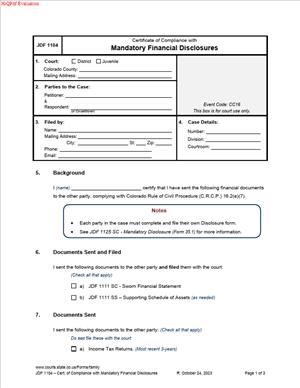
JDF 1104 – Certificate of Compliance with Mandatory Financial Disclosures
Fill out nowJurisdiction: Country: United States | Province or State: Colorado
The JDF 1104 – Certificate of Compliance with Mandatory Financial Disclosures is a court form used in Colorado family law cases. You file it to confirm that you have provided the required financial documents to the other party. It does not list your finances in detail. Instead, it confirms that you exchanged the required information.
If you are representing yourself in a divorce, legal separation, or certain allocation of parental responsibilities cases, this form is part of the standard process. Colorado courts require both sides to share financial information early in the case. This document tells the court that you completed that step.
When you submit the JDF 1104 – Certificate of Compliance with Mandatory Financial Disclosures, you are making a formal statement. You are telling the court that you provided the required documents within the time allowed. The court relies on this filing to move your case forward.
Understanding how this form works helps you avoid delays. If financial disclosures are incomplete or not properly certified, hearings may be postponed. Judges often review whether both parties complied before addressing property division, support, or other financial issues.
This guide explains what the form does, when you use it, and how to complete it clearly and accurately.
What is JDF 1104 – Certificate of Compliance with Mandatory Financial Disclosures?
Clear definition
JDF 1104 – Certificate of Compliance with Mandatory Financial Disclosures is a written statement filed with the Colorado court. It confirms that you have exchanged specific financial documents required under Colorado family law rules.
The form does not attach the financial documents themselves. Instead, it certifies that you provided them directly to the other party. The court generally does not want sensitive financial paperwork filed in the public record unless required.
By signing the form, you are stating that you have completed your disclosure obligations. This includes providing documents such as income information, bank statements, tax returns, and other financial records listed in the rules governing domestic relations cases.
Who typically uses this form?
This form is most often used by spouses in divorce or legal separation cases. It may also be used by parents in cases involving child support or allocation of parental responsibilities when financial issues are involved.
Both the petitioner and the respondent usually complete and file their own Certificate of Compliance. Each party must independently confirm that they provided their required disclosures.
Self-represented individuals commonly use this form. It is part of the standard packet of documents in Colorado family law cases. Attorneys also prepare and file it for their clients when applicable.
Why might you need this form?
You need this form because Colorado courts require mandatory financial disclosures in many domestic relations cases. These disclosures are not optional. They are part of the process designed to ensure fairness.
Before the court can decide issues like property division, spousal maintenance, or child support, both sides must understand each other’s financial situation. The certificate confirms that this exchange happened.
Without this filing, the court may consider your disclosures incomplete. That can delay hearings or prevent the court from entering final orders. The certificate acts as proof that you met a key procedural requirement.
Typical real-life scenarios
- You file for divorce and request child support. After serving your spouse, you gather your pay stubs, tax returns, and bank statements. You provide copies to your spouse within the required time. You then complete and file the certificate to show the court you complied.
- Your spouse files for legal separation. You respond and prepare your financial documents. Once you deliver those documents to your spouse, you file your own certificate to confirm compliance.
- You and the other parent are disputing child support. The court schedules a temporary orders hearing. Before the hearing, both sides exchanged financial records. Each of you files the certificate so the judge knows disclosures are complete.
- You are representing yourself and preparing for mediation. You provide all required financial documents to the other party. Filing the certificate helps demonstrate that you followed the court’s financial disclosure rules.
When would you use JDF 1104 – Certificate of Compliance with Mandatory Financial Disclosures?
You typically use this form after you have completed your mandatory financial disclosures. The timing depends on the stage of your case, but it usually occurs early in the process.
In many Colorado family law cases, the rules set a deadline for exchanging financial information. This deadline may be tied to the date the petition was served or the date the response was filed. Once you meet that deadline and provide the documents, you complete the certificate.
Both parties use this form separately. If you are the petitioner, you file it after you provide your disclosures. If you are the respondent, you do the same after your exchange is complete.
You also use this form before important court events. Judges often expect financial disclosures to be finished before temporary orders hearings, settlement conferences, or final hearings. Filing the certificate signals that your case is ready to move forward on financial issues.
If additional disclosures are required later, such as updated income information, the court process may involve further certifications or filings. The certificate focuses on confirming that the initial mandatory disclosures were completed.
Legal characteristics of JDF 1104 – Certificate of Compliance with Mandatory Financial Disclosures
This form is a procedural filing. It does not resolve disputes or create financial obligations by itself. Its main function is to document compliance with court rules.
For the certificate to be effective, it must be complete, accurate, and properly filed with the court. It usually includes identifying information such as the case number, the parties’ names, and the court location. Missing information can cause administrative delays.
One common problem is filing the certificate before actually providing all required documents. If the other party disputes your compliance, the court may review whether the disclosures were complete and timely. Inaccurate certification can create credibility issues.
Another issue arises when parties misunderstand what counts as a required disclosure. The rules typically specify categories of documents. If you omit required items, the other party may file a motion or request additional information.
This form does not replace the obligation to update financial information when circumstances change. If your income changes significantly during the case, you may have continuing duties under the rules. The certificate confirms initial compliance, not permanent completion of all financial responsibilities.
Colorado’s procedures for financial disclosure are specific to its domestic relations rules. Other states may use different forms or processes. The structure and timing of this certificate are tied to Colorado court requirements.
Is it legally binding?
The certificate itself does not create a contract between you and the other party. However, it is a formal statement made to the court. When you sign it, you are declaring that the information in the form is true to the best of your knowledge.
Because it is filed with the court, the accuracy of your statement matters. Courts rely on these certifications when managing cases. If a certification is knowingly false, it can lead to court consequences within the case.
The legal effect comes from the procedural rules that require disclosure. By filing the certificate, you are confirming compliance with those rules. The binding aspect is your representation to the court that you completed your obligation.
In that sense, the form carries legal weight as part of the court record. It supports the fairness and transparency of the financial process in your case.
How to fill out JDF 1104 – Certificate of Compliance with Mandatory Financial Disclosures
Step 1 – Complete the case caption
At the top of the form, fill in the court information. This includes the county, the court address, and the case number. Enter the names of the parties exactly as they appear in your original petition or response. Accuracy here ensures the document is filed in the correct case.
Step 2 – Identify your role in the case
Indicate whether you are the petitioner or the respondent. This clarifies who is making the certification. Use the same designation you used in earlier filings. Do not switch roles based on who filed most recently.
Step 3 – Review the list of mandatory disclosures
Read the section of the form that references the required financial documents. Confirm that you have provided each category of document required under the applicable rules. This may include income documentation, tax returns, financial statements, and other records.
Before moving forward, verify that the other party received these documents. Delivery methods may vary, but you are certifying that the exchange occurred. Make sure your records match what you state in the form.
Step 4 – Enter the date of compliance
Provide the date or dates when you completed your disclosures. This shows that you met the required timeline. Use clear and consistent date formatting to avoid confusion.
If your disclosures were provided in more than one set, reflect that accurately. The key point is that the required materials were delivered within the timeframe established in your case.
Step 5 – Sign the certification
Read the certification statement carefully. By signing, you are confirming that you have complied with mandatory financial disclosure requirements. Sign your name in the space provided.
Print your name, address, phone number, and any other required contact information. This ensures the court and the other party can identify you as the person making the statement.
Step 6 – File the form with the court
Submit the completed form to the appropriate Colorado court handling your case. Follow the court’s procedures for filing, whether in person, by mail, or through an approved electronic filing system.
Keep a copy of the filed document for your records. Once filed, the JDF 1104 – Certificate of Compliance with Mandatory Financial Disclosures becomes part of your case file and reflects that you completed this required step in the process.
Legal terms you might encounter in JDF 1104 – Certificate of Compliance with Mandatory Financial Disclosures
- Mandatory Financial Disclosures: These are the specific financial documents each party must exchange in certain family law cases. They typically include income information, tax returns, bank statements, debt records, and asset details. On this form, you confirm that you have provided all required items to the other party.
- Certificate of Compliance: This is your written statement to the court that you completed your required disclosures. By signing it, you are formally declaring that you followed the rules. The court relies on this certification to move your case forward.
- Party: A party is a person involved in the case. In family law matters, that usually means you and the other spouse or parent. In this document, you identify whether you are the petitioner or the respondent.
- Petitioner: The petitioner is the person who started the case by filing the initial paperwork. If you filed the original petition, you are the petitioner and must mark that role correctly on this form.
- Respondent: The respondent is the person who responds to the petition. If you did not start the case but were served with paperwork, you are likely the respondent.
- Service: Service refers to the formal delivery of legal documents to the other party. For financial disclosures, service usually means providing copies directly to the other side, not filing sensitive financial documents with the court.
- Sworn Statement: A sworn statement is a declaration made under penalty of perjury. When you sign this certificate, you are affirming that your disclosures are complete and accurate to the best of your knowledge.
- Case Caption: The case caption is the heading at the top of the form. It includes the court name, parties’ names, and case number. It must match exactly what appears on other filed documents in your case.
- Compliance Date: This is the date you completed your disclosures. You enter this date on the form to show the court when you fulfilled your obligation.
- Financial Affidavit: A financial affidavit is a detailed form that lists your income, expenses, assets, and debts. It is one of the key documents typically included in your mandatory disclosures and supports the statements made in this certificate.
FAQs
What exactly am I certifying when I sign this form?
You are telling the court that you have provided all required financial documents to the other party. You are not filing your bank statements or tax returns with the court through this document. You are confirming that you exchanged them as required and that your disclosure is complete as of the date listed.
Do I file my financial documents with JDF 1104 – Certificate of Compliance with Mandatory Financial Disclosures?
In most cases, you do not file the underlying financial documents with the court. You only file the certificate. The financial records are exchanged directly between you and the other party. This helps protect sensitive information such as account numbers and Social Security numbers.
What date should I enter as the compliance date?
Enter the actual date you finished providing all required documents to the other party. If you sent documents in batches, use the date when the final required item was delivered. Make sure the date reflects full compliance, not partial disclosure.
What happens if I realize I forgot to include a document after filing this certificate?
You should promptly provide the missing document to the other party. Then consider whether you need to update your certification to reflect the complete disclosure. Failing to correct an omission can affect court deadlines or hearings and may damage your credibility.
Does the court review my financial documents when I file this certificate?
The court typically does not review your financial documents at the time you file this form. The certificate simply informs the court that disclosure has occurred. The documents themselves may become relevant later if there is a dispute about finances or if a hearing requires financial evidence.
What if the other party says I did not provide everything?
Disputes about disclosure can arise if something is missing or unclear. Keep proof of what you provided and when. If there is a disagreement, the court may schedule a hearing or require further documentation. Your signed certificate can be reviewed to determine whether you acted in good faith.
Do both parties have to file this document?
Yes. Each party must complete and file its own certificate once they have met its disclosure obligation. Your responsibility is separate from the other party’s. Do not wait for them to file before completing your own requirement.
Will filing this form change anything in the public record?
This document becomes part of the court file, but it does not include detailed financial data. It only reflects that you complied with disclosure requirements as of a certain date. Your private financial documents are generally not placed in the public record through this filing.
Checklist: Before, During, and After JDF 1104 – Certificate of Compliance with Mandatory Financial Disclosures
Before
- Confirm that your case requires mandatory financial disclosures.
- Gather all required documents, including income, tax, asset, and debt records.
- Complete your financial affidavit accurately and fully.
- Review court rules to confirm disclosure deadlines.
- Make copies of all documents for your records.
- Verify the other party’s correct mailing or delivery address.
- Check that your case caption matches prior filings exactly.
During
- Fill in the full court name and case number in the caption.
- Mark whether you are the petitioner or the respondent.
- Confirm that you have exchanged every required document.
- Enter the exact date you completed full disclosure.
- Review the form for accuracy and completeness.
- Sign and date the certificate where indicated.
- Make a copy of the signed form before filing.
After
- File the signed certificate with the court clerk using the approved method.
- Confirm that the court accepted the filing.
- Keep stamped or electronic confirmation for your records.
- Organize proof of delivery of your financial documents.
- Calendar any upcoming court dates affected by disclosure deadlines.
- Monitor for any notice from the court regarding incomplete filings.
- Update your records if you later supplement your disclosure.
Common mistakes to avoid with JDF 1104 – Certificate of Compliance with Mandatory Financial Disclosures
- Mistake: Filing the certificate before completing all required disclosures, often because of deadline pressure, which can lead to court sanctions or delays; do not forget to confirm every required document has been delivered before signing.
- Mistake: Using the wrong case number or misspelling a party’s name in the caption, usually due to copying errors, which can cause filing rejection; do not forget to match the caption exactly to prior court documents.
- Mistake: Listing an incorrect compliance date because you guessed or relied on memory, which may create timeline disputes; do not forget to verify the actual date you completed full disclosure.
- Mistake: Assuming the other party’s filing covers your obligation, which happens when parties communicate informally, leading to noncompliance findings; do not forget that each party must file its own certificate.
- Mistake: Forgetting to sign the form, often overlooked when rushing to file, results in rejection by the clerk; do not forget that your signature is required to make the certification valid.
- Mistake: Failing to keep proof of what you disclosed and when, which happens when documents are exchanged casually, leading to disputes; do not forget to save copies and delivery confirmations.
- Mistake: Including sensitive financial documents with the certificate when filing, usually out of confusion, which can expose private information; do not forget that the certificate is filed, but disclosures are typically exchanged separately.
- Mistake: Ignoring the need to supplement disclosures after changes in income or assets, often due to a misunderstanding of ongoing duties, which may affect court decisions; do not forget to update the other party if required.
What to do after filling out JDF 1104 – Certificate of Compliance with Mandatory Financial Disclosures
Once you complete and sign the form, your next focus is proper filing and recordkeeping. Accuracy and timing matter. A small oversight can delay hearings or create unnecessary disputes.
Start by reviewing the signed document one more time. Confirm the case number, party names, and compliance date. Make sure your signature and the date of signing are clearly written.
- Step 1: Make at least two copies of the signed form, one for your records and one for working use.
- Step 2: File the original with the court using the method accepted in your case, such as in-person filing or electronic submission if available.
- Step 3: Obtain proof of filing, such as a stamped copy or electronic confirmation notice.
- Step 4: Store your proof of filing in a dedicated case folder, either physical or digital.
- Step 5: Organize all financial documents you disclosed in a secure location, grouped by category (income, assets, debts, expenses).
- Step 6: Keep evidence of how and when you delivered the disclosures to the other party, such as mailing receipts or written acknowledgments.
- Step 7: Review upcoming court dates to ensure your disclosure timing aligns with scheduling orders.
- Step 8: Monitor communications from the court or the other party in case there are objections or requests for additional documents.
- Step 9: Update your financial information if your situation changes and provide supplemental disclosures if required.
- Step 10: Bring copies of your certificate and proof of disclosure to any financial hearing or settlement conference.
Stay organized. Courts expect transparency in financial matters. When you can quickly show what you disclosed and when, you strengthen your position and reduce the risk of conflict. Keep your records accessible until your case is fully resolved.
Disclaimer: This guide is provided for informational purposes only and is not intended as legal advice. You should consult a legal professional.