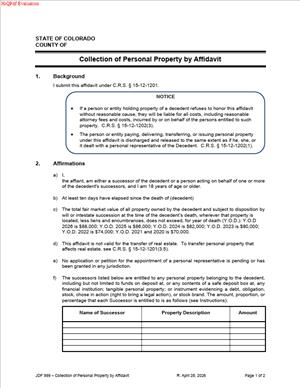
JDF 999 – Collection of Personal Property by Affidavit
Fill out nowJurisdiction: Country: United States | Province or State: Colorado
If you are trying to collect property that belonged to someone who has died, you may come across JDF 999 – Collection of Personal Property by Affidavit. This form is designed for situations where an estate may not need a full probate case. It allows a person to request certain property by signing a sworn statement.
JDF 999 – Collection of Personal Property by Affidavit is part of the Colorado Judicial Branch forms. It is used when specific legal conditions are met. The form acts as a written statement, made under oath, that you are entitled to receive the property listed in it.
This document can help you access assets such as bank funds, vehicles, or other personal property. It is often used when the total value of the estate falls under a certain limit. Instead of going through a lengthy court process, you present this completed affidavit directly to the person or institution holding the property.
If you are about to fill out this form, you need to understand what it does and what it does not do. It does not automatically transfer ownership by itself. It is a sworn claim that allows others to release property to you if the legal requirements are satisfied.
What is JDF 999 – Collection of Personal Property by Affidavit?
Clear definition
JDF 999 – Collection of Personal Property by Affidavit is a sworn written statement used to collect a deceased person’s personal property without opening a formal probate case. By signing it, you confirm certain facts under oath, such as the date of death and your legal right to receive the property.
The form identifies the deceased person, describes the property, and states why you are entitled to it. It is typically presented to a third party, such as a bank or another institution, that is holding the property.
Because it is an affidavit, you sign it under penalty of perjury. This means the statements in the document must be accurate and complete. False information can create legal consequences.
Who typically uses this form?
This form is often used by heirs of a deceased person. An heir is someone who is legally entitled to inherit property when there is no will.
It may also be used by a person named in a will, sometimes referred to as a beneficiary or devisee, if the estate qualifies for collection by affidavit. In some situations, a surviving spouse or adult child completes the form.
The person signing the document is usually someone who has a clear legal right to the property and who is willing to take responsibility for the truth of the statements made in the affidavit.
Why might you need this form?
You might need this form if the deceased person owned property solely in their name and the estate qualifies as a small estate. Instead of opening a probate case with the court, this affidavit provides a simpler way to collect certain assets.
This form is commonly used when there is no appointed personal representative. It can save time and expense compared to a full probate proceeding.
You may also need it when a bank, financial institution, or other property holder requires proof of your right to the asset before releasing it. The affidavit serves as that proof when formal court documents are not available.
Typical real-life scenarios
- A parent passes away and leaves a modest bank account in their name only. The adult child wants to access the funds to pay final expenses. If the estate qualifies, the child may complete this affidavit and present it to the bank.
- A deceased person owned a vehicle titled solely in their name. An heir needs to transfer the title. The affidavit can be used to confirm the heir’s right to the vehicle, subject to applicable title procedures.
- An individual dies without a will and leaves personal belongings and a small investment account. The surviving spouse may use the affidavit to collect those assets without opening probate.
- A person named in a simple will is entitled to a specific item of personal property, such as equipment or household goods. If the estate meets the legal criteria, the beneficiary may use the affidavit to obtain that property directly from the holder.
When would you use JDF 999 – Collection of Personal Property by Affidavit?
You would use this form when the estate qualifies under Colorado law for collection by affidavit instead of formal probate. This typically involves estates with a total value under a specific limit and no pending probate appointment.
Timing also matters. There is generally a required waiting period after the person’s death before you can use the affidavit. The form asks you to confirm that this time has passed.
You may use it when no personal representative has been appointed by the court, or when none is expected to be appointed. If a probate case is already open and a personal representative is serving, this form is usually not the correct tool for collecting property.
This form is often presented to third parties such as banks, brokerage firms, or individuals who are holding property. They rely on the statements in the affidavit to decide whether to release the property to you.
If you are acting as an heir, you use the form to assert your right under inheritance laws. If you are a named beneficiary under a will, you use it to confirm your entitlement to the specific property described in the document.
Legal characteristics of JDF 999 – Collection of Personal Property by Affidavit
This document is a sworn affidavit. Its legal force comes from the fact that you sign it under oath. You are declaring that the information provided is true to the best of your knowledge.
For the affidavit to be effective, it must meet all required legal conditions. These typically include confirming the date of death, stating that the estate’s value falls within the allowed limit, and confirming that no personal representative has been appointed.
Common problems arise when the estate value is calculated incorrectly or when required information is missing. If you fail to list all known heirs or beneficiaries, the affidavit may be challenged. Inaccurate property descriptions can also lead to delays or rejection by the institution holding the asset.
High-level differences may exist across jurisdictions in how small estates are handled. In Colorado, the Colorado Judicial Branch provides this specific form for collection by affidavit. Other states may use different procedures or thresholds.
It is important to understand what this form does not do. It does not appoint you as a personal representative. It does not resolve disputes among heirs. It does not automatically clear creditor claims against the estate. It is a tool for collecting qualifying property under limited circumstances.
Is it legally binding?
Yes, the affidavit is legally binding in the sense that you are making sworn statements. When you sign it, you are legally responsible for the accuracy of the information.
The binding effect relates to your declaration of facts. If the statements are true and all legal conditions are satisfied, the institution holding the property may rely on the affidavit to release the assets.
However, the document does not override inheritance laws or valid creditor claims. If another person has a stronger legal claim to the property, or if the estate does not meet the required criteria, the affidavit alone does not settle that conflict.
Its legal effect depends on compliance with the governing rules and the accuracy of the information provided. If those elements are present, it can function as a legally recognized method of transferring qualifying personal property.
How to fill out JDF 999 – Collection of Personal Property by Affidavit
Step 1 – Identify the deceased person
Enter the full legal name of the deceased person exactly as it appears on official records. Provide the date of death and any other identifying information requested on the form. Accuracy here is critical because the property holder will match this information to their records.
Step 2 – Confirm eligibility under the small estate requirements
Complete the section where you state that the estate qualifies for collection by affidavit. This typically includes confirming that the total value of the estate falls within the allowed limit and that the required waiting period has passed. You are declaring these facts under oath, so ensure the figures and dates are correct.
Step 3 – State that no personal representative has been appointed
Indicate that no court has appointed a personal representative for the estate. The form may ask you to confirm that no application or petition for appointment is pending. This statement helps show that a formal probate administration is not currently in place.
Step 4 – Identify your relationship and legal right
Explain your relationship to the deceased person. State whether you are an heir under inheritance laws or a beneficiary named in a will. The form requires you to describe the basis for your right to collect the property.
Step 5 – List the personal property to be collected
Describe the property clearly and specifically. Include account numbers, vehicle identification numbers, or detailed descriptions of other assets when available. The description should allow the holder to identify the property without confusion.
Step 6 – Address payment of debts and distribution
Complete the section that addresses outstanding debts and how the property will be distributed. The form may require you to confirm that funeral expenses, medical bills, or other claims will be handled appropriately. Read this section carefully before signing, as it defines your responsibilities.
Step 7 – Review all statements for accuracy
Before signing, read the entire document from beginning to end. Confirm that names, dates, values, and property descriptions are correct. Make sure every required field is completed and that there are no blank sections where information is required.
Step 8 – Sign the affidavit under oath
Sign the form where indicated. Because this is an affidavit, it must be signed under oath. Follow the instructions on the form regarding notarization or signing before an authorized official, if required. Once signed, the document is ready to present to the person or institution holding the property.
Legal terms you might encounter in JDF 999 – Collection of Personal Property by Affidavit
- Affidavit: A written statement you sign under oath. By signing this form, you are swearing that the information is true to the best of your knowledge. If you knowingly include false information, you can face legal consequences.
- Decedent: The person who has died. You must use the decedent’s full legal name exactly as it appears on official records, such as the death certificate, because banks and other institutions will match that name to their accounts.
- Successor: A person who has the legal right to receive the decedent’s property. On this form, you are stating that you qualify as a successor under the law and are entitled to collect the listed personal property.
- Personal Property: Assets that are not real estate. This can include bank accounts, vehicles, stocks, refunds, wages owed, and household items. You must clearly identify the specific property you are claiming.
- Estate: The total property and debts left behind by the decedent. This form is used only when the estate qualifies as a small estate under the applicable limits.
- Personal Representative: A person formally appointed by a court to manage the estate. On this form, you confirm that no personal representative has been appointed and that none is pending.
- Gross Value: The total value of the decedent’s property before subtracting debts. You must ensure the estate’s gross value falls within the small estate limit to use this process.
- Heir: A person entitled to inherit under state law when there is no will. If there is no will, your right to collect property depends on your status as an heir.
- Devisee: A person named in a valid will to receive property. If a will exists, you may be acting as a devisee rather than an heir.
- Notarization: The process of signing the affidavit in front of a notary public. The notary verifies your identity and witnesses your signature. Many institutions will not accept the document without proper notarization.
FAQs
Do I have to file JDF 999 – Collection of Personal Property by Affidavit with the court?
In most situations, you do not file this document with the court. You present it directly to the bank, financial institution, or person holding the property. Before you rely on it, confirm whether the institution requires a certified death certificate or any additional internal forms along with the affidavit.
When can I sign and use this form?
You can sign and use this document only after the required waiting period has passed since the date of death. Check the death certificate for the exact date and count carefully. Institutions may verify that the minimum time has passed before releasing any funds.
What information must match exactly in this document?
Names and identifying details must match official records. The decedent’s name should match the death certificate and the account records. Your name should match your government-issued identification. Even small differences, such as missing middle initials, can cause delays.
Do I need to attach a copy of the death certificate?
Yes, most institutions will require a certified copy of the death certificate. Some may keep the certified copy, while others only review it. Call ahead and ask how many certified copies you should bring and whether they return them.
What if there are multiple heirs or successors?
If more than one person is entitled to the property, you must confirm how the institution handles that situation. Some may require all successors to sign the affidavit. Others may require separate affidavits from each person claiming a share. Make sure everyone agrees on how the property will be divided before you present the document.
Can I use this form to transfer a vehicle?
Possibly, but you must check with the motor vehicle agency to confirm their requirements. They may require additional title transfer forms or fees. This document supports your right to collect the vehicle, but it does not replace the required title paperwork.
What happens if someone later challenges my right to the property?
By signing this document, you are swearing that you are entitled to the property. If another person disputes your claim, you may have to prove your eligibility. Keep copies of the completed JDF 999 – Collection of Personal Property by Affidavit and any supporting documents that show your relationship or status.
Does this document change the public record of ownership?
This document does not automatically update public property records. It allows you to collect specific personal property from whoever holds it. For assets that require a formal transfer, such as titled property, you must complete the separate transfer process after using the affidavit.
Checklist: Before, During, and After JDF 999 – Collection of Personal Property by Affidavit
Before
- Confirm the estate qualifies under the small estate value limit.
- Verify that the required waiting period since death has passed.
- Obtain certified copies of the death certificate.
- Gather documents showing your relationship to the decedent.
- Identify all personal property you intend to collect.
- Check whether a court case has already been opened for the estate.
- Confirm no personal representative has been appointed.
- Contact the institution holding the property to ask about their requirements.
During
- Enter the decedent’s full legal name exactly as shown on official records.
- Accurately state the date of death from the death certificate.
- Clearly describe each item of personal property.
- Confirm your legal basis as heir or devisee.
- Review the estate’s total value to ensure eligibility.
- Read each statement carefully before signing.
- Sign the affidavit in front of a notary.
- Make copies immediately after notarization.
After
- Provide the notarized affidavit to the institution holding the property.
- Present certified death certificates as required.
- Complete any additional internal forms requested.
- Request written confirmation of funds or property release.
- Deposit or secure collected funds appropriately.
- Keep detailed records of amounts received.
- Distribute property according to legal entitlement.
- Store copies of all documents in a safe place.
Common mistakes to avoid with JDF 999 – Collection of Personal Property by Affidavit
- Mistake: Listing property too vaguely, which happens when you rush through the description section; this can cause the institution to reject the affidavit, so do not forget to include account numbers or clear identifiers.
- Mistake: Miscalculating the estate’s total value because you overlook smaller assets; this can make the estate ineligible for the small estate process, so do not forget to add all personal property before signing.
- Mistake: Signing without notarization, often due to misunderstanding the oath requirement; this will make the document invalid for most institutions, so do not forget to sign in front of a notary.
- Mistake: Using a name that does not match official records, which often occurs when nicknames are used; this can delay access to funds, so do not forget to copy names exactly from the death certificate and account statements.
- Mistake: Ignoring other heirs, which happens when communication breaks down among family members; this can lead to disputes or legal claims, so do not forget to confirm who else has rights to the property.
- Mistake: Assuming this form transfers title automatically, which happens when people confuse collection with ownership transfer; this can leave assets improperly titled, so do not forget to complete any separate transfer steps required by the relevant agency.
What to do after filling out JDF 999 – Collection of Personal Property by Affidavit
Once the affidavit is complete and notarized, your next steps focus on collection, documentation, and proper handling of the property. Stay organized. Keep everything in writing whenever possible.
- Step 1: Make at least two copies of the signed and notarized affidavit for your records.
- Step 2: Gather certified copies of the death certificate and any documents proving your relationship or status.
- Step 3: Contact the bank, agency, or person holding the property to confirm their submission process.
- Step 4: Deliver the affidavit and required attachments in person or by secure mail, depending on their policy.
- Step 5: Ask for written confirmation that your documents were received and accepted.
- Step 6: Follow up within a reasonable time if you do not receive confirmation or payment.
- Step 7: Deposit any funds collected into an account that allows you to track distributions clearly.
- Step 8: Pay any valid debts of the decedent if required before distributing the remaining property.
- Step 9: Distribute the remaining property to the proper heirs or devisees according to the law or will.
- Step 10: Keep a file with copies of the affidavit, correspondence, receipts, and proof of distribution.
You should also update any internal records you maintain. Create a simple written summary listing what property you collected, when you received it, and how it was distributed. This protects you if questions arise later.
If an institution refuses to honor the affidavit, ask for a written explanation. The issue may relate to missing documentation, value limits, or conflicting claims. Address the specific concern before taking further action.
Finally, store all paperwork securely. Even after distribution, you may need to show proof of how the estate property was handled. Clear records reduce conflict and protect your position as the person who relied on the affidavit.
Disclaimer: This guide is provided for informational purposes only and is not intended as legal advice. You should consult a legal professional.