MC 01 – Summons
Fill out nowJurisdiction: Country: United States | Province or State: Michigan
If you are starting a court case in Michigan, the MC 01 – Summons is one of the first documents you will encounter. It is a formal notice from the court that tells the other party they are being sued and must respond.
The MC 01 – Summons works together with your complaint. The complaint explains your claims. The summons officially notifies the defendant and sets the deadline to answer.
This form is not just paperwork. It triggers the legal timeline. Once it is served, the clock starts for the other party to file a response.
If you are representing yourself, understanding this document is critical. A mistake on the summons can delay your case or cause service problems. Knowing what it does and how it functions will help you avoid common issues at the beginning of your case.
What is MC 01 – Summons?
Clear definition
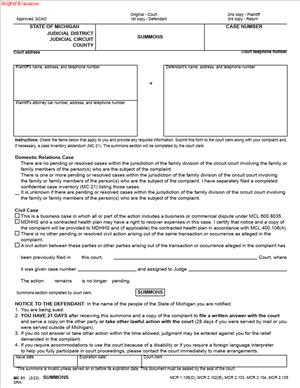
The MC 01 – Summons is a standard Michigan court form used to notify a defendant that a lawsuit has been filed against them. It is issued by the court after you file your complaint.
The form identifies the court, the parties, and the case number. It states how long the defendant has to respond. It also explains that failing to respond may result in a default judgment.
This document is not your argument. It does not explain the facts of your case in detail. Its purpose is to provide official notice and establish response deadlines.
Who typically uses this form?
Plaintiffs use this form when they start a civil case in a Michigan court. A plaintiff may be an individual, a business, or another legal entity.
Self-represented individuals often use this form when filing cases involving contracts, property disputes, or personal injury claims. Attorneys also use the same form when representing clients.
Court clerks process and issue the summons after the complaint is filed. Process servers or other authorized individuals use it when serving the defendant.
Why might you need this form?
You need this form when you are formally beginning a lawsuit. Filing a complaint alone is not enough. The other party must receive official notice.
Without proper service of a valid summons, the court may not have authority over the defendant. This can prevent your case from moving forward.
The summons also sets clear expectations. It tells the defendant when and how to respond. That deadline is tied to how and where service occurs.
Typical real-life scenarios
- You may use this form if you are suing someone for unpaid rent after a lease dispute. Once you file your complaint, the summons is issued to notify the tenant of the lawsuit.
- Another common situation involves unpaid debts. If someone owes you money and informal efforts have failed, you may file a civil complaint. The summons informs the debtor of the case and response deadline.
- Business disputes also involve this document. For example, if a vendor fails to deliver goods under a contract, a business may file suit and use the summons to notify the vendor.
- Personal injury cases often begin with this form as well. If you claim someone’s negligence caused harm, the summons is served with the complaint to start the formal court process.
- Property disputes between neighbors may also require this form. If informal resolution fails, the summons ensures the other party is officially brought into court.
When would you use MC 01 – Summons?
You use the MC 01 – Summons at the start of a civil lawsuit in Michigan. It is prepared after the complaint is drafted and filed with the court.
This form is typically used by the plaintiff. The defendant receives it. In some cases, there may be multiple defendants, and each one must receive a properly issued summons.
You would not use this form for informal disputes or negotiations. It is specifically for court actions. Once the complaint is accepted for filing, the summons becomes part of the official case file.
Timing matters. The summons must generally be served within a set period after it is issued. If it expires before service, you may need a new one issued. This affects how quickly your case can proceed.
In cases involving out-of-state defendants, the response time stated on the summons may differ. The method of service can affect deadlines. The form reflects these timing differences.
If you are adding a new defendant later in the case, a separate summons may be required for that party. Each defendant must receive individual notice that meets procedural rules.
Legal characteristics of MC 01 – Summons
The MC 01 – Summons is a court-issued notice. It becomes effective when the court signs, seals, or otherwise validates it according to court procedure.
It contains the required elements. These usually include the court name, case number, names of the parties, and the response deadline. Missing or incorrect information can cause delays.
Service is a key legal feature. The summons must be delivered in a manner allowed by court rules. Improper service may result in the court lacking personal jurisdiction over the defendant.
A common issue is failing to serve the summons within its valid time period. If it expires, it may no longer be effective. Courts often require a new issuance in that situation.
Errors in party names can also create problems. If the defendant’s legal name is incorrect, enforcement later in the case may become more complicated.
This form does not prove your claims. It does not guarantee that you will win. It only ensures that the defendant is formally notified and given an opportunity to respond.
Court procedures may vary slightly depending on the level of court. Deadlines and technical requirements can differ between district and circuit courts. The structure of the summons remains consistent, but the surrounding rules may vary.
Is it legally binding?
The summons itself does not create a contract or agreement. It is not binding in the way a signed contract is binding.
However, it has legal force because it is issued by a court. Once properly served, it obligates the defendant to respond within the stated time frame.
If the defendant does not respond, the court may enter a default. That default can lead to a judgment. In that sense, the summons plays a direct role in creating legal consequences.
Its authority comes from court rules and procedural law. When properly issued and served, it is an official notice that carries enforceable deadlines.
How to fill out MC 01 – Summons
Step 1 – Identify the court
Enter the full name of the court where your complaint is filed. Include the court’s address and any required division information. This must match the court listed on your complaint.
Step 2 – Enter the case number
Write the case number assigned by the court clerk after you file your complaint. Double-check this number. It links the summons to the correct case file.
Step 3 – List the parties
Enter your name as the plaintiff and the other party’s name as the defendant. Use full legal names. Ensure the spelling matches your complaint exactly.
If there is more than one defendant, list each one clearly. Each defendant may require a separate copy for service.
Step 4 – Confirm defendant information
Provide the defendant’s address if required on the form. This helps ensure accurate service. Use a current and complete address whenever possible.
If the defendant is a business, use the correct registered or legal business name. Avoid informal or trade names unless they are legally recognized.
Step 5 – Review response time language
The form includes preprinted language about how long the defendant has to answer. Confirm that the response period aligns with the method of service and location of the defendant.
Do not alter standard language unless instructed by the court. The deadlines are typically set by court rule.
Step 6 – Submit for court issuance
After completing your portion, submit the form to the court clerk for issuance. The clerk may sign, stamp, or seal the summons to make it official.
A summons is not effective until it is properly issued by the court. Make sure you receive the issued version before attempting service.
Step 7 – Check the expiration period
Look for any expiration date on the issued summons. Note the timeframe in which it must be served.
If service is not completed before expiration, additional steps may be required to continue the case. Keeping track of this date prevents unnecessary delay.
Step 8 – Prepare copies for service
Make copies of the issued summons to serve on each defendant. The summons is usually served together with the complaint.
Ensure each copy is clear and complete. Incomplete or illegible copies can create service disputes later in the case.
Step 9 – Coordinate proper service
Arrange for service using a method allowed by court rules. This may involve personal delivery, certified mail, or another approved method.
The person serving the documents typically completes a proof of service. That proof is filed with the court to confirm that the defendant received the summons and complaint.
Careful completion and tracking at this stage helps your case move forward without avoidable procedural setbacks.
Legal terms you might encounter in MC 01 – Summons
- Plaintiff: The person or entity starting the lawsuit. In this document, the plaintiff’s name must match exactly how it appears on the complaint. If the name is misspelled or inconsistent, it can create confusion in the court record and delay service.
- Defendant: The person or entity being sued. This is the party who must respond within the time stated in the summons. You must list the defendant’s full legal name and accurate address to ensure proper service.
- Case Number: A unique number assigned by the court clerk when the complaint is filed. This number connects the summons to the correct case file. If you enter the wrong number, the court may reject the document or misfile it.
- Court Clerk: The court official who issues the summons. The clerk signs, dates, or stamps the document to make it official. Without a clerk’s issuance, the summons is not valid for service.
- Service of Process: The formal delivery of court papers to the defendant. The summons tells the defendant that service has occurred and that a response deadline applies. Proper service is required before the court can move forward.
- Proof of Service: A separate document showing when and how the defendant was served. While it is not part of the summons itself, it is directly tied to it. The court relies on this proof to confirm that notice was properly given.
- Response Deadline: The specific number of days the defendant has to file an answer or other response. The summons states this timeframe clearly. Missing this deadline can lead to serious consequences, including default.
- Default: A court action that can occur if the defendant fails to respond on time. The summons warns the defendant about this possibility. Default can allow the plaintiff to seek a judgment without further participation from the defendant.
- Issuance Date: The date the clerk officially signs or stamps the summons. This date is important because it often affects how long the summons remains valid for service. Always confirm the issuance date before arranging service.
- Expiration Period: The limited time in which the summons must be served after issuance. If it expires before service, you may need to request a new one. Tracking this period helps avoid delays in your case.
FAQs
What date should I use as the official start of the response period?
You should look at the date the defendant is actually served, not the date you filled out the document. The response period typically begins the day after service is completed. Confirm the service date from the proof of service and count the required number of days carefully, including checking whether weekends or holidays affect the calculation.
Do I need the clerk’s signature before I serve this document?
Yes. The summons must be issued by the court clerk before it is valid. That means it needs the clerk’s signature, stamp, or official seal. If you try to serve it before issuance, service may be considered invalid, and you may have to start over.
What happens if I make a mistake in the defendant’s name?
If the name does not exactly match the legal name of the person or business, the defendant may challenge service. This can delay the case or require you to correct the document and re-serve it. Before submitting the MC 01 – Summons for issuance, double-check spelling, business designations, and middle initials.
Can I change information after the court issues the summons?
Once issued, you should not alter the document yourself. Any change usually requires court approval or a newly issued summons. If you notice an error after issuance, contact the clerk promptly to ask about the proper correction process rather than marking it up by hand.
How do I know if the court accepted my summons for filing and issuance?
After submission, the clerk will either return a signed and stamped copy or provide confirmation that it has been issued. Check for an issuance date and official marking. If you do not receive confirmation, follow up to ensure it is officially part of the court record.
What if the defendant refuses to accept the papers?
Refusal does not automatically stop service. The method of service matters. If service is performed according to the rules, it may still be valid even if the defendant declines to physically take the documents. Make sure the person serving the papers completes the proof of service accurately and notes what happened.
Does the summons become part of the public record?
Yes. Once issued and filed, it becomes part of the case file. The names of the parties and the case number will appear in court records. Review the information carefully before submission to ensure everything is accurate and consistent with the complaint.
How long is MC 01 – Summons valid after it is issued?
The validity period depends on court rules and begins on the issuance date shown on the document. If you do not complete the service within that time, it may expire. If it expires, you typically need to request a new MC 01 – Summons and repeat the issuance and service steps.
Checklist: Before, During, and After MC 01 – Summons
Before
- Confirm that the complaint has been properly filed with the court.
- Verify the correct legal names of all plaintiffs and defendants.
- Double-check the defendant’s physical address for service.
- Make sure you have the correct court name and location.
- Leave signature and issuance areas blank for the clerk if required.
- Prepare the required number of copies for court submission.
- Review deadlines related to service and expiration periods.
During
- Enter the case number exactly as assigned by the clerk.
- Print names clearly and consistently with the complaint.
- Review all response time language for accuracy.
- Submit the document to the clerk for official issuance.
- Confirm the issuance date and the clerk’s signature or stamp.
- Obtain file-stamped copies for your records.
- Arrange for proper service using an authorized method.
After
- Track the date the service is completed on the defendant.
- File the proof of service with the court promptly.
- Calculate the defendant’s response deadline based on service.
- Monitor the case docket for any response filed.
- Calendar the expiration date if the service has not yet occurred.
- Store stamped copies in a secure, organized file.
- Prepare next steps in case of response or default.
Common mistakes to avoid with MC 01 – Summons
- Mistake: Listing an incorrect or incomplete defendant name because you relied on informal information, which can lead to rejected service or dismissal, so do not forget to verify the exact legal name from reliable records.
- Mistake: Serving the document before the clerk issues it, often due to rushing the process, which can invalidate service and waste time and fees, so do not forget to confirm the clerk’s signature or stamp first.
- Mistake: Using the wrong case number because of copying from another file, which may cause misfiling or confusion in court records, so do not forget to match the number exactly to your assigned case.
- Mistake: Missing the expiration period because you did not track the issuance date, which may require reissuance and delay your case, so do not forget to calendar the service deadline immediately.
- Mistake: Failing to file proof of service after delivery, often due to assuming service alone is enough, which prevents the court from recognizing proper notice, so do not forget to submit the proof promptly.
- Mistake: Handwriting unclear or inconsistent information, which can cause clerk rejection or service disputes, so do not forget to print neatly and review every line before submission.
- Mistake: Altering the summons after issuance without court approval, which can make the document invalid, so do not forget to request a corrected or new issuance instead of making manual changes.
What to do after filling out MC 01 – Summons
Once you complete the form and the clerk issues it, your focus shifts to proper service and deadline tracking. The summons only works if it is delivered correctly and documented in the court file.
- Step 1: Obtain at least two stamped copies from the clerk after issuance—one for service and one for your records.
- Step 2: Review the issuance date on the document and immediately calculate the last day for valid service within the expiration period.
- Step 3: Choose an approved method of service and arrange for delivery to the defendant at the correct address.
- Step 4: Provide the server with all required documents, including the complaint and any attachments that must accompany the summons.
- Step 5: After service is completed, collect the signed proof of service from the person who delivered the papers.
- Step 6: File the proof of service with the court as soon as possible and confirm it appears on the case docket.
- Step 7: Calculate the defendant’s response deadline based on the date of service and record it in your calendar.
- Step 8: Monitor the court file for any answer, motion, or other response submitted by the defendant.
- Step 9: If no response is filed by the deadline, review the court’s process for requesting default and gather the necessary supporting documents.
- Step 10: Keep all originals and stamped copies organized in a dedicated case file, including notes about service dates and communications.
Stay proactive. Track every date. Keep copies of everything you submit or receive. Careful recordkeeping and deadline management will help your case move forward without unnecessary setbacks.
Disclaimer: This guide is provided for informational purposes only and is not intended as legal advice. You should consult a legal professional.