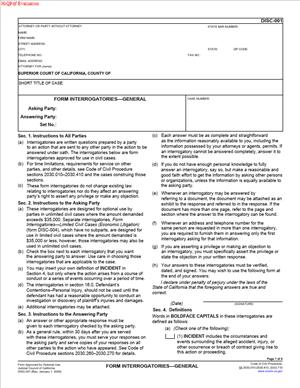
DISC-001 – Form Interrogatories—General
Fill out nowJurisdiction: Country: United States | Province or State: California
DISC-001 – Form Interrogatories—General is a standard court form used in civil cases in California to ask written questions of the other side. It is part of the discovery process. Discovery is the stage where both sides exchange information before trial.
If you are representing yourself, this form may feel overwhelming at first. It contains pre-written questions that cover many common issues in a lawsuit. You select the questions that apply to your case and serve them on the other party.
This document matters because it helps you gather facts, identify witnesses, and understand the other side’s claims or defenses. The answers you receive can shape how you prepare for settlement discussions or trial.
The form belongs to the Superior Court of California and follows a standard format. That standard structure helps ensure that the questions are recognized and enforceable within the court system.
Understanding how this form works can help you avoid common mistakes. It also helps you use the discovery process more effectively and stay organized as your case moves forward.
What is DISC-001 – Form Interrogatories—General?
Clear definition
DISC-001 – Form Interrogatories—General is a pre-approved set of written questions used in civil cases. These questions are called “interrogatories.” They are sent by one party to another to obtain information relevant to the lawsuit.
Unlike custom-written interrogatories, this form contains standardized questions drafted for general use. You check the boxes next to the questions you want answered. The responding party must provide written answers under oath.
The form covers broad topics. These include basic background information, details about claims and defenses, insurance coverage, witnesses, documents, and damages. Because the questions are standardized, courts are familiar with them.
Who typically uses this form?
Plaintiffs and defendants both use this form in civil cases. A plaintiff might use it to learn more about a defendant’s version of events. A defendant might use it to test the strength of the plaintiff’s claims.
Self-represented litigants often use this form because it provides ready-made questions. Attorneys also use it regularly because it saves time and ensures coverage of key issues.
It is commonly used in cases involving personal injury, property damage, contract disputes, and other civil matters filed in the Superior Court of California.
Why might you need this form?
You may need this form if you want detailed information from the other party that is not already in the court file. Pleadings often give only basic allegations. Interrogatories push for specifics.
For example, you might want to know the names of witnesses, the amount of damages being claimed, or the facts supporting a defense. This form allows you to request that information in a structured way.
Using this document can also clarify weak points in a case. If the other side cannot provide clear facts, that may affect how the case develops.
Typical real-life scenarios
- In a car accident case, a plaintiff may use this form to ask the defendant to describe how the collision occurred. The questions may also request information about insurance policies and witnesses at the scene.
- In a breach of contract case, one party may use the form to ask the other to explain how the contract was allegedly violated. The questions may seek identification of documents that support those claims.
- In a slip-and-fall case, a defendant may use the form to learn about the plaintiff’s injuries, medical treatment, and claimed damages. This helps the defendant understand the scope of the claim.
- In a property dispute, one party may use the form to identify people who have knowledge of property boundaries or agreements. The answers can narrow the factual issues in dispute.
- In an employment-related civil case, a party may use the form to obtain details about lost wages or other claimed losses. The standardized questions help ensure important topics are not missed.
When would you use DISC-001 – Form Interrogatories—General?
You typically use this form after the lawsuit has been filed and the other party has been served. Discovery generally begins after the initial pleadings are in place.
If you are the plaintiff, you might send this form after the defendant files an answer. If you are the defendant, you might send it after you have filed your answer to the complaint.
The timing often depends on the stage of the case and any scheduling orders. Courts may set deadlines for completing discovery. Within those deadlines, either side may use interrogatories to gather information.
You might also use this form when informal requests for information have not been successful. Formal discovery creates a structured process with deadlines and written responses under oath.
In some cases, parties use this form early to understand the strengths and weaknesses of the case. In other cases, it may be used later to clarify specific issues that remain disputed.
Legal characteristics of DISC-001 – Form Interrogatories—General
This form is effective because it is an officially recognized discovery tool in California civil procedure. It follows a format accepted by the Superior Court of California.
For the form to function properly, it must be completed accurately and served according to procedural rules. Proper service, correct identification of the parties, and selection of relevant questions all matter.
Problems often arise when too many questions are selected without considering the limits that may apply. Another common issue is failing to serve the form correctly. Incomplete or unclear selections can also cause confusion or disputes.
The form does not decide your case. It does not create a ruling or judgment. It is a request for information only. The value comes from the answers you receive.
Responses to these interrogatories must typically be verified. That means the responding party signs under oath, confirming the truth of the answers. Failure to respond or providing incomplete responses can lead to disputes and possible court involvement.
Rules governing interrogatories can vary in detail between jurisdictions. This form is specific to California state court practice. Federal courts and other states use different forms and procedures.
Is it legally binding?
DISC-001 – Form Interrogatories—General itself is not a contract or agreement. It becomes legally significant once it is properly served in an active case.
When the other party receives it, they are generally required to respond within a set time frame. Their answers must be truthful and are given under oath. That gives the responses legal weight.
If a party does not respond or provides inadequate answers, the issue may be brought before the court. The court can require compliance. This enforcement mechanism is what gives interrogatories their practical force.
The form does not bind the court to any outcome. It does not automatically prove facts. However, the answers can be used during the case, including at trial, subject to procedural rules.
How to fill out DISC-001 – Form Interrogatories—General
Step 1 – Complete the caption section
At the top of the form, fill in the court name, county, and branch, as shown on your other filed documents. Enter the case title exactly as it appears on the complaint or answer. Include the case number. Identify yourself as the party serving the interrogatories and list the name of the party that will respond.
Step 2 – Identify the responding party
In the section that states who must answer the interrogatories, clearly print the name of the party you are directing the questions to. Make sure the name matches the official court records. If there are multiple defendants or plaintiffs, confirm you are directing the questions to the correct one.
Step 3 – Review all available interrogatories carefully
Read through each numbered interrogatory before checking any boxes. The form covers many topics. Some questions may not apply to your case. Selecting only relevant questions keeps the process focused and easier to manage.
Step 4 – Check the boxes next to the questions you are asking
Mark the box beside each interrogatory you want the other party to answer. Be deliberate. Each checked box represents a formal request for information. Avoid selecting questions that have no connection to your claims or defenses.
Step 5 – Consider subparts and definitions
Some interrogatories include subparts or refer to defined terms. Read any definitions included in the form so you understand the scope of what is being asked. This helps you anticipate the type of information you may receive in response.
Step 6 – Add additional pages if necessary
If the form allows space for additional specifications or attachments, follow the formatting instructions. Label any attachments clearly. Include the case name and number on each added page to keep the document organized.
Step 7 – Review for completeness and accuracy
Before serving the form, check that all required fields are filled in. Confirm the case number, party names, and selected interrogatories are correct. Errors in identification can delay responses or create confusion.
Step 8 – Sign and date the form
Sign the form where indicated. Print your name and include the date of signing. Your signature confirms that you are formally issuing these interrogatories in the case.
Step 9 – Prepare for service
Make copies of the completed form for your records. Arrange for service on the responding party in a manner permitted in civil cases. Keep proof that the document was served, as this establishes the response deadline.
Step 10 – Calendar the response deadline
After service, calculate the expected deadline for responses based on the applicable procedural time frame. Mark this date clearly in your calendar so you can track whether a response is received on time.
Legal terms you might encounter in DISC-001 – Form Interrogatories—General
- Interrogatories: Written questions that one party sends to another during discovery. In this form, they are prewritten and numbered. The responding party must answer each selected question in writing and under oath.
- Responding Party: The person or entity who must answer the interrogatories. Their name appears in the caption and in the section identifying who is responding. Make sure this matches the party name exactly as it appears in the case.
- Propounding Party: The person or entity who is asking the questions. This is the party serving the form. Their attorney information, or their self-represented status, appears at the top of the document.
- Verification: A signed statement confirming that the answers are true and correct under penalty of perjury. The responding party must sign the verification, even if a lawyer prepares the responses. Without it, the answers are incomplete.
- Objection: A formal reason for not answering a question fully. On this form, the responding party may object to specific interrogatories. Objections must be stated clearly and relate to the specific question.
- Separate Statement: A document sometimes required in connection with motions about discovery disputes. While not part of the initial form, it may become relevant if there is a disagreement about the answers provided.
- Continuing Duty to Respond: The obligation to update responses if new information becomes available. If facts change or new evidence is discovered, the responding party may need to supplement their answers.
- Service: The formal delivery of the interrogatories or responses to the other party. This is not a filing with the court. Service must follow the rules for how documents are delivered in a lawsuit.
- Proof of Service: A written declaration showing when and how the document was delivered. It identifies who served the document, on whom, and by what method. This is essential to show that deadlines were properly triggered.
- Caption: The heading at the top of the first page that lists the court, parties, and case number. It must match exactly what appears on other documents, in your case.
FAQs
Do I file DISC-001 – Form Interrogatories—General with the court?
No. This document is served on the other party, not filed with the court, at the time you send it. You prepare it, select the questions, and have it properly served. You only involve the court if there is a dispute about the responses or if a judge later needs to review what was asked and answered.
How many questions can I ask using this form?
This form contains preapproved interrogatories that do not count toward the usual numerical limit for specially drafted questions. You may select as many of the listed questions as apply to your case. Review each section carefully so you only check the boxes for questions that are relevant to your claims or defenses.
What if I am the one who received this document?
You must prepare written responses to each question that was selected. For every interrogatory, you either provide a complete answer, state an objection, or say you lack sufficient information after a reasonable effort to find it. You then sign a verification confirming your answers are true and submit your responses by the deadline.
Do I have to answer every question even if it does not apply to me?
If a question truly does not apply, you should explain why in your response. You cannot simply ignore it. If appropriate, you may object and state the legal reason. Each numbered interrogatory requires some type of response so the record is clear.
How do I know which boxes to check when I am sending this form?
Read through all categories of interrogatories and compare them to the issues in your case. Check only the boxes next to the questions that relate to your dispute. Once served, the other party must respond to every interrogatory you selected, so choose carefully and strategically.
What is the deadline to respond after being served?
The deadline depends on the rules that apply to your case and how the document was served. You calculate the response date from the date of service shown on the proof of service. Mark that date on your calendar immediately to avoid missing it.
Can I change or withdraw interrogatories after I serve them?
You generally cannot unilaterally undo service once it has occurred. However, you may agree with the other party in writing to narrow the issues or clarify questions. If you need different information later, you may be able to serve additional discovery within the allowed limits.
What happens if someone does not respond properly to this document?
If the responding party fails to answer, provides incomplete responses, or does not verify the answers, the propounding party may attempt to resolve the issue informally first. If that fails, the issue can be brought before a judge, who may order further responses and, in some cases, impose consequences.
Checklist: Before, During, and After DISC-001 – Form Interrogatories—General
Before
- Review your complaint and answer to identify the key disputed issues.
- Gather basic facts, documents, and timelines, so you know what information you need.
- Confirm the correct case name and case number for the caption.
- Decide whether you are the propounding party or the responding party.
- Check the service rules that apply in your case.
- Calendar expected response deadlines.
- Consider whether other discovery tools might also be needed.
- Prepare a clean copy of the form for completion.
During
- Complete the caption exactly as it appears in your case filings.
- Clearly identify the responding party by full legal name.
- Read each interrogatory carefully before checking its box.
- Check only the boxes for questions relevant to your case.
- Ensure all selected pages are included and properly numbered.
- Prepare a proof of service form.
- If responding, draft clear, complete answers for each numbered question.
- Add objections only where appropriate and specific.
- Sign and date the document or verification where required.
After
- Make copies of the final document for your records.
- Serve the document using an approved method.
- Complete and retain the signed proof of service.
- Calendar the response deadline if you served the interrogatories.
- Track when responses are due or received.
- Review responses carefully for completeness.
- Follow up promptly if answers are missing or unclear.
- Store all originals and copies in your case file.
Common mistakes to avoid with DISC-001 – Form Interrogatories—General
- Mistake: Checking every box without reviewing relevance, which happens when you assume more questions are always better, leading to unnecessary disputes and wasted time, do not forget to tailor your selections to the actual issues in your case.
- Mistake: Ignoring a question when responding because it seems unimportant, which often occurs due to oversight, resulting in incomplete responses and possible motions to compel, so do not forget to address every numbered interrogatory.
- Mistake: Failing to sign the verification, which happens when you think your typed name is enough, causing your responses to be treated as defective, so do not forget to sign under penalty of perjury where required.
- Mistake: Serving the document without a proper proof of service, which occurs when you focus only on the questions, creating disputes about deadlines, so do not forget to complete and keep the proof of service.
- Mistake: Using the wrong party name in the caption, which happens when you copy from memory instead of the complaint, leading to confusion or rejection in later proceedings, so do not forget to match the caption exactly.
- Mistake: Missing the response deadline because you miscalculated from the service date, which often results from not checking the method of service, exposing you to court action, so do not forget to calendar the correct due date immediately.
- Mistake: Giving vague or incomplete answers, which happens when you rush or avoid detail, weakening your position and inviting follow-up motions, so do not forget to provide full and specific information.
- Mistake: Including arguments instead of factual responses, which occurs when emotions run high, reducing clarity and credibility, so do not forget that interrogatories call for facts, not speeches.
What to do after filling out DISC-001 – Form Interrogatories—General
Once you complete the form, shift your focus to proper handling and follow-through. Accuracy is only part of the process. Delivery and recordkeeping matter just as much.
- Step 1: Review the entire document from top to bottom. Confirm the caption, party names, and case number are correct.
- Step 2: Make sure every selected interrogatory is included and clearly marked.
- Step 3: If you are responding, confirm that each question has a complete answer or a clearly stated objection.
- Step 4: Sign the document where required. If you are responding, sign the verification under penalty of perjury.
- Step 5: Prepare a proof of service that states the date, method of service, and the name and address of the person served.
- Step 6: Make at least two copies—one for you and one for service. Keep your copy in a dedicated discovery section of your case file.
- Step 7: Serve the document using the appropriate method. Remember, service is not the same as filing. Do not send the original to the court unless a rule or later motion requires it.
- Step 8: Calendar important dates. If you served the interrogatories, mark the response deadline. If you responded, note the date you served your answers.
- Step 9: Monitor compliance. If you are waiting for responses, track whether they arrive on time and whether they include a signed verification.
- Step 10: Organize all related papers together, including correspondence, extensions, and any agreements about deadlines.
- Step 11: Update your case strategy based on the information received. Interrogatory answers often reveal witnesses, documents, and factual positions that shape your next steps.
- Step 12: Preserve everything. Keep digital and physical copies secure so you can reference them if there is a dispute or court hearing.
Treat this stage seriously. Discovery builds the factual foundation of your case. Careful preparation, proper service, and organized follow-up put you in a stronger position as your case moves forward.
Disclaimer: This guide is provided for informational purposes only and is not intended as legal advice. You should consult a legal professional.