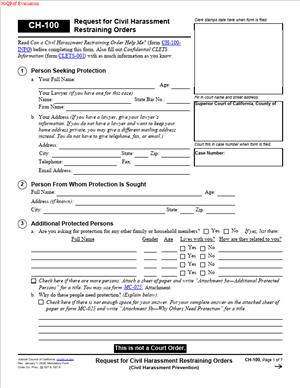
CH-100 – Request For Civil Harassment Restraining Orders (Civil Harassment Prevention)
Fill out nowJurisdiction: Country: United States | Province or State: California
If you are dealing with harassment and need court protection, CH-100 – Request For Civil Harassment Restraining Orders is the form that starts the process in California. This document is filed with the Superior Court to ask a judge for protection from someone who is harassing, threatening, or stalking you.
You use this form to formally explain what has happened and what protection you are requesting. It tells the court who you are, who the restrained person would be, and what specific orders you want in place. The judge relies heavily on what you write here.
This form is often completed by people representing themselves. You may be filling it out without a lawyer. That makes it even more important to understand what each section is asking for and how your answers will be read by the court.
The information you provide can affect whether the court grants temporary orders right away and whether longer-term orders are issued later. Accuracy, clarity, and detail matter.
CH-100 – Request for Civil Harassment Restraining Orders is part of a larger set of civil harassment forms, but this document is the foundation. It sets out your request and frames the entire case.
What is CH-100 – Request for Civil Harassment Restraining Orders?
Clear definition
CH-100 – Request for Civil Harassment Restraining Orders is a court filing used to ask for protection from civil harassment in California. It is submitted to the Superior Court in the county where you or the other person lives, or where the harassment occurred.
This form asks the court to issue orders that can limit or prohibit contact, communication, or proximity. It may also request other protections, such as orders regarding firearms.
The document is a sworn statement. When you sign it, you are declaring under penalty of perjury that the information is true and correct to the best of your knowledge. That makes it more than just a complaint. It is a formal testimony to the court in writing.
Who typically uses this form?
This form is commonly used by individuals who are being harassed by someone who is not a close family member or intimate partner. Civil harassment cases often involve neighbors, roommates, coworkers, acquaintances, or even strangers.
If the issue involves a spouse, former spouse, co-parent, or someone you have dated, a different type of restraining order form is often used. CH-100 – Request for Civil Harassment Restraining Orders is generally for situations outside of domestic relationships.
Parents or guardians may also use this form on behalf of a minor child who is experiencing harassment. In that case, the adult fills out the form as the petitioner for the child.
Self-represented individuals make up a large portion of the people who complete this document. The court system is structured to allow people to file it without hiring an attorney.
Why might you need this form?
You might need this form if someone is repeatedly contacting you in a way that causes substantial emotional distress. Harassment can include threats, stalking, unwanted visits, repeated messages, or behavior that serves no legitimate purpose and alarms or annoys you.
The form allows you to ask the court for immediate temporary protection. In many cases, a judge reviews the paperwork quickly to decide whether to issue temporary restraining orders before a full hearing.
Without filing this form, the court cannot issue civil harassment restraining orders. Verbal complaints or police reports alone do not start a civil court case. The written filing is what officially opens the matter.
This document also creates a structured way to present your story. Instead of explaining events informally, you organize incidents by date and describe specific actions. That clarity can be critical to the court’s decision.
Typical real-life scenarios
- You may use this form if a neighbor repeatedly threatens you during disputes and sends hostile messages late at night. Even if there has been no physical violence, ongoing threats and intimidation can qualify as harassment.
- Another common situation involves a former friend or acquaintance who continues to contact you after you have clearly asked them to stop. This can include excessive texts, emails, or showing up at your workplace uninvited.
- Workplace-related harassment between coworkers, when not handled through internal policies or when it extends beyond work, may also lead someone to seek a civil harassment restraining order.
- Stalking by someone you do not have a close relationship with is another typical scenario. Repeated following, monitoring, or appearing unexpectedly at places you frequent may form the basis of the request.
- In some cases, disputes between roommates escalate into threats or aggressive conduct. When communication breaks down and safety becomes a concern, this form may be used to seek distance and clear boundaries enforced by court order.
When would you use CH-100 – Request for Civil Harassment Restraining Orders?
You would use this form when the behavior rises above ordinary conflict and fits the legal definition of harassment. That often involves unlawful violence, credible threats of violence, or a course of conduct that seriously alarms, annoys, or harasses you and serves no legitimate purpose.
The form is used at the beginning of the case. It is not a follow-up document. Filing it starts the court process and allows the judge to consider issuing temporary restraining orders.
People typically use this form when they want enforceable court protection. Informal requests to stop, mediation efforts, or conversations have often already failed. The filing signals that the issue has reached a point where court involvement is necessary.
If you are seeking orders that prevent contact, require a certain distance to be maintained, or restrict specific actions, this is the document that formally asks for those protections in a civil harassment context.
You would not use this form to divide property, resolve financial disputes, or seek child custody orders. Its purpose is focused on personal safety and protection from harassment.
Legal characteristics of CH-100 – Request for Civil Harassment Restraining Orders
This form becomes legally significant once it is properly completed, signed, and filed with the court. The information you include forms the basis for the judge’s decision about temporary and long-term orders.
For the request to be considered valid, it must be filled out clearly and completely. Missing names, incomplete addresses, or vague descriptions of incidents can delay the case or lead to denial of temporary orders. The court needs enough detail to understand what happened and why protection is necessary.
Accuracy is essential. Because you sign under penalty of perjury, knowingly false statements can carry serious consequences. The judge may also question credibility if the narrative is inconsistent or unsupported by specific facts.
The form itself does not create protection. Orders become effective only if a judge reviews the request and signs the appropriate restraining order documents. The CH-100 – Request For Civil Harassment Restraining Orders is the request, not the order.
There can be procedural differences between counties in how filings are processed, such as scheduling of hearings or methods of submission. However, the core structure and purpose of the form remain consistent throughout California.
It is important to understand what this document does not do. It does not automatically remove someone from shared property unless the court specifically orders it. It does not resolve criminal charges. It does not award money damages. Its function is to request protective civil orders.
Is it legally binding?
By itself, the completed form is not a binding court order. It is a sworn request for relief. The binding effect comes after a judge reviews the filing and issues a temporary restraining order or a final restraining order following a hearing.
Once a judge signs and issues orders based on your request, those orders become legally binding on the restrained person once they are properly served. Violating a restraining order can lead to legal consequences, including possible arrest.
Your signature on the form is legally significant. You are declaring under penalty of perjury that the information is true. That sworn declaration is binding on you in the sense that you are accountable for its accuracy.
The restraining orders, if granted, are enforceable by law enforcement. The form is the first step in that chain of events, but it does not, on its own, impose restrictions on the other person.
How to fill out CH-100 – Request for Civil Harassment Restraining Orders
Step 1 – Fill in the court information
At the top of the form, enter the name of the Superior Court and its address. This is usually the court in the county where you live, where the other person lives, or where the harassment occurred. Leave the case number blank if you do not yet have one. The clerk typically assigns it when you file.
Step 2 – Identify yourself as the person seeking protection
In the section identifying the petitioner, write your full legal name. Provide your contact information as requested. If you are asking for protection for a minor or another person, clearly state that and provide their name in the appropriate space.
Step 3 – Identify the person you want restrained
Enter the full name of the person you are asking the court to restrain. Include as much identifying information as the form requests, such as approximate age and address if known. Clear identification helps ensure proper service and enforcement.
Step 4 – Describe the relationship between you and the restrained person
Indicate how you know this person. The form usually asks you to check or explain the type of relationship, such as neighbor, coworker, roommate, or other non-domestic connection. This helps the court confirm that a civil harassment order is the correct category.
Step 5 – Request specific orders
The form provides options for the types of orders you are seeking. These may include no-contact orders, stay-away distances, and other restrictions. Read each option carefully and mark only those that reflect what you are asking the court to order.
Step 6 – Describe the harassment in detail
In the section asking for facts, explain what happened. Provide dates, locations, and specific actions. Focus on observable behavior rather than conclusions. Instead of writing that the person is “crazy” or “dangerous,” describe what they did or said.
If there were multiple incidents, describe them in chronological order. If you need more space, you may attach additional pages as allowed, clearly labeling them and referencing the section they relate to.
Step 7 – Explain why you need protection
The form may ask how the behavior affected you. Briefly describe any fear, emotional distress, or disruption to your daily life. Be direct and factual. The court uses this information to assess whether the legal standard for harassment is met.
Step 8 – Address firearms and related concerns
If the form includes questions about firearms, read them carefully and respond based on your knowledge. The court often considers firearm restrictions in restraining order cases, and your answers may influence what orders are issued.
Step 9 – Review for completeness and accuracy
Before signing, read the entire document from beginning to end. Check that names are spelled correctly, dates are accurate, and all required sections are filled in. Make sure attachments are clearly labeled and referenced.
Step 10 – Sign under penalty of perjury
At the end of the form, sign and date where indicated. By signing, you are declaring that everything written in the CH-100 – Request For Civil Harassment Restraining Orders is true and correct to the best of your knowledge. Once signed, the document is ready for filing with the court clerk.
Legal terms you might encounter in CH-100 – Request For Civil Harassment Restraining Orders
- Petitioner: This is you, the person asking the court for protection. Your name, contact details, and basic identifying information appear at the top of the form. Everything you request in the document is made from your position as the petitioner.
- Respondent: This is the person you want the court to restrain. You must list their full legal name, and if known, their address, age, and physical description. The court uses this information to identify the correct individual and to prepare service documents.
- Temporary Restraining Order (TRO): A short-term order you can request that takes effect before the full court hearing. You check boxes in the form to ask for immediate protection. A judge may grant or deny this request based only on your written statements.
- Personal Conduct Orders: These are specific rules you ask the court to impose on the respondent. They usually include orders not to harass, threaten, contact, or stalk you. You must clearly mark which conduct you want prohibited.
- Stay-Away Orders: These orders require the respondent to keep a certain distance from you and other protected people or places. The form allows you to list locations such as your home, job, school, or vehicle. You choose the distance requested, such as 100 yards.
- Protected Person: This is anyone you want covered by the restraining order besides yourself. You can list family or household members if they are also affected. Each person must be clearly identified in the form.
- Service of Process: This refers to officially delivering court papers to the respondent. You cannot serve the papers yourself. The form prepares the case, but service must be completed so the court can move forward.
- Firearms Relinquishment: If the court grants certain orders, the respondent may be required to turn in or sell firearms. The form includes questions about whether the respondent owns or has access to guns. Your answers help the judge decide whether firearm restrictions are necessary.
- Proof of Harassment: This is the evidence you describe in the section where you explain what happened. It can include threats, unwanted contact, stalking, or violence. You may attach additional pages if the space provided is not enough.
- Hearing Date: After you file, the court sets a hearing where both sides can appear. The date is not chosen by you. It will appear on court-issued paperwork after filing.
FAQs
What information must match exactly between this form and my other court papers?
Your name and the respondent’s name must be spelled the same way on every document. If you use a middle name or initial here, use it the same way everywhere else. The court’s case number, once assigned, must also appear exactly the same on all later filings.
When does the protection I request actually take effect?
The protection does not start just because you complete the paperwork. A judge must review and sign an order. If a temporary restraining order is granted, it becomes effective once the respondent is properly served, not when you fill out the document.
Do I need to attach extra pages if I run out of space?
Yes, if the section describing the harassment is too small, you should attach additional pages. Clearly label them and reference the section number from this document. Make sure your name and, once assigned, the case number appear on every extra page.
What happens after I submit CH-100 – Request For Civil Harassment Restraining Orders to the court?
The clerk reviews it for filing acceptance and assigns a case number. A judge then decides whether to grant temporary orders. You will receive filed copies and possibly additional forms that include a hearing date and instructions for service.
Can I keep my address private on this document?
If you are concerned about safety, there are ways to limit public disclosure of your home address. You must follow the instructions on the form about where to provide contact information. Do not leave the address section blank unless you are using an approved alternative.
What if I do not know the respondent’s exact address?
Provide as much identifying information as possible, such as workplace, phone number, or physical description. The court needs enough detail to identify the correct person and allow service. Without usable information, service may be delayed.
What changes in the public record once I file?
Once accepted, this form becomes part of the court file. The respondent’s name, your name, and the requested orders are recorded. If orders are granted, they may be entered into law enforcement databases for enforcement purposes.
Can I change what I asked for after filing this form?
You generally cannot alter the original filed document. If you need changes, you may have to file additional paperwork before the hearing. Any updates must be clearly submitted so the court record accurately reflects what you are requesting.
Checklist: Before, During, and After CH-100 – Request for Civil Harassment Restraining Orders
Before
- Write a clear timeline of incidents with dates, times, and locations.
- Gather screenshots, messages, photos, or police reports that support your statements.
- Confirm the correct legal name and identifying details of the respondent.
- Decide which specific orders you are requesting, including distances for stay-away orders.
- Identify any additional protected persons and confirm their full names.
- Review your own contact information for accuracy and safety concerns.
- Set aside enough time to complete the form carefully without rushing.
During
- Print clearly or type so every word is readable.
- Answer every required section; write “unknown” if information is not available.
- Describe incidents in chronological order with specific details.
- Attach additional pages if you need more space and label them properly.
- Check all the requested orders that apply to your situation.
- Review firearm-related questions and answer them truthfully.
- Re-read the entire document before signing under penalty of perjury.
After
- Make at least two copies of everything you filed.
- File the original with the court clerk and obtain a case number.
- Wait for the judge’s decision on temporary orders.
- Arrange for proper service of the filed documents on the respondent.
- Keep a stamped copy with you at all times if temporary orders are granted.
- Calendar the hearing date and prepare any additional evidence.
- Bring copies of all documents and proof of service to the hearing.
Common mistakes to avoid with CH-100 – Request for Civil Harassment Restraining Orders
- Mistake: Writing vague statements like “they harassed me,” which happens when you assume the court understands your situation; this can weaken your request because the judge needs specific facts, so do not forget to include dates, words said, actions taken, and how it affected you.
- Mistake: Misspelling the respondent’s name or using nicknames, which happens when you rely on memory; this can cause service problems or confusion in enforcement, so do not forget to verify the full legal name.
- Mistake: Leaving sections blank, which often happens when you are unsure what to write; this may delay filing or lead to denial of certain requests, so do not forget to write “not applicable” or “unknown” where appropriate.
- Mistake: Forgetting to attach extra pages when space runs out, which happens when incidents are lengthy; this can result in incomplete information before the judge, so do not forget to clearly label and include all attachments.
- Mistake: Failing to sign under penalty of perjury, which can happen if you focus only on the narrative sections; unsigned forms may be rejected, so do not forget to sign and date where required.
- Mistake: Requesting orders that are inconsistent with your description, which happens when boxes are checked without careful review; this can confuse the judge, so do not forget to make sure each request matches the facts you described.
- Mistake: Not preparing for service, which often occurs because you think filing is the final step; without proper service, the court cannot enforce orders, so do not forget to plan how the respondent will be served.
- Mistake: Providing outdated contact information, which happens if you recently moved; this may prevent you from receiving court notices, so do not forget to confirm your current mailing details before filing.
What to do after filling out CH-100 – Request For Civil Harassment Restraining Orders
Once you finish the document, your focus shifts from writing to process. The court must formally accept your paperwork before anything else can happen.
- Step 1: Make at least two complete copies of the signed form and all attachments.
- Step 2: File the original with the court clerk, either in person or through an approved filing method.
- Step 3: Receive a stamped copy and a case number from the clerk.
- After filing, the judge reviews your request for temporary orders. This review usually happens without the respondent present. If temporary protection is granted, you will receive signed orders that outline what is enforceable right away.
- Step 4: Carefully read any signed temporary orders to confirm what was granted and what was denied.
- Step 5: Arrange for the service of all required documents on the respondent by someone legally allowed to serve papers.
- Step 6: Obtain proof that the service was completed and file that proof with the court.
- Service is critical. The respondent must receive the filed documents and any temporary orders before the court can enforce them. Keep copies of everything served.
- Step 7: Mark your hearing date on your calendar and set reminders.
- Step 8: Organize your evidence in a folder in the order you plan to explain it.
- Step 9: Prepare a short outline of what you will say at the hearing, focusing on facts and dates.
If temporary orders were granted, keep a copy with you. You may also want to provide copies to your workplace, school, or building security if appropriate.
Step 10: Bring filed copies, proof of service, and all evidence to the hearing.
After the hearing, follow any final orders exactly as written. Store certified copies in a safe place. If circumstances change, you may need additional filings to modify or extend the order. Always make sure your contact information stays current with the court so you receive future notices.
Disclaimer: This guide is provided for informational purposes only and is not intended as legal advice. You should consult a legal professional.