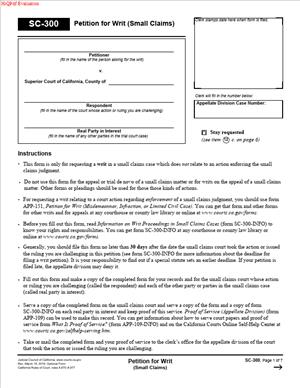
SC-300 – Petition for Writ (Small Claims)
Fill out nowJurisdiction: Country: United States | Province or State: California
The SC-300 – Petition for Writ (Small Claims) is a court filing used after a small claims case has already happened. It is not about starting a new dispute. It focuses on reviewing a specific decision or action taken by the small claims court.
You usually encounter this document when a small claims judgment feels procedurally wrong rather than factually unfair. The form centers on how the case was handled, not whether the outcome felt just. That distinction matters when you are deciding whether this filing fits your situation.
People often look at this form when ordinary small claims options are no longer available. Appeals are limited in small claims, and this document exists within that narrow space. It addresses legal process issues rather than re-arguing evidence.
This document matters because it is one of the few formal ways to ask a higher court to review a small claims matter. The process is technical. Small errors can stop the request before it is reviewed. Understanding the purpose and structure of the form helps you approach it with realistic expectations.
Before filling it out, it helps to understand what this filing can and cannot accomplish. It is not a second trial. It does not reopen testimony. It asks the court to look at whether the lower court acted within its authority.
What is SC-300 – Petition for Writ (Small Claims)?
Clear definition
SC-300 – Petition for Writ (Small Claims) is a written request asking a higher court to review a small claims court decision or procedure. The review is limited. The higher court looks at whether the small claims court made a legal or procedural error.
This form is used to request a writ, not an appeal in the traditional sense. A writ is an extraordinary review tool. It focuses on whether the court exceeded its authority or failed to follow required procedures.
The document does not ask the reviewing court to decide who was right or wrong in the dispute. It asks whether the process itself was legally proper. This narrow focus shapes how the form is completed and reviewed.
The form itself organizes information about the case, the parties, and the specific action being challenged. It also frames the issue in a way the reviewing court can evaluate without re-hearing the case.
Who typically uses this form/document?
This form is commonly used by someone who participated in a small claims case and believes a procedural mistake occurred. That person may be the plaintiff or the defendant in the original case.
Self-represented individuals use this document more often than attorneys. Small claims cases are designed for people without lawyers, and writ petitions often follow that same pattern.
The form may also be used by someone affected by a small claims order even if they were not the primary party. This can happen when the order impacts property, payment, or enforcement actions.
People using this form are often familiar with the small claims process but unfamiliar with higher court procedures. The document bridges that gap by requiring structured, written explanations.
Why you might need this form/document
You might look at this document when you believe the small claims court acted outside its authority. This can include situations where the required notice was missing or a hearing did not follow basic procedural rules.
Another reason this form becomes relevant is when there is no right to appeal. In many small claims situations, appeals are restricted or unavailable, leaving writ review as the only possible court review.
The form also matters when timing is critical. Certain court actions, such as enforcement steps, may move forward unless challenged. The petition brings the issue to the attention of a higher court.
Using this document can clarify the record. Even if the writ is not granted, the filing creates a formal explanation of the claimed procedural issue.
Typical real-life scenarios
- A common scenario involves a defendant who did not receive proper notice of the small claims hearing. After a default judgment is entered, the person discovers the case only when enforcement begins. The petition focuses on the lack of notice rather than the merits of the dispute.
- Another situation arises when a small claims court hears a matter it may not have the authority to decide. This can involve subject matter limits or procedural boundaries. The petition raises the question of whether the court exceeded its role.
- Sometimes a party attends the hearing but is not allowed to present evidence or speak. The petition describes how the hearing process itself was limited. The focus remains on the procedure, not the underlying disagreement.
- There are also cases where a small claims court issues an order without holding a required hearing. The petition outlines the steps that were skipped and why that matters procedurally.
When would you use SC-300 – Petition for Writ (Small Claims)?
This form is used after the small claims court has already taken action. It is not filed before a hearing or instead of attending court. Timing is tied to the event being challenged, such as a judgment or order.
People usually consider this document when other small claims remedies are no longer available. This often happens when the time for requesting reconsideration or other internal court review has passed or does not apply.
The filing commonly comes up when enforcement actions begin. Wage garnishments, bank levies, or liens can trigger a closer look at how the original decision was made.
This document is also used when someone learns new information about the process used in their case. Discovering missing paperwork or procedural shortcuts can prompt review.
While plaintiffs and defendants both use this form, defendants appear more frequently in writ filings. That pattern reflects how judgments and enforcement often affect defendants directly.
The form is not used to negotiate or settle disputes. It is used to request judicial review. That purpose shapes the tone and content of the filing.
Legal characteristics of SC-300 – Petition for Writ (Small Claims)
This document has a formal legal effect once filed correctly. It asks a higher court to exercise supervisory authority over a lower court. That authority is discretionary, not automatic.
Effectiveness depends on procedural accuracy. Courts commonly reject or dismiss petitions that are incomplete, unclear, or filed incorrectly. Small technical issues can prevent review.
The form requires clear identification of the lower court action being challenged. Vague dissatisfaction with the outcome is not enough. The focus is on specific procedural acts or omissions.
Jurisdictional rules matter. While writs exist broadly, the standards and expectations can vary by court and location. In California, small claims writ petitions follow specific procedural frameworks.
This document does not pause enforcement by itself. It also does not guarantee a hearing. The reviewing court decides whether to consider the petition based on its content.
The form does not replace appeals where appeals are allowed. It also does not create new rights or claims. It operates within a narrow review channel.
Is it legally binding?
The filing itself is not a binding decision. It is a request for review. Its legal effect depends on how the reviewing court responds.
If the court grants the writ, the resulting order can be binding on the lower court. That order may direct the small claims court to take or refrain from certain actions.
If the court denies the petition, the original small claims decision generally remains in effect. The denial does not usually include detailed explanations.
The binding force comes from the court’s response, not from submitting the form alone. That distinction is important when evaluating expectations.
How to fill out SC-300 – Petition for Writ (Small Claims)
Step 1 – Identify the court and case
This step involves stating which court issued the small claims decision and identifying the case. You provide basic information so the reviewing court knows what action is being referenced. Accuracy here connects the petition to the correct record.
Step 2 – List the parties
This section names the people or entities involved in the original small claims case. The names must match the small claims case exactly. This allows the reviewing court to understand who is affected by the petition.
Step 3 – Describe the challenged action
Here, you explain what the small claims court did that is being challenged. The description focuses on a specific action or decision. The explanation stays procedural rather than argumentative.
Step 4 – Explain the procedural issue
This step describes why the action is claimed to be improper. The focus is on process, authority, or required steps. The explanation ties the issue to how the court handled the matter.
Step 5 – State the requested review
In this section, you explain what type of court review is being requested. The language stays within the concept of review rather than outcome. This helps the court understand the scope of the petition.
Step 6 – Include supporting details
This step provides additional context that helps clarify the procedural issue. Dates, filings, and the sequence of events matter here. The information supports the explanation without adding new claims.
Step 7 – Sign and date the form
The final step involves signing and dating the document. This confirms that the information is presented formally to the court. The signature completes the submission process.
Legal terms you might encounter in SC-300 – Petition for Writ (Small Claims)
- Petition for Writ: This is the written request asking a higher court to review something that happened in your small claims case. On this form, you explain what action you are challenging and why you believe review is appropriate. It does not re-try the case facts but focuses on procedure or authority.
- Writ of Mandate: This refers to a type of writ asking the reviewing court to order a lower court to perform a required act. In this document, you may be requesting this if you believe the small claims court failed to follow a required rule or process.
- Writ of Prohibition: This is a request asking a higher court to stop a lower court from taking an action. On the form, this usually relates to preventing the enforcement or continuation of an order you believe is improper.
- Respondent: The respondent is the court or judicial officer whose action you are asking the higher court to review. This term appears in the party section and must match the official name used in the case record.
- Real Party in Interest: This is the other party from the small claims case who has a direct interest in the outcome of the writ. You list them because the reviewing court needs to know who could be affected if your request is granted.
- Small Claims Judgment: This is the decision issued at the end of the small claims case. In this form, you are not appealing the judgment itself but pointing to a legal or procedural issue connected to it.
- Jurisdiction: Jurisdiction describes the authority of a court to hear a matter. In this document, you are asserting that the reviewing court has the power to consider your request and that the small claims court acted within or outside its authority.
- Record: The record is the collection of documents, filings, and orders from the small claims case. When completing this form, you often rely on the record to describe what happened and to support your explanation.
- Relief Requested: This is the specific outcome you want from the reviewing court. On the form, you must clearly state what action you want the court to take if it agrees with you.
FAQs
Is SC-300 – Petition for Writ (Small Claims) the same as an appeal?
No. This form is not used to argue that the judge made the wrong factual decision. You use it to challenge a legal or procedural issue, such as whether the court had authority or followed required steps.
What date should I use when describing the challenged action?
You should use the date shown on the order, notice, or minute entry you are challenging. Check the small claims case file so the date you enter matches the official record.
Who signs this document if there were more than one plaintiff or defendant?
The person filing the request signs the form. If multiple people are joining, each signer’s name must be consistent with how they appear in the small claims case caption.
Do I need to attach copies of small claims paperwork?
Yes, you typically attach copies of key documents that show what happened, such as the judgment or order you are challenging. Attachments should be clear and complete so the reviewing court can understand your explanation.
What happens if names on this form do not exactly match the small claims case?
Name mismatches can cause confusion or delay. The reviewing court relies on exact matching to connect this document to the correct case, so you should copy names exactly as they appear in the original filings.
Does filing this form change the public record of my small claims case?
Filing this document creates a new court filing related to your case. It does not erase or rewrite the small claims judgment, but it becomes part of the public court record connected to the dispute.
How do I know if the court accepted my filing?
You usually receive a stamped copy, receipt, or electronic confirmation after submission. Keep that confirmation because it shows the filing date and that the document was received.
Can I correct something after submitting this form?
Corrections may be possible, but they usually require an additional filing or court permission. Review everything carefully before submission so you do not rely on later fixes.
Checklist: Before, During, and After SC-300 – Petition for Writ (Small Claims)
Before
- Confirm the small claims case number and court name from official records
- Identify the exact action or order you are challenging
- Gather copies of judgments, orders, and notices you plan to reference
- Verify the full legal names of all parties as shown in the case
- Decide what specific outcome you want the reviewing court to order
- Set aside time to write a clear and focused explanation
- Review the form fields so you know what information is required
- Prepare a simple timeline of events for your own reference
During
- Write the court name and case number exactly as they appear in the record
- List all parties in the correct roles without abbreviations
- Describe the challenged action using dates and document titles
- Explain the procedural issue without arguing facts of the dispute
- State your requested relief in direct and concrete terms
- Check that attachments are labeled and readable
- Sign and date the form where indicated
- Make sure handwriting or text is easy to read
After
- Make copies of the completed form and all attachments
- Submit the document using the required filing method
- Obtain proof that the court received your filing
- Store stamped copies in a dedicated case folder
- Track any deadlines or notices that follow submission
- Watch for responses or orders from the reviewing court
- Update your personal notes about the case status
- Bring copies to any future hearings or proceedings
Common mistakes to avoid
- Mistake: Treating the form like an appeal because people want to relitigate facts, which can lead to denial, since writ review focuses on procedure, and you should not forget to frame the issue as a legal or authority problem.
- Mistake: Using informal or shortened party names because it feels faster, which can cause confusion in court records, and you should not forget to copy names exactly from the small claims case.
- Mistake: Leaving out dates of the challenged action because you assume the court already knows, which can make the request unclear, and you should not forget to match dates to the official order.
- Mistake: Attaching too many unrelated documents because you want to tell the whole story, which can distract from the issue, and you should not forget to include only what supports the procedural challenge.
- Mistake: Failing to clearly state the relief requested because it seems obvious, which can leave the court guessing, and you should not forget to spell out the exact action you want.
- Mistake: Signing in the wrong place or not signing at all because the form looks complete, which can invalidate the filing, and you should not forget to check the signature and date fields.
- Mistake: Missing a filing deadline because you are gathering more information, which can end the review opportunity, and you should not forget to track time limits early.
- Mistake: Not keeping proof of filing because you trust the process, which can create problems later, and you should not forget to save stamped or confirmed copies.
What to do after filling out SC-300 – Petition for Writ (Small Claims)
Once the form is complete, your focus shifts from writing to managing the filing and follow-up. Organization matters at this stage. Keep everything together and act promptly when the court communicates with you.
- Step 1: Make at least two complete copies of the signed form and all attachments so you have a backup and a personal reference set.
- Step 2: Submit the original document to the appropriate court using the accepted filing method and confirm that all pages are included.
- Step 3: Obtain confirmation of filing, such as a stamped copy or electronic notice, and check that the date is correct.
- Step 4: Place the confirmation and copies into a labeled folder for this case so you can find them quickly later.
- Step 5: Note any new case number or reference number assigned to the writ proceeding and add it to your records.
- Step 6: Watch for notices, orders, or deadlines issued by the reviewing court, as these may require a response or additional documents.
- Step 7: Update any personal timelines or summaries you keep so they reflect that a writ request is pending.
- Step 8: Prepare to explain your filing clearly if the court schedules a hearing or requests clarification.
- Step 9: Keep copies accessible in case you need to provide them to another court or party.
- Step 10: Review any court response carefully so you understand what was decided and what, if anything, you must do next.
Disclaimer: This guide is provided for informational purposes only and is not intended as legal advice. You should consult a legal professional.