The Real Rule: Landlord Law Is Provincial, Procedural, and Unforgiving
Canadian residential tenancy law is not truly “Canadian” in a practical sense. It is provincial law enforced through provincial tribunals. A landlord who considers a notice requirement as “mostly right” often loses, even with a valid grievance. Residential tenancy statutes function as consumer protection regulations. They limit landlord discretion regarding rent increases, deposits, entry, termination, and enforcement.
That constraint creates a predictable business outcome. Landlord files depend on process quality, not just facts. If your notice is defective, a tribunal may never consider the merits. If your evidence is disorganized, a valid claim can fail due to a lack of proof. This is why landlord-side firms that standardize form workflows outperform those that improvise.
For small- to mid-size firms, landlord law is also a volume practice. Volume amplifies small errors. A single defective “end of tenancy notice” may be survivable. A recurring defect across 30 files becomes a margin leak.
Two practical implications follow:
- Your lease is not your authority. The statute is your authority. A lease clause inconsistent with the statute is usually void.
- Your form is part of the law. Where forms are prescribed, a “lease termination letter” that looks reasonable can still be invalid.
Core Statutes and Forums (What Controls the File)
The first compliance task is to identify the correct statute and the correct forum. Lawyers and operators should treat this as an intake checklist item, not an assumption.
Table 1 — Governing Laws and Decision-Makers
Alt text: Residential tenancy statutes and landlord adjudication bodies by province in Canada
| Province | Governing Law | Primary Forum / Decision-Maker | Practical consequence for landlords |
| Ontario | Residential Tenancies Act, 2006 | Landlord and Tenant Board | Prescribed forms dominate. Defects commonly cause dismissal. |
| Alberta | Residential Tenancies Act | RTDRS / Provincial Court | Content + service compliance matters; templates are common but not numbered like Ontario. |
| Saskatchewan | The Residential Tenancies Act, 2006 (often informally called “landlord and tenant act Saskatchewan”) | Office of Residential Tenancies | Online portal and provincial forms are central. |
| British Columbia | Residential Tenancy Act | Residential Tenancy Branch | Form precision is high; web portal use is increasingly required for some notices. |
| Quebec | Civil Code of Québec (residential lease rules) | Tribunal administratif du logement | Different concepts and timelines; “resiliation” replaces common-law “termination.” |
Sources: official statutes and tribunal guidance.
Ontario landlord tenant bill awareness
If you advise Ontario landlords, track legislative change as a compliance risk. Ontario has seen proposed and enacted bills affecting landlord-tenant frameworks, including Bill 60 (Fighting Delays, Building Faster Act, 2025) and proposed amendments such as Bill 163 (Relief for Renters Act, 2024). Treat these as moving parts that can affect procedures and form updates.⁷ ⁸
What Landlords Can Do (When They Do It Correctly)
Landlords have enforceable rights, but statutes limit those rights under certain conditions.
Set rent at the start of a tenancy
In most provinces, landlords can set initial rent at market levels, subject to human rights constraints and statutory prohibitions on certain conduct. Ontario rent control rules depend on unit qualification and timing.
Collect deposits within caps
Deposit rules are not uniform. Ontario limits deposits to last month’s rent. Alberta caps security deposits at one month’s rent. Saskatchewan uses statutory controls on deposit handling and return.
For landlord-side practice management, deposits matter because they intersect with evidence. If you claim damage, you need move-in condition proof and a documented repair trail. A deposit dispute becomes a documentation contest.
Enter the unit—only when the statute allows it
Most provinces permit entry for inspections, repairs, and showings, but require notice, compliance with timing and purpose requirements, and other conditions. Entry disputes are often “credibility disputes.” Your best protection is documented notice, timestamps, and consistent procedures.
Terminate a tenancy—only for a statutory ground, using the statutory process
Landlords cannot terminate the relationship because it soured. They terminate because the statute recognizes a ground for termination. This includes non-payment, substantial breach, illegal acts, and in some provinces landlord’s own use. The legal gate is always the same: ground + notice + form + service + proof.

What Landlords Cannot Do (Even If the Lease “Authorizes” It)
Self-help eviction
Lockouts, utility shutoffs, and removal of property without an order are prohibited. Provinces treat these as serious violations.
Retaliation and punitive leverage
If a tenant complains, files with the tribunal, or asserts statutory rights, landlords cannot retaliate by terminating or reducing services. Ontario’s statute explicitly addresses reprisal.
Contracting out
A lease clause that waives statutory rights is usually void. “They signed it” is not a defense. This is one reason landlord forms must be standardized: inconsistent clauses can put landlords in unenforceable positions.
The Termination Engine: Ground, Notice, Form, Service, Proof
Landlords win termination disputes when they operationalize five steps:
- Confirm the ground fits the statute. Labeling does not matter; the facts do.
- Use the correct “end of tenancy notice.” Notice periods vary by ground.
- Use the correct form. In Ontario and BC, form mismatch is a high-risk for dismissal.
- Serve properly. Service is often the easiest issue to prove and the most neglected.
- Build proof contemporaneously. A hearing is not where you “reconstruct” your file.
Landlord-side workflows should assume the tenant will challenge at least one of these steps. Build the file as if it will be litigated, even if you expect a settlement.
The Five Most Important Landlord Forms in Each Province (Use These Correctly)
Landlord errors are rarely conceptual. They are usually mechanical: wrong form, missing field, wrong dates, or poor service proof.
Table 2 — Five High-Impact Landlord Forms by Province
Alt text: Most important landlord termination and enforcement forms under the Residential Tenancies Act systems and Quebec civil law
| Province | Five forms/notices landlords use most | Why these matter |
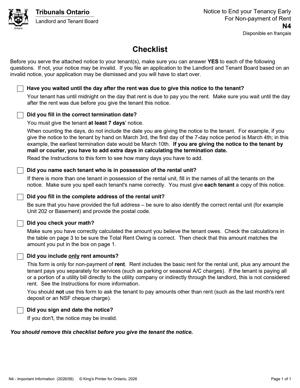
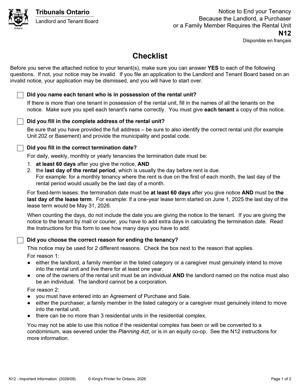
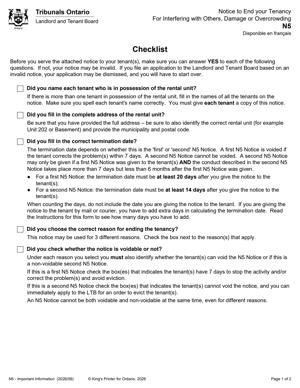
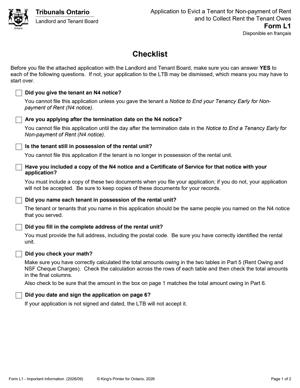
| Ontario | N4 (non-payment), N5 (damage/interference/overcrowding), N11 (mutual agreement to end tenancy), N12 (landlord’s own use), L1 (eviction application for non-payment) | Ontario’s Landlord and Tenant Board is form-driven; correct forms anchor admissible relief. |
| Alberta | 14-Day Notice (non-payment), Notice for Substantial Breach, Notice for Illegal Acts, Mutual Termination Agreement (written), RTDRS Application | Alberta uses statutory content requirements. The Termination Handbook outlines notice elements and follow-on steps. |
| Saskatchewan | Form 7 (notice to vacate / arrears forms exist), Notice of Rent Increase (ORT form), Application for Termination/Possession, Order of Possession Application, Written Mutual Agreement | Saskatchewan’s ORT portal and forms drive process. Rent increase and termination are common compliance traps. |
| British Columbia | RTB termination notices + landlord dispute resolution applications (including mutual agreement forms) | BC requires prescribed tenancy forms; the province publishes a comprehensive forms library and portal workflows. |
| Quebec | TAL lease and notice set: lease (“bail”), rent increase/modification notice, resiliation/termination-related notices, and TAL applications | Quebec requires the use of the TAL lease form for new residential leases and provides notice templates, including rent increase/modification notices. |
Official forms portals and guidance: Ontario LTB; BC tenancy forms; Saskatchewan ORT pages and ORT PDFs; Alberta termination handbook and RTDRS forms; Quebec TAL forms.
A keyword reality check for SEO and practice
Your clients will still search “landlord and tenant board” even when they mean “tribunal.” They will search “Residential Tenancies Act Ontario” even when they need an L1 application. They will search “lease termination letter” even when the statute requires an N-form notice. Your content should capture those searches and correct them.
Mutual Agreement to End Tenancy: Settlement Without Procedural Risk
A mutual agreement to end tenancy is often the fastest landlord outcome when the relationship is salvageable enough to negotiate an exit.
- In Ontario, the LTB publishes Form N11 (Agreement to End the Tenancy).
- In BC, the province publishes mutual agreement forms in the tenancy forms library.⁵
- In Alberta and Saskatchewan, written agreements are accepted, but clarity and voluntariness matter.
- In Quebec, the civil-law concept is resiliation by agreement, often described in landlord practice as “resiliation bail Quebec.” Quebec’s housing authorities emphasize the use of the TAL lease form (“bail”) and related notices.
A mutual termination agreement fails when it reads like coercion. The landlord-side best practice is to document: (1) the termination date, (2) consideration, if any, (3) the condition of return and keys, and (4) release language that does not contradict statutory rights.
Operational note: Even where a mutual agreement exists, keep proof of service and execution. Tenants sometimes deny that they agreed or claim a misunderstanding.
Early Termination of Lease Agreement and the “Penalty” Myth
Landlords and managers routinely ask: “What is the penalty for breaking a lease?” This question matters because it drives settlement posture.
In most Canadian residential regimes, there is no automatic “penalty clause” that landlords can enforce, like liquidated damages. Landlords may claim actual losses, typically limited to rent lost during the reasonable re-rental period, plus provable re-rental costs, subject to mitigation duties. Ontario’s statutory framework explicitly addresses mitigation expectations in this context.
The practical landlord rule: treat early termination as a damages-and-mitigation file, not a punishment file. A landlord who refuses to re-rent or who rejects reasonable replacement tenants undermines their damages claim.
Where tenants have statutory early-termination rights (for example, safety-related regimes), landlords must follow the statute or risk counterclaims and credibility damage. If you do not have a strong published authority for a specific claimed “penalty,” say so. As of June 2025, there is no universal published appellate rule imposing punitive penalties for lease-breaking across Canadian provinces.
Month-to-Month Lease Termination: The Silent Trap for Landlords
Most fixed-term residential leases convert to a periodic tenancy at the end of the term. Landlords often assume they can end the tenancy by giving a “month’s notice.” In many provinces, that is wrong unless the statute permits termination for that reason.
This is why “month-to-month lease termination” searches are so common. Landlords want a simple answer. The correct answer is procedural: the landlord needs a statutory ground and the correct notice/form.
Ontario is the clearest example. Landlords cannot end a tenancy merely because the lease term ended. They must use statutory grounds and board-recognized notices and applications.
Practice implication: build a rule into intake. If the file is month-to-month, the file is not “easier.” It is often harder because landlords mistakenly rely on informal letters.
Service and Proof: The Evidence Most Landlords Forget to Create
Landlords lose hearings because they cannot prove what they did. The law often rewards the party with the better paper trail.
A landlord-side file should include:
- the notice or form (final version served)
- proof of service (method, time, address, and who served)
- rent ledger and payment history (for non-payment)
- condition documentation (photos, dated repair invoices, inspection reports)
- communication log (one timeline, not a pile of messages)
BC’s forms library includes proof-of-service documents and dispute resolution packaging guidance. Treat that as a workflow benchmark, even if your province does not prescribe identical proofs.
Table 3 — Landlord Proof Package by Common Ground
Alt text: Evidence checklist landlords should assemble for common Residential Tenancies Act termination grounds
| Termination ground | What you must prove | Best landlord evidence | Common failure |
| Non-payment | arrears and proper notice | rent ledger, bank records, served notice + proof | missing ledger continuity; service not proven |
| Substantial breach/damage | breach + seriousness + steps taken | photos, repair invoices, written warnings, witness notes | evidence created after the fact |
| Illegal acts | factual basis and statutory threshold | police occurrence number, if relevant, witness statement, dated incident log | relying on hearsay or vague allegations |
| Landlord’s own use | genuine intent + statutory compliance | sworn statement, timeline, evidence of planned occupancy | weak documentation; inconsistent story |
| Mutual agreement | voluntary agreement + clear date | signed agreement, proof of execution and delivery | unclear date or disputed consent |
This table reflects cross-province proof logic; specific requirements vary by statute and forum.

Ontario Deep Cut: Forms, the Landlord and Tenant Board, and “Ontario Landlord Tenant Bill” Change Risk
Ontario remains Canada’s highest-volume tribunal environment, with a strong procedural culture. Landlords who treat the LTB as “small claims with forms” get burned. It is a specialized tribunal with its own expectations.
Three Ontario realities matter for landlord-side operators:
- The LTB form ecosystem is a compliance system. Ontario’s LTB publishes forms and filing guidance through Tribunals Ontario.
- Non-payment files require discipline. L1-style eviction workflows should be standardized, with rent ledgers auto-generated and service proof templated.
- Legislative updates can change procedures. Ontario has enacted and proposed legislation affecting landlord-tenant frameworks, including Bill 60, receiving Royal Assent, and proposed amendments like Bill 163.
If your content uses the phrase “Ontario landlord tenant bill”, clarify what you mean. Lawyers should cite the bill number and status and then explain operational impact: whether forms change, timelines change, or hearing processes change. Use official legislative sources when you do this.
Alberta Practical Focus: Termination Rules and Follow-On Steps
Alberta’s Residential Tenancies Act system relies heavily on proper notice content, timing, and follow-through. Alberta’s public guidance emphasizes that written notice must state the reason and termination date, and that landlords must apply to court or RTDRS when the tenant does not vacate after certain notices.
Two landlord-side practice points:
- 24-hour and short-notice scenarios are higher risk. They require precise facts and immediate follow-on filings if the tenant does not leave.
- RTDRS filing readiness matters. Alberta provides RTDRS forms, including landlord applications for termination and unpaid rent. Standardize your evidence bundle before filing.
For law firms, Alberta benefits from a “one file, one bundle” approach: rent ledger, notice, service proof, communications, and relief requested, assembled once and reused.
Saskatchewan Practical Focus: The ORT Portal, Rent Increases, and Termination Discipline
Saskatchewan’s Office of Residential Tenancies provides guidance on ending a tenancy and makes notices and applications available through its portal. Rent increase workflows are also standardized through government guidance and ORT forms, including a published “Notice of Rent Increase” template.
Two practical landlord warnings:
- Rent increase mistakes often create tenant disputes and delay revenue adjustments. Use the government’s form and follow the timing rules.⁹
- Termination workflows should not be “letter-based.” Use the ORT’s notice and application structure.
If your clients still call it the “landlord and tenant act Saskatchewan,” meet them there in your intake, then map them to the correct statute and ORT process.
British Columbia Practical Focus: Forms Library Discipline and Portal Reality
BC provides a comprehensive tenancy forms library and increasingly portal-dependent workflows for certain notices and dispute resolution actions.
Landlord-side success in BC often comes down to document precision:
- correct notice type
- correct service method
- correct timing
- correct dispute resolution filing approach
BC’s forms page is also a good benchmark for other provinces because it explicitly organizes forms by tenancy lifecycle: starting a tenancy, rent increases, ending tenancy, dispute resolution, and proof of service.
For law firms, this structure maps cleanly onto matter stages in practice management software.
Quebec Deep Cut: “Bail,” Mandatory Forms, and Resiliation Vocabulary
Quebec is not a Residential Tenancies Act province. It is a civil-law province with a codified lease framework and a specialized housing tribunal.
Two Quebec landlord workflow rules matter:
- Quebec’s housing guidance emphasizes the TAL lease form for new residential leases (“bail”).
- The TAL publishes forms and notices, including rent increase/lease modification notice templates and procedural forms for tribunal applications.
In Quebec practice, landlords and managers commonly use the language “resiliation du bail” for termination. If you are doing SEO for “resiliation bail Quebec,” treat the term as a gateway keyword, then translate it into the correct TAL process and notice documentation.
Quebec has also seen heightened technicality around notice content for lease modifications, including rent increases. Use the TAL notice templates rather than drafting from scratch.
Why Compliance Matters to Law Firms: Cycle Time, Realization, and Risk
For landlord-side law practices, residential tenancy work becomes profitable when it is standardized. The value is not in rethinking the statute on every file. The value is in executing a correct, repeatable compliance pipeline.
Compliance failures hurt in three ways:
- Delay: a dismissed application resets timelines.
- Write-down pressure: clients resist paying for repeated procedural work.
- Risk: self-help or improper tactics can create counterclaims.
There is no consolidated national dataset quantifying dismissal rates by tribunal (No published national dataset as of June 2025). Individual tribunals publish varying guidance and statistics, but not in a standardized, comparable format. When you lack a strong national benchmark, do not invent one. Track your own firm’s internal outcomes instead.
RunSensible Forms: Faster, Safer Form Completion for Landlord Workflows
Landlord-side teams spend outsized time on forms because forms are the law in practice. The goal is not “filling faster.” The goal is to reduce defect risk while increasing throughput.
RunSensible Forms can support landlord compliance by turning form completion into a guided workflow:
- Easy form filling: users complete landlord notices and applications through structured fields rather than unstructured drafting.
- Full form details: each form can be paired with an operational context: when to use it, what facts trigger it, which evidence to attach, and what common errors cause dismissal.
Compliance note: AI tooling should not replace legal judgment. It can reduce mechanical errors and improve file completeness. Lawyers remain responsible for legal positions, statutory interpretation, and tribunal advocacy.

Self Represent vs Counsel: What Landlords Should Actually Do
Landlords can self-represent in many residential tenancy forums. Success depends on doing procedural work correctly: selecting the right form, completing required details, serving properly, and proving the ground with organized evidence. A lawyer is optional, but often helpful in own-use terminations, bad-faith allegations, complex arrears ledgers, and rent-control disputes.
This is also where tenant dispute lawyers change outcomes. Experienced tenant counsel often wins on process defects, credibility contradictions, and evidence gaps. Landlords who self-represent should assume those vulnerabilities will be exploited. The landlord-side solution is not “argue harder.” It is “file cleaner.”
Frequently Asked Questions
Which statute governs landlords in Ontario?
Ontario landlords operate under the Residential Tenancies Act, 2006, and disputes are heard by the Landlord and Tenant Board. The LTB publishes official forms and filing guidance through Tribunals Ontario.²
Is a lease termination letter enough to end a tenancy?
Often no. A “lease termination letter” is not the same as a statutory notice. In provinces with prescribed forms, landlords must use the correct “end of tenancy notice” form and comply with service rules. Ontario and BC are the highest-risk examples.
What is the penalty for breaking a lease early?
Usually, there is no automatic penalty. Landlords typically claim actual losses, limited by mitigation. Ontario’s framework explicitly addresses mitigation expectations. If you cannot cite a binding penalty authority, do not assume one exists.
How does a mutual agreement to end tenancy work?
It is a signed, voluntary agreement setting a termination date and exit terms. Ontario provides Form N11 for this purpose. BC publishes mutual agreement forms in its forms library.² ⁵
Can landlords self-represent at hearings?
Yes. Landlords can self-represent, but they must select the right form, complete the required details, serve correctly, and prove their ground with organized evidence. A lawyer is optional but often helpful in complex cases.
What does “resiliation bail Quebec” mean in practice?
It describes Quebec’s civil-law concept of ending a residential lease (“bail”). Quebec landlords use TAL forms and notice templates, including rent increase/lease modification notices. Quebec procedure differs from that of common-law provinces.
References
-
Service Alberta. (n.d.). Termination of a Tenancy (RTA handbook/tipsheet).
https://www.servicealberta.gov.ab.ca/pdf/tipsheets/Termination_of_a_Tenancy_RTA_Handbook_BW.pdf -
Government of Saskatchewan. (n.d.). Ending a tenancy (ORT guidance/portal).
https://www.saskatchewan.ca/residents/housing-and-renting/renting-and-leasing/giving-notice-to-end-a-tenancy -
Government of British Columbia. (n.d.). Tenancy forms — Residential Tenancy Branch.
https://www2.gov.bc.ca/gov/content/housing-tenancy/residential-tenancies/calculators-and-resources/tenancy-forms -
Tribunal administratif du logement. (n.d.). Formulaires (TAL forms and notices).
https://www.tal.gouv.qc.ca/fr/formulaires -
Legislative Assembly of Ontario. (2024). Bill 163, Relief for Renters Act, 2024.
https://www.ola.org/en/legislative-business/bills/parliament-43/session-1/bill-163 -
Tribunal administratif du logement. (n.d.). Notice of rent increase and modification of another condition of the lease (TAL notice).
https://www.tal.gouv.qc.ca/sites/default/files/notices/TAL_806A_E.pdf -
Gouvernement du Québec. (n.d.). Bail (TAL lease form requirement and information).
https://www.quebec.ca/habitation-territoire/location/bail -
Government of Alberta. (n.d.). RTDR0007 — Landlord’s Application for Termination of Tenancy and Unpaid Rent.
https://cfr.forms.gov.ab.ca/Form/RTDR0007
Disclaimer: The content provided on this blog is for informational purposes only and does not constitute legal, financial, or professional advice.
Contents