OREA Form 123 – Waiver – Agreement of Purchase and Sale
Fill out nowJurisdiction: Country: Canada | Province or State: Ontario
What is an OREA Form 123 – Waiver – Agreement of Purchase and Sale?
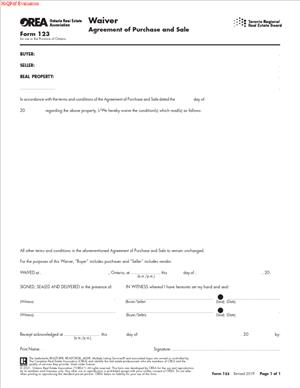
OREA Form 123 is the Ontario Real Estate Association’s standard waiver used to remove one or more conditions in a signed Agreement of Purchase and Sale (APS). Its function is narrow and precise: it identifies the APS, names the parties, pinpoints the condition(s) that protect one party, and removes those condition(s) when signed and delivered on time. Once all conditions are removed or fulfilled, the deal becomes firm under the existing terms.
Conditions in an APS are protective checkpoints. Common ones include financing approval, a satisfactory home inspection, confirmation of insurability, a review of a condominium status certificate, or a “sale of buyer’s property” clause. They pause the full legal effect of the APS until met, fulfilled, or waived. A waiver is the written decision by the party who benefits from a specific condition to relinquish that protection. Only the beneficiary can waive; neither party can waive a condition designed for the other.
Most residential conditions are for the buyer’s benefit, but sellers may also hold conditions (for example, a discharge of a specific encumbrance). The wording reveals who is protected: “This Offer is conditional upon the Buyer…” signals a buyer condition; “This Offer is conditional upon the Seller…” points to the seller. If multiple people or entities benefit (e.g., two buyers), all beneficiaries must sign.
Typical reasons to use the waiver
- Financing is approved (or acceptable alternatives are secured).
- The home inspection is satisfactory, or you are prepared to accept issues without other changes.
- Property insurance is confirmable on reasonable terms.
- Your lawyer’s review of a condo status certificate is acceptable.
- You choose to proceed despite an unsold current home (SPP).
A waiver does not change any other APS term: price, closing date, inclusions/exclusions, representations, or deadlines remain exactly the same. If you need to alter terms or extend a timeline, the appropriate instrument is an amendment signed by both parties. If you want to confirm satisfaction (not merely give up the protection), some parties use a fulfillment notice; but when you intend to remove a condition that benefits you, the Form 123 waiver is the correct tool.
Timing and delivery are critical. The waiver must be signed by all required beneficiaries and delivered exactly as the APS’s Notices clause permits, before the condition’s expiry date and time. When properly delivered on time, it is binding and cannot be unilaterally withdrawn. If every remaining condition is removed, the APS is firm, and both sides are bound to close on the original terms.
Waiving carries risk because it removes a safety net. If you waive financing and later cannot fund, you may be in default, risking loss of your deposit and possibly more. Coordinate with your lender, insurer, and lawyer before waiving important protections. Treat waiver as your final step from conditional to firm.
When Would You Use an OREA Form 123 – Waiver – Agreement of Purchase and Sale?
You use Form 123 during the conditional period in the APS. The waiver must be executed by the condition’s beneficiary and delivered per the Notices clause on or before the stated deadline. If you meet those formalities, the listed condition(s) are removed and the deal continues under existing terms.
Common buyer scenarios
- Financing confirmed: You have a clear approval for the specific property and loan amount, and you can meet any lender conditions (e.g., appraisal, documentation) before closing.
- Inspection acceptable: You accept the property’s condition as-is or after negotiations have failed, with no further requests for repairs or price changes.
- Insurance verified: You obtained a bindable quote, including any required upgrades or inspections you are prepared to complete.
- Status certificate review: Your lawyer has reviewed the condo documents, and you have chosen to proceed despite any noted risks or open issues.
- Sale of buyer’s property: You decide to proceed even if your current home is unsold, confident you can carry both properties or have arranged appropriate financing.
Seller scenarios
- Seller-benefit condition: If a clause protects the seller (e.g., discharge of an encumbrance by a date) and the seller is satisfied or willing to accept the risk, the seller may waive it to firm the deal (subject to remaining buyer conditions).
When a waiver is not appropriate
- Mutual benefit conditions: A clause designed to protect both parties cannot be unilaterally waived. Use a mutually signed amendment to alter or remove it.
- Conditions benefiting the other party: You cannot waive a condition protecting the other side.
- Need more time or changes: Use an amendment to extend deadlines or modify terms. A waiver cannot add time or impose new obligations.
- After expiry: A late waiver is typically ineffective, especially where “time is of the essence.” If a condition expires without a proper waiver or extension, the APS may become null and void. Reviving the deal usually requires a signed amendment executed before expiry or a new APS.
Practical timing tips
- Track all expiry dates and exact times (often, “local time of the property” governs). Avoid last-minute transmissions.
- Push third-party steps early (appraisal, status certificate order and review, insurer underwriting) to avoid deadline pressure.
- Prepare a draft waiver populated with the precise condition language so you can execute quickly when ready.
- Confirm delivery logistics under the Notices clause (correct brokerage addresses/emails) and allow extra time for receipt and acknowledgment.
Use waiver strategically. Competitive markets may tempt premature waivers. Do not waive unless you independently confirm you can close. Once waived, the protection is gone.
Legal Characteristics of the OREA Form 123 – Waiver – Agreement of Purchase and Sale
Key legal features
- Beneficiary requirement: Only the party who benefits from the condition may waive it. If multiple beneficiaries exist, all must sign. Corporate parties must sign through authorized signatories with authority indicated.
- Strict timing: Deadlines are strictly enforced where “time is of the essence.” The waiver must be delivered before the condition’s expiry.
- Clear identification: The waiver must accurately identify the APS (date, property) and the exact condition(s) being removed. Ambiguity invites disputes.
- Notices compliance: Deliver the waiver exactly as the APS allows (recipient, address, method). Delivery to a non-authorized address or method risks ineffectiveness.
- Consideration: The APS provides consideration; no new payment is required for a valid waiver.
- Irrevocability: Once properly delivered and effective, a waiver cannot be unilaterally retracted.
- No term changes: A waiver removes conditions only; it does not alter any other term. Amendments require both parties’ signatures.
- Proof: Maintain evidence of delivery and timing (email headers, e-sign audit trails, fax confirmations, acknowledgments).
- Condition type: Most APS conditions are conditions precedent that must be satisfied, fulfilled, or waived before the APS becomes firm. Some rare conditions may allow termination later if unmet; understand which type you’re addressing.
- Parties and capacity: Names and capacities on the waiver should mirror the APS (individuals, spouses, corporations, trustees, power of attorney). Mismatched execution can undermine effectiveness.
Consequences of waiving
- Risk assumption: You accept the risk that the condition was meant to mitigate (e.g., hidden defects if you waive inspection).
- Default exposure: If you waive financing and cannot close, you may forfeit your deposit and face damages.
- Third-party alignment: A waiver does not create lender approval or insurance coverage. Confirm external readiness before waiving.
Professional guidance
- Real estate agents can prepare the form, but legal advice is wise for unusual or complex conditions (commercial use, zoning, environmental, wells/septics, tenancies) or where drafting is non-standard. Counsel can confirm who benefits and whether a tailored amendment is preferable to a waiver.
How to Fill Out an OREA Form 123 – Waiver – Agreement of Purchase and Sale
1) Identify the agreement
- Insert the APS date exactly as on page one of the APS.
- Write the full property address, including unit, parking, and locker details if applicable.
- Enter party names exactly as in the APS (spelling, order, corporate style, “o/a” if used).
- Optional: include the legal description or PIN if consistent with the APS.
- Cross-check all details to avoid clerical discrepancies.
2) Confirm who is waiving
- Read the condition’s language to identify the beneficiary. “Conditional upon the Buyer…” indicates a buyer condition; “Conditional upon the Seller…” indicates a seller condition.
- Only the beneficiary can waive unilaterally. Mutual-benefit conditions require an amendment signed by both parties.
- Ensure all beneficiaries sign (all buyers or all sellers who benefit). If an entity signed, use an authorized signatory and indicate authority to bind.
- Match signers to the APS (including spouses or attorneys-in-fact where applicable).
3) Specify the condition(s) to be waived
- List each condition separately and precisely, with clause numbers and schedule references (e.g., “Buyer financing condition, Schedule A, para 2”).
- Quote key wording for customized clauses to avoid ambiguity.
- Avoid generic phrasing like “we waive all conditions.” Only the conditions you list are removed; unlisted ones remain.
- Do not attempt partial waivers (“except roof”). Carve-outs require a mutually signed amendment.
4) Check the deadline
- Confirm each condition’s expiry date and time (and time zone).
- The waiver must be delivered before expiry; signing alone is insufficient.
- Date the waiver; optionally note signing time, but timely delivery controls.
- Allow for delays (after-hours brokerage access, email queues). Deliver early.
5) Keep other terms unchanged
- Do not add or change terms on the waiver. New obligations or changes require an amendment signed by both parties.
- Use an amendment to extend a condition deadline or adjust price, credits, holdbacks, inclusions, or closing date.
6) Signatures
- All beneficiaries sign and date. Ensure signatures align with names and capacities on the APS.
- If multiple beneficiaries exist, each must sign. Initial any handwritten edits.
- Witnesses are typically optional unless brokerage policy dictates.
- Electronic signatures are common if permitted by the APS; keep e-signature audit trails.
7) Delivery and receipt
- Deliver per the APS’s Notices clause (recipient brokerage, address/email, allowed method).
- Verify correct delivery details from the APS. Avoid sending only to a salesperson’s personal email unless expressly permitted.
- Obtain acknowledgment of receipt with date/time. Keep email timestamps, e-sign certificates, or fax confirmations.
- If hand-delivering, get a signed receipt; if electronic, ensure file legibility.
8) File and notify
- Send the executed waiver to your lawyer and, if applicable, your lender or broker.
- Keep a copy with the APS and related documents.
- Update your checklist for any remaining conditions or milestones.
9) Multiple conditions
- You may waive some conditions and leave others active. Only the listed conditions are removed.
- Be explicit; do not imply all conditions are gone unless they are.
- Once all conditions are removed or fulfilled, the deal is firm, and you must close per the APS.
10) After delivery
- Confirm timely receipt with both brokerages and update the transaction status (firm if all conditions are cleared).
- Stop work on waived conditions and continue due diligence on the remaining ones.
- Proceed with closing steps: finalize mortgage instructions, secure insurance binders, coordinate appraisals, provide your lawyer with identification and funds direction, and schedule movers and utilities.
Legal Terms You Might Encounter (Bring OREA Form 123 – Waiver – Agreement of Purchase and Sale)
- Condition: A requirement that must be satisfied, fulfilled, or waived for the APS to remain binding or become firm.
- Waiver: A unilateral declaration by the beneficiary relinquishing the protection of a condition.
- Benefitting party: The party for whose protection a condition exists; only this party can waive it unilaterally.
- Mutual benefit condition: A clause protecting both parties; it can only be removed or changed by a signed amendment.
- Consideration: The value that supports a contract. The APS supplies consideration; no new consideration is needed for a waiver.
- Delivery: Sending the signed waiver using the methods and addresses in the APS’s Notices clause, before the deadline.
- Time is of the essence: A term making deadlines strict and enforceable; late delivery typically invalidates the waiver.
- Acknowledgment of receipt: Written confirmation that the waiver was received and when; useful for resolving timing disputes.
- Execution: Proper signing by all required beneficiaries in the correct legal capacity.
- Amendment: A document signed by both parties that changes APS terms or extends deadlines.
- Firm deal: Status after all conditions are removed/fulfilled; both parties must close on the original terms.
- Default: Failure to complete obligations under a firm APS, potentially leading to deposit loss and damages.
- Notices clause: The APS section dictates how and where formal notices (including waivers) must be delivered.
- Condition precedent vs. condition subsequent: A precedent must be cleared before the APS is firm; a subsequent (rarer) may allow termination later if unmet.
FAQs (Bring OREA Form 123 – Waiver – Agreement of Purchase and Sale or Form category)
Do you need the other party to sign your waiver?
No. If the condition benefits you, only you (and any co-beneficiaries) sign. Proper delivery on time makes it effective. Mutual conditions require a signed amendment instead.
Do you have to waive all conditions at once?
No. You may remove one or more and leave others. Be specific about which ones you’re waiving.
Can you waive a condition after the deadline?
Generally no. If a deadline passes without a proper waiver or a signed extension, the condition typically fails, and the APS may be void.
Can you send the waiver by email or e-sign it?
Often, yes, if the APS allows electronic signatures and specifies email as an acceptable delivery method. Follow the Notices clause precisely and keep timestamped proof.
Can you revoke a waiver after you send it?
Usually no. A properly delivered waiver is binding and irrevocable. Confirm financing, insurance, and legal review before sending.
What happens if you waive financing and later can’t fund?
You may be in default, risking loss of deposit and potential damages. Do not waive unless you are confident you can close.
Can the seller refuse your waiver?
If the condition is solely your benefit and delivery is proper and on time, no consent is required. If the condition is not solely yours, a unilateral waiver is ineffective.
Do you need to explain why you’re waiving or attach reports?
No. The waiver should simply identify the APS and the condition(s) being removed. Keep supporting documents in your file.
What if the waiver has a typo in a name or address?
Minor clerical errors may not invalidate a waiver if the APS is clearly identifiable and delivery is proper, but accuracy minimizes disputes. Match the APS exactly.
Is delivery to the salesperson’s personal email sufficient?
Not unless the Notices clause permits it. Deliver to the addresses specified in the APS and request acknowledgment.
Can one co-buyer waive a condition without the other?
No, if both benefit. All beneficiaries must sign for the waiver to be effective.
Does a witness need to sign?
Generally, no, unless the brokerage policy requires it. Proper execution by beneficiaries and compliant delivery are what matter.
Is a waiver the same as confirming fulfillment?
No. Waiver removes the protection regardless of actual satisfaction; fulfillment confirms the requirement was met. Either way, you cannot later rely on that condition to terminate.
Can you add a repair credit or holdback on the waiver?
No. Use an amendment signed by both parties to change any term or add credits/holdbacks.
If the condition requires written notice of fulfillment or waiver, is Form 123 sufficient?
Yes, if completed and delivered as the APS requires, and the condition is described accurately.
What if the waiver is late, but the other side acknowledges it?
Acknowledgment does not usually cure lateness when time is of the essence. You would need a signed amendment to extend or revive a deadline.
Can the seller waive a buyer’s condition to force the deal firm?
No. Only the beneficiary can waive a condition.
Do you need to pay the deposit before waiving?
Deposit timing is governed by the APS. While not a legal prerequisite to waiving, ensure you comply with deposit deadlines to avoid issues.
Checklist: Before, During, and After the OREA Form 123 – Waiver – Agreement of Purchase and Sale
Before signing
- Copy of the fully signed APS with all schedules, amendments, and the Notices clause.
- Condition text (clause numbers and exact wording) you intend to waive.
- Verified deadlines (date, time, time zone) and reminders before expiry.
- Third-party confirmations: lender commitment, insurability, inspection report, and lawyer’s review.
- Correct delivery details per the Notices clause (brokerage names, emails, fax numbers, addresses).
- Exact party names and signing authority (corporations, trusts, POAs).
- Draft waiver prepared with APS references and condition language.
During signing
- Confirm APS date, property, and party names match the APS.
- Precisely identify each condition being waived with clause/schedule references.
- Ensure no new terms are added.
- Date the waiver and verify delivery time will precede the deadline.
- Obtain all required signatures; maintain e-signature audit trails if used.
- Assemble a clean, legible PDF and prepare a brief cover note requesting acknowledgment.
After signing
- Deliver promptly per the Notices clause; allow cushion time for receipt.
- Capture and store acknowledgment and transmission proof with timestamps.
- Provide copies to your agent, lawyer, and lender as appropriate.
- Update your timeline; mark conditions waived and whether the deal is now firm.
- File the executed waiver with the APS and related communications.
- Note next steps that become time-sensitive after firming (appraisals, insurance binder, legal instructions, utilities, movers).
Common Mistakes to Avoid OREA Form 123 – Waiver – Agreement of Purchase and Sale
- Vague or incorrect clause references: Not specifying the exact condition and location can cause disputes or ineffective waivers.
- Missing the deadline: Assuming a short delay is acceptable is risky; lateness usually invalidates the waiver.
- Adding new terms on a waiver: Credits, repairs, holdbacks, or date changes belong in an amendment, not a waiver.
- Waiving a non-beneficiary or mutual condition: Unilateral waivers are ineffective where the condition protects the other party or both parties.
- Poor delivery compliance: Sending to the wrong address or method, contrary to the Notices clause, risks ineffectiveness.
- Incomplete signatures: All beneficiaries must sign; missing signatures can invalidate the waiver.
- Confusing waiver with fulfillment: Use the correct instrument to avoid misunderstandings about what occurred.
- Waiving without third-party readiness: Proceeding without lender/insurer certainty exposes you to default.
- Relying on drafts or unsigned documents: Only executed and properly delivered waivers are effective.
- Weak recordkeeping: Lack of proof of timely delivery makes disputes harder to resolve.
What to Do After Filling Out the Form OREA Form 123 – Waiver – Agreement of Purchase and Sale
- Deliver immediately using the approved method, recipients, and addresses per the Notices clause, with time to spare.
- Preserve proof: email threads, e-sign certificates, fax logs, and acknowledgments with timestamps.
- Notify stakeholders: your real estate representative, lawyer, lender, and any co-parties; share the executed waiver and confirm next steps.
- Update status: mark the APS firm if all conditions are removed; track any remaining deadlines closely.
- Use amendments where needed: if you require more time or any term change, prepare and sign an amendment before deadlines expire.
- Organize your file: store the waiver with the APS, amendments, notices, and communications for easy retrieval.
- Plan forward:
- Finalize mortgage instructions; deliver any outstanding documents; facilitate appraisal.
- Confirm insurance and obtain a binder or certificate.
- Coordinate with your lawyer on searches, encumbrances, funds, and the statement of adjustments.
- Arrange utilities, movers, and service transfers consistent with the closing date.
- For condos, book move elevators and follow the property manager’s requirements.
- For rural properties, schedule any needed water, septic, or related inspections you agreed to assume.
Disclaimer: This guide is provided for informational purposes only and is not intended as legal advice. You should consult a legal professional.