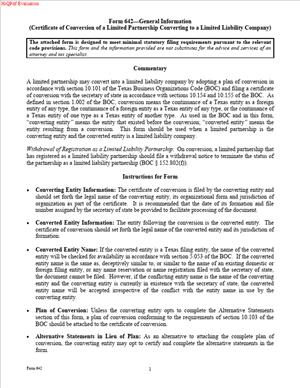
Form 642 – Certificate of Conversion of a Limited Partnership Converting to a Limited Liability Company
Fill out nowJurisdiction: Country: United States | Province or State: Texas
What is a Form 642 – Certificate of Conversion of a Limited Partnership Converting to a Limited Liability Company?
Form 642 is the official filing used in Texas to convert an existing limited partnership into a limited liability company while allowing the business to continue uninterrupted. Rather than shutting down the partnership and forming a brand-new entity, this form enables a statutory conversion under Texas law. The business remains the same ongoing enterprise, but its legal structure changes from a limited partnership to a limited liability company.
At its core, Form 642 is a certification to the Texas Secretary of State that the limited partnership has followed all required internal and statutory steps to approve a conversion and that it is now becoming an LLC. Once the filing is accepted and becomes effective, the law treats the resulting LLC as the same entity that previously operated as a limited partnership. This continuity is one of the most important features of the conversion process.
Unlike dissolution and reformation, a conversion using Form 642 does not require winding up the partnership’s affairs, transferring assets one by one, or renegotiating every agreement. By operation of law, all property owned by the limited partnership automatically becomes property of the LLC. The same is true for liabilities, contractual obligations, permits, and legal rights. The conversion does not erase history or reset the entity’s existence; it simply changes the legal wrapper around the business.
Form 642 exists within a broader framework of Texas statutory conversion rules. These rules are designed to give businesses flexibility as they grow, evolve, or change strategic direction. Many enterprises begin life as limited partnerships because that structure fits their initial ownership, tax, or investment needs. Over time, however, the same businesses may find that an LLC better reflects how they actually operate. Form 642 provides a formal, efficient way to make that transition.
The form is typically prepared and filed by a general partner of the limited partnership or another individual who has been authorized to act on behalf of the entity. In practice, this might include a managing partner, an officer of a corporate general partner, or another person designated in the partnership agreement or through a formal resolution. While the form itself is relatively concise, the decisions behind it often involve significant legal, financial, and operational considerations.
It is important to understand what Form 642 is not. It is not an amendment to a partnership agreement, not a certificate of formation for a new LLC, not a merger filing, and not a dissolution document. Its sole purpose is to certify and effect a conversion from a limited partnership to a limited liability company under Texas law. Once the Texas Secretary of State files the certificate, the conversion is legally effective as of the stated effective date.
Because Form 642 results in a public record, it also serves an informational role. Third parties such as banks, investors, vendors, and government agencies may rely on the filed certificate to confirm that the entity is now an LLC. This makes accuracy, completeness, and consistency with other filings especially important.
When Would You Use a Form 642 – Certificate of Conversion of a Limited Partnership Converting to a Limited Liability Company?
Form 642 is used when the owners of a Texas limited partnership have made a deliberate decision to change the entity’s legal form to a limited liability company. This decision is often the result of a broader review of how the business is structured compared to how it actually functions day to day.
One of the most common reasons for conversion is management simplicity. A limited partnership must have at least one general partner who is responsible for managing the business. Depending on the structure, that general partner may face broader exposure or administrative complexity. An LLC, by contrast, allows the business to choose between member-managed and manager-managed structures. This flexibility can make it easier to align legal authority with real-world decision-making.
Liability considerations are another frequent driver. While limited partners typically enjoy liability protection, general partners may not have the same level of insulation unless the general partner itself is a liability-shielded entity. Converting to an LLC can provide more uniform liability protection across all owners, which can be especially appealing as the business takes on additional risk, enters new markets, or signs larger contracts.
Tax planning can also play a role in the decision to file Form 642. Although both limited partnerships and LLCs are often treated as pass-through entities for tax purposes, LLCs offer greater flexibility in allocating profits, losses, and management rights. Some businesses convert as part of a larger tax strategy developed with advisors, even though the form itself does not make or change tax elections.
Form 642 is frequently used in connection with growth or transition events. Examples include bringing in new investors, preparing for a sale or recapitalization, implementing a succession plan, or restructuring ownership among family members or partners. Investors and lenders often find LLCs easier to evaluate because of their standardized structure and widespread familiarity.
Another common scenario involves operational reality catching up with legal form. Many businesses originally formed as limited partnerships for specific reasons that no longer apply. Over time, the distinction between general and limited partners may blur, or the governance provisions of the partnership agreement may become cumbersome. Converting to an LLC can simplify internal rules while preserving the business’s continuity.
It is equally important to understand when Form 642 should not be used. This form is not appropriate if the goal is to dissolve the partnership and end the business. It is also not the correct filing if the partnership is merging into another entity, changing only its name, or converting into a different type of entity, such as a corporation. Form 642 is narrowly tailored to conversions from a limited partnership to a limited liability company.
Timing is another strategic consideration. Many businesses choose to file Form 642 at the beginning of a fiscal year to simplify accounting and reporting. Others coordinate the conversion with the execution of new contracts, loan agreements, or internal reorganizations. Texas law allows the form to specify an immediate or delayed effective date, giving businesses some flexibility in managing the transition.
For partnerships formed outside Texas but registered to do business in the state, additional analysis may be required. While Form 642 applies to Texas conversions, the interaction between Texas law and the law of the partnership’s original jurisdiction must be considered. Confirming eligibility and the correct filing path before submitting the form can prevent costly errors.
Legal Characteristics of the Form 642 – Certificate of Conversion of a Limited Partnership Converting to a Limited Liability Company
Form 642 has significant legal consequences once it is filed and accepted by the Texas Secretary of State. It serves as a formal declaration that the limited partnership has satisfied all statutory and internal requirements for conversion and that the entity is now operating as a limited liability company.
One of the defining legal characteristics of Form 642 is that it relies on certification rather than documentation. The form does not require the filer to attach partnership agreements, consents, or resolutions. Instead, the authorized signer certifies that the conversion was approved in accordance with the partnership’s governing documents and applicable law. This places responsibility on the entity and the signer to ensure that approvals were properly obtained.
Accuracy is critical. The legal names of both the converting limited partnership and the resulting LLC must exactly match the names on file or intended to be filed with the state. The form must clearly identify the entity types before and after conversion and specify the jurisdiction of formation. Mistakes in these areas can lead to rejection or create ambiguity about the entity’s legal status.
Once the conversion becomes effective, the limited partnership ceases to exist in its prior form and continues as an LLC. Importantly, the law treats this as a continuation of the same entity, not the creation of a new one. This continuity means that the business’s existence date, history, and legal identity are preserved, even though the governing statute changes.
All property owned by the limited partnership automatically vests in the LLC. This includes real estate, personal property, intellectual property, and contractual rights. There is no requirement to record new deeds or assignments solely because of the conversion, although updating records for clarity or third-party requirements may still be advisable.
Similarly, all liabilities and obligations of the limited partnership continue as obligations of the LLC. Creditors’ rights are not impaired by the conversion, and the LLC remains responsible for debts, claims, and legal actions. Ongoing lawsuits or administrative proceedings typically continue with the LLC substituted as the successor entity.
Because Form 642 is a public filing, it becomes part of the official state record. Third parties may rely on it to confirm the entity’s status, authority, and structure. For this reason, the form’s legal effect extends beyond the internal relationship among partners and members; it also affects how the business is perceived and treated by outsiders.
Another legal characteristic is the ability to specify an effective date. If no delayed date is provided, the conversion is effective upon filing. If a delayed effective date is selected, the conversion will occur automatically on that date without further action. This feature allows businesses to plan for a smooth transition but also requires careful coordination to avoid confusion.
How to Fill Out a Form 642 – Certificate of Conversion of a Limited Partnership Converting to a Limited Liability Company
Completing Form 642 requires careful preparation and attention to detail, even though the form itself is relatively short. The first step is to identify the converting entity accurately. You must enter the exact legal name of the limited partnership as it appears in the records of the Texas Secretary of State or, if the partnership was formed elsewhere, as it is registered in Texas. Consistency with state records is essential.
Next, the form asks for the jurisdiction of formation of the limited partnership. This information should be confirmed by reviewing the original formation documents or state filings. Errors in the jurisdiction field can delay processing or raise questions about the validity of the conversion.
The form then requires the name of the resulting limited liability company. This name must comply with Texas naming requirements for LLCs, including the use of an appropriate designator such as “Limited Liability Company” or an accepted abbreviation. The name must also be distinguishable from other entities on file. Many filers check name availability in advance to reduce the risk of rejection.
You will also indicate the entity type before conversion and after conversion, confirming that the filing is a conversion from a limited partnership to a limited liability company. This may seem straightforward, but accuracy matters because the Secretary of State processes many different types of filings.
One of the most significant sections of Form 642 is the statement regarding approval of the conversion. By including this statement and signing the form, the authorized person certifies that the conversion was approved in accordance with the Texas Business Organizations Code and the partnership’s governing documents. This means that all required votes, consents, or approvals must already be in place before filing.
If the form allows for a delayed effective date, you must decide whether to use it. A delayed effective date can be helpful for aligning the conversion with accounting periods, tax planning, or operational changes. However, the date must be clearly stated and must comply with state rules regarding how far into the future it can be set.
The final step is signing the form. The signer must be an authorized person, such as a general partner or another individual empowered by the partnership. The signer’s name should be clearly printed, and the signature should reflect the authority granted internally. Signing the form is not merely a formality; it carries legal responsibility for the accuracy of the filing.
Before submitting Form 642, it is wise to review the entire document carefully. Check spelling, punctuation, dates, and consistency with other filings. Once the form is filed, correcting errors usually requires additional filings and fees. After submission, retain copies of the filed certificate, as they will be needed to update banks, licenses, contracts, and internal records.
Legal Terms You Might Encounter (Related to Form 642)
- A certificate of conversion is the official state document that implements a statutory conversion. It is the mechanism by which the entity’s legal form changes once the filing is accepted.
- A limited partnership is the entity being converted. It generally consists of one or more general partners who manage the business and one or more limited partners who contribute capital and have limited management authority.
- A limited liability company is the resulting entity after conversion. Its owners are called members, and it offers flexible management structures and liability protection.
- Conversion refers to the statutory process that allows an entity to change its legal form while continuing its existence. It differs from dissolution and reformation in that continuity is preserved.
- An authorized person is the individual who signs and submits Form 642 on behalf of the entity. This person certifies compliance with legal and internal requirements.
- An effective date is the date on which the conversion becomes legally operative. It may be immediate upon filing or delayed to a future date.
- Governing documents are the internal agreements that control how the partnership operates, such as the partnership agreement or amendments.
- A successor entity is the entity that exists after the conversion. In this context, the LLC is the successor to the limited partnership.
- Liability protection refers to the legal separation between the entity’s obligations and the personal assets of its owners, a key consideration in many conversions.
FAQs About Form 642 – Certificate of Conversion
Do you have to close your business to use this form?
No. The purpose of Form 642 is to allow the business to continue without interruption. Only the legal structure changes.
Do you need approval from all partners before filing?
Approval requirements depend on the partnership agreement and applicable law. The signer certifies that the required approvals have been obtained.
Do you need to re-sign contracts after conversion?
Most contracts continue automatically with the LLC as the successor entity, though some counterparties may request notice or confirmation.
Do you get a new business identity after conversion?
The entity remains the same for most legal purposes, but records and registrations should be updated to reflect the LLC form.
Do you need to file other forms along with this one?
Form 642 handles the conversion itself. Additional filings may be needed to update names, licenses, or tax elections.
Do you need a lawyer or advisor to complete the form?
Professional assistance is not required but can be helpful, especially for complex ownership or planning considerations.
Do you need to notify employees or partners?
Yes. Clear communication helps ensure everyone understands the new structure and any changes in authority or governance.
Checklist: Before, During, and After Form 642
Before signing:
Confirm the exact legal name of the limited partnership, verify the jurisdiction of formation, review governing documents for approval requirements, document partner approvals, check LLC name availability, decide on an effective date, and identify the authorized signer.
During signing:
Review all entries carefully, confirm entity types, verify the effective date, ensure the signer’s authority, and sign consistently with internal authorizations.
After signing:
File Form 642 with the Texas Secretary of State, pay the required fee, obtain confirmation of filing, retain copies for records, update operating agreements, notify banks and counterparties, and align licenses, permits, and registrations with the LLC structure.
Common Mistakes to Avoid with Form 642
- Using an incorrect or inconsistent entity name can lead to rejection or confusion.
- Choosing an unavailable or noncompliant LLC name can delay the conversion.
- Filing without proper internal approval can create disputes or liability.
- Misunderstanding the effective date can cause operational or accounting problems.
- Assuming the filing updates all records automatically can lead to missed obligations.
What to Do After Filling Out Form 642
After submitting Form 642, wait for confirmation that the filing has been accepted. Once the conversion is effective, operate exclusively as the LLC. Update internal documents such as operating agreements, ownership records, and management resolutions. Notify financial institutions, vendors, clients, and government agencies of the new structure. Provide copies of the filed certificate to members and managers, and store it securely with the entity’s permanent records.
Disclaimer: This guide is provided for informational purposes only and is not intended as legal advice. You should consult a legal professional.