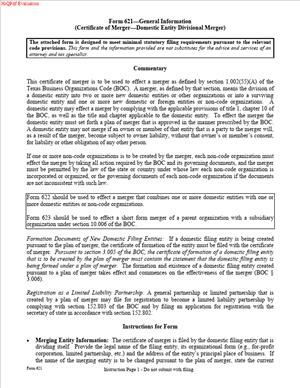
Form 621 – Certificate of Merger – Domestic Entity Divisional Merger – Business Organizations Code
Fill out nowJurisdiction: Country: United States | Province/State: Texas
What is a Form 621 – Certificate of Merger – Domestic Entity Divisional Merger – Business Organizations Code?
Form 621 is the filing you use to complete a divisional merger under Texas law. It tells the Texas Secretary of State that your Texas entity approved and carried out a divisional merger. It also identifies the surviving entity and any new Texas entities created by the division. You file it to make the merger effective under the Texas Business Organizations Code.
A divisional merger is a statutory way to split one entity into two or more entities. You “merge” the original entity into multiple Texas entities under a single plan. You allocate assets, contracts, and liabilities among them in that plan. The law treats the allocations as occurring by operation of law. That means you often avoid separate assignments or deeds under Texas law. You still must handle filings in other jurisdictions where local law demands recordation.
You use Form 621 when the dividing entity is a Texas filing entity. That includes a Texas LLC, corporation, limited partnership, professional corporation, or professional LLC. The form supports a division where the dividing entity either survives or ends. If it does not survive, the form can also form any new Texas entities as part of the same filing.
Who typically uses this form?
Owners, managers, and officers of Texas entities use it. General counsel and outside counsel prepare and file it. Accountants and corporate secretaries support the process. Lenders and investors may require it as part of a closing.
Why would you need this form?
You use it to restructure your Texas business legally. You may want to place different business lines in separate entities. You may want to isolate liabilities or ring-fence assets. You may want to prepare for a sale or spin-off. You may need to create a subsidiary structure for financing. You may want to separate operating assets from IP or real estate holdings.
Typical usage scenarios include a Texas LLC that wants to split into two Texas LLCs. The plan allocates the e‑commerce line and related contracts to one LLC. It allocates the retail line and its leases to another LLC. Or a Texas corporation wants to separate a risky product line into a new Texas corporation. The plan places the liabilities there and keeps the core assets in the survivor. Another common case is a family business that separates divisions among siblings. Each new Texas entity receives specific assets and obligations.
In each case, Form 621 serves as the record of the merger. It shows the parties, approvals, and effective date. It attaches formation documents for any new Texas filing entities formed in the division. Once filed, it puts the change into the public record. It also triggers updates to tax accounts, banking, and licensing records.
When Would You Use a Form 621 – Certificate of Merger – Domestic Entity Divisional Merger – Business Organizations Code?
You use Form 621 when your Texas entity approves a divisional merger, and you are ready to make it effective. You have adopted a written plan of merger that details the split. You have obtained all required approvals under the Texas code and your governing documents. You have confirmed that each new entity’s name is available. You have prepared the certificates of formation for each new Texas entity to be created.
A Texas LLC manager would use this form after members approve a divisional merger. A corporate secretary would use it after the board and shareholders approve the plan. A limited partnership’s general partner would file it after partner approval. A general counsel would file it as part of a reorganization plan. An owner-operator would file it to separate assets before a sale or financing.
You would also use it when you want the division to take effect on a specific date and time. Texas allows a delayed effective date or time. You can set the divisional merger to close at month-end. You can coordinate with lender consents and system cutovers. You can align the effective time with accounting and tax planning.
You would not use this form if a foreign entity is the only party. You would not use it for a cross-border merger involving non-Texas entities only. You would not use it to convert an entity type. You would not use it to form a new Texas entity without a merger. Those actions use other filings.
A company in distress may use a divisional merger to isolate legacy liabilities. You must handle creditor issues with care. Contracts may have covenants that require notices or consents. Lenders may require pre-approval. You should align the plan with your covenants before filing.
Real estate-heavy businesses often use this filing. They place properties in a new LLC for risk management. They keep operations in a separate entity. You then update county property records after the merger. Motor vehicle dealers, healthcare providers, and licensed trades also use it. They coordinate with licensing boards to move permits. You may need to reissue licenses or file amendments after the merger.
Legal Characteristics of the Form 621 – Certificate of Merger – Domestic Entity Divisional Merger – Business Organizations Code
Form 621 has legal force because Texas law requires a certificate of merger to effect a merger. A divisional merger is a merger under the Texas code. Filing the certificate puts the merger into effect as of the stated time and date. The filing creates any new Texas entities in the division when the certificate becomes effective. If the dividing entity does not survive, its existence ends at that time.
Enforceability rests on statutory compliance. You must adopt a written plan of merger that meets legal requirements. You must obtain the approvals required by the Texas code and your governing documents. You must prepare correct and complete formation documents for any new entities. You must complete the certificate of merger accurately and sign it by an authorized person. You must pay the filing fee and meet any tax clearance requirements for terminating entities.
The plan of merger controls the allocation of assets, liabilities, and obligations. Texas law treats allocations in a divisional merger as occurring by operation of law. The statute does not treat the allocation as a transfer or assignment under Texas law. That reduces the need for individual assignments of contracts or property. However, you should still review counterparty contract terms. Some contracts define a merger as an assignment or a change of control. You may need consent under contract terms even if the statute treats it differently.
Creditor rights remain relevant. You should consider fraudulent transfer and voidable transaction laws. A divisional merger cannot lawfully hinder, delay, or defraud creditors. Courts may examine your plan if creditors are prejudiced. You should model solvency for each resulting entity. You should maintain adequate capitalization. You should document the business purpose and fairness of allocations.
Third-party filings may still be required. Title records outside Texas may require deeds or assignments. Vehicle titles, IP registrations, and government permits often need updates. Franchise, environmental, and professional licenses may require amendments or reissuance. You should plan those steps around the effective date.
Tax matters also apply. Texas franchise tax accounts must be updated for each entity. If a Texas taxable entity does not survive, you generally need a tax clearance certificate to end it. You will need new EINs for each new employer entity. Federal and state tax consequences can vary. You should coordinate with your tax advisor before finalizing the plan.
The certificate becomes part of the public record. The plan of merger itself is not filed unless you choose to attach it. The certificate must state that a copy of the plan is on file at the principal places of business. It must state that a copy will be furnished on request without cost to owners. That notice supports transparency for equity holders and regulators.
Effective timing matters. You can make the filing effective on filing or at a later date and time. Texas allows a delayed effective time within a short window. Many users set effectiveness at 11:59 p.m. for clean accounting cutoffs. If your filing fails for defects, the merger does not occur. You should review the certificate carefully and correct errors promptly if needed.
How to Fill Out a Form 621 – Certificate of Merger – Domestic Entity Divisional Merger – Business Organizations Code
Follow these steps to prepare and file Form 621 for a divisional merger.
1) Define your structure and timeline.
- Decide if the dividing entity will survive or end.
- Decide how many new Texas entities you will create.
- Verify name availability for each new entity.
- Identify your target effective date and time.
- Map your closing checklist around that time.
2) Draft the plan of merger (divisional).
- Identify the dividing entity and each resulting entity.
- Allocate assets, contracts, and claims to each entity.
- Allocate liabilities and obligations with specificity.
- State how ownership interests will be allocated.
- Address governance of each resulting entity.
- Include any amendments to the survivor’s formation documents.
- State where the plan will be kept and how owners can request copies.
- Set the effective date and time as permitted by law.
3) Obtain approvals.
- For a corporation, obtain board approval and shareholder approval.
- For an LLC, follow the company agreement voting rules.
- For a limited partnership, follow the partnership agreement rules.
- Document consents in written resolutions or meeting minutes.
- Obtain lender, landlord, and key counterparty consents if required.
- Confirm any regulatory approvals or notices.
4) Prepare formation documents for each new Texas entity.
- Draft a certificate of formation for each new Texas LLC or corporation.
- Set the entity name, purpose, and management structure.
- Designate the registered agent and office in Texas.
- Name the initial governing persons as required.
- Confirm registered agent consent has been obtained.
- Keep each certificate ready as an attachment to Form 621.
5) Gather required information for Form 621.
- Legal name, type, and Texas file number of the dividing entity.
- Legal name and type of the survivor, if the dividing entity survives.
- Legal name and type of each new Texas entity to be created.
- Jurisdictions of formation for all parties (Texas for domestic).
- Details of any amendments to the survivor’s formation document.
- Approval dates and the manner of approval for each entity.
- Desired effective date and time or delayed effectiveness.
- Confirmation of whether any Texas taxable entity will terminate.
6) Complete the header and party information.
- Enter the name, type, and Texas file number of the dividing entity.
- If the dividing entity survives, identify it as the survivor.
- If the dividing entity does not survive, identify the survivor among the new or existing entities.
- List each new Texas entity created by the merger.
7) State the plan approval and compliance statements.
- State that a plan of merger has been approved.
- State that approvals were obtained as required by law.
- Include the date each Texas entity approved the plan.
- Include the statutory notice that the plan is on file.
- State that owners may obtain a copy on written request without cost.
8) Add amendments for the survivor, if any.
- If the survivor’s formation document changes, describe the amendments.
- Change the name, purpose, or governance if needed.
- If no amendments, state that none are included.
9) Attach formation documents for new entities.
- Attach a certificate of formation for each new Texas filing entity.
- Ensure each certificate is complete and signed by an organizer if required.
- Ensure consistency with the names and details in Form 621.
10) Set the effectiveness.
- Choose “effective on filing” if you need immediate effect.
- Or set a delayed effective date and time within the permitted window.
- Use a specific clock time to align with closing logistics.
- Confirm time zones in your internal checklist to avoid confusion.
11) Address tax clearance for terminating Texas taxable entities.
- If a Texas taxable entity does not survive, obtain a tax clearance certificate.
- Attach the certificate for each terminating Texas taxable entity as required.
- If the dividing entity survives, confirm if no tax clearance is required.
- Align the timing of tax clearance with your effective date.
12) Sign the certificate.
- Have an authorized person sign on behalf of the survivor.
- Texas allows one filing signed by a managerial official of the survivor.
- If the dividing entity survives, its authorized officer can sign.
- Ensure the signatory’s name and title are printed clearly.
- Use a wet signature or an electronic signature as permitted.
13) Prepare payment and delivery.
- Calculate the filing fee based on the entities involved.
- Include additional fees for certified copies if needed.
- Submit the form and attachments with the fee.
- You may file electronically or by paper delivery.
- Keep a copy of all submitted documents for your records.
14) Confirm filing and obtain evidence.
- Obtain a file-stamped copy of the certificate.
- Request a certificate of fact or certified copies for closings.
- Share evidence with lenders, buyers, and internal teams.
- Confirm the exact effective date and time in writing.
15) Complete post-filing tasks.
- Apply for new EINs for new employer entities.
- Update Texas franchise tax accounts and Public Information Reports.
- Update bank accounts and treasury authorizations.
- Update insurance policies and certificates.
- Record real estate filings in county records if needed.
- Update titles, vehicle registrations, and UCC filings if relevant.
- Notify licensors and regulators and amend permits.
- Notify key counterparties and deliver required notices.
- Update assumed name (DBA) filings as needed.
16) Clean up governance and records.
- Adopt new company agreements, bylaws, or partnership agreements.
- Issue membership interests or stock as allocated in the plan.
- Update cap tables and ownership ledgers.
- Appoint officers and managers of the new entities.
- Calendar annual meetings and state filing deadlines.
17) Avoid common mistakes.
- Do not omit the plan approval dates.
- Do not forget to attach each new certificate of formation.
- Do not set an effective date beyond the allowed window.
- Do not misstate entity names or Texas file numbers.
- Do not ignore contract consents or lender covenants.
- Do not forget tax clearance for any terminating Texas taxable entity.
- Do not assume third-party records update automatically.
18) Coordinate communications.
- Prepare a communication plan for employees and customers.
- Align announcements to the effective time.
- Provide updated W‑9s, remittance details, and legal names.
- Confirm continuity of service and invoicing arrangements.
19) Maintain your plan and records.
- Keep the executed plan of merger at the principal offices.
- Respond to owner requests for copies without charge.
- Retain filed documents, approvals, and consents.
- Keep a checklist of all post-closing tasks and the owners responsible.
20) Plan for contingencies.
- If a defect is found, consider a corrective filing.
- If a filing is rejected, cure issues and resubmit quickly.
- If a date shift is needed, adjust closing documents accordingly.
- Keep all parties informed of any changes.
Practical example: You manage a Texas LLC that owns two product lines. You want to separate them. You draft a plan of divisional merger that creates two new Texas LLCs. You allocate contracts and inventory to each. Your LLC continues as the survivor and holds shared IP. Members approve the plan. You prepare certificates of formation for the two new LLCs. You complete Form 621, list the survivor and the two new LLCs, and attach the two formations. You set a delayed effectiveness for midnight on the last day of the quarter. You file the form and pay the fee. On effectiveness, the two LLCs come into existence and hold the allocated assets. You update bank accounts and notify customers. You file county notices for certain permits and record IP assignments as needed.
Another example: A Texas corporation divides and does not survive. It will merge into two new Texas corporations. You obtain shareholder approval. You secure lender consent. You obtain tax clearance for the terminating corporation. You complete Form 621, attach two certificates of formation, and set the effectiveness. On filing, the old corporation ends. The two new corporations exist and operate the divided lines. You close the books, issue shares, and file franchise tax registrations.
With careful planning, Form 621 lets you execute a clean division under Texas law. Follow the steps. Document your approvals. Align your effective time. File complete, accurate documents. Then complete your post-filing tasks without delay.
Legal Terms You Might Encounter
- Divisional merger. A divisional merger is a merger where one Texas entity splits its business into two or more entities under a single plan. You use this form to certify that the split and to create or continue the resulting entities as described in your plan.
- Dividing entity. The dividing entity is the original business that adopts the plan and divides its assets, liabilities, contracts, and ownership interests. You will list its legal name and Texas file number on the form.
- Resulting entity. A resulting entity is any entity that exists after the divisional merger. That can include the original entity (if it survives) and any new entities created by the plan. The form asks you to name each resulting entity and identify its type.
- Surviving entity. The surviving entity is the entity that continues in existence after the filing takes effect. In a divisional merger, the dividing entity may or may not survive. The form requires you to state which entity or entities survive.
- Plan of merger. The plan of merger is the internal document that sets the terms of the divisional merger. It allocates assets and liabilities, describes ownership changes, and states whether the dividing entity survives. You do not usually attach the full plan to the form, but the form must certify that the plan was approved as required.
- Governing authority. The governing authority is the decision-making body that approves the plan (for example, members or managers of an LLC, a board and shareholders of a corporation, or partners of a partnership). The form requires a statement that the plan was approved by each entity’s governing authority as required by law and organizational documents.
- Manner and basis of conversion. This describes how current ownership interests change in the divisional merger. For example, how the dividing entity’s membership interests convert into interests of the resulting entities or into cash or other rights. The form requires a clear statement of this conversion.
- Allocation of liabilities. This is how debts and obligations are assigned among the resulting entities under the plan. For a divisional merger, the form requires a statement that liabilities were allocated as provided in the plan and that the allocation was not made to hinder, delay, or defraud any creditor.
- Registered agent and registered office. Every Texas filing entity must maintain a registered agent and office in Texas. If your divisional merger creates a new domestic filing entity, your certificate must include the agent and office details for each new entity and confirm the agent’s consent.
- Texas file number. This is the unique number issued by the filing office to each Texas filing entity. The form asks for the Texas file number of the dividing entity and any other Texas entities involved, which helps match the filing to existing records.
- Effective date and time. You can choose the filing to be effective when filed or at a later specified date and time (subject to the time window allowed). The form includes a section for this choice.
- Organizational documents. These are the governing documents for each entity, like a certificate of formation, bylaws, company agreement, or partnership agreement. The form’s approval statements rely on these documents because they set the internal approval rules for the merger.
FAQs
Do you attach the full plan of merger to the filing?
No. You typically do not attach the full plan. Instead, you complete the form’s required statements and certify that the plan was approved and is on file at the principal place of business of the surviving or resulting entities. Keep the signed plan with your records. You may need to provide it to owners, regulators, or other parties upon request.
Do you need separate formation filings for new entities created by the divisional merger?
Not usually. If your divisional merger creates new domestic filing entities, the certificate of merger can serve as the formation filing for those new entities. You must include all information required for a formation filing in the certificate, such as name, entity type, registered agent, and purpose if required. If not included, the filing may be rejected.
Can you delay the effective date or time?
Yes. You can choose a delayed effective date or a specific effective time. The delay must be within the allowed window set by the filing office. If you need time to coordinate closings, bank transitions, or contract notices, set a delayed effectiveness that fits your plan.
Do you need owner approval for a divisional merger?
Yes. Each entity involved must approve the plan under the Business Organizations Code and its own governing documents. The form requires a statement that the plan was approved by the appropriate governing authority and, if applicable, by owners. Confirm the vote thresholds in your governing documents before you sign.
Do you need creditor consent?
Often no. A divisional merger allocates liabilities under the plan and does not require creditor consent in many cases. That said, your contracts may have change-of-control, assignment, or notice clauses. Review key contracts and financing documents to see if any notice or consent is required and plan your communications.
What happens to existing contracts, permits, and licenses?
They follow the allocations in your plan. If a contract or license is assigned to a resulting entity, you should notify the counterparty or agency, provide the certificate of merger, and update records. Some permits and licenses require prior approval or post-closing notice. Build those steps into your timeline.
Do the resulting entities need new tax registrations?
Often yes. Each resulting entity is a separate taxpayer. You may need new tax accounts, employer registrations, and other government filings. Coordinate with your tax advisor so registrations are ready when the merger becomes effective.
Can you correct an error after filing?
Yes. If you discover a typographical error or similar mistake in the certificate, you can file a correction instrument to fix it. If the business terms of the merger change before effectiveness, adopt an amended plan and, if needed, file an amended certificate before it takes effect.
Checklist: Before, During, and After the Form 621
Before signing
- Confirm the legal names and Texas file numbers of the dividing entity and any existing Texas entities involved.
- Run name availability for each new resulting entity and reserve names if needed.
- Draft and finalize the plan of merger, including asset and liability allocations and ownership conversions.
- Confirm the required governance approvals and any owner votes; collect signed consents or meeting minutes.
- Gather registered agent and office details for each resulting domestic filing entity; obtain written agent consent.
- Prepare formation-level information for any new domestic filing entities, including purpose if required.
- Review key contracts, loans, leases, and licenses for notice, consent, or timing requirements.
- Choose the effective date and time; coordinate with banking, payroll, and system cutovers.
- Prepare signature blocks for authorized signers of each entity; confirm authority.
- Decide if you will request certified copies for banks, title companies, or regulators.
During signing
- Verify the exact names and entity types for the dividing and resulting entities.
- Check that all Texas file numbers are correct and match the state’s records.
- Confirm the statement that the plan of merger was approved by the required governing authorities.
- Review the manner and basis of converting ownership interests for clarity and accuracy.
- Ensure the allocation of liabilities statement is included, and include the not-to-hinder-or-defraud statement.
- If creating new entities, confirm all required formation information is complete and current.
- Confirm registered agent and registered office details for each resulting domestic entity and agent consent.
- Enter the effective date and time correctly, or select effectiveness on filing.
- Review any additional provisions to reflect special terms in your plan.
- Sign the certificate with the correct titles and dates; check that each required signer has signed.
After signing
- File the executed certificate with the Secretary of State and pay the required fee.
- If you chose a delayed effective date or time, calendar it and pause operational changes until then.
- Order certified copies if needed for banks, title companies, regulators, or foreign registrations.
- Distribute the filed certificate and the plan of merger to internal stakeholders.
- Update company records: minute books, cap tables, ledgers, and membership or stock registers.
- Implement allocations: transfer bank accounts, revise accounting systems, and move digital assets per the plan.
- Notify contract counterparties and lenders as required; deliver notices and obtain consents if needed.
- Update tax registrations, employer accounts, and payroll with the new entity information.
- Refile assumed names (DBAs) under the correct resulting entities; withdraw old DBAs if appropriate.
- Review insurance policies and endorsements; align coverage with the new entity structure.
- Update intellectual property ownership records; record assignments for patents, trademarks, and copyrights.
- Re-record deeds or file real property affidavits as required by local recording practices.
- Qualify resulting entities to do business in other states as needed; withdraw or amend prior registrations.
- Store the executed plan and filed certificate safely; keep proof of delivery and acceptance.
Common Mistakes to Avoid
- Don’t forget the allocation statement unique to divisional mergers. Leaving out the liability allocation statement and the no-hinder-or-defraud statement can lead to rejection. It also creates uncertainty about which entity is responsible for specific obligations.
- Don’t use a name that isn’t available. If a new resulting entity’s name conflicts with an existing record, the filing may be rejected. Reserve names ahead of time to avoid last-minute changes that ripple through governing documents and contracts.
- Don’t omit registered agent details or consent for new entities. Missing agent information or a lack of consent will delay acceptance. Banks and regulators also rely on registered agent records to verify good standing.
- Don’t misstate the manner and basis of conversion. If ownership conversions are vague, you risk disputes among owners and recordkeeping errors. State how each class or series converts, including any cash or rights.
- Don’t assume contracts will “just follow” the assets. Some agreements restrict assignment or require notice. If you skip notices or consents, you can trigger defaults, acceleration, or loss of rights.
- Don’t set the wrong effective timing. Mistimed effectiveness can strand payroll, deposits, or closings. Align the effective date and time with banking cutovers and regulatory notice windows.
What to Do After Filling Out the Form
- File the certificate. Submit the signed certificate and fee to the Secretary of State. If you need evidence for a closing, request expedited handling and certified copies. Keep a filing confirmation or evidence of filing in your records.
- Implement the plan. On the effective date and time, post the closing entries, update accounting systems, and move assets, contracts, and employees as allocated. Issue new equity interests to owners as set out in the manner and basis of conversion.
- Distribute documentation. Provide the filed certificate and relevant plan extracts to your banks, lenders, key customers, landlords, and insurers. Offer a certificate of existence or good standing if they request it after acceptance.
- Update public records. File assumed names for any trade names the resulting entities will use. If the merger affects real property, record the filed certificate or an affidavit with the county as required by local practice. Update intellectual property ownership with the relevant offices.
- Refresh registrations and licenses. Obtain or update sales tax, employer, and other regulatory accounts for each resulting entity. Some permits require new applications or post-merger notices. Calendar renewal dates and keep copies of approvals.
- Coordinate tax and payroll. Set up new payroll registrations where needed and migrate wage reporting to the correct entity. Align banking authorizations and ACH origins with the resulting entities to avoid rejected transactions.
- Notify counterparties. Send contract notices and obtain consents if required. Share the effective date and confirm remittance and invoicing details. Update W-9s for vendors and request updated vendor onboarding where you are the customer.
- Manage foreign qualifications. If a resulting entity will operate in other states, file foreign registration applications promptly. Withdraw or amend registrations for entities that no longer operate in those states.
- Maintain records. Place the executed plan, filed certificate, and all approvals in your minute book. Update the cap table and ownership ledgers. Store the registered agent consents and any certified copies with your permanent records.
- Correct or amend if needed. If you spot a clerical mistake in the filed certificate, prepare and file a correction instrument. If the business terms change before effectiveness, adopt an amended plan and file an amended certificate before the effective date.
- Plan communications. Communicate the new structure to employees, customers, and suppliers. Update websites, invoices, email signatures, and marketing materials to reflect the correct legal names.
- Track compliance. Monitor annual report, franchise tax, and other compliance obligations for each resulting entity. Set reminders to keep all entities in good standing.
Disclaimer: This guide is provided for informational purposes only and is not intended as legal advice. You should consult a legal professional.